South Korean Giant BC Card Concludes Stablecoin Payments Pilot Ahead Of 2026 Framework

bitcoinistОпубликовано 2025-12-24Обновлено 2025-12-24

Введение

South Korean payments giant BC Card has completed a two-month pilot project enabling foreigners to use stablecoins for payments at domestic merchants. The pilot, conducted with partners including Wavebridge and Aaron Group, tested the stability and convenience of converting foreign-held stablecoins into digital prepaid cards for QR code transactions, eliminating the need for physical cards or currency exchange. BC Card integrated the system into its existing payment infrastructure, allowing transactions to function like conventional card payments. The initiative is part of preparations for future regulatory changes, as South Korea anticipates a framework for won-pegged stablecoins by 2026. The project aims to establish a compliant "Korean-style stablecoin payment infrastructure" aligned with upcoming legislation.

South Korean payments giant BC Card has completed its pilot project to verify the stability and convenience of card-integrated stablecoins in collaboration with domestic and international digital asset companies.

BC Card Completes Stablecoin Payment Pilot Project For Foreigners

On Tuesday, South Korea’s largest payment processing company, BC Card, announced it had concluded its two-month pilot project enabling foreigners to use stablecoins as a payment method at domestic merchants.

The project was conducted alongside blockchain financial firm Wavebridge, overseas digital wallet company Aaron Group, and remittance fintech company Global Money Express.

According to BC Card, the pilot focused on “verifying whether foreign currency-based stablecoins held by foreigners could be practically used within the domestic payment environment, while also assessing payment convenience and stability.”

For the project, foreign users converted their stablecoins held in oversea wallets parented with BC Card into digital prepaid cards that could be used at domestic affiliated merchants using a QR code, without requiring a physical card or currency exchange procedures.

The company integrated stablecoin payments into the existing card authorization and settlement structure using a digital prepaid card as an intermediary, the announcement explained, noting that “this design enables both paying customers and merchants to transact in the same manner as with conventional card payments.”

BC Card’s President, Choi Won-seok, stated, “Stablecoins, due to their technical characteristics, are particularly useful for cross-border payments and hold significant potential to improve the domestic payment experience for foreign consumers.”

South Korean Companies Prepares For 2026 Framework

The payments giant affirmed that the pilot was not a “short-term technical verification” but a “process to prepare a stablecoin payment structure responsive to future domestic legal and regulatory changes.”

Notably, the South Korean government recently failed to submit the highly anticipated bill for the Second Phase of the Virtual Asset User Protection Act, which will address the issuance and distribution of won-pegged stablecoins.

As reported by Bitcoinist, the Financial Services Commission (FSC) did not meet the ruling party’s December 10 deadline to submit the government’s legislation to the National Policy Committee.

According to local media, the government bill was delayed after the FSC and the Bank of Korea (BOK) failed to resolve their differences over the issuance of won-denominated stablecoins.

The financial authorities reportedly agree that financial institutions must be involved in the issuance of the tokens but disagree on the extent of banks’ role. While the central bank has been pushing for a consortium of banks owning at least 51% of any stablecoin issuer seeking approval in the country, the FSC has expressed concerns that giving a majority stake to banks could reduce participation from tech firms and limit the market’s innovation.

Recent reports affirmed that the government’s proposal is expected to be announced by early next month at the latest, as the integrated bill must be submitted in January 2026. “To protect the public’s right to know, there will be a separate opportunity to explain the government’s proposed bill to the public while submitting it to the National Assembly,” an FSC official stated last week.

Ultimately, BC Card pledged to strengthen its cooperation with relevant agencies while considering the flow of virtual asset legislation, aiming to “lead the establishment of a ‘Korean-style stablecoin payment infrastructure’ by progressively advancing a payment model compliant with domestic regulations.”

“BC Card will leverage its card payment infrastructure to progressively prepare a stable stablecoin payment model that aligns with Korea’s legal and regulatory environment,” the company’s president concluded.
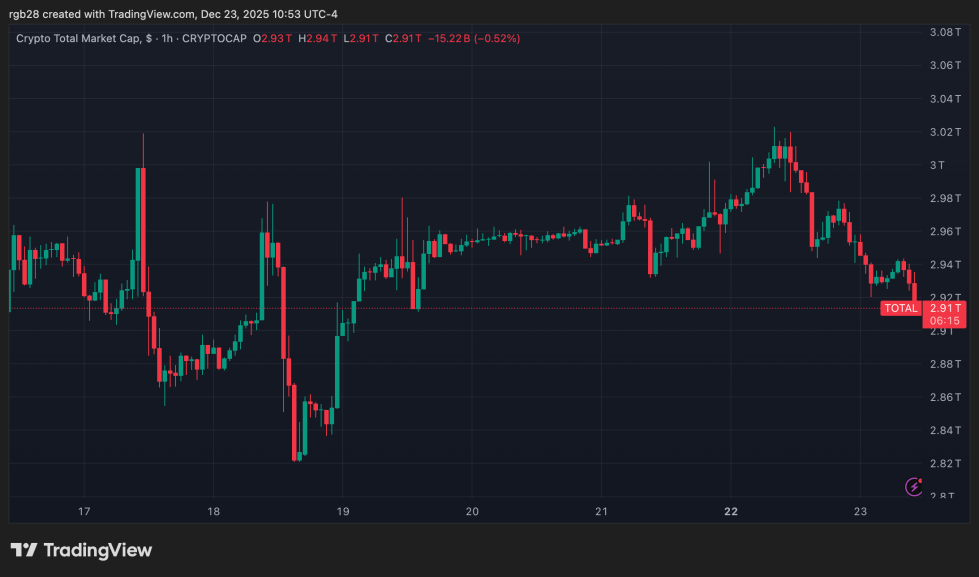
The total crypto market capitalization is at $2.91 trillion in the one-week chart. Source: TOTAL on TradingView


Связанные с этим вопросы

QWhat was the main goal of BC Card's pilot project regarding stablecoins?

AThe main goal was to verify the stability and convenience of using card-integrated stablecoins for payments by foreigners at domestic merchants, assessing their practical use within the domestic payment environment.

QWhich companies collaborated with BC Card on the stablecoin payment pilot?

ABC Card collaborated with blockchain financial firm Wavebridge, overseas digital wallet company Aaron Group, and remittance fintech company Global Money Express.

QHow did foreign users utilize their stablecoins for payments in the pilot project?

AForeign users converted their stablecoins held in overseas wallets into digital prepaid cards that could be used at domestic merchants via QR code, without needing a physical card or currency exchange.

QWhy was the South Korean government's bill for the Second Phase of the Virtual Asset User Protection Act delayed?

AThe bill was delayed because the Financial Services Commission (FSC) and the Bank of Korea (BOK) failed to resolve their differences over the issuance of won-denominated stablecoins, particularly regarding the extent of banks' role in the issuance process.

QWhat is BC Card's future plan regarding stablecoin payments in South Korea?

ABC Card aims to lead the establishment of a 'Korean-style stablecoin payment infrastructure' by progressively advancing a payment model compliant with domestic regulations, leveraging its card payment infrastructure and strengthening cooperation with relevant agencies.

Похожее

a16z: AI's 'Amnesia', Can Continuous Learning Cure It?

The article "a16z: AI's 'Amnesia' – Can Continual Learning Cure It?" explores the limitations of current large language models (LLMs), which, like the protagonist in the film *Memento*, are trapped in a perpetual present—unable to form new memories after training. While methods like in-context learning (ICL), retrieval-augmented generation (RAG), and external scaffolding (e.g., chat history, prompts) provide temporary solutions, they fail to enable true internalization of new knowledge. The authors argue that compression—the core of learning during training—is halted at deployment, preventing models from generalizing, discovering novel solutions (e.g., mathematical proofs), or handling adversarial scenarios. The piece introduces *continual learning* as a critical research direction to address this, categorizing approaches into three paths: 1. **Context**: Scaling external memory via longer context windows, multi-agent systems, and smarter retrieval. 2. **Modules**: Using pluggable adapters or external memory layers for specialization without full retraining. 3. **Weights**: Enabling parameter updates through sparse training, test-time training, meta-learning, distillation, and reinforcement learning from feedback. Challenges include catastrophic forgetting, safety risks, and auditability, but overcoming these could unlock models that learn iteratively from experience. The conclusion emphasizes that while context-based methods are effective, true breakthroughs require models to compress new information into weights post-deployment, moving from mere retrieval to genuine learning.

marsbit53 мин. назад

a16z: AI's 'Amnesia', Can Continuous Learning Cure It?

marsbit53 мин. назад

Can a Hair Dryer Earn $34,000? Deciphering the Reflexivity Paradox in Prediction Markets

An individual manipulated a weather sensor at Paris Charles de Gaulle Airport with a portable heat source, causing a Polymarket weather market to settle at 22°C and earning $34,000. This incident highlights a fundamental issue in prediction markets: when a market aims to reflect reality, it also incentivizes participants to influence that reality. Prediction markets operate on two layers: platform rules (what outcome counts as a win) and data sources (what actually happened). While most focus on rules, the real vulnerability lies in the data source. If reality is recorded through a specific source, influencing that source directly affects market settlement. The article categorizes markets by their vulnerability: 1. **Single-point physical data sources** (e.g., weather stations): Easily manipulated through physical interference. 2. **Insider information markets** (e.g., MrBeast video details): Insiders like team members use non-public information to trade. Kalshi fined a剪辑师 $20,000 for insider trading. 3. **Actor-manipulated markets** (e.g., Andrew Tate’s tweet counts): The subject of the market can control the outcome. Evidence suggests Tate’sociated accounts coordinated to profit. 4. **Individual-action markets** (e.g., WNBA disruptions): A single person can execute an event to profit from their pre-placed bets. Kalshi and Polymarket handle these issues differently. Kalshi enforces strict KYC, publicly penalizes insider trading, and reports to regulators. Polymarket, with its anonymous wallet-based system, has historically been more permissive, arguing that insider information improves market accuracy. However, it cooperated with authorities in the "Van Dyke case," where a user traded on classified government information. The core paradox is reflexivity: prediction markets are designed to discover truth, but their financial incentives can distort reality. The more valuable a prediction becomes, the more likely participants are to influence the event itself. The market ceases to be a mirror of reality and instead shapes it.

marsbit1 ч. назад

Can a Hair Dryer Earn $34,000? Deciphering the Reflexivity Paradox in Prediction Markets

marsbit1 ч. назад

Торговля

Спот
Фьючерсы
活动图片