South Korean financial authorities have pledged to revise their crypto custody practices following public scrutiny over multiple incidents that led to the loss of nearly $30 million in seized digital assets over the past few months.
Authorities Move To Enhance Crypto Custody Practices
South Korea’s Deputy Prime Minister and Minister of Finance, Koo Yun-cheol, affirmed that authorities will review their management practices of seized crypto assets by government and public authorities, and develop measures to prevent the theft and loss of these assets.
“In response to the recent digital asset information leak incident at the National Tax Service (NTS), the government will promptly review the status and management practices of digital assets held and managed by government and public institutions—such as those seized from delinquent taxpayers—in collaboration with relevant agencies, including the Financial Services Commission (FSC) and the Financial Supervisory Service (FSS),” the finance minister wrote in a Sunday X post.
“We will also swiftly develop and implement measures to prevent recurrence, including strengthening digital asset security management,” he continued, noting that the South Korean government only holds crypto assets acquired through legal enforcement actions, such as seizure.
The upcoming review and Koo’s statement follow a wave of criticism over the authorities’ practices and management of crypto assets after the tax agency exposed the recovery seed phrase of a seized wallet, leading to unauthorized access and theft of the tokens inside it.
As reported by Bitcoinist, South Korea’s National Tax Service recently published an official press release to highlight its crackdown on tax nonpayers, but accidentally shared a full wallet seed phrase in the process.
The Thursday press release was reportedly part of a broader NTS enforcement campaign targeted at people who owed taxes, showing seized crypto assets as evidence of the agency’s efforts.
Nonetheless, it included an image of two Ledger cold wallets alongside a handwritten sheet of paper that exposed the wallets’ complete mnemonic recovery phrases.
Soon after, one of the confiscated wallets’ entire balance, 4 million Pre-Retogeum (PRTG) tokens worth around $4.8 million, was transferred to another address, blockchain researchers found, but noted that the cryptocurrency has extremely low liquidity.
According to Professor Cho Jae-woo of Hansung University’s Blockchain Research Institute, the other wallets with seed phrases visible in the same image did not appear to carry significant risk, as the leaked tokens are also difficult to convert into cash.
The expert criticized the incident, but shared his hope that it “serves as a turning point for the establishment of a robust virtual asset management system within Korea’s public sector.”
South Korea’s Custody Mishaps
Last week’s incident is the latest in a series of security breaches that have led to the loss of around $27 million in seized crypto assets under the government’s custody since the start of the year.
In January, the Gwangju District Prosecutors’ Office faced backlash after discovering that 320 Bitcoin (BTC), worth around $21 million, had gone missing months ago. According to local reports, authorities only discovered the theft during a routine check of seized financial assets held as criminal evidence.
Prosecutors found that the crypto assets, first seized in 2021, were lost to a scam in August while authorities were handling the assets. Notably, a malicious actor drained the wallets after investigators mistakenly accessed a phishing website.
In an unexpected turn of events, the hacker returned the stolen Bitcoin in mid-February, the Gwangju District Prosecutors’ Office confirmed, vowing to continue to track down the malicious actors involved while conducting related investigations and inspections.
The incident led to a nationwide review, which revealed another security breach at the Seoul Gangnam Police Station last month. The Gangnam station announced it had lost 22 BTC, worth around $1.4 million at the time, that were voluntarily submitted to authorities during an investigation in November 2021.
Local news outlets reported that the leak had not been detected until recently, as the investigation into that case had been suspended. The inspection revealed that the cold wallet storing the Bitcoin was not stolen. However, the assets stored inside had vanished without a trace, deepening concerns about local authorities’ knowledge of cryptocurrencies and proper measures to handle and custody seized digital assets.
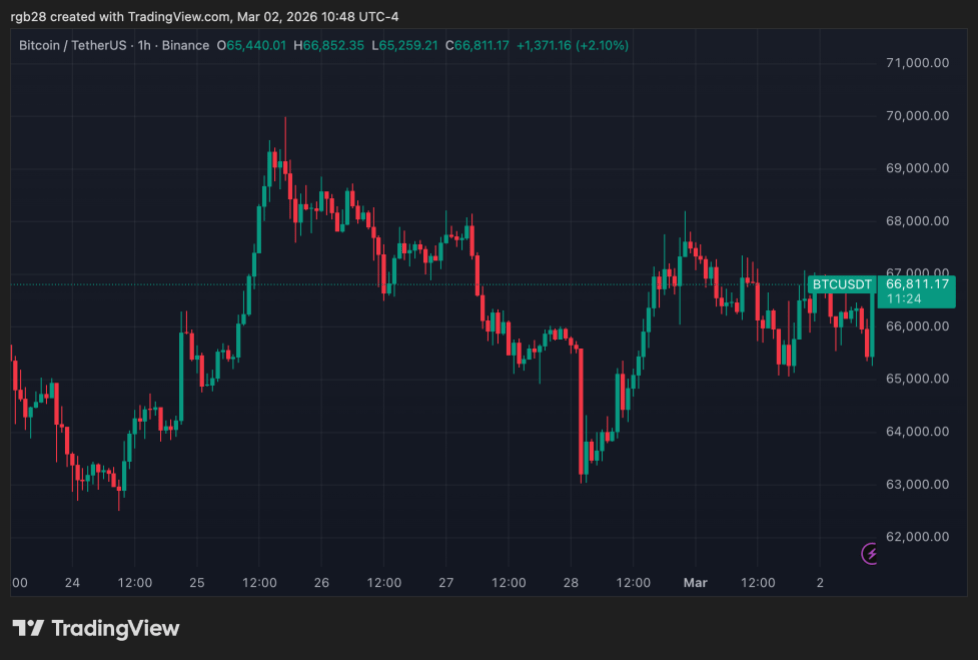
Bitcoin trades at $66,811 in the one-week chart. Source: BTCUSDT on TradingView