South Korea Plans Cap On Crypto Exchange Ownership Despite Industry Concerns

bitcoinistОпубликовано 2026-01-29Обновлено 2026-01-29

Введение

South Korea's Financial Services Commission (FSC) is proceeding with a proposal to cap major shareholders' stakes in cryptocurrency exchanges at 15%-20%, despite opposition from industry players and the ruling Democratic Party of Korea (DPK). FSC Chairman Lee Eog-weon argued the measure is necessary to align governance standards with exchanges' expanding public role and to prevent conflicts of interest. The cap would be part of the upcoming Digital Asset Basic Act, which would also transition exchanges from a renewable notification system to a permanent authorization system. Major exchanges like Upbit and Coinone oppose the move, warning it could hinder industry growth. Meanwhile, lawmakers aim to introduce the comprehensive digital asset framework before the Lunar New Year. The legislation also addresses stablecoin regulation, setting a minimum capital requirement of 5 billion won ($3.48 million) for issuers, though no agreement has been reached on won-pegged stablecoins.

South Korea’s Financial Services Commission (FSC) has shared its intention to move forward with the proposed cap on crypto exchange ownership despite concerns from industry players and the ruling Democratic Party of Korea (DPK).

FSC Backs Ownership Cap For Crypto Exchanges

On Wednesday, Financial Services Commission Chairman Lee Eog-weon revealed that the regulatory agency is reviewing a proposal to cap major shareholders’ stakes in crypto exchanges at around 15%-20%.

According to The Korea Times, Lee stressed the need to limit the ownership stakes of controlling shareholders in crypto exchanges, claiming that the move is necessary to “align governance standards with the exchanges’ increasing public role.”

He argued that “excessive concentration of ownership” could increase the risk of conflicts of interest while undermining market integrity, noting that securities exchanges and other trading systems are subject to similar limits.

The chairman highlighted that existing regulations mainly focus on anti-money laundering and investor protection. The ownership cap proposal would be included in the upcoming Digital Asset Basic Act, also known as the Second Phase of the Virtual Asset User Protection Act, which is expected to serve as a comprehensive framework for the entire industry.

“Under the current system, virtual asset exchanges operate under a notification system that requires renewal every three years. The proposed shift to an authorization system would effectively grant exchanges permanent operating status,” Lee explained.

He emphasized that “this higher status means exchanges need governance rules that match their larger role and greater responsibilities.” As a result, exchanges would assume characteristics similar to public infrastructure.

A joint council representing domestic crypto exchanges, including Upbit, Bithumb, and Coinone, has opposed the proposed cap, warning that it could hinder the development of South Korea’s digital asset sector.

Notably, major players like Song Chi-hyung, the chairman of Dunamu, the company that operates Upbit, and Cha Myung-hoon, the founder of Coinone, would be forced to sell significant portions of their holdings if the law is enacted.

The Democratic Party of Korea also expressed its concerns, observing that similar ownership caps are uncommon worldwide and could make South Korea’s framework inconsistent with global regulatory trends.

Lawmakers Set New Deadline For Digital Assets Framework

ChosunBiz reported that the DPK’s Digital Assets Task Force (TF) discussed key details of the Digital Asset Basic Act in a Wednesday meeting at the National Assembly members’ office building, attended by government officials.

According to the report, the ruling party’s members did not discuss the cap on crypto exchange ownership. Still, they revealed that they will introduce the framework before the Lunar New Year holiday on February 17.

DPK’s Lawmaker Ahn Do-geol said, “We plan to introduce the Digital Asset Basic Act before the Lunar New Year, and we hope that by then a plan agreed upon with the government as much as possible will be put together.”

Instead of the “unanimous consent system” proposed by the Bank of Korea (BOK), the task force settled on a consultative body to discuss stablecoin authorizations, comprised of the BOK, the FSC, the Ministry of Economy and Finance, and the Financial Supervisory Service.

The task force considered that requiring unanimity for stablecoin authorization would slow issuance, while observers believe that the central bank’s proposal was “a way to control stablecoins.”

In addition, the minimum statutory capital for stablecoin issuers was set at 5 billion won, approximately $3.48 million. Nonetheless, the report affirmed that there has not been an agreement on the issuance of won-pegged stablecoins.

As reported by Bitcoinist, the BOK and the FSC have been clashing over the extent of banks’ role in stablecoin issuance. While the central bank has been pushing for a consortium of banks owning at least 51% of any stablecoin issuer seeking approval in the country, the FSC has expressed concerns about this proposal.

Lee Kang-il, a DPK lawmaker on the task force, asserted that “the 50%+1 share rule remains contentious because there is still no willingness to concede among government ministries,” but added that they have prepared a mediation plan and will “make decisions in a direction that serves the national interest overall and benefits the public.”

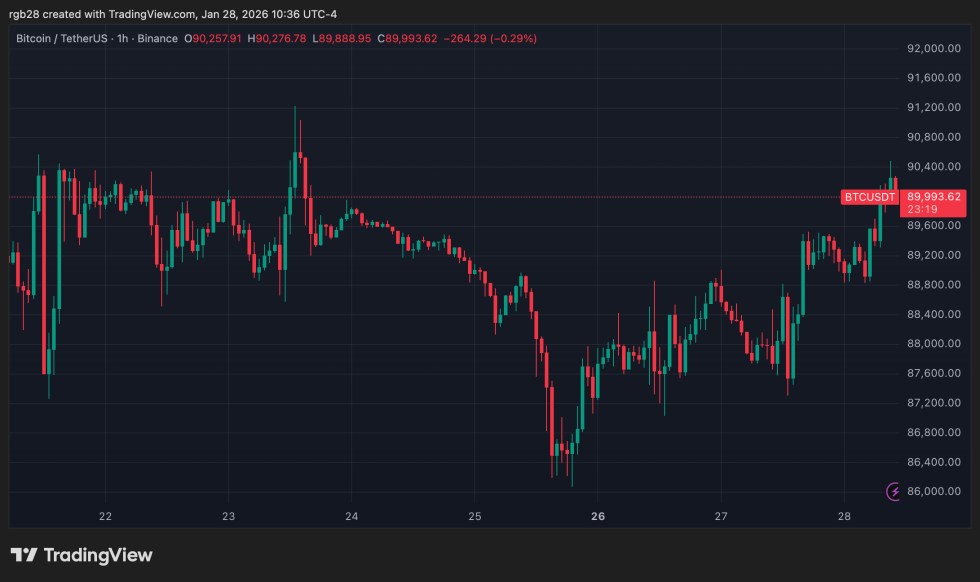
Bitcoin (BTC) trades at $89,993 in the one-week chart. Source: BTCUSDT on TradingView

Связанные с этим вопросы

QWhat is the proposed ownership cap for major shareholders in crypto exchanges by South Korea's FSC?

AThe Financial Services Commission (FSC) is reviewing a proposal to cap major shareholders’ stakes in crypto exchanges at around 15%-20%.

QWhy does the FSC believe an ownership cap is necessary for crypto exchanges?

AThe FSC argues that an 'excessive concentration of ownership' could increase the risk of conflicts of interest and undermine market integrity, and that exchanges need governance rules that match their larger public role and greater responsibilities.

QWhich major industry players have opposed the proposed ownership cap?

AA joint council representing domestic crypto exchanges, including Upbit, Bithumb, and Coinone, has opposed the cap. Key individuals like Dunamu's chairman Song Chi-hyung and Coinone founder Cha Myung-hoon would be forced to sell significant portions of their holdings.

QWhat is the new deadline for introducing the Digital Asset Basic Act, as set by lawmakers?

AThe ruling Democratic Party of Korea (DPK) plans to introduce the Digital Asset Basic Act before the Lunar New Year holiday on February 17.

QWhat was the minimum statutory capital set for stablecoin issuers, and what is its approximate value in US dollars?

AThe minimum statutory capital for stablecoin issuers was set at 5 billion won, which is approximately $3.48 million.

Похожее

OpenAI's 'Blueprint for the Future': Making AI Beneficial for Every Person on the Planet

A new transformative technology emerges every few generations. OpenAI draws a parallel with the advent of electricity in the 1920s, which initially brought convenience but ultimately enabled unprecedented progress in medicine, engineering, and living standards by empowering people to create new possibilities. AI is poised to recreate this phenomenon. Its true significance lies not in the technology itself, but in what people can achieve with it—from understanding a medical bill or starting a business to aiding scientific discovery. OpenAI believes AI should be universally accessible, allowing everyone to use it according to their own needs. This future, however, is not guaranteed. While transformative tech can centralize power, OpenAI's philosophy is that AI must serve humanity, augmenting human capabilities and broadly distributing its benefits. The company's first commitment is to build AI for human service, aiming to empower the many rather than concentrate power in a few. Safety, alignment with human intent, and oversight are paramount. OpenAI is optimistic about AI's potential to expand human welfare but remains clear-eyed about risks. The goal is to help people achieve more, not to replace them. Full automation is not the desired future; human judgment, values, and direction will become even more critical. OpenAI outlines three core goals: 1. Build automated AI researchers to accelerate and increasingly automate the research process itself, maintaining close human collaboration. The internal projection is that by March 2028, a significant portion of their research will be conducted by AI systems working alongside human researchers. 2. Accelerate economic development by advancing science, boosting productivity, and fostering growth, while ensuring the fruits are widely shared. 3. Provide a personal AGI for everyone on Earth, allowing individuals to benefit from this transformative technology in their own way. The company is entering its third phase, moving from foundational AGI research (Phase 1) to product deployment and learning from real-world use (Phase 2). The current challenge is making advanced AI abundant, affordable, safe, practical, and usable for all individuals and organizations. OpenAI concludes that a widely distributed power structure leads to a more resilient, adaptable, and free society. A positive AI future should not be controlled by a handful of entities but built, benefited from, and owned by many. If realized correctly, AI can become a cornerstone for enhancing global productivity, creativity, scientific advancement, and economic opportunity, fulfilling the mission to ensure AGI benefits all of humanity.

marsbit32 мин. назад

OpenAI's 'Blueprint for the Future': Making AI Beneficial for Every Person on the Planet

marsbit32 мин. назад

Arthur Hayes' New Article: AI Bubble Nears Bursting, Crypto Market Faces Short-Term Pressure

In a new essay, Arthur Hayes argues that the AI market bubble is approaching a rupture, which will place significant short-term pressure on crypto assets. He identifies rising oil prices, a trio of massive tech IPOs (SpaceX, Anthropic, OpenAI), and potential anti-AI political rhetoric from Trump as the three key catalysts for a correction. Hayes posits that the prolonged blockage of the Strait of Hormuz will drive energy prices higher, increasing operational costs for data centers and squeezing AI company profits. Simultaneously, the market may struggle to absorb the upcoming wave of multi-trillion dollar tech IPOs. Furthermore, with high inflation hurting his election chances, Trump could pivot to attacking the AI sector with proposals for heavy taxation and regulation to win over voters, spooking the market. Hayes notes that nearly all new dollar liquidity since 2022 has flowed into the AI sector, leaving little for Bitcoin, explaining its recent underperformance. He believes an AI stock crash would trigger a broad risk-off sentiment and credit contraction, dragging down crypto in the near term. Consequently, his fund, Maelstrom, has sold all AI-related stocks and non-core cryptocurrencies, retaining only Bitcoin and Ethereum while building positions in traditional energy stocks. He anticipates Bitcoin will bottom and resume its bull run only after the AI bubble pops and a new monetary easing cycle begins.

marsbit35 мин. назад

Arthur Hayes' New Article: AI Bubble Nears Bursting, Crypto Market Faces Short-Term Pressure

marsbit35 мин. назад

Торговля

Спот
Фьючерсы

Популярные статьи

Как купить S

Добро пожаловать на HTX.com! Мы сделали приобретение Sonic (S) простым и удобным. Следуйте нашему пошаговому руководству и отправляйтесь в свое крипто-путешествие.Шаг 1: Создайте аккаунт на HTXИспользуйте свой адрес электронной почты или номер телефона, чтобы зарегистрироваться и бесплатно создать аккаунт на HTX. Пройдите удобную регистрацию и откройте для себя весь функционал.Создать аккаунтШаг 2: Перейдите в Купить криптовалюту и выберите свой способ оплатыКредитная/Дебетовая Карта: Используйте свою карту Visa или Mastercard для мгновенной покупки Sonic (S).Баланс: Используйте средства с баланса вашего аккаунта HTX для простой торговли.Третьи Лица: Мы добавили популярные способы оплаты, такие как Google Pay и Apple Pay, для повышения удобства.P2P: Торгуйте напрямую с другими пользователями на HTX.Внебиржевая Торговля (OTC): Мы предлагаем индивидуальные услуги и конкурентоспособные обменные курсы для трейдеров.Шаг 3: Хранение Sonic (S)После приобретения вами Sonic (S) храните их в своем аккаунте на HTX. В качестве альтернативы вы можете отправить их куда-либо с помощью перевода в блокчейне или использовать для торговли с другими криптовалютами.Шаг 4: Торговля Sonic (S)С легкостью торгуйте Sonic (S) на спотовом рынке HTX. Просто зайдите в свой аккаунт, выберите торговую пару, совершайте сделки и следите за ними в режиме реального времени. Мы предлагаем удобный интерфейс как для начинающих, так и для опытных трейдеров.

1.4k просмотров всегоОпубликовано 2025.01.15Обновлено 2026.06.02

Как купить S

Sonic: Обновления под руководством Андре Кронье – новая звезда Layer-1 на фоне спада рынка

Он решает проблемы масштабируемости, совместимости между блокчейнами и стимулов для разработчиков с помощью технологических инноваций.

2.3k просмотров всегоОпубликовано 2025.04.09Обновлено 2025.04.09

Sonic: Обновления под руководством Андре Кронье – новая звезда Layer-1 на фоне спада рынка

HTX Learn: Пройдите обучение по "Sonic" и разделите 1000 USDT

HTX Learn — ваш проводник в мир перспективных проектов, и мы запускаем специальное мероприятие "Учитесь и Зарабатывайте", посвящённое этим проектам. Наше новое направление .

1.8k просмотров всегоОпубликовано 2025.04.10Обновлено 2025.04.10

HTX Learn: Пройдите обучение по "Sonic" и разделите 1000 USDT

Обсуждения

Добро пожаловать в Сообщество HTX. Здесь вы сможете быть в курсе последних новостей о развитии платформы и получить доступ к профессиональной аналитической информации о рынке. Мнения пользователей о цене на S (S) представлены ниже.

活动图片