Solana treasury Upexi slides 7.5% on $1B shelf registration filing

cointelegraphОпубликовано 2025-12-24Обновлено 2025-12-24

Введение

Upexi shares fell 7.5% after filing a shelf registration to raise up to $1 billion, intended to expand its Solana treasury and pursue related opportunities. The company, which holds 2.1 million SOL worth $262.3 million, is the fourth-largest corporate holder of Solana. Proceeds will be used for general corporate purposes, including accumulating and staking SOL. However, Upexi hasn't purchased Solana since July, and its holdings have declined from a peak of $525 million amid a broader crypto market pullback. The company is currently facing a 19% paper loss on its Solana investments.

Shares in Upexi closed Tuesday down 7.5% after it filed to raise up to $1 billion to expand its Solana treasury and pursue other opportunities related to the token.

Upexi said in its shelf registration filing to the Securities and Exchange Commission on Tuesday, that the raise could cover common and preferred stock, debt securities, warrants and units, which may be issued over time.

It said net proceeds from the offering would be used for general corporate purposes. The company primarily focuses on accumulating as much Solana (SOL) as possible and staking it to be rewarded with additional tokens.

Upexi holds 2.1 million SOL worth $262.3 million, making it the fourth-largest corporate Solana treasury company, CoinGecko data shows.

Solana treasury purchases have slowed significantly in the back half of 2025 amid a broader crypto market pullback, along with waning confidence in the sustainability of crypto treasury strategies.

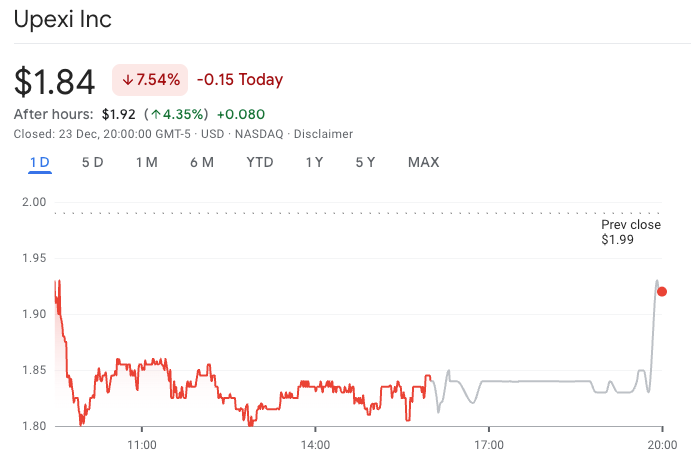
Shares in Upexi (UPXI) closed Tuesday down 7.54% to $1.84, but saw a small reprieve after the bell, gaining 4.34% to $1.92.

Upexi saw a small rally late in after-hours trading on Tuesday, gaining back the day’s losses. Source: Google Finance


Upexi's business was centered around consumer products and e‐commerce before pivoting to a Solana treasury company in late April.

Related: Eclipse brings Solana's parallel runtime to Ethereum

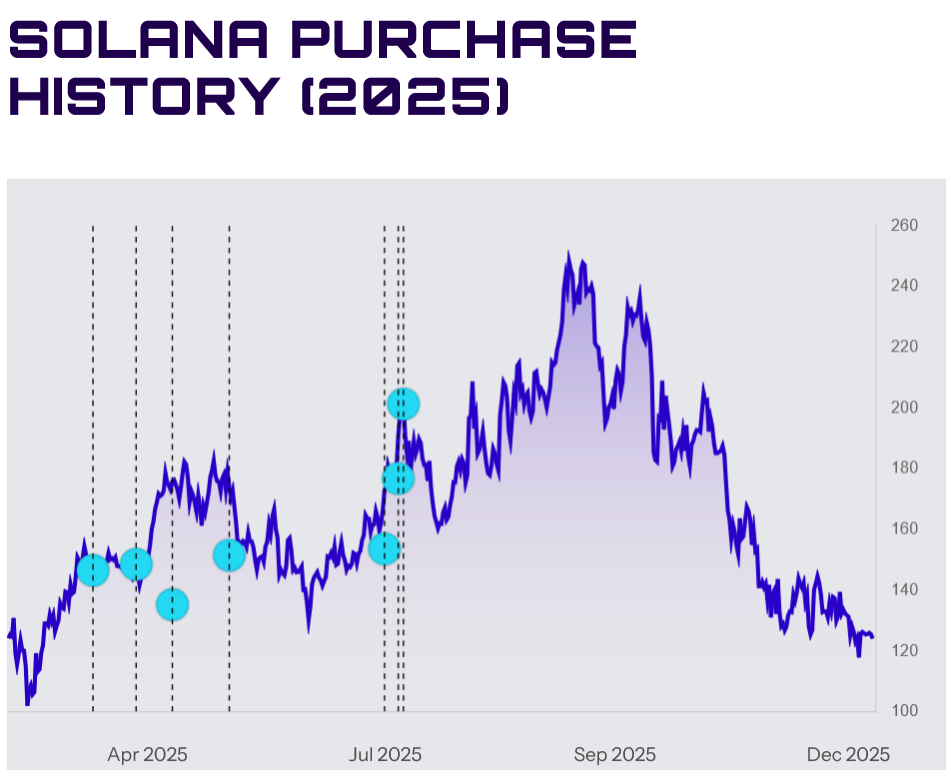
However, it hasn’t made a Solana purchase since July 23 and has seen the value of its SOL stash tumble from a peak of around $525 million in mid-September to $262.3 million at current prices.

Timeline of Upexi’s SOL purchases since its first purchase in late April. Source: Upexi


The company is currently holding a 19% paper loss on its Solana treasury.

Solana is trading at $123.75, down 57.5% from its $293.31 all-time high set on Jan. 19, 2025, CoinGecko data shows.

Magazine: Sei wallets in Xiaomi, Bhutan’s gold on Solana: Asia Express

Связанные с этим вопросы

QWhy did Upexi's shares drop 7.5% on Tuesday?

AUpexi's shares dropped 7.5% after the company filed a shelf registration with the SEC to raise up to $1 billion.

QWhat is the primary purpose of Upexi's $1 billion shelf registration?

AThe net proceeds are intended for general corporate purposes, primarily to expand its Solana (SOL) treasury and stake it to earn additional tokens.

QHow much Solana does Upexi currently hold, and what is its market value?

AUpexi holds 2.1 million SOL, which is currently worth $262.3 million.

QWhat was Upexi's original business focus before pivoting to a Solana treasury company?

AUpexi was originally centered around consumer products and e-commerce before pivoting to a Solana treasury strategy in late April.

QWhat is the current paper loss percentage on Upexi's Solana treasury holdings?

AUpexi is currently holding a 19% paper loss on its Solana treasury.

Похожее

Jensen Huang's CMU Speech: In the AI Era, Don't Just Watch, Build

Jensen Huang, CEO of NVIDIA and a first-generation immigrant, delivered the commencement address to Carnegie Mellon University's class of 2026. He shared his personal journey from a humble background to founding NVIDIA, emphasizing resilience, learning from failure, and the responsibility that comes with leadership. Huang framed the present moment as the dawn of the AI revolution, a shift he believes is more profound than previous computing waves. He described AI as fundamentally resetting computing—moving from human-written software to machines that understand, reason, and use tools. This will create a new industry for generating intelligence and transform every sector. While acknowledging AI's potential to automate tasks and displace some jobs, Huang distinguished between the *tasks* of a job and its core *purpose*. He argued AI will augment human capability, not replace humans. The real risk, he stated, is not AI itself, but people being left behind by those who effectively use AI. He presented AI as a generational opportunity for massive infrastructure investment—in chip factories, data centers, energy grids, and advanced manufacturing—that could re-industrialize nations like the U.S. and bridge the digital divide by making computing and intelligent tools accessible to all. Huang called for a balanced approach: advancing AI safely and responsibly, establishing prudent policies, ensuring broad access, and encouraging universal participation. He urged the graduates not to fear the future but to engage with optimism and ambition, reminding them of CMU's motto, "My heart is in the work." His core message was clear: this is their moment to actively build and shape the AI-powered future, not merely observe it.

marsbit6 мин. назад

Jensen Huang's CMU Speech: In the AI Era, Don't Just Watch, Build

marsbit6 мин. назад

The Era Has Arrived Where Human Writers Must Prove They Are Not Machines

The article describes an era where AI-generated content is flooding the market, forcing human authors to prove they are not machines. It begins with the example of dozens of AI-written, error-ridden biographies of Henry Kissinger appearing on Amazon within hours of his death, a pattern repeated for other deceased celebrities and even living experts who find fraudulent books under their names. This spam content has exploded, with monthly new book releases on platforms like Amazon reaching 300,000 by late 2025. The issue spans genres, from suspiciously high proportions of AI-written teen romance and self-help books to dangerous, AI-generated foraging guides containing lethal advice. The platforms' automated review systems, designed to catch plagiarism and banned words, are ill-equipped to detect AI-generated text that avoids these pitfalls while being nonsensical or fraudulent. The problem has infiltrated traditional publishing. A major publisher, Hachette, had to recall a bestselling horror novel after AI detection tools suggested 78% of its content was machine-generated. An acclaimed European philosophy book was later revealed to be entirely written by AI under a fake author persona. In response, authors are fighting back. At the 2026 London Book Fair, 10,000 writers published a blank book titled "Don't Steal This Book" containing only their signatures—using emptiness as a protest weapon in an age of AI overproduction. Initiatives like the "Human Author Certification" program have emerged, ironically placing the burden on humans to prove their work is not machine-made. The article warns of a vicious cycle: AI-generated low-quality books pollute the data used to train future AI models, leading to "model collapse" and an ever-worsening flood of digital waste, eroding trust in publishing and devaluing human creativity.

marsbit32 мин. назад

The Era Has Arrived Where Human Writers Must Prove They Are Not Machines

marsbit32 мин. назад

Торговля

Спот
Фьючерсы

Популярные статьи

Обсуждения

Добро пожаловать в Сообщество HTX. Здесь вы сможете быть в курсе последних новостей о развитии платформы и получить доступ к профессиональной аналитической информации о рынке. Мнения пользователей о цене на SOL (SOL) представлены ниже.

活动图片