Solana RWA holders jump 440% YoY – Can it bridge gap to Ethereum’s XAUT?

ambcryptoОпубликовано 2026-04-06Обновлено 2026-04-06

Введение

Solana's RWA ecosystem is experiencing explosive growth, with a 440% year-over-year surge in holders, totaling 218,000. This positions Solana as a major hub for tokenized real-world assets, which now have a total on-chain market cap of $24 billion. While Tether Gold (XAUT) on Ethereum leads the RWA market at $3.3 billion, Solana is gaining momentum through its strong focus on tokenized U.S. Treasuries. These assets, which make up over 50% of the RWA market, could generate revenue to strengthen Solana's digital asset treasuries (DATs) and support long-term network growth. The IMF has warned that the rapid growth of on-chain RWAs could disrupt traditional finance. Solana's expansion in this sector suggests it could become a viable alternative to Ethereum for institutional capital seeking tokenized assets.

When the International Monetary Fund (IMF) sounds the alarm, it signals that the threat is real.

Recently, the IMF has been pointing out how fast the Real World Asset (RWA) market is growing on-chain, warning that TradFi players could fall behind if this keeps up.

The logic is simple: More real-world capital is moving onto blockchain, which could change how central banks manage money and financial stability.

Notably, the numbers back it up.

The on-chain market cap of total RWAs has just hit a new all-time high of $24 billion, with Tether Gold [XAUT] leading the pack at $3.3 billion. What’s really interesting is how the market reacted immediately, with much of the momentum flowing toward Solana [SOL] as more investors look to take advantage of its growing RWA ecosystem.

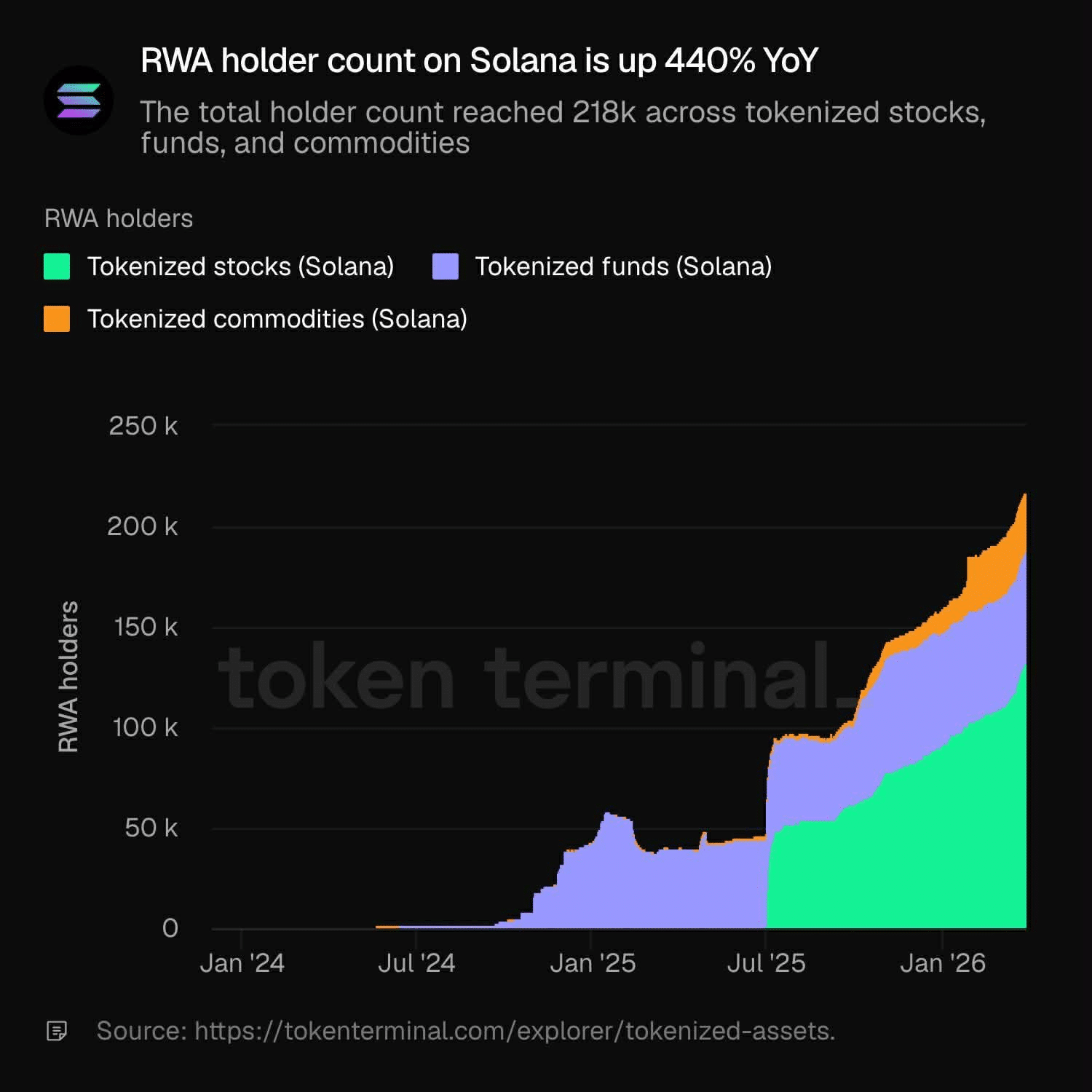
Source: Token Terminal

The real story? Solana’s RWA holder count.

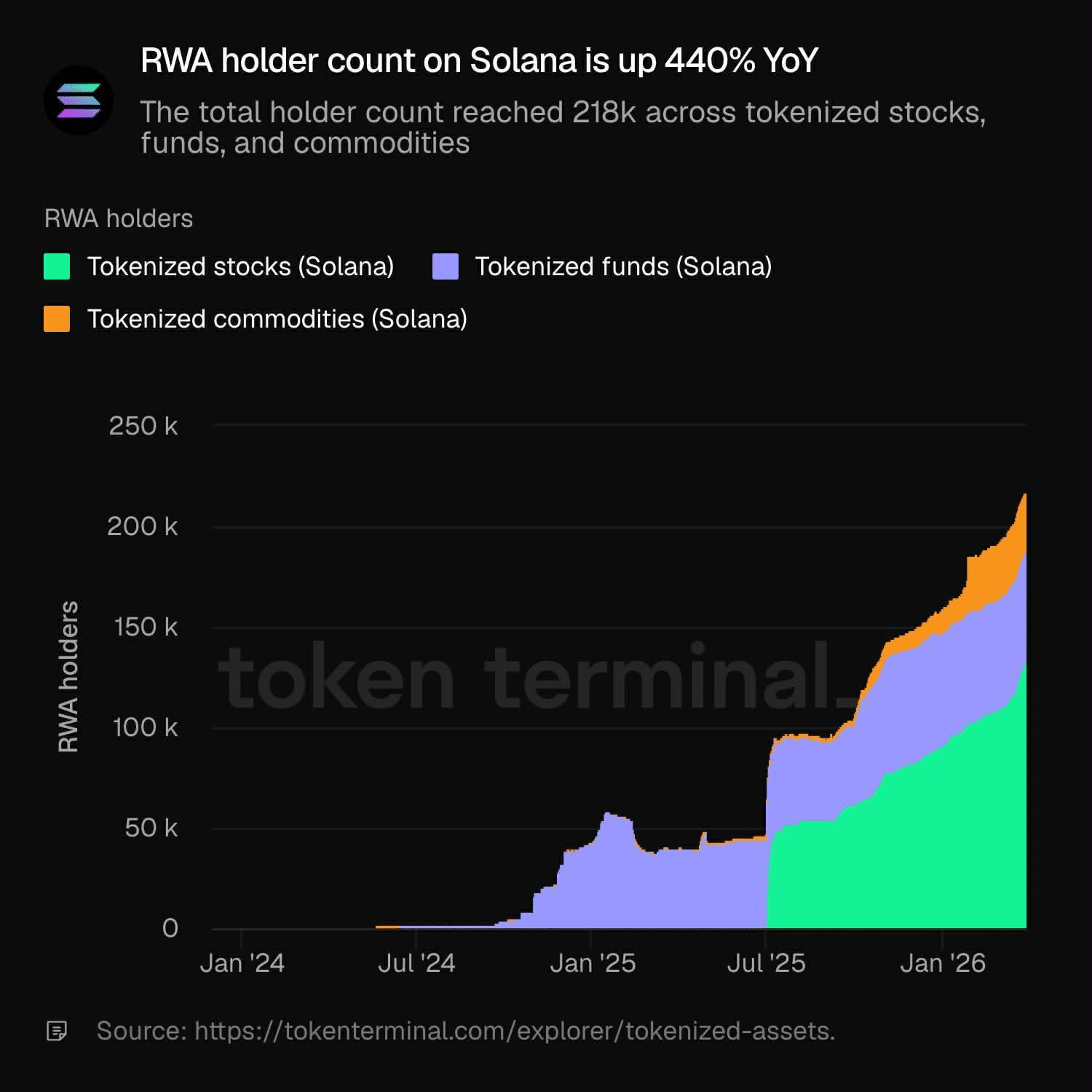
As the chart showed, the number of RWA holders on Solana was up 440% year-over-year, totaling 218,000 across tokenized stocks, funds, and commodities.

This surge signals more than hype.

Instead, it’s a clear sign that Solana is becoming a go-to network for tokenized real-world assets.

Against this backdrop, the IMF’s raising alarms starts to make sense.

XAUT’s lead in the RWA space is particularly noteworthy. Its growth comes at a time of heightened geopolitical tensions, which usually push capital into traditional safe havens.

But instead of sticking to the old playbook, investors are flowing into a tokenized version of gold, showing how RWAs are changing the way capital moves.

That said, this also complicates the narrative around Solana as the go-to network for RWAs.

XAUT currently trades only on Ethereum [ETH], raising the question: Can Solana capture this momentum indirectly, or does it need its own tokenized gold options to really cement its position in the RWA space?

Solana’s long road to dominating tokenized real-world assets

At the aggregate level, the RWA market is over 50% made up of U.S. Treasury assets.

Solana is clearly positioning itself to capture a slice of this momentum.

According to RWA.xyz, after stablecoins, Solana’s most concentrated RWAs are U.S. Treasuries, essentially tokenized versions of government debt that allow investors to hold U.S. debt on-chain and earn routine interest.

This is significant for a few reasons. Solana treasury companies are showing weak price action. Every small pump gets retraced, signaling that market confidence in treasuries hasn’t caught up with on-chain growth yet.

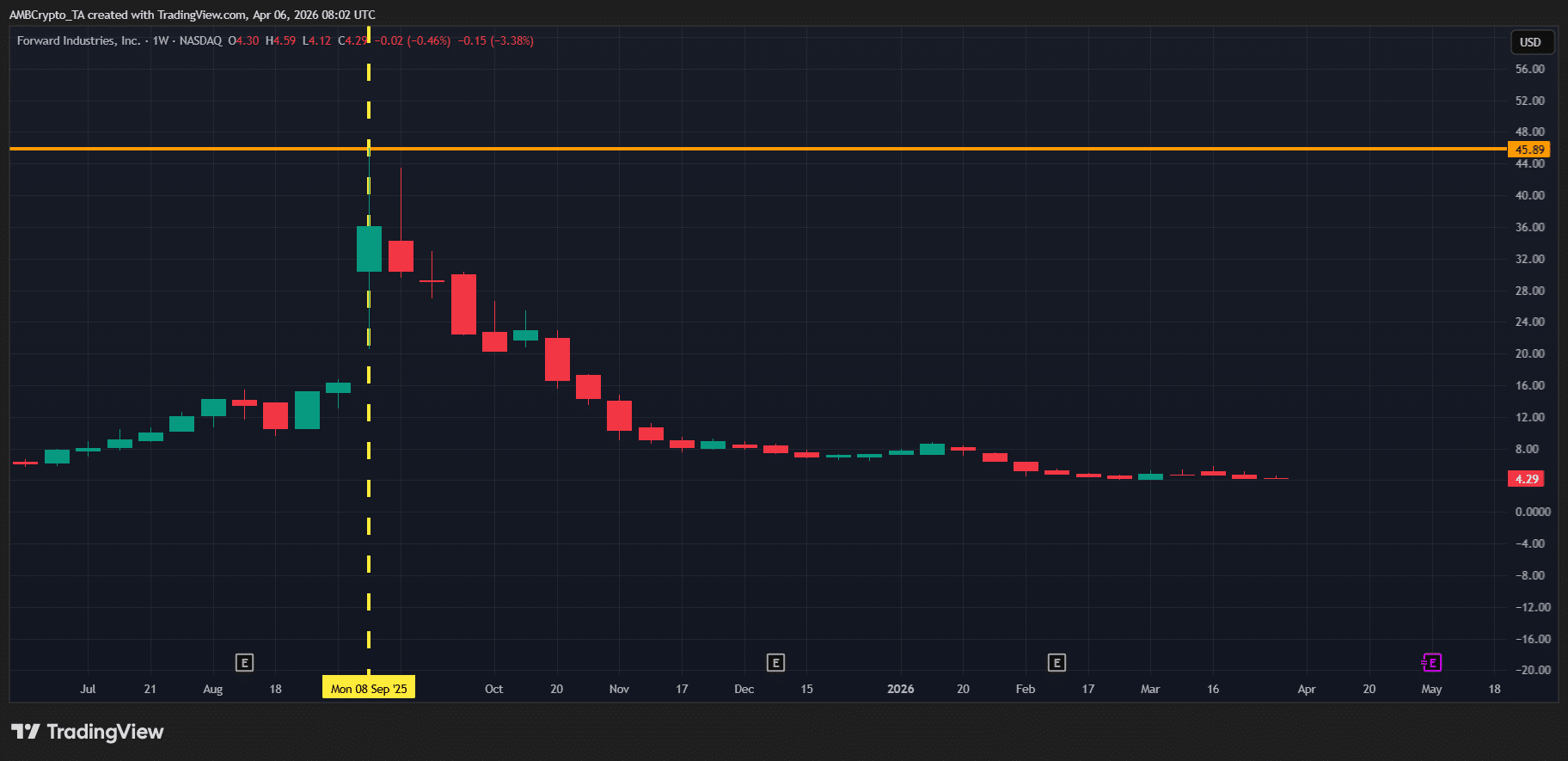
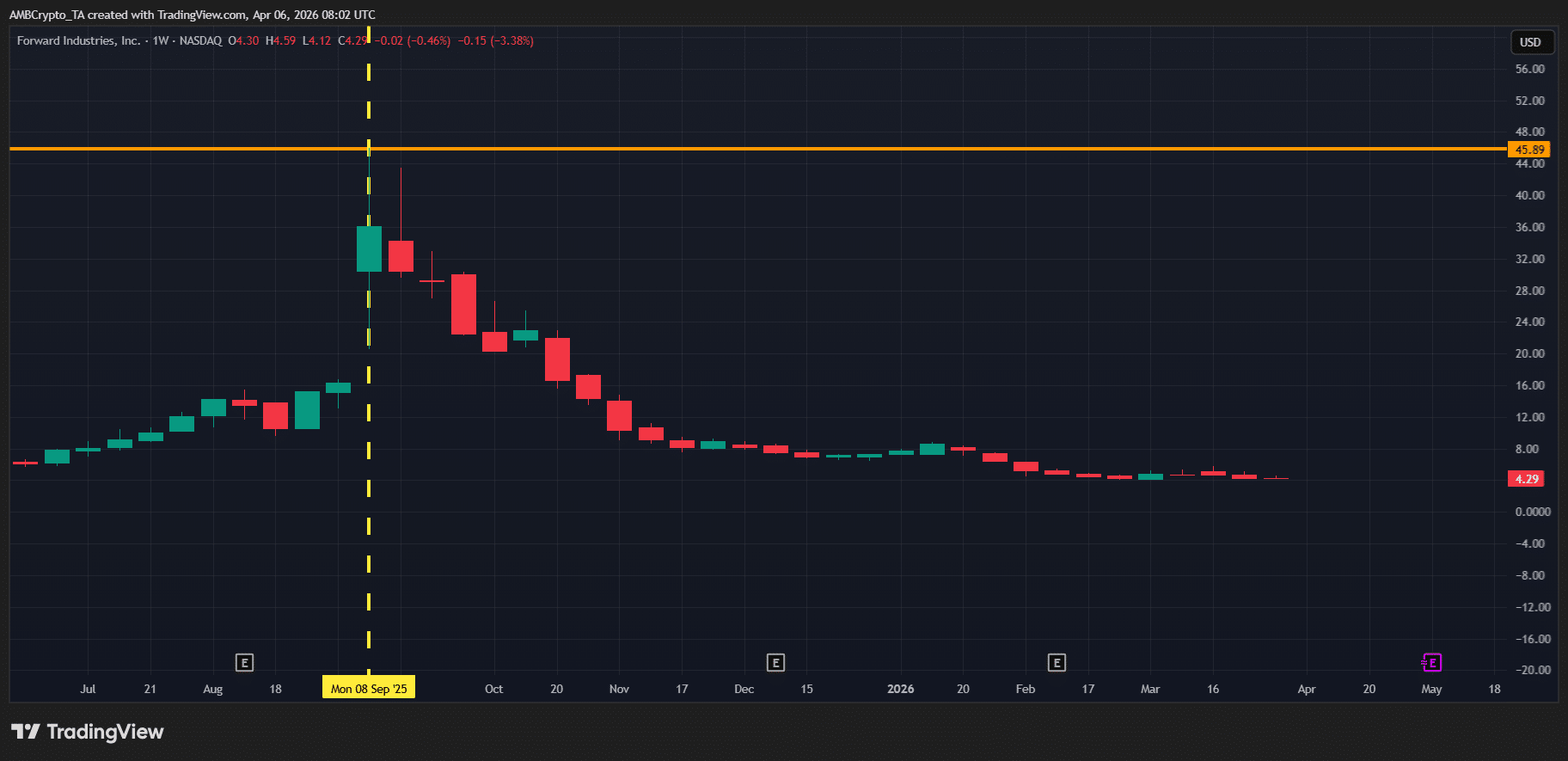
Take the largest SOL DAT, Forward Industries (NASDAQ: FWDI), for instance. It’s still over 80% below its pre-October crash levels.

Source: TradingView (FWDI/USD)

Against this backdrop, Solana’s RWA flows act as a key catalyst.

On a macro level, tokenized U.S. Treasuries could generate revenue for Digital Asset Treasuries (DATs), which can then be used to stockpile more SOL.

With Solana already holding a strong position in tokenized bonds, this is a tangible strategy that can strengthen treasuries and support long-term network growth.

Looking at the bigger picture (RWA market growth, Solana’s rising RWA holder count, and strong capital flows into U.S. Treasuries), Solana could emerge as a viable alternative to Ethereum’s XAUT play.

If the network continues to expand its RWA ecosystem, it has the potential to establish itself as a leading hub for tokenized assets, attracting substantial institutional capital in the process.


Final Summary

  • Solana is emerging as a major hub for on-chain RWAs, with a 440% YoY increase in holders.
  • Strong flows into tokenized U.S. Treasuries could make Solana a viable alternative to Ethereum’s XAUT, offering a pathway to strengthen DATs.

Связанные с этим вопросы

QWhat is the year-over-year growth in the number of RWA holders on the Solana network, and what does this surge signify?

AThe number of RWA holders on Solana grew by 440% year-over-year, totaling 218,000. This surge is more than just hype; it's a clear sign that Solana is becoming a go-to network for tokenized real-world assets.

QWhich token is the on-chain RWA market cap leader, and on which blockchain does it currently trade?

ATether Gold (XAUT) is the on-chain RWA market cap leader with $3.3 billion. It currently trades only on the Ethereum blockchain.

QAccording to the article, what is the primary component (over 50%) of the aggregate RWA market?

AU.S. Treasury assets make up over 50% of the aggregate RWA market.

QWhat potential strategy is mentioned for Solana's Digital Asset Treasuries (DATs) to strengthen themselves and support long-term network growth?

ATokenized U.S. Treasuries could generate revenue for Digital Asset Treasuries (DATs), which can then be used to stockpile more SOL, thereby strengthening the treasuries and supporting long-term network growth.

QWhat key concern does the International Monetary Fund (IMF) raise regarding the article's subject matter?

AThe IMF warns that the fast-growing Real World Asset (RWA) market on-chain could cause traditional finance (TradFi) players to fall behind, potentially changing how central banks manage money and financial stability.

Похожее

What Happens to Ethereum Developer Tools After the Grants Run Out?

On February 27th, the Ethereum Foundation (EF) announced Project Odin, a structured sustainability support program designed for a select group of strategic, previously grant-funded teams. Unlike a standard grant, Odin offers a long-term advisory mechanism focused on helping these teams establish credible, sustainable paths within a two-year framework, thereby reducing long-term dependence on single funding sources. The program addresses a critical post-grant challenge: how essential public goods, especially major developer tools, can achieve financial sustainability beyond initial funding. While grants from EF and programs like Gitcoin or RetroPGF remain vital for startups and research, they often fall short for mature, widely-used infrastructure. Tools like compilers, languages, and network stacks are deeply embedded but struggle with monetization, trapped between being too foundational to lose and too public to generate natural revenue. Project Odin provides teams with a dedicated Strategic Advisor to guide them through a three-phase process: 1) analyzing current funding and realistic options, 2) validating potential paths with stakeholders, and 3) executing plans, which may include crafting support contracts, service agreements, or other recurring revenue models. The first pilot participant is Vyper, a critical smart contract language for the EVM, highlighting the need for sustainable models for core infrastructure. The initiative reframes the public goods conversation from "who should be funded" to "how do already-proven teams avoid perpetual funding crises?" It encourages ecosystem participants—protocols and projects that depend on these tools—to view sustainable support not just as charity, but as essential risk management for their own operational supply chains.

marsbit31 мин. назад

What Happens to Ethereum Developer Tools After the Grants Run Out?

marsbit31 мин. назад

MARA Reports Q1 Revenue Below Expectations, Net Loss of $1.3 Billion, Stock Plunges After Hours

Bitcoin mining firm MARA Holdings reported disappointing Q1 2024 results, causing its stock to erase all daily gains and fall 3.44% in after-hours trading. Revenue dropped 18% year-over-year to $174.6 million, missing Wall Street estimates of $192.7 million. The company posted a net loss of $1.3 billion, a significant increase from a $533.4 million loss a year ago, primarily driven by unrealized losses on its holdings of 38,689 Bitcoin, which depreciated in value during the quarter. MARA also sold over 15,100 BTC in late March to repurchase debt at a discount. The broader mining environment remains challenging due to a 35% decline in Bitcoin's price from its all-time high and a nearly 30% increase in mining difficulty over the past year. MARA's market cap ranking among U.S. miners has slipped to seventh. Critically, the company announced a strategic pivot away from Bitcoin mining expansion. It stated it has no plans to purchase new mining equipment and is fully transitioning toward AI data centers. Its strategy involves retrofitting existing mining sites for AI and high-performance computing (HPC) and leveraging its recent $1.5 billion acquisition of Long Ridge Energy & Power, a gas-fired power plant and data center. This infrastructure could eventually support 600 MW of AI compute capacity, allowing MARA to redeploy up to 90% of its non-custodial mining power for AI and IT workloads.

marsbit32 мин. назад

MARA Reports Q1 Revenue Below Expectations, Net Loss of $1.3 Billion, Stock Plunges After Hours

marsbit32 мин. назад

The AI Investment Landscape Is Being Reshaped: Beyond the 'Magnificent Seven', What Opportunities Lie in the Semiconductor Supply Chain?

AI Investment Map is Reshaping: Opportunities Beyond the 'Magnificent Seven' Since ChatGPT ignited the AI wave, investment initially focused on the "Magnificent Seven" tech giants dominating cloud infrastructure. However, the rise of DeepSeek and debates on AI capital expenditure effectiveness are shifting this dynamic. Investors now recognize opportunities deeper in the supply chain—the companies providing the essential "picks and shovels." Early concerns about an AI investment "arms race" and potential low returns were partly alleviated by strong Q1 earnings from cloud providers, validating robust compute demand. This has highlighted a more certain investment thesis: regardless of which AI applications ultimately win, massive capital expenditure will first fuel demand for semiconductors and related components. This "pick-and-shovel" logic has driven semiconductor ETFs to record highs. Key beneficiaries include: * **Memory Chipmakers (e.g., SK Hynix, Samsung, Micron)**: High Bandwidth Memory (HBM) is a critical bottleneck for AI training. * **Photonics Companies**: Crucial for high-speed data transfer within AI data centers. * **The Broader "AI-11" Semiconductor Ecosystem**: This encompasses foundries & lithography (TSMC, ASML), logic & custom chips (AMD, Broadcom, Intel, Marvell), and enterprise storage (SanDisk, Western Digital). Every dollar of AI infrastructure spending flows through this chain. While the "Magnificent Seven" remain dominant in market size, their earnings growth premium over the rest of the S&P 500 ("S&P 493") is narrowing. Market attention and marginal investment are shifting towards the expanding semiconductor supply chain. The investment narrative is evolving from "betting on the ultimate AI winner" to "investing in the certainty of the infrastructure build-out." Understanding this shift from the demand side to the supply side is key to identifying future AI investment opportunities.

marsbit1 ч. назад

The AI Investment Landscape Is Being Reshaped: Beyond the 'Magnificent Seven', What Opportunities Lie in the Semiconductor Supply Chain?

marsbit1 ч. назад

Торговля

Спот
Фьючерсы

Популярные статьи

Неделя обучения по популярным токенам 9: во время геополитических кризисов рост популярности защитных активов, таких как XAUT и XAG

Серебро (XAG) как важная часть "RWA/товарных фьючерсов" формирует вместе с XAUT/PAXG матрицу драгоценных металлов.

1.2k просмотров всегоОпубликовано 2026.03.03Обновлено 2026.03.03

Неделя обучения по популярным токенам 9: во время геополитических кризисов рост популярности защитных активов, таких как XAUT и XAG

Неделя обучения по популярным токенам 10: Обновление Alpenglow ожидается в первой половине 2026 года, долгосрочный прогноз по XAUT и XAG остается позитивным

Ожидается, что в первой половине 2026 года начнется развертывание масштабного обновления Alpenglow SOL.

1.2k просмотров всегоОпубликовано 2026.03.31Обновлено 2026.03.31

Неделя обучения по популярным токенам 10: Обновление Alpenglow ожидается в первой половине 2026 года, долгосрочный прогноз по XAUT и XAG остается позитивным

Обсуждения

Добро пожаловать в Сообщество HTX. Здесь вы сможете быть в курсе последних новостей о развитии платформы и получить доступ к профессиональной аналитической информации о рынке. Мнения пользователей о цене на XAUT (XAUT) представлены ниже.

活动图片