Solana Price Stays Under Pressure As 1.4M Tokens Flow To Exchanges

bitcoinistОпубликовано 2026-04-06Обновлено 2026-04-06

Введение

The Solana price is facing significant downward pressure, exacerbated by a major DeFi exploit that resulted in over $270 million in outflows from the ecosystem. On-chain data reveals a bearish signal as 1.4 million SOL tokens, valued at approximately $110 million, were transferred to centralized exchanges within a 72-hour period. This substantial increase in exchange inflows is often a precursor to heightened selling pressure, as investors move assets to exchanges to offload them. Consequently, the Solana price, which had already dropped below the key $80 support level after a local high of $85, remains under strain. At the time of writing, SOL is trading around $80.80, showing little change over 24 hours but down more than 3% over the past week.

The cryptocurrency market has indeed seen better days than the past week, but the Solana price has particularly struggled to contend with the broad downward pressure. This sluggish price action could be linked to the major DeFi exploit that rocked the ecosystem, causing the outflow of more than $270 million in value. According to the latest on-chain data, the Solana price could see even further pressure as exchange inflows spike.

$110 Million Of SOL Flow To Centralized Exchanges In 3 Days

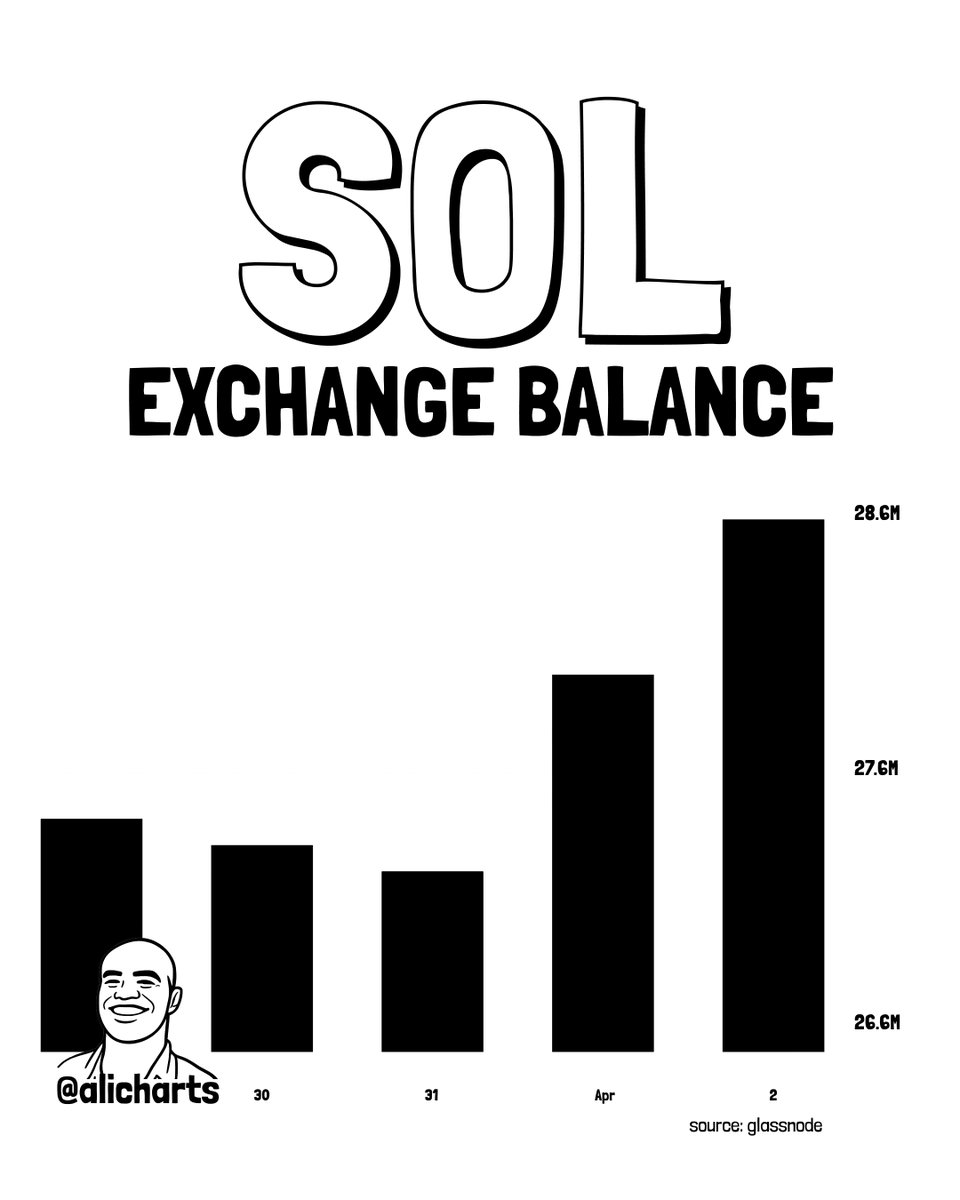
In an April 4th post on the social media platform X, crypto analyst Ali Martinez shared that significant amounts of the Solana token have been moved to centralized exchanges over the past few days. This on-chain observation has caused a warning alarm to go off on the potential price trajectory of SOL, especially considering the already not-so-optimistic market climate.

The relevant indicator here is the Exchange Balance metric, which tracks the amount of a particular cryptocurrency available on centralized exchanges at a given time. This on-chain metric provides some level of insight into the current demand and supply dynamics in the crypto open market.

Hence, a rise in the value of this metric suggests that more market participants are sending assets to exchanges, which could imply that supply might be overwhelming the available demand. This trend could be bearish for an asset’s value (the Solana price, in this case), as it could be an indication of increasing selling pressure.

Source: @alicharts on X

According to Glassnode data highlighted by Martinez, 1.40 million Solana, valued at approximately $110 million, were transferred to centralized exchanges in the last 72 hours. As inferred earlier, coin movements of this magnitude are often red flags in the market, as they could be a potential source of bearish pressure on price.

The rationale behind this conclusion is that one of the major services offered by centralized exchanges is a platform for investors and traders to offload their digital assets. Hence, this latest increase in the exchange inflow can be linked to a rise in selling pressure on the Solana price.

Solana Price At A Glance

Interestingly, the Solana price fell below the psychological $80 support after reaching the local high of around $85. As of this writing, the price of SOL stands at around $80.8, reflecting no significant change in the past 24 hours. According to data from CoinGecko, the altcoin’s value has been down by more than 3% in the past seven days.

The price of Solana on the daily timeframe | Source: SOLUSDT chart on TradingView

Связанные с этим вопросы

QWhat is the main reason for the recent downward pressure on the Solana (SOL) price mentioned in the article?

AThe main reason for the downward pressure is a spike in exchange inflows, with 1.4 million SOL tokens (worth ~$110 million) being moved to centralized exchanges in the last 72 hours, indicating potential increased selling pressure.

QAccording to the on-chain data shared by analyst Ali Martinez, how many SOL tokens were sent to exchanges in a 3-day period?

AAccording to the on-chain data from Glassnode, 1.40 million SOL tokens were transferred to centralized exchanges in the last 72 hours.

QWhat does a rise in the 'Exchange Balance' metric typically indicate for a cryptocurrency's price?

AA rise in the Exchange Balance metric suggests that more market participants are depositing assets to exchanges, which can imply that supply is overwhelming demand. This is often a bearish signal as it indicates increasing selling pressure.

QWhat was the value of the SOL tokens that flowed into exchanges, and what was the time frame for this movement?

AThe value of the SOL tokens that flowed into exchanges was approximately $110 million, and this movement occurred over a 72-hour (3-day) period.

QAt what price level did Solana find psychological support after falling from its local high?

ASolana found psychological support at the $80 price level after falling from its local high of around $85.

Похожее

$9.4 Billion: The Largest Robotics Funding This Year Has Emerged

Munich-based humanoid robotics company Neura has completed a $1.4 billion (approximately RMB 94.9 billion) Series C funding round, valuing the company at around $7 billion and positioning it among the global leaders in the sector. The investment round is notable not just for its size—reportedly the largest in robotics this year—but also for its strategic backers, which include tech giants like NVIDIA and Amazon, alongside established industrial players such as German engineering firms Bosch and Schaeffler. This mix of investors signals a significant shift in the industry's focus from technological demonstrations and general-purpose narratives toward practical, industrial deployment and commercialization. Neura's approach centers on developing humanoid robots for defined, high-value industrial tasks rather than pursuing a general-purpose model. Its early validation comes from a partnership with BMW, where its robots are being tested on actual production lines. The involvement of Bosch and Schaeffler, companies deeply embedded in global manufacturing, underscores a growing belief that humanoid robots are transitioning from labs to viable factory-floor solutions. The article highlights two converging trends driving investment: advancements in AI and large language models, which enhance robots' perception and decision-making in unstructured environments, and mounting pressure from labor shortages and rising costs in major manufacturing regions. The funding landscape is now bifurcating between companies like Figure AI, focusing on versatile general-purpose robots, and firms like Neura, targeting specific vertical industrial applications with clearer, shorter paths to ROI. While technical hurdles remain, the core challenges for widespread adoption are increasingly seen as engineering and commercial in nature: managing the high integration and customization costs for different factory environments and establishing robust, localized maintenance and service networks. The record investment in Neura, particularly from industrial capital, indicates the industry's growing confidence in moving from proving feasibility to solving the practical problems of scalability, reliability, and building sustainable business models around humanoid robots in real-world settings like automotive manufacturing and hazardous labor environments.

marsbit1 ч. назад

$9.4 Billion: The Largest Robotics Funding This Year Has Emerged

marsbit1 ч. назад

"119 to 176 Dollars": Behind SpaceX's Listing, MSX Once Again Successfully Executes the Pre-IPO Closed Loop

Following May's 300% gain on Cerebras, MSX delivered another outstanding performance during SpaceX's listing night. On June 12, SpaceX (SPCX) launched on Nasdaq, reaching a high of $176. This marked the successful culmination of MSX's Pre-IPO project launched in March, where users subscribed at $119, achieving gains of approximately 40-48%. This event validated MSX's complete Pre-IPO mechanism, a crucial advantage in a market where access to top-tier private company equity is typically limited to institutions. MSX's model provides a full cycle for users: subscription (at $119 for SpaceX), real-time on-chain portfolio tracking, optional early redemption, seamless conversion to tradable spot assets (SPCX.M) upon IPO, and final settlement in stablecoins. This end-to-end process distinguishes MSX from platforms that faced settlement issues during the SpaceX IPO, highlighting that the core challenge of Pre-IPO is not just access, but a clear exit and conversion path post-listing. This success with SpaceX is MSX's second major Pre-IPO verification, following the Cerebras listing in May, which yielded ~300% returns for early participants. These back-to-back achievements demonstrate MSX's capability to source, structure, and deliver real assets through a replicable on-chain model. The true barrier for Pre-IPO products lies not in providing an entry point, but in ensuring reliable fulfillment from subscription through to post-IPO liquidity. MSX's proven闭环 (closed-loop) process addresses this, offering Web3 users a structured way to access high-growth, pre-public companies in sectors like AI and frontier tech. MSX plans to continue expanding its Pre-IPO portfolio with this focus on authenticity, transparency, and post-listing execution.

Odaily星球日报14 ч. назад

"119 to 176 Dollars": Behind SpaceX's Listing, MSX Once Again Successfully Executes the Pre-IPO Closed Loop

Odaily星球日报14 ч. назад

Торговля

Спот
Фьючерсы
活动图片