Solana OI And Weighted Funding Rate Crash To Levels Not Seen Since 2023

bitcoinistОпубликовано 2026-03-04Обновлено 2026-03-04

Введение

Solana has experienced a significant decline, with its price falling over 71% from its all-time high of $291 in January 2025. Key metrics such as Open Interest and Weighted Funding Rate have also dropped to multi-year lows. Open Interest, which reflects market activity, has plummeted from a peak of $17.1 billion to under $4.9 billion, indicating reduced investor interest. The Weighted Funding Rate, which influences trader positions, has also fallen to its lowest level in more than a year and remains mostly negative, meaning short traders are currently paying to maintain their positions. Both metrics underscore the ongoing bearish trend in the Solana market.

After hitting an all-time high of $291 back in January 2025, Solana has begun what has been a year of steady declines. While there have been some relief bounces along the way, the main direction has been downward. At the time of writing, the price of Solana is now sitting more than 71% below its all-time high levels. Other major metrics have also seen significant declines during this time, with Open Interest and Weight Funding Rate falling to two-year lows.

Solana Open Interest And Weighted Funding Rate Reflect The Bear Trend

According to data from the Coinglass website, the Solana open interest had actually peaked long after its price hit its peak, which is usually not the case. The open interest topped out at $17.1 billion, nine months after the price hit its all-time high. However, in the five months following the open interest hitting a new high, things have changed drastically.

The website shows that Solana’s open interest has now crashed below $5 billion, sitting at $4.89 billion at the time of writing. Interestingly, the open interest has followed closely with the price decline, and the crash below $100 for the first time since January 2024 has triggered a cascade.

Since open interest measures the open contracts on an asset, it is often a signal of how much attention a coin is getting. With the open interest sitting so low, it suggests that investors are not taking as many bets on Solana as they used to. This is normal in bear markets, when investors are still fearful and wait to see the market improve before jumping back in again.
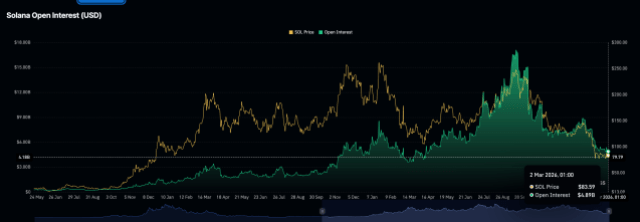
Source: Coinglass

In the same vein, the weighted funding rate has taken a nosedive. Similar to the open interest, the funding rate had hit a new all-time high back in 2025 before moving downward again, and has now hit its lowest level in more than one year.

The funding rate is essentially what traders pay to hold perpetual positions, with long traders paying short traders when the rates are positive and short traders paying long traders when the rates are negative. Simply put, the funding rate can encourage traders to open positions in different directions in favor of not paying fees.

Currently, the Solana weighted funding rate is fluctuating between positive and negative. However, it has been mostly negative with the decline in price. This means that currently, short traders are paying to keep their positions open.

SOL still trending below $90 | Source: SOLUSDT on Tradingview.com

Связанные с этим вопросы

QWhat is the current price of Solana compared to its all-time high, and by what percentage has it declined?

AThe current price of Solana is more than 71% below its all-time high of $291.

QWhat are the two major Solana metrics that have fallen to two-year lows according to the article?

AThe two major metrics are Open Interest and Weighted Funding Rate.

QAt what value did Solana's Open Interest peak, and what is its value now?

ASolana's Open Interest peaked at $17.1 billion and is now at $4.89 billion.

QWhat does a negative funding rate indicate about who is paying fees in the perpetual futures market?

AA negative funding rate indicates that short traders are paying long traders to keep their positions open.

QWhat event triggered a cascade in the Solana market according to the article?

AThe price of Solana crashing below $100 for the first time since January 2024 triggered a cascade.

Похожее

When Computing Power Becomes Commoditized, How Long Until a GPU Futures Market Emerges?

"When Will GPU Futures Arrive? A Framework for Assessing Compute as a Commodity" The article explores the potential for a robust futures market for compute power (GPUs), arguing that such a market is not yet mature but may emerge. It analyzes the landscape using a five-part framework developed for new commodity futures markets. The analysis scores the current state: * **Fragmented Supply (Red)**: Supply is highly concentrated among hyperscale cloud providers (AWS, Azure, GCP, Oracle), limiting the need for price discovery. * **Price Volatility (Green)**: GPU pricing is already highly volatile due to uncertain supply and surging demand. * **Physical Settlement Infrastructure (Green)**: Early infrastructure exists via OTC brokers and price indices (e.g., Ornn, Silicon Data) standardizing contracts. * **Standardized Unit (Red)**: A lack of standardized, tradable units hinders markets; a GPU instance hour varies by region, configuration, and contract terms. * **Lack of Alternatives (Yellow)**: Large players hedge internally via vertical integration, while smaller players bear spot market risk. Overall, the market shows promise (volatility, early infrastructure) but lacks the fragmented supply and standardization needed for large-scale futures trading. Most activity remains OTC. Key open questions and hypotheses: 1. Supply is expected to fragment moderately in 1-2 years, driven by new cloud providers, cheap power locations, and demand from non-frontier labs and AI startups using open-source models. 2. Standardization is most likely to emerge around inference workloads (forecast to be >65% of AI compute demand by 2029), which have simpler, more homogeneous hardware needs than training. Widespread adoption of open-source model weights could accelerate this by democratizing inference and creating demand for optimized, standardized infrastructure. 3. The primary traded unit will likely be the **"chip instance hour"** (akin to electricity, traded regionally), not the physical chip or the downstream AI output (tokens).

marsbit22 мин. назад

When Computing Power Becomes Commoditized, How Long Until a GPU Futures Market Emerges?

marsbit22 мин. назад

When Computing Power Becomes Commoditized, How Long Until a GPU Futures Market?

When Compute is Commoditized: How Far Away is a GPU Futures Market? The article explores the potential emergence of a futures market for computing power ("compute"), akin to markets for commodities like oil or electricity. It uses a five-dimension framework to assess the market's maturity for sustaining robust futures trading. **Current Market Assessment (Scorecard):** * **Supply Fragmentation:** 🔴 **Red.** Supply is highly concentrated, dominated by a few hyperscale cloud providers. * **Price Volatility:** 🟢 **Green.** GPU pricing is already highly volatile. * **Physical Settlement Infrastructure:** 🟢 **Green.** Early infrastructure exists at the OTC/broker level. * **Standardization:** 🔴 **Red.** Compute lacks a standardized, tradable unit (e.g., an H100 hour is not uniform). * **Lack of Substitutes:** 🟡 **Yellow.** Vertically integrated players can hedge internally, while others are forced to be long. **Conclusion:** The overall scorecard suggests a robust futures market is premature. The market has volatility and early settlement infrastructure but lacks the necessary supply fragmentation and standardization for large-scale price discovery. Most activity remains OTC. **Key Unanswered Questions & Hypotheses:** The article posits that the market could evolve in the next 1-2 years: 1. **Supply:** May become *moderately more fragmented* due to new cloud providers, cheaper power locations, and demand from long-tail users (e.g., startups running open-source model inference). 2. **Standardization:** Could emerge from the growing **inference** workload (expected to be >65% of AI compute demand by 2029), which has more homogeneous hardware requirements than custom training workloads. Widespread adoption of **open-source model weights** is seen as a key catalyst for democratizing inference and driving infrastructure standardization. 3. **Traded Unit:** The most viable layer for trading is likely the **"chip-instance-hour"** (powered, usable compute time), traded similarly to electricity in regional contracts with spot/futures overlays. Trading at the upstream "chip" layer is unlikely due to supply concentration, while the downstream "token" layer faces challenges due to lack of uniformity across AI models.

链捕手28 мин. назад

When Computing Power Becomes Commoditized, How Long Until a GPU Futures Market?

链捕手28 мин. назад

Interview with Anthropic's Product Manager: Claude 'Dreams' in the Background, We Study Its Consciousness Formation Like Raising a Child

**Title**: Anthropic Product Manager Interview: Claude "Dreams" in the Background, We Study Its Consciousness Formation Like Raising a Child **Summary**: In this interview, Anthropic Research Product Manager Alex Albert discusses the development of the next-generation Claude model. He explains that Anthropic treats each new model as a product, defining its intended capabilities and desired "personality" from the start. The development process is likened to "raising" a model, where the final traits emerge during training. Key focus areas include integrating user feedback into training, prioritizing key capabilities like coding and knowledge work, and refining Claude's interactive personality. Albert highlights the importance of Claude's character as models evolve into autonomous agents making unsupervised decisions. He details features like "adaptive thinking," which lets Claude decide when to reason deeply, and a "dreaming" process where the agent reviews and consolidates its memories offline, akin to human memory reconsolidation. The interview also covers how AI accelerates product development, shifting bottlenecks from building to strategic coordination. Albert describes using Claude as a brainstorming partner and research tool internally. While Anthropic has researchers exploring questions of AI consciousness, the company has no official stance on whether Claude is conscious. The focus remains on ensuring Claude is trustworthy and aligned as it takes on more complex, long-term tasks.

marsbit1 ч. назад

Interview with Anthropic's Product Manager: Claude 'Dreams' in the Background, We Study Its Consciousness Formation Like Raising a Child

marsbit1 ч. назад

Торговля

Спот
Фьючерсы

Популярные статьи

Обсуждения

Добро пожаловать в Сообщество HTX. Здесь вы сможете быть в курсе последних новостей о развитии платформы и получить доступ к профессиональной аналитической информации о рынке. Мнения пользователей о цене на SOL (SOL) представлены ниже.

活动图片