Solana Foundation President Lily Liu Says 'Don't Waste Time with Crypto'—Is the Crypto Industry Really Dead?

marsbitОпубликовано 2026-02-28Обновлено 2026-02-28

Введение

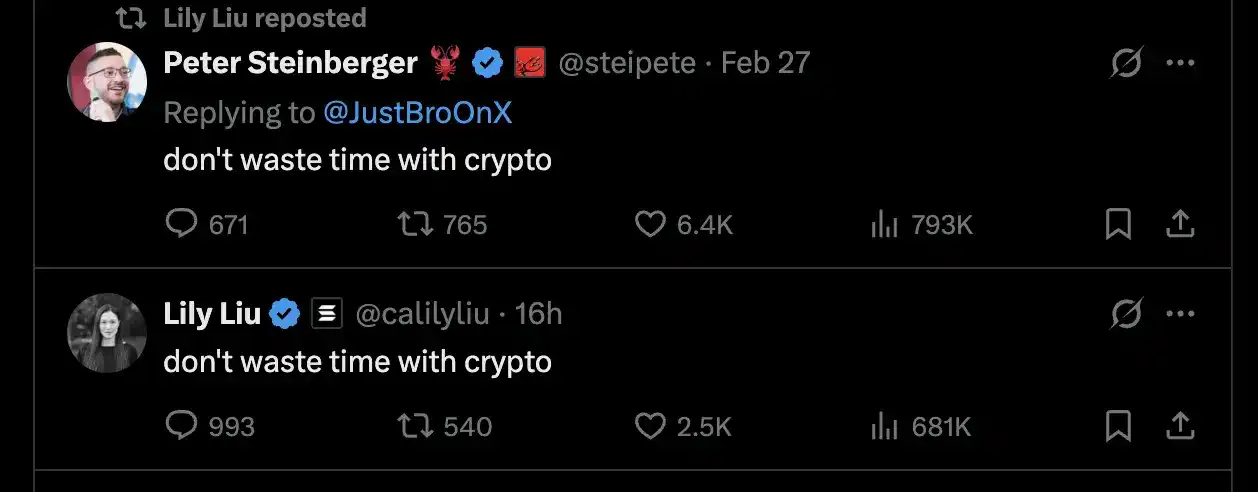
Lily Liu, President of the Solana Foundation, sparked controversy by echoing a statement from OpenClaw founder Peter Steinberger: "don't waste time with crypto." Steinberger’s remark was a direct response to ongoing harassment from crypto speculators who promoted a fraudulent token falsely tied to his project, causing significant financial losses for investors. His frustration is aimed at the predatory and scam-prone aspects of the industry rather than the technology itself. Liu’s repetition of the statement, however, was met with criticism and confusion, given her leadership role in a major blockchain foundation. Many interpreted it as a negative signal toward the crypto industry’s current state, though others suggested it might be ironic commentary on its speculative excesses. The incident reflects broader trends: talent and capital are shifting toward AI, which is seen as being in a value-creation phase with clearer opportunities. However, the crypto market has historically absorbed capital and attention when other tech sectors mature and returns diminish. The current downturn is part of a natural cycle, and the industry’s long-term viability will depend on what remains after speculative projects are filtered out.

Author: Chloe, ChainCatcher

Yesterday, OpenClaw founder Peter Steinberger responded to a user's question on X, 'What advice do you have for people in their 20s?' His answer was just one sentence: 'don't waste time with crypto.' This tweet was subsequently reposted by Solana Foundation President Lily Liu, who also posted the exact same phrase herself.

The two tweets collectively garnered over a million views, and the comment section quickly filled with skepticism. Is Lily Liu hitting back with sarcasm? Or does it mean the crypto industry is dying?

Steinberger Has Reasons to Dislike the Industry, But What About Lily?

OpenClaw, formerly known as Clawdbot and Moltbot, was officially launched under its current name on January 30 this year. The project has already garnered over 200,000 stars on GitHub, becoming a rare viral phenomenon in the open-source community recently.

Following its explosive popularity, a flood of noise unrelated to technical development emerged, with speculators rushing into the community urging the launch of a token, attempting to capitalize on the project's hype for炒作. As a result, Steinberger has developed a strong aversion to the crypto industry. He even implemented a comprehensive ban on Discord, where any mention of 'crypto' or 'bitcoin' would result in an immediate ban (whether it's promotion, spam, or purely technical discussion).

According to CoinDesk, the ban was prompted by an incident in January when the project, then named Clawdbot, decided to rebrand due to a trademark warning from Anthropic. In the brief window between releasing the old GitHub/X account and registering a new one, someone immediately hijacked the account and launched a fake $CLAWD token on Solana.

The fake token's market cap surged to $16 million within hours, then plummeted over 90% after Steinberger publicly denied any association, leaving late entrants with massive losses. He was subsequently harassed by victims, leading him to publicly state: 'Please, crypto community, stop harassing me. I will never issue a token. Any token labeling me as a holder is a scam!'

Against this backdrop, his statement about not wasting time on cryptocurrency is a direct response to the ongoing harassment, with a clear target, and not a comprehensive rejection of cryptocurrency as a technology or asset class itself.

Lily's situation is entirely different. She chose not only to repost but also to personally reiterate the same phrase at a time when market attention on Steinberger's original post was high. External interpretations generally fall into two categories: first, that this is a pessimistic signal about the state of the industry; second, that the phrase itself is ironic, pointing to specific behavioral patterns within the crypto industry rather than the industry as a whole.

Regardless of Lily's original intention, the market reaction to this statement has been largely negative. Several industry figures have publicly criticized it, believing it is clearly inconsistent with her role and responsibilities. 'As the foundation president, it's like telling holders that what they've bet on isn't worth it. Whether it's a joke or not, the signal itself is terrible.'

However, it must be acknowledged that in the current industry narrative, projects that quickly issue tokens, create short-term wealth effects, and lack substantial technical development have long been a core issue discussed within the industry. The long-term透支 of this ecosystem has accelerated the outflow of capital and talent, with AI承接 these resources.

Capital and Talent Are Fleeing—Where Is the Crypto Industry Headed?

Prominent investor Stanley Druckenmiller mentioned in an interview with Morgan Stanley that the interest of the younger generation is shifting from cryptocurrency to the field of artificial intelligence.

This aligns with the current phenomenon in the crypto industry: a significant amount of technical talent and early-stage venture capital is concentrating towards AI, while the narrative heat of the crypto market has frozen.

Upon closer examination, the current AI industry is still in the early stages of infrastructure construction and technological capability expansion, a cycle characterized primarily by value creation. The technological红利 has not yet been fully released, the window for entrepreneurship remains open, and the return expectations for early participants are relatively clear. The flow of young talent in this direction is a rational response to real opportunities, not an active abandonment of cryptocurrency.

Looking at historical references, the development of mobile internet also went through similar stages of evolution. In the later stages of the value creation cycle, when technological红利趋于 saturated and market competition intensified, compressing entrepreneurial returns, capital and attention began to seek new outlets. The concentrated outbreak of the cryptocurrency market in 2017 highly coincided with the mobile internet entering maturity, which to some extent confirms that the opening of a value redistribution cycle is often accompanied by the process of new asset classes承接溢出 capital.

Whether the development cycle of AI will follow a similar path is currently uncertain. But if this is used as a reference, the true cycle of value redistribution will only begin when homogeneous competition in the AI market starts to lower overall entrepreneurial returns and market attention begins to shift away from AI. In that stage, the crypto market, with its low asset barriers and high liquidity, will still hold appeal for the younger generation with limited capital accumulation, and will not be permanently ignored due to today's short-term attention migration.

For the crypto industry, the maturation process of any emerging industry cannot bypass this stage: the loss of attention, the adjustment of valuations, and the clearing out of speculative projects are all part of the industry cycle, not the end.

Ebb and flow are the norm. What is truly worth paying attention to is what remains after the low tide.

Связанные с этим вопросы

QWhat was the controversial statement made by Solana Foundation President Lily Liu, and why did it cause concern?

ALily Liu tweeted 'don't waste time with crypto,' which was a direct quote from OpenClaw founder Peter Steinberger. This caused concern because, as the president of the Solana Foundation, her role is to promote and support the ecosystem. Many interpreted her echoing this sentiment as a negative signal about the industry's prospects, potentially undermining confidence among investors and community members.

QWhat incident led Peter Steinberger to develop a strong aversion to the cryptocurrency space?

APeter Steinberger's aversion stemmed from an incident where, during a brief window when his project (then called Clawdbot) was changing its name and social media accounts, a bad actor hijacked the old account and launched a fake $CLAWD token on Solana. The fake token's market cap surged to $16 million before crashing after his public denial, causing significant financial losses for late buyers. He was subsequently harassed by victims of the scam, leading to his negative stance.

QAccording to the article, what is the current trend regarding talent and capital flow between the crypto and AI industries?

AThe article states that there is a current trend of both technical talent and early-stage venture capital moving away from the cryptocurrency industry and concentrating instead on the AI sector. This shift is attributed to AI being in an early, value-creation phase with clearer return expectations, while crypto faces a narrative that has cooled significantly.

QHow does the article contextualize the current 'cooling' period of the crypto industry within a broader historical cycle?

AThe article contextualizes the current cooling period by comparing it to the development cycle of mobile internet. It suggests that after a technology's value-creation phase matures and competition increases, capital and attention seek new outlets. The crypto market's previous boom coincided with the maturation of mobile internet. Similarly, the article posits that attention may return to crypto market when AI enters a more competitive, later stage, making crypto's lower asset barriers attractive again for value redistribution.

QWhat are the two main interpretations the article presents for Lily Liu's 'don't waste time with crypto' tweet?

AThe article presents two main interpretations for Lily Liu's tweet. The first is that it was a pessimistic signal indicating a belief that the crypto industry is in decline. The second is that it was meant as sarcasm or a rebuttal, specifically targeting the negative behaviors within the crypto industry (like scams and投机炒作), rather than being a condemnation of the entire technology or asset class.

Похожее

Telegram Takes Direct Control of TON, Social Traffic Rewrites the Public Chain Narrative

Telegram founder Pavel Durov announced that Telegram will replace the TON Foundation as the core driver and largest validator of The Open Network (TON). Key initiatives include a sixfold reduction in transaction fees, performance upgrades, and improved developer tools within the next few weeks. This marks a strategic shift from Telegram merely providing user access to deeply integrating TON into its platform's core infrastructure. The goal is to transform Telegram's massive social traffic into sustainable on-chain activity. While viral mini-apps like Notcoin have demonstrated Telegram's ability to drive user adoption, TON aims to support frequent, low-value transactions inherent to social platforms—such as tipping, in-app payments, and game rewards. Ultra-low fees and sub-second finality (0.6 seconds) are crucial to making blockchain interactions seamless and nearly invisible within the Telegram user experience. However, Telegram's increased central role raises questions about network decentralization. Durov argues that Telegram's participation will attract more large validators, thereby enhancing decentralization. TON also offers high annual staking rewards (18.8%), aiming to retain capital within its ecosystem. The fundamental challenge for TON is no longer leveraging Telegram's user base, but becoming an indispensable, seamless infrastructure layer for Telegram's everyday applications—moving from an adjacent chain to an embedded utility.

marsbit5 мин. назад

Telegram Takes Direct Control of TON, Social Traffic Rewrites the Public Chain Narrative

marsbit5 мин. назад

Telegram Takes Direct Control of TON, Social Traffic Reshapes Public Chain Narrative

Telegram's founder, Pavel Durov, has announced a major shift in the development of The Open Network (TON). Telegram will now become the core driver of TON, replacing the TON Foundation and becoming its largest validator. The focus will be on technical upgrades over the next few weeks, including slashing network fees by six times to near-zero and improving finality time to 0.6 seconds. This move signifies a deeper integration between Telegram and TON, moving beyond just providing a user base. The goal is to transform Telegram's vast social traffic and built-in features—like Mini Apps, payments, and bots—into sustainable, on-chain usage scenarios. The reduced fees and faster speeds are crucial for enabling the small, frequent transactions typical of social interactions. While this promises stronger execution and product alignment, it raises questions about centralization. Durov argues Telegram's involvement will attract more validators, enhancing decentralization, but the outcome remains to be seen. Additionally, TON's high annual staking reward of 18.8% aims to retain capital within the ecosystem. The key challenge for TON is no longer just leveraging Telegram's entry point, but becoming an invisible, seamless infrastructure layer within Telegram's daily use. Its success hinges on converting viral attention into lasting, embedded utility.

Odaily星球日报14 мин. назад

Telegram Takes Direct Control of TON, Social Traffic Reshapes Public Chain Narrative

Odaily星球日报14 мин. назад

OpenAI Post-Training Engineer Weng Jiayi Proposes a New Paradigm Hypothesis for Agentic AI

OpenAI engineer Weng Jiayi's "Heuristic Learning" experiments propose a new paradigm for Agentic AI, suggesting that intelligent agents can improve not just by training neural networks, but also by autonomously writing and refining code based on environmental feedback. In the experiment, a coding agent (powered by Codex) was tasked with developing and maintaining a programmatic strategy for the Atari game Breakout. Starting from a basic prompt, the agent iteratively wrote code, ran the game, analyzed logs and video replays to identify failures, and then modified the code. Through this engineering loop of "code-run-debug-update," it evolved a pure Python heuristic strategy that achieved a perfect score of 864 in Breakout and performed competitively with deep reinforcement learning (RL) algorithms in MuJoCo control tasks like Ant and HalfCheetah. This approach, termed Heuristic Learning (HL), contrasts with Deep RL. In HL, experience is captured in readable, modifiable code, tests, logs, and configurations—a software system—rather than being encoded solely into opaque neural network weights. This offers potential advantages in explainability, auditability for safety-critical applications, easier integration of regression tests to combat catastrophic forgetting, and more efficient sample use in early learning stages, as demonstrated in broader tests on 57 Atari games. However, the blog acknowledges clear limitations. Programmatic strategies struggle with tasks requiring long-horizon planning or complex perception (e.g., Montezuma's Revenge), areas where neural networks excel. The future vision is a hybrid architecture: specialized neural networks for fast perception (System 1), HL systems for rules, safety, and local recovery (also System 1), and LLM agents providing high-level feedback and learning from the HL system's data (System 2). The core proposition is that in the era of capable coding agents, a significant portion of an AI's learned experience could be maintained as an auditable, evolving software system.

marsbit1 ч. назад

OpenAI Post-Training Engineer Weng Jiayi Proposes a New Paradigm Hypothesis for Agentic AI

marsbit1 ч. назад

Your Claude Will Dream Tonight, Don't Disturb It

This article explores the recent phenomenon of AI companies increasingly using anthropomorphic language—like "thinking," "memory," "hallucination," and now "dreaming"—to describe machine learning processes. Focusing on Anthropic's newly announced "Dreaming" feature for its Claude Agent platform, the piece explains that this function is essentially an automated, offline batch processing of an agent's operational logs. It analyzes past task sessions to identify patterns, optimize future actions, and consolidate learnings into a persistent memory system, akin to a form of reinforcement learning and self-correction. The article draws parallels to similar features in other AI agent systems like Hermes Agent and OpenClaw, which also implement mechanisms for reviewing historical data, extracting reusable "skills," and strengthening long-term memory. It notes a key difference from human dreaming: these AI "dreams" still consume computational resources and user tokens. Further context is provided by discussing the technical challenges of managing AI "memory" or context, highlighting the computational expense of large context windows and innovations like Subquadratic's new model claiming drastically longer contexts. The core critique argues that this strategic use of human-centric vocabulary does more than market products; it subtly reshapes user perception. By framing algorithms with terms associated with consciousness, companies blur the line between tool and autonomous entity. This linguistic shift can influence user expectations, tolerance for errors, and even perceptions of responsibility when systems fail, potentially diverting scrutiny from the companies and engineers behind the technology. The article concludes by speculating that terms like "daydreaming" for predictive task simulation might be next, continuing this trend of embedding the idea of an "inner life" into computational processes.

marsbit1 ч. назад

Your Claude Will Dream Tonight, Don't Disturb It

marsbit1 ч. назад

Торговля

Спот
Фьючерсы
活动图片