Solana eyes $117 – But here’s why SOL bulls still look fragile

ambcryptoОпубликовано 2026-03-25Обновлено 2026-03-25

Введение

Solana (SOL) is gradually climbing, trading near $91.64, but remains over 76% below its 2025 peak. The recent rebound, marked by higher highs and lows, lacks strong conviction. A potential short squeeze could push prices toward the $94–$96 range, where significant short liquidity lies. Key resistance is at $117; reclaiming it would signal strength, while failure to hold above $100 may lead to a drop toward $67.60. Open Interest (OI) dropped from $5.92B to $4.85B before a slight recovery, indicating shaky bullish sentiment. Despite some optimism from ceasefire hopes in geopolitical conflicts, SOL's upward move remains fragile and vulnerable to rejection without sustained momentum and higher OI.

Solana is grinding higher, but nobody should call it safe. The token is still buried more than 76% below its 2025 peak.

Even so, the past few weeks dragged out higher highs, higher lows, and a move back above $90. However, this rebound needed conviction.

War headlines still hung over the market, but growing ceasefire hopes in the U.S.-Israel-Iran conflict gave risk assets some breathing room.

SOL hunts for short liquidity after a long wipeout

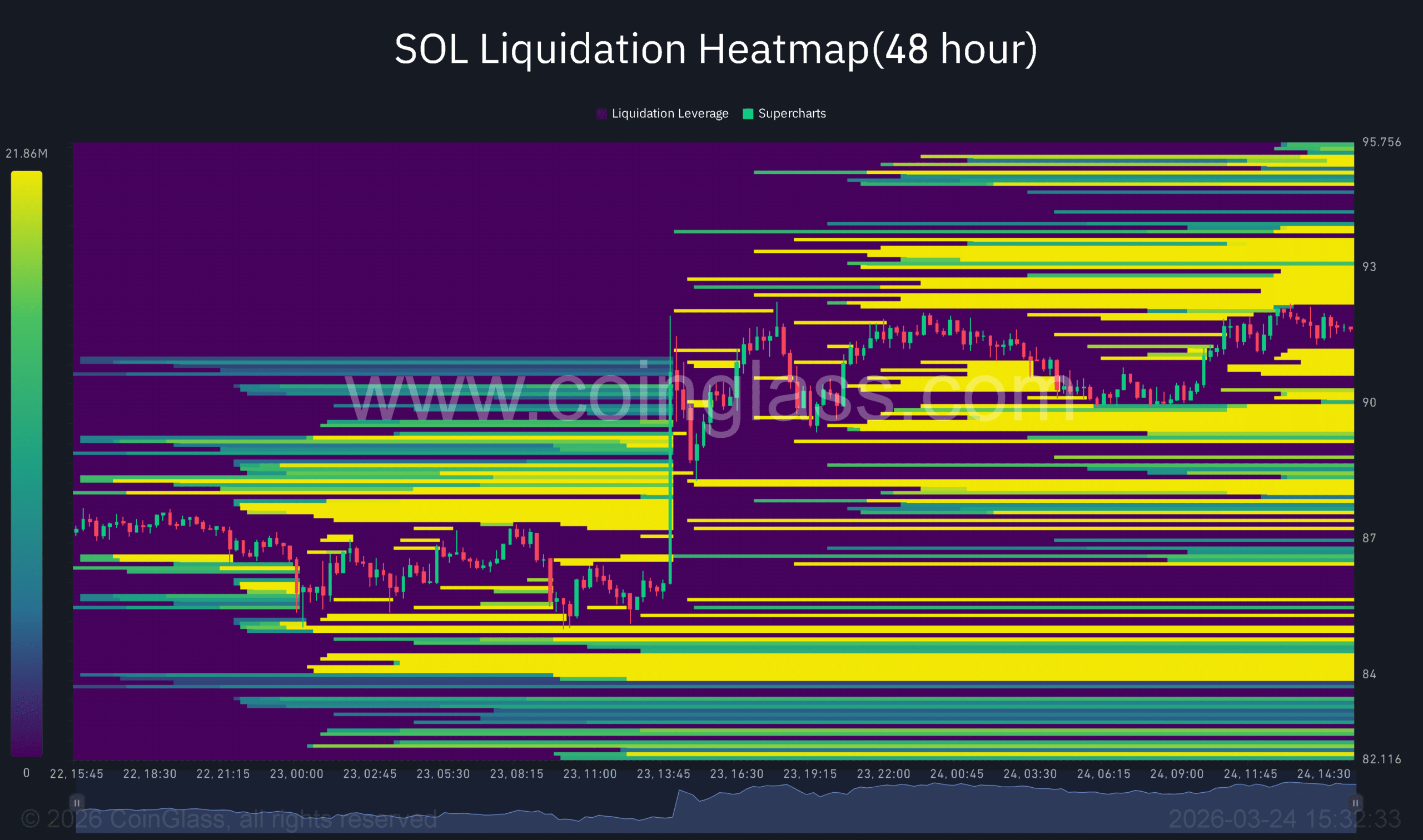
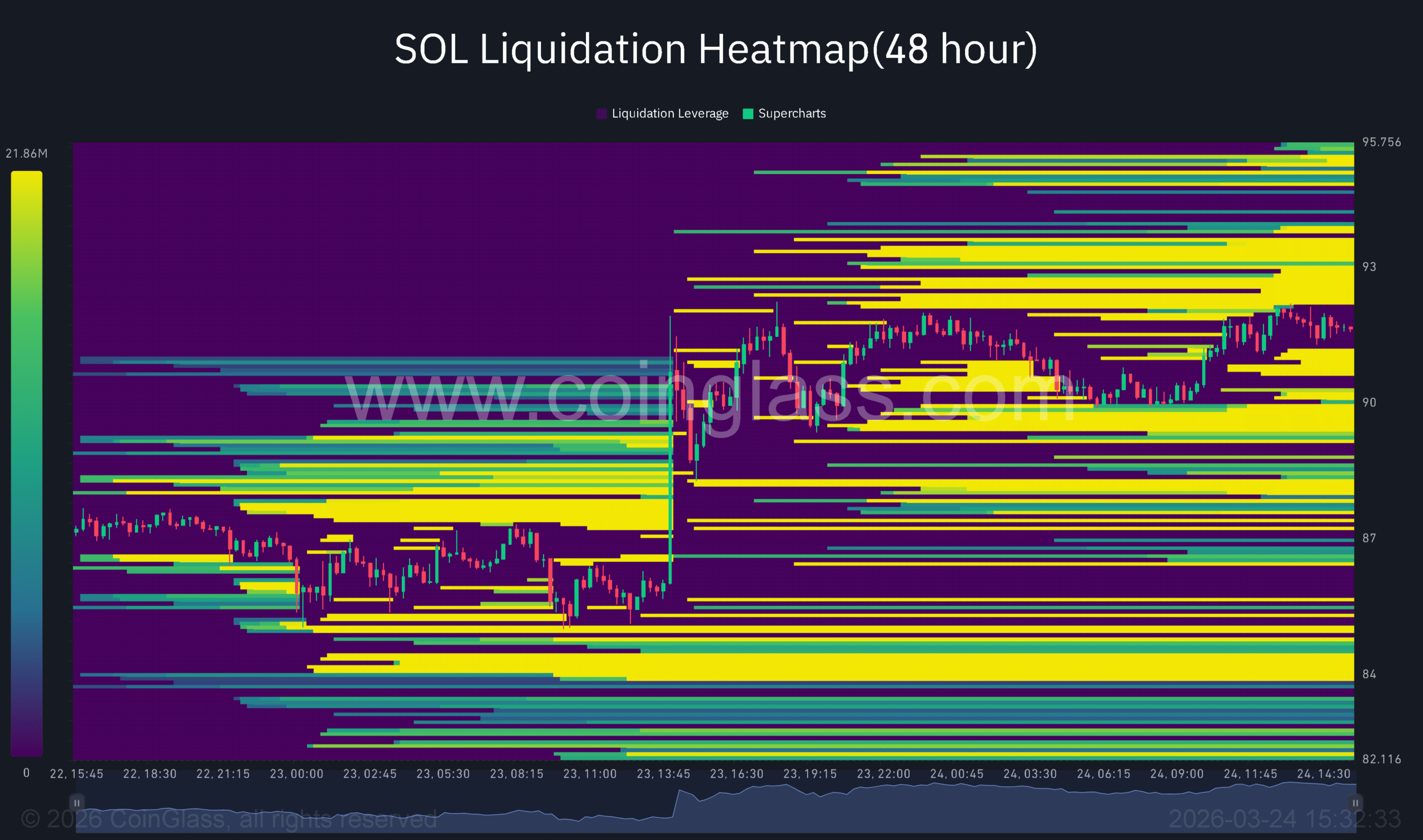
Solana cleared long liquidity, then started leaning toward shorts. On the 24-hour and 48-hour liquidation heatmaps, heavy topside liquidity sat between $94 and $96. If the price kept rising, shorts could have been forced out fast.

Source: CoinGlass

That was the attraction. Short squeezes turned violent because trapped traders became fuel. As a result, SOL did not need hype. It only needed strength to keep pushing and punish the late bears.

Can Solana reclaim $117 and keep rising?

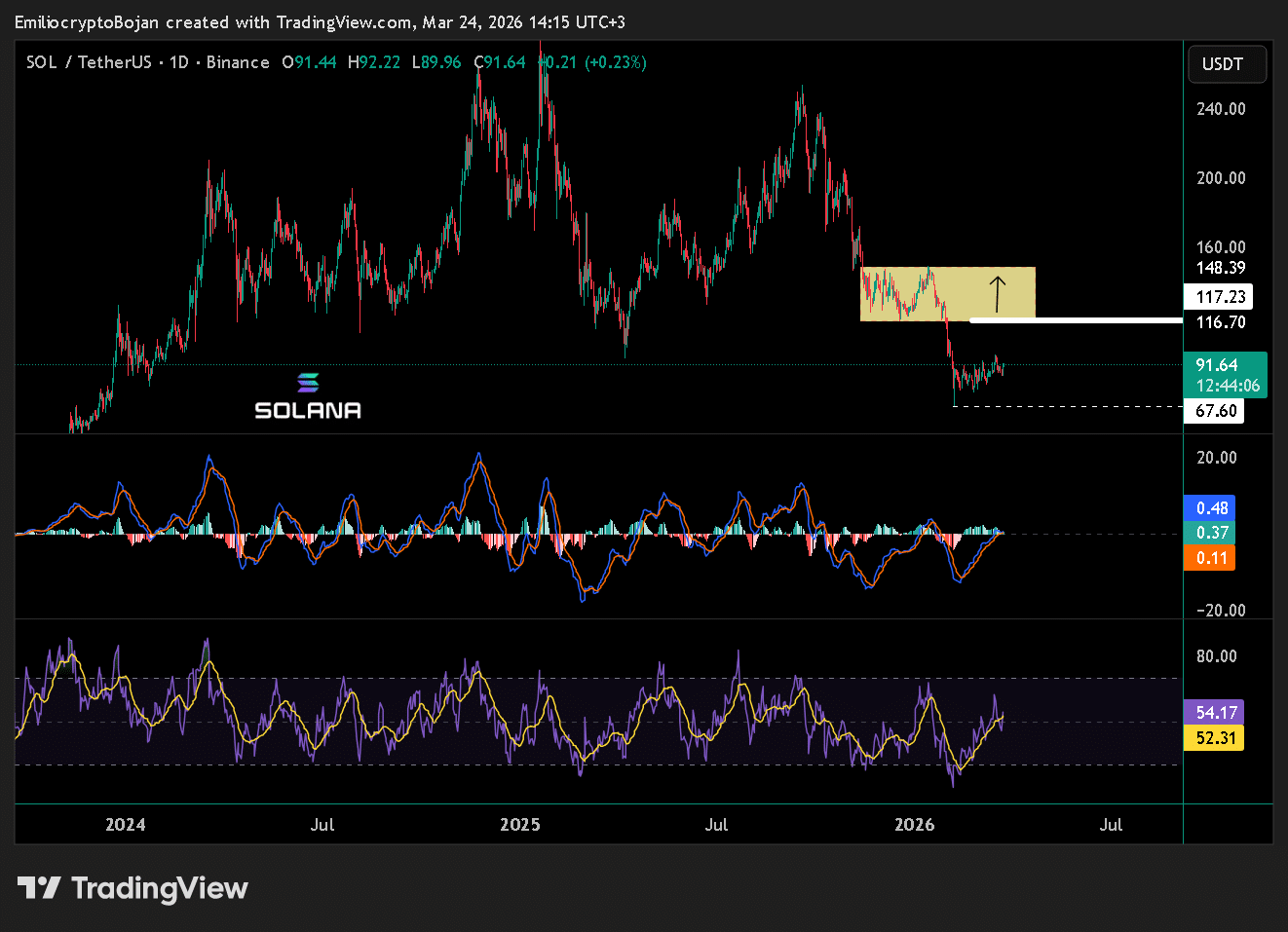
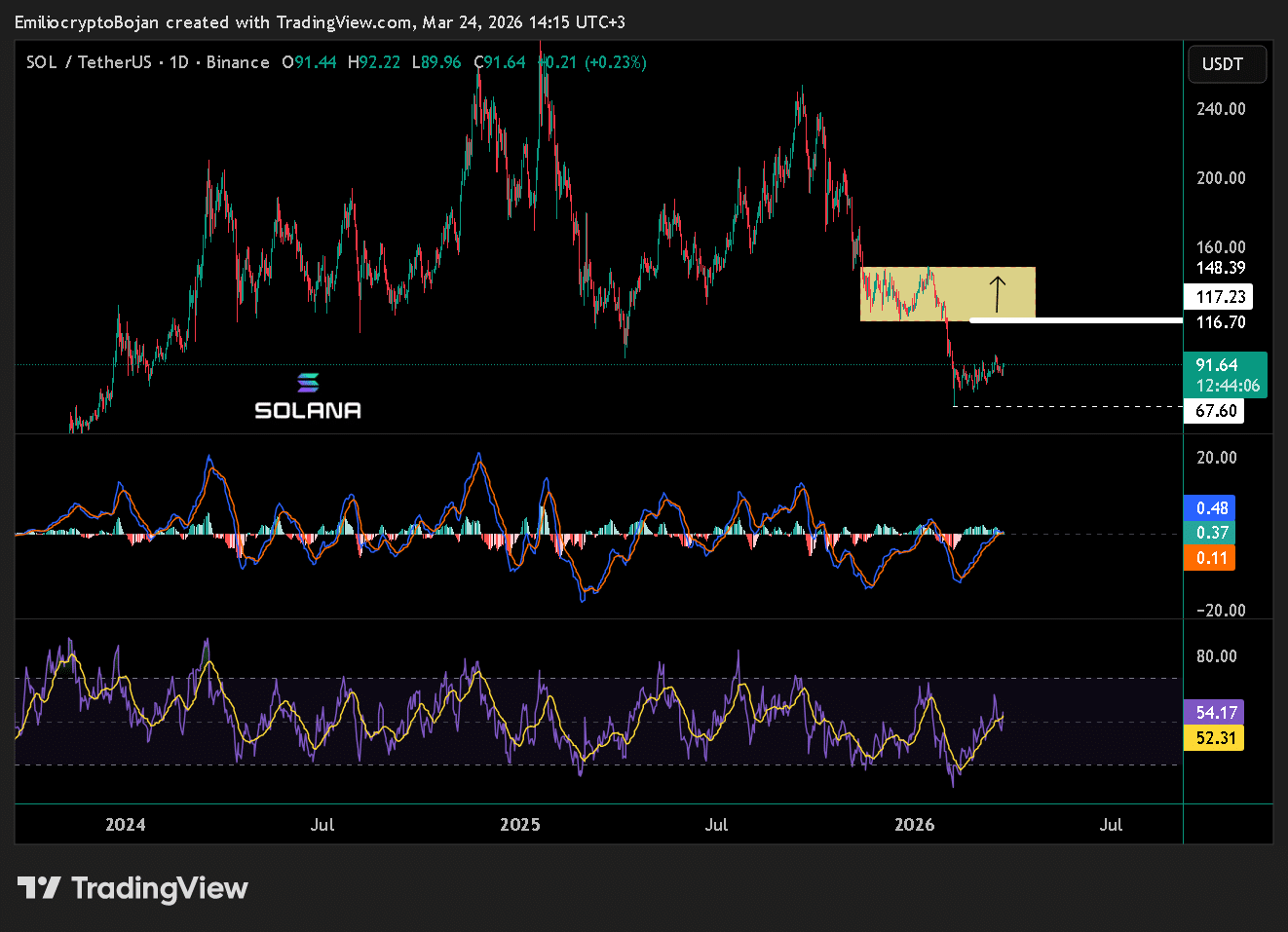
At the time of writing, Solana [SOL] traded near $91.64 inside a rising structure. The chart pointed toward the broader $117-$145 range, but $117 stayed the reclaim. Clear that level, and Solana would have looked stronger than during the sideways mess.

Source: TradingView

However, failure to reclaim even $100 will signal weakness. Therefore, the bulls still have work to do. If momentum fades, the door back toward $67.60 will open again. That threat stays alive.

Are bulls leaving, and is it a warning sign?

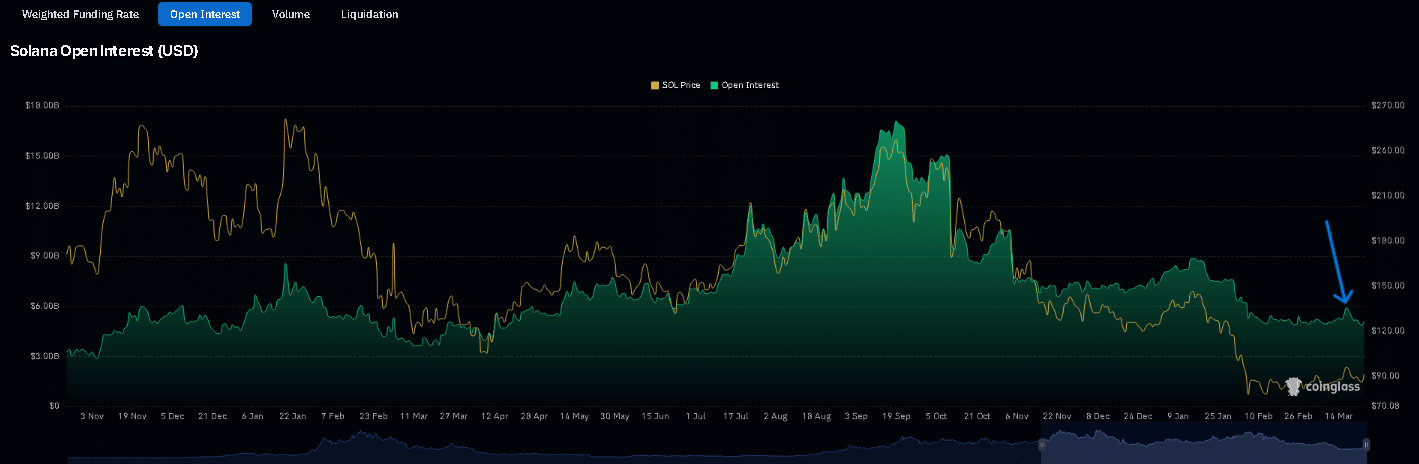
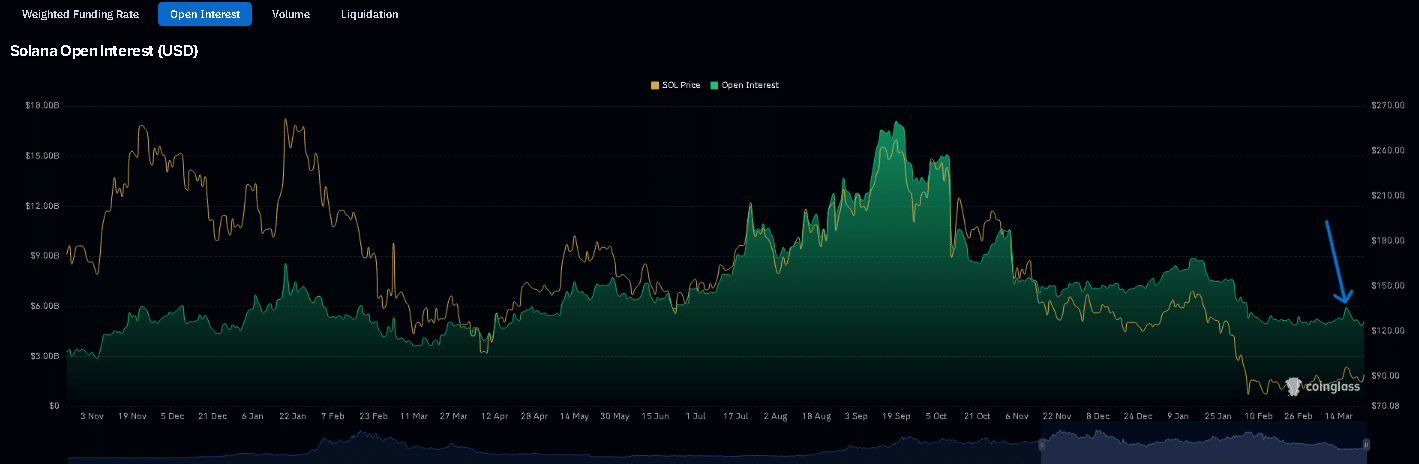
Open Interest made the setup shakier. Why? Ceasefire hopes in the U.S.-Israel conflict with Iran briefly lifted sentiment, pushing OI to $5.92B. However, that strength faded fast, with OI dropping to $4.85B before recovering near $5.1B.

Source: CoinGlass

That drop did not mean the bulls were gone. However, it did show that conviction was shaky. Looking ahead, stronger OI would have helped confirm continuation. Failure to do which, this rebound would have remained vulnerable to another rejection.


Final Summary

  • Solana’s rebound looked cleaner, but $117 still stood there like a wall.
  • Falling OI kept the setup fragile, because weak conviction could still ruin the move.

Связанные с этим вопросы

QWhat is the key resistance level that Solana needs to reclaim to signal stronger bullish momentum?

ASolana needs to reclaim the $117 level to signal stronger bullish momentum and look stronger than during the previous period of sideways movement.

QWhy does the article suggest that Solana's bullish setup remains fragile despite the recent price increase?

AThe setup remains fragile due to falling Open Interest (OI), which indicates shaky conviction among traders and makes the rebound vulnerable to another rejection.

QWhat was the significance of the liquidity between $94 and $96 on the liquidation heatmaps?

AHeavy topside liquidity between $94 and $96 meant that if the price continued rising, it could trigger a short squeeze, forcing out short traders and providing fuel for a violent price move upward.

QWhat price level could Solana potentially fall back to if the current bullish momentum fades?

AIf the bullish momentum fades, Solana could fall back toward the $67.60 level, reopening the door to further downside.

QHow did geopolitical events involving the U.S., Israel, and Iran impact market sentiment and Solana's Open Interest?

AGrowing ceasefire hopes in the U.S.-Israel-Iran conflict briefly lifted market sentiment, pushing Solana's Open Interest to $5.92B. However, this strength faded quickly, and OI dropped to $4.85B before a partial recovery, showing unstable conviction.

Похожее

Agents Take Over Traffic Distribution Power: What Are Tencent, ByteDance, and Alibaba Competing For?

In the race to dominate the AI era's entry point, China's tech giants—Tencent, ByteDance, and Alibaba—are aggressively deploying AI Agents to control the future of traffic distribution. Alibaba is pursuing a dual-track "closed loop + openness" strategy. Its Qianwen app is evolving into a super-Agent integrated across its ecosystem (Taobao, Alipay, etc.) to handle complex tasks like travel planning. Concurrently, it is opening its platform to external brands (Luckin Coffee, KFC) and has launched a B2B Agent platform, "Wukong," targeting enterprise automation. Its other flagship, Quark, aims to be an "AI super search box" for information and tasks. ByteDance is executing an omnipresent "sprawl strategy." Its Doubao app boasts over 300 million monthly active users and is evolving into a default AI entry point for daily life, with plans for paid versions and e-commerce integration. Its core weapon is the Kouzi platform, a visual "AI assembly factory" for developers to build custom Agents. ByteDance is also pushing hardware integration, collaborating on AI phones and developing smart glasses to embed Doubao everywhere. Tencent is playing its long-held "ultimate card" by quietly embedding an AI Agent directly into WeChat. This Agent, accessible via a swipe, can understand user commands and automatically execute tasks by calling upon WeChat's millions of mini-programs (e.g., finding and ordering coffee). This leverages WeChat's unparalleled 1.4-billion-user ecosystem to position the app as an AI-powered "service operating system," a move that could dramatically reshape the competitive landscape. The core battleground is shifting from competing for "user screen time" to competing to be the "default execution layer" for user intent. The business model is evolving from an "attention economy" to an "intent economy," where the Agent that can most efficiently fulfill a user's need gains control over service access and token flow. This represents a fundamental change in how users connect with digital services, making the fight for the Agent入口 (entry point) a pivotal moment for redefining industry leadership in the AI age.

marsbit31 мин. назад

Agents Take Over Traffic Distribution Power: What Are Tencent, ByteDance, and Alibaba Competing For?

marsbit31 мин. назад

From Banning Doubao to Embracing Honor: Why Did WeChat Suddenly 'Change Its Face'?

The article explores the sudden shift in WeChat's strategy towards AI assistants from mobile phone manufacturers, transitioning from strict opposition to active collaboration. For over a year, WeChat fiercely resisted attempts by phone AI assistants (like ByteDance's Doubao in late 2025) to control its features via GUI automation ("simulated clicking"), citing security and data control concerns. This stance created a significant barrier for system-level AI integration. Now, Tencent has initiated A2A (Agent-to-Agent) partnerships with major phone brands like Honor, Xiaomi, OPPO, and vivo. This model allows a phone's system AI (e.g., Honor's YOYO) to parse a user's voice command and send a structured request directly to WeChat's own internal AI agent via secure APIs. WeChat then executes the action (e.g., sending a message) and returns the result. The article attributes Tencent's "change of face" to strategic pressure. While leading in social app usage, Tencent trails rivals like ByteDance and Alibaba in standalone AI app popularity. WeChat, with its vast mini-program ecosystem, is Tencent's key asset for an AI comeback. The upcoming WeChat AI agent aims to handle tasks like booking and payments within the app. However, phone system assistants remain the primary AI entry point for most users. The A2A collaboration allows Tencent to extend WeChat's AI reach to this crucial system layer while maintaining control over its core functions and data. For phone manufacturers, embracing A2A is a pragmatic move. The GUI route proved unviable due to WeChat's blocks. A2A offers a compliant path to integrate a vital service, enhancing their AI assistants' usefulness. It allows them to focus on developing their own AI ecosystems for other services while cooperating on WeChat access. The collaboration is framed as a mutual, strategic necessity: Tencent gains a distribution channel, and manufacturers gain a key functionality. The partnership relies on a "dual authorization" mechanism for security, requiring both user and app consent for each action. While questions about long-term data privacy practices remain, experts note A2A is more secure and compliant than GUI automation. Ultimately, this cooperation is seen as a tentative, calculated truce. Tencent's long-term goal is to make WeChat an AI-powered "service OS." Phone manufacturers aim to make their system AI the central user interface. Their paths may converge or clash in the future, but for now, the A2A deal represents the opening chapter in the battle for the AI-era user入口, driven by necessity and strategic calculus on both sides.

marsbit2 ч. назад

From Banning Doubao to Embracing Honor: Why Did WeChat Suddenly 'Change Its Face'?

marsbit2 ч. назад

Торговля

Спот
Фьючерсы

Популярные статьи

Обсуждения

Добро пожаловать в Сообщество HTX. Здесь вы сможете быть в курсе последних новостей о развитии платформы и получить доступ к профессиональной аналитической информации о рынке. Мнения пользователей о цене на SOL (SOL) представлены ниже.

活动图片