Solana ETF Defies Market Trend with Sustained Inflows: 7 Consecutive Days of Capital Inflow Highlight Institutional Long-Term Confidence

marsbitОпубликовано 2025-12-14Обновлено 2025-12-14

Введение

Despite Solana (SOL) facing significant price pressure—down nearly 55% from its January peak—its spot ETF has demonstrated strong capital attraction, with seven consecutive days of net inflows totalling nearly $700 million, according to Farside Investors. The Bitwise BSOL ETF, which stakes 100% of assets for 5-7% annual yield, dominates with over 90% of inflows, offering dual exposure to price and staking returns. This contrasts with Grayscale’s lower staking ratio and higher fees. The divergence between sustained institutional inflows and SOL’s price decline reflects macro pressure, profit-taking, and large sell-offs. However, on-chain data shows accumulation by long-term holders. A key innovation is the compliant integration of staking rewards into traditional finance, allowing passive yield without direct token ownership—a regulatory shift that benefits PoS assets. While institutional views diverge, with some citing meme-driven speculation risks, developments like Western Union’s stablecoin issuance on Solana may strengthen its utility. Continued network growth and enterprise adoption could align ETF inflows with price performance over time.

Despite continued pressure on the price of Solana (SOL) tokens, its spot ETF has demonstrated strong capital attraction capabilities. According to data from Farside Investors, the Solana ETF has achieved net capital inflows for 7 consecutive days, with cumulative net inflows approaching $700 million. The highest single-day inflow occurred on December 12, reaching $16.6 million. This phenomenon contrasts sharply with SOL's weak performance, which has fallen nearly 55% from its January all-time high, reflecting that institutional investors may be positioning themselves in the Solana ecosystem with a long-term perspective.

I. Inflow Structure: Bitwise as the Dominant Force, Staking Mechanism as Key Attraction
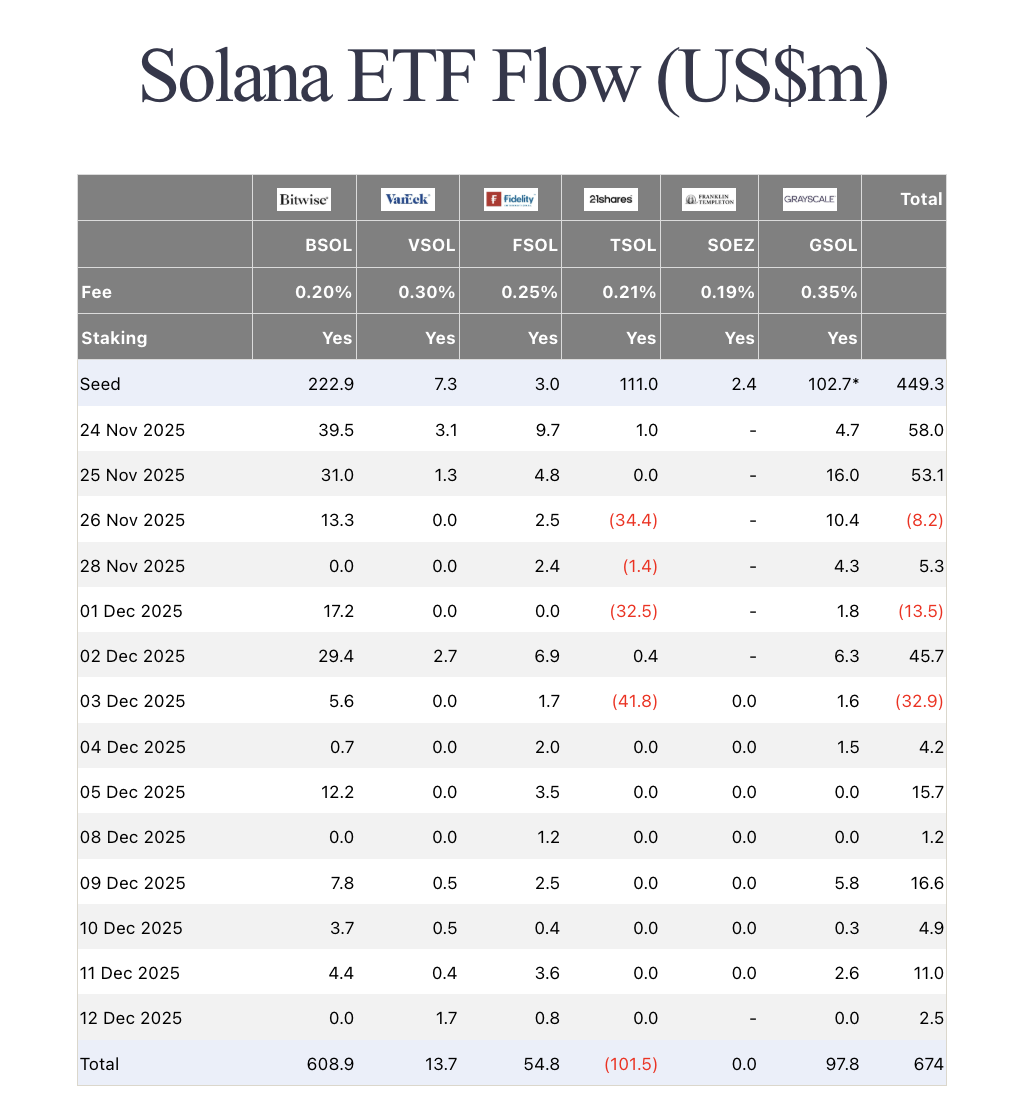
SOL ETF inflow situation. Source: Farside Investors

Solana ETF inflows are highly concentrated, with Bitwise's BSOL ETF being the primary contributor, accounting for over 90% of total inflows, and its assets under management have surpassed $6 billion. This advantage stems from its product design: BSOL utilizes 100% of its custodied assets for on-chain staking, offering an annualized yield of approximately 5%-7%, providing investors with dual returns from "price exposure + staking rewards." In contrast, Grayscale's GSOL stakes only 77% of its assets and has a higher management fee (0.35%), making it less attractive.

Furthermore, the entry of traditional asset management giants like Franklin Templeton has further enriched the product matrix. The staking rewards from these ETFs are directly compounded into the fund's net asset value rather than distributed as cash dividends, better aligning with long-term allocation needs.


II. Price and Flow Decoupling: Short-Term Selling Pressure vs. Long-Term Value Game
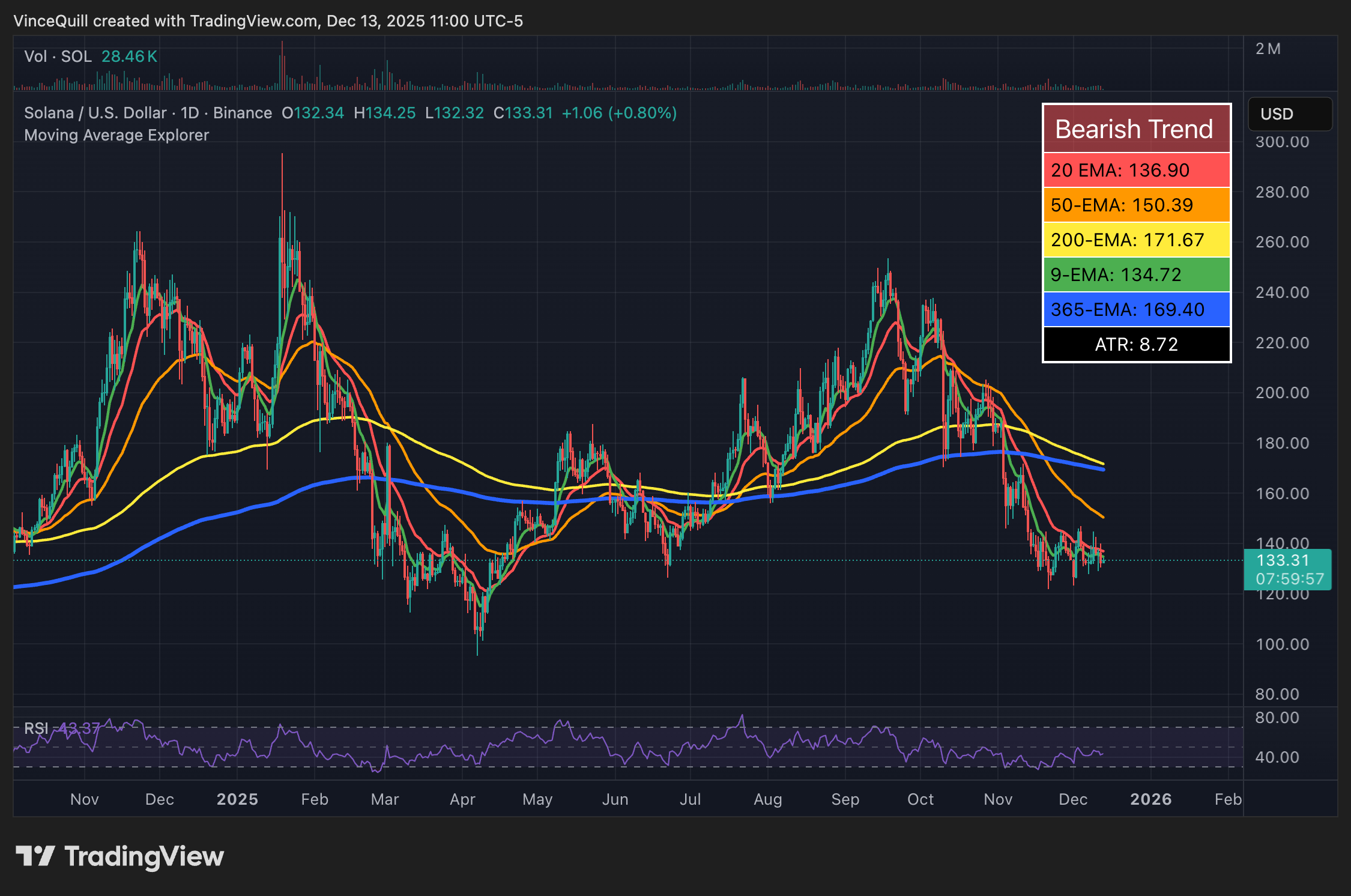
SOL price movement from November 2024 to December 2025. Source: TradingView

Despite continuous ETF inflows, the SOL price remains down roughly 47% from its September local high and has been trading below its 365-day moving average for an extended period. This decoupling is primarily due to three factors:

  1. Macro Market Pressure: Bitcoin and Ethereum ETFs experienced large-scale net outflows during the same period ($3.48 billion and $1.42 billion respectively), dragging down overall crypto market sentiment.
  2. Profit-Taking by Speculators: A concentrated outbreak of "buy the rumor, sell the news" behavior after ETF approval, with some early investors choosing to realize profits.
  3. Whale Selling Impact: For instance, Jump Crypto once sold 1.1 million SOL (approx. $205 million) in a single transaction in late October, creating significant selling pressure in the short term.


However, on-chain data shows that some institutional investors are quietly accumulating during the decline. For example, a mysterious whale cumulatively transferred 1.57 million SOL (approx. $329 million) from platforms like Coinbase to private wallets, hinting at long-term bullish confidence.

III. The Innovative Significance of ETFs: From Price Exposure to Yield Financialization

The core breakthrough of the Solana ETF lies in the compliance of its staking rewards.

By embedding an on-chain staking mechanism into traditional financial products, investors can participate in network governance and earn rewards without directly holding the tokens. This model, referred to as "yield-bearing assets" by Bitwise CIO Matt Hougan, is particularly attractive to traditional financial institutions in a low-interest-rate environment.

Furthermore, the SEC's tacit approval of the staking clauses signals a shift in regulatory attitude. Previously, Ethereum ETFs were forced to remove related clauses due to staking concerns, while the successful listing of Solana ETFs has paved a compliant path for more PoS assets.


IV. Future Outlook: Institutional Divergence and the Battle of Ecosystem Fundamentals

Despite strong inflows, institutional attitudes towards Solana are diverging:

  • Bullish Camp: Grayscale's Head of Research, Zach Pandl, predicts that Solana ETFs could absorb 5% of the total supply (approx. $5 billion).
  • Cautious Camp: Institutions like BlackRock believe the Solana ecosystem is overly reliant on Meme coin trading, posing speculative risks.


Ecosystem fundamentals remain key to long-term value. Western Union's announcement of issuing a stablecoin on Solana, along with improvements in network throughput and developer activity, is gradually strengthening its positioning as "financial infrastructure." If Solana can continue to optimize network stability and expand enterprise-level use cases, the long-term effects of ETF inflows are expected to gradually materialize in the price.



Связанные с этим вопросы

QWhat is the continuous trend of Solana ETF's fund inflows according to Farside Investors data?

ASolana ETF has achieved net capital inflows for 7 consecutive days, with cumulative net inflows approaching $700 million.

QWhich ETF product is the main contributor to Solana ETF inflows and what is its key feature?

ABitwise's BSOL ETF is the main contributor, accounting for over 90% of the total inflows. Its key feature is that it stakes 100% of its custodial assets on-chain, providing an annualized yield of approximately 5%-7%.

QWhat are the three main reasons for the decoupling between SOL's price decline and the ETF's continuous capital inflows?

AThe three main reasons are: 1. Macro market pressure, with Bitcoin and Ethereum ETFs experiencing large net outflows; 2. Profit-taking by speculative traders after the ETF approval; 3. Selling pressure from large holders, such as Jump Crypto's sale of 1.1 million SOL.

QWhat is the core innovation of the Solana ETF highlighted in the article?

AThe core innovation is the合规化 (compliant integration) of staking rewards, allowing investors to gain exposure to price and earn yield without directly holding the token, a model referred to as 'yield-bearing assets'.

QHow do institutional views on Solana's future differ according to the article?

AViews are divided. The bullish camp, like Grayscale's research head, predicts the ETF could attract 5% of the total supply. The cautious camp, including BlackRock, believes the ecosystem relies too heavily on meme coin trading and carries speculative risks.

Похожее

The King of Blind Date Attire in Korea: How SK Hynix Made a Comeback Against Samsung?

In South Korea's dating scene, SK Hynix employees are now highly sought after, a status shift fueled by the company's astronomical profits and employee bonuses, projected to reach up to 6.1 million RMB per person by 2027. This marks a dramatic reversal for the long-time second-place player in memory semiconductors, which has now surpassed its rival Samsung in annual operating profit. The turnaround story began in 2008 when a struggling Hynix, emerging from bankruptcy restructuring, took a risky bet by agreeing to develop High Bandwidth Memory (HBM) with AMD. At the time, HBM had no clear market beyond high-end graphics cards and was a costly, complex technology. Major players like Samsung, pursuing its own HMC technology, declined. For Hynix, with only memory as its core business, it was a gamble born of necessity. The pivotal moment came in 2012 when SK Group Chairman Chey Tae-won acquired Hynix. Defying industry downturns, he invested heavily in R&D and fabrication, sustaining the HBM project through over a decade of commercial uncertainty and internal challenges. A key break occurred around 2016-2017 when Samsung faced production issues supplying HBM2 for Google's TPU, allowing SK Hynix to gain a crucial foothold in the data center market. The AI explosion post-ChatGPT in 2022 was the catalyst, turning HBM into a critical bottleneck for AI accelerators like NVIDIA's GPUs. By 2025, SK Hynix captured 62% of the global HBM market, leaving Samsung at 17%. For the first time, its annual operating profit exceeded Samsung's. Analysts point to the "innovator's dilemma" to explain Samsung's miss: its vast, successful business portfolio made it risk-averse, preventing an all-in bet on the initially niche HBM technology. In contrast, SK Hynix, as a challenger with its back against the wall, had no choice but to commit fully. The story highlights how Korea's chaebol system allows for ultra-long-term bets beyond quarterly pressures. However, SK Hynix's lead isn't guaranteed. Samsung is aggressively catching up on HBM4, and challenges like customer concentration (heavy reliance on NVIDIA) and technical hurdles in advanced packaging remain. The narrative underscores a market truth: the greatest alpha often comes from betting on uncertain, long-term directions others dismiss, much like HBM in 2008.

marsbit12 мин. назад

The King of Blind Date Attire in Korea: How SK Hynix Made a Comeback Against Samsung?

marsbit12 мин. назад

Understanding Hash in One Article: The "Browser Miner" on Ethereum

Hash is an Ethereum-based ERC-20 token described as a "browser-minable post-quantum token." Its key features include enabling browser-based GPU mining without specialized hardware, a fixed supply cap of 21 million tokens, immutable and permissionless smart contracts with no team allocation or pre-mining, and an emphasis on post-quantum security using Keccak256 hashing. The mining mechanism is a simplified on-chain proof-of-work where miners solve unique challenges tied to their wallet address. Key design elements prevent answer theft, with epochs resetting every 100 blocks (~20 minutes) and a per-block minting limit. Emission follows a Bitcoin-like halving schedule every 100,000 mints, starting at 100 tokens per mint. Projections suggest all tokens could be mined within approximately 294 days if a target rate of one mint per minute is sustained. Hash emphasizes "post-quantum" security by leveraging hash-based primitives like Keccak256, which are considered more resistant to quantum attacks compared to elliptic-curve cryptography. While not a fully post-quantum asset, it aligns with Ethereum's broader post-quantum research narrative. The project completed its Genesis sale at $0.03 and began trading on Uniswap, with its price reaching around $0.19. The initial circulating supply is small, with 5% sold in Genesis and 5% allocated to liquidity. The majority (47.6% of total supply) is allocated to early-stage mining, leading to a front-loaded emission schedule. This structure, combined with low initial liquidity, makes Hash a high-volatility, high-risk project dependent on sustained miner participation and market demand to absorb new supply.

marsbit26 мин. назад

Understanding Hash in One Article: The "Browser Miner" on Ethereum

marsbit26 мин. назад

OpenAI's Largest Internal Wealth Creation: 600 People Cash Out a Total of $6.6 Billion, 75 Take Home the Maximum $30 Million Each

A Wall Street Journal report reveals OpenAI's unprecedented pre-IPO wealth creation. In a single employee stock sale last October, over 600 current and former employees sold shares, collectively cashing out approximately $6.6 billion. Due to high investor demand, the company tripled the individual sale cap to $30 million, with about 75 employees selling the maximum amount. This event represents the largest such transaction in tech industry history for a private company. OpenAI's valuation was $500 billion for this tender offer. Employees with over two years of tenure were eligible, allowing many post-ChatGPT hires their first liquidity event. The company's stock has reportedly grown over 100-fold in seven years. Following a restructuring, employees collectively hold about 26% of OpenAI. The scale of executive wealth is also staggering. In court testimony related to Elon Musk's lawsuit, President and co-founder Greg Brockman confirmed his OpenAI stake is worth around $30 billion. Analysis indicates about 165 current and former employees hold a combined ~$164.9 billion in equity, averaging nearly $1 billion per person in paper wealth. OpenAI's per-employee stock-based compensation is estimated to be 34 times the average of major tech firms before their IPOs. OpenAI continues its rapid ascent, closing a $122 billion funding round at an $852 billion valuation in March. With monthly revenue hitting $2 billion, over 900 million weekly ChatGPT users, and plans for a potential trillion-dollar IPO in late 2026, this wealth-creation engine shows no signs of stopping.

链捕手48 мин. назад

OpenAI's Largest Internal Wealth Creation: 600 People Cash Out a Total of $6.6 Billion, 75 Take Home the Maximum $30 Million Each

链捕手48 мин. назад

Торговля

Спот
Фьючерсы

Популярные статьи

Обсуждения

Добро пожаловать в Сообщество HTX. Здесь вы сможете быть в курсе последних новостей о развитии платформы и получить доступ к профессиональной аналитической информации о рынке. Мнения пользователей о цене на SOL (SOL) представлены ниже.

活动图片