Small-Cap Tokens Hit Four-Year Low, Is the 'Altcoin Bull Run' Completely Hopeless?

marsbitОпубликовано 2025-12-16Обновлено 2025-12-16

Введение

Small-cap cryptocurrency tokens have plummeted to multi-year lows, with indices tracking altcoins significantly underperforming both major cryptocurrencies and traditional equities. In 2024–2025, while the S&P 500 and Nasdaq 100 delivered strong double-digit returns with limited drawdowns, altcoin indices like the CoinDesk 80 and MarketVector Small-Cap Index fell sharply—by nearly 40% and to November 2020 lows, respectively. These altcoin indices showed high correlation (0.9) with large-cap crypto assets like Bitcoin and Ethereum but delivered deeply negative returns, higher volatility, and worse risk-adjusted performance (negative Sharpe ratios). Liquidity is increasingly concentrated in high-value, institutionally supported assets such as Bitcoin, Ethereum, SOL, and XRP, indicating a structural shift away from speculative small-cap tokens. The data suggests that altcoins offered no diversification benefits and instead magnified losses during a period of broader market growth.

Author: Gino Matos

Compiled by: Luffy, Foresight News

Since January 2024, the performance comparison between cryptocurrencies and stocks indicates that the so-called new "altcoin trading" is essentially just a substitute for stock trading.

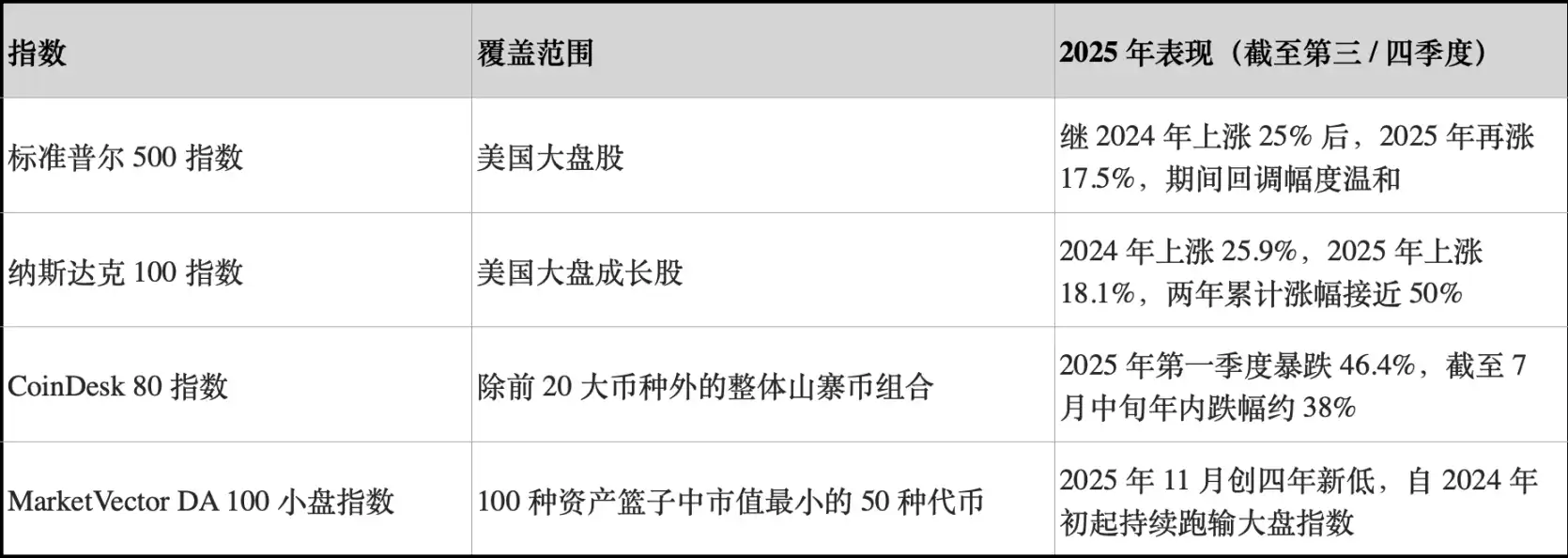
In 2024, the S&P 500 index had a return of approximately 25%, and in 2025 it reached 17.5%, with a cumulative two-year increase of about 47%. During the same period, the Nasdaq 100 index rose by 25.9% and 18.1% respectively, with a cumulative increase of nearly 49%.

The CoinDesk 80 Index, which tracks 80 assets outside the top 20 cryptocurrencies by market capitalization, plummeted 46.4% in the first quarter of 2025 alone, and by mid-July, its year-to-date decline was about 38%.

By the end of 2025, the MarketVector Digital Assets 100 Small-Cap Index fell to its lowest level since November 2020, wiping out over $1 trillion in total cryptocurrency market capitalization.

This divergence in performance is by no means a statistical error. Not only did the overall altcoin portfolio have a negative return, but its volatility was comparable to or even higher than that of stocks; in contrast, major U.S. stock indices achieved double-digit growth with controllable drawdowns.

For Bitcoin investors, the core question is: Can allocating to small-cap tokens deliver risk-adjusted returns? Or is such an allocation merely taking on exposure to a negative Sharpe ratio while maintaining similar correlations to stocks? (Note: The Sharpe ratio is a core metric for measuring the risk-adjusted return of an investment portfolio. Its calculation formula is: Annualized portfolio return - Annualized risk-free rate / Annualized volatility of the portfolio.)

Choosing a Reliable Altcoin Index

For analysis, CryptoSlate tracked three altcoin indices.

The first is the CoinDesk 80 Index, launched in January 2025. This index covers 80 assets outside the CoinDesk 20 Index, providing a portfolio of diversified assets beyond Bitcoin, Ethereum, and other major tokens.

The second is the MarketVector Digital Assets 100 Small-Cap Index. This index selects the 50 smallest tokens by market cap from a basket of 100 assets, serving as a barometer for the market's "junk assets."

The third is a small-cap index launched by Kaiko. This is a research product, not a tradable benchmark, offering a clear sell-side quantitative perspective for analyzing the small-cap asset group.

These three depict the market landscape from different dimensions: the overall altcoin portfolio, high-beta small-cap tokens, and a quantitative research perspective. Yet, the conclusions they point to are highly consistent.

In contrast, the benchmark performance of the stock market shows a completely opposite trend.

In 2024, major U.S. indices achieved gains of around 25%, and in 2025, they also saw double-digit increases, with relatively limited drawdowns during the period. During this time, the maximum intra-year drawdown of the S&P 500 index was only in the mid-to-high single digits, while the Nasdaq 100 index maintained a strong upward trend throughout.

Both major indices achieved compounded annual growth without significant givebacks of gains.

The trend of the overall altcoin indices, however, is vastly different. Reports from CoinDesk Indices show that the CoinDesk 80 Index plummeted 46.4% in the first quarter alone, while the large-cap tracking CoinDesk 20 Index fell 23.2% during the same period.

By mid-July 2025, the CoinDesk 80 Index was down 38% year-to-date, whereas the CoinDesk 5 Index, which tracks Bitcoin, Ethereum, and three other major tokens, achieved a gain of 12% to 13% during the same period.

Andrew Baehr of CoinDesk Indices, in an interview with ETF.com, described this phenomenon as "identical correlation, vastly different profit and loss performance."

The correlation between the CoinDesk 5 Index and the CoinDesk 80 Index is as high as 0.9, meaning their price movements are completely aligned in direction, but the former achieved a slight double-digit growth while the latter plunged nearly 40%.

It turns out that the diversification benefits of holding small-cap altcoins are minimal, while the performance cost is extremely heavy.

The performance of the small-cap asset sector is even worse. According to Bloomberg, by November 2025, the MarketVector Digital Assets 100 Small-Cap Index had fallen to its lowest level since November 2020.

Over the past five years, the return of this small-cap index has been approximately -8%, while the corresponding large-cap index has surged about 380%. Institutional funds clearly favor large-cap assets and avoid tail risks.

Looking at the performance of altcoins in 2024, the Kaiko small-cap index fell over 30% for the year, and mid-cap tokens also struggled to keep up with Bitcoin's gains.

Market winners were highly concentrated in a few top tokens, such as SOL and Ripple. Although the share of altcoin trading volume once rebounded to the 2021 high in 2024, 64% of the trading volume was concentrated in the top ten altcoins.

Liquidity in the cryptocurrency market has not disappeared but has shifted towards higher-value assets.

Sharpe Ratio and Drawdown Magnitude

If compared from the perspective of risk-adjusted returns, the gap widens further. The CoinDesk 80 Index and various small-cap altcoin indices not only have returns deep in negative territory but also have volatility comparable to or even higher than stocks.

The CoinDesk 80 Index plummeted 46.4% in a single quarter; the MarketVector small-cap index fell to pandemic-era lows in November after another round of declines.

The overall altcoin index experienced multiple index-level halving drawdowns: the Kaiko small-cap index fell over 30% in 2024, the CoinDesk 80 Index crashed 46% in Q1 2025, and the small-cap index fell again to 2020 lows by the end of 2025.

In contrast, the S&P 500 and Nasdaq 100 indices achieved cumulative returns of 25% and 17% over two years, with maximum drawdowns only in the mid-to-high single digits. The U.S. stock market had fluctuations, but they were overall controllable; the volatility of cryptocurrency indices, however, was highly destructive.

Even if the high volatility of altcoins is considered a structural feature, their unit risk return from 2024 to 2025 was still far lower than that of holding major U.S. stock indices.

From 2024 to 2025, the overall altcoin index had a negative Sharpe ratio; meanwhile, the S&P and Nasdaq indices had strong Sharpe ratios even without volatility adjustment. After volatility adjustment, the gap between them further widened.
Bitcoin Investors and Cryptocurrency Liquidity

The first insight from the above data is the trend of liquidity concentration and migration towards high-value assets. Reports from Bloomberg and Whalebook on the MarketVector small-cap index both pointed out that since early 2024, small-cap altcoins have consistently underperformed, and institutional funds have instead flowed into Bitcoin and Ethereum ETFs.

Combined with Kaiko's observations, although the share of altcoin trading volume rebounded to 2021 levels, funds were concentrated in the top ten altcoins. The market trend is already clear: liquidity has not completely left the cryptocurrency market but has shifted towards higher-value assets.

The previous altcoin bull market was essentially just a basis trade strategy, not a structural outperformance of assets. In December 2024, the CryptoRank Altcoin Bull Index once soared to 88 points, then plummeted to 16 points in April 2025, completely giving back all gains.

The 2024 altcoin bull market ultimately turned into a typical bubble burst; by mid-2025, the overall altcoin portfolio had almost given back all its gains, while the S&P and Nasdaq indices continued to compound growth.

For wealth advisors and asset allocators considering diversification beyond Bitcoin and Ethereum, the data from CoinDesk provides a clear case reference.

As of mid-July 2025, the large-cap tracking CoinDesk 5 Index achieved a slight double-digit growth year-to-date, while the diversified altcoin index CoinDesk 80 plummeted nearly 40%, yet their correlation was as high as 0.9.

Investors allocating to small-cap altcoins did not obtain substantial diversification benefits but instead suffered far higher return losses and drawdown risks compared to Bitcoin, Ethereum, and U.S. stocks, while still being exposed to the same macro drivers.

Current capital views most altcoins as tactical trading targets, not strategic allocation assets. From 2024 to 2025, Bitcoin and Ethereum spot ETFs had significantly better risk-adjusted returns, and U.S. stocks also performed brilliantly.

Liquidity in the altcoin market is increasingly concentrating towards a few "institutional-grade coins," such as SOL, Ripple, and other tokens with independent positive factors or clear regulatory prospects. Asset diversity at the index level is being squeezed by the market.
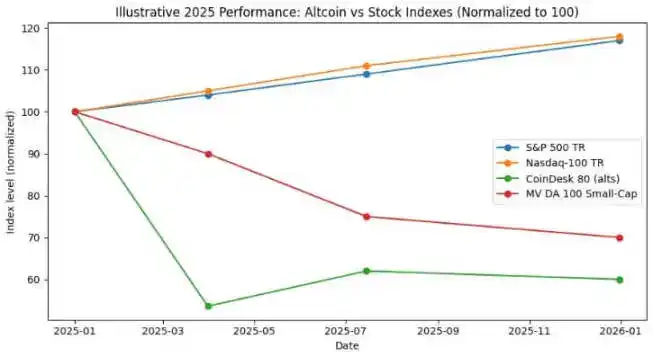
In 2025, the S&P 500 and Nasdaq 100 indices rose about 17%, while the CoinDesk 80 cryptocurrency index fell 40%, and small-cap cryptocurrencies fell 30%

What Does This Mean for Liquidity in the Next Market Cycle?

The market performance from 2024 to 2025 tested whether altcoins could achieve diversification value or outperform in an environment of rising macro risk appetite. During this period, U.S. stocks achieved double-digit growth for two consecutive years with controllable drawdowns.

Bitcoin and Ethereum gained institutional recognition through spot ETFs and benefited from a moderating regulatory environment.

In contrast, the overall altcoin index not only had negative returns and larger drawdowns but also maintained high correlations with major crypto tokens and stocks, yet failed to provide corresponding compensation for the additional risks investors undertook.

Institutional capital always chases performance. The five-year return of the MarketVector small-cap index is -8%, while the corresponding large-cap index surged 380%. This gap reflects the migration of capital towards assets with clear regulation, sufficient derivatives market liquidity, and well-developed custody infrastructure.

The CoinDesk 80 Index's 46% plunge in the first quarter and its 38% year-to-date decline by mid-July indicate that the trend of capital migration towards high-value assets is not reversing but accelerating.

For Bitcoin and Ethereum investors evaluating whether to allocate to small-cap crypto tokens, the data from 2024 to 2025 provides a clear answer: the absolute returns of the overall altcoin portfolio underperformed U.S. stocks, and the risk-adjusted returns were inferior to Bitcoin and Ethereum; despite a correlation as high as 0.9 with major crypto tokens, it provided no diversification value.


Связанные с этим вопросы

QWhat was the performance difference between the S&P 500 and the CoinDesk 80 Index in 2025?

AIn 2025, the S&P 500 index rose by approximately 17.5%, while the CoinDesk 80 Index plummeted by 40%.

QAccording to the article, what is the main reason for the poor performance of small-cap altcoins?

AThe main reason is that institutional capital is migrating towards high-value assets like Bitcoin and Ethereum ETFs, which are seen as having clearer regulatory prospects and better infrastructure, leaving small-cap altcoins with negative returns and high volatility.

QWhat was the correlation between the CoinDesk 5 Index and the CoinDesk 80 Index, and what does this imply?

AThe correlation between the CoinDesk 5 Index and the CoinDesk 80 Index was as high as 0.9. This implies that their price directions moved almost identically, yet the performance was drastically different, with the former achieving double-digit gains while the latter fell nearly 40%, offering no meaningful diversification benefit.

QTo what level did the MarketVector Digital Assets 100 Small-Cap Index fall by the end of 2025?

ABy the end of 2025, the MarketVector Digital Assets 100 Small-Cap Index fell to its lowest level since November 2020.

QWhat does the article conclude about allocating to small-cap tokens for Bitcoin investors?

AThe article concludes that allocating to small-cap tokens did not provide a risk-adjusted return benefit. Instead, it resulted in significantly worse returns and higher drawdown risks compared to holding Bitcoin, Ethereum, or U.S. stocks, while still being exposed to the same macroeconomic factors.

Похожее

Высвобождение ликвидности на $100 млн? Новая политика Pump.fun тестирует «5-минутную накачку»

21 июля платформа Pump.fun объявила о запуске режима BOOST, ставшего новой стандартной механикой запуска токенов. Его цель — решить проблему «мёртвой ликвидности». Когда токен переходит с bonding curve в ликвидный пул PumpSwap, около 20% средств навсегда блокируются в LP, становясь недоступными. По оценкам платформы, это приводит к ежегодным потерям ликвидности на сумму более $1 млрд. Механика BOOST меняет это: вместо блокировки, эти 20% средств (например, ~17.6 SOL для SOL-пар) используются в первые 5 минут после миграции токена для его скупки по методу TWAP (средневзвешенная цена по времени). Все выкупленные токены немедленно сжигаются. Это создаёт кратковременный искусственный покупательский спрос и одновременно сокращает предложение токена. Режим автоматически применяется для всех токенов, мигрирующих после 21 июля. Ранее выпущенные токены и токены, запущенные через Mayhem (AI Agent Lab), не участвуют. Цель BOOST — оживить торговлю в критические первые минуты после выпуска, чтобы удержать трейдеров и повысить общий объём торгов на платформе. Однако критики отмечают риски: после 5-минутного «фейерверка» токен может резко обрушиться при крупных продажах, а упрощённый старт может поощрить выпуск более низкокачественных мем-токенов.

marsbit9 мин. назад

Высвобождение ликвидности на $100 млн? Новая политика Pump.fun тестирует «5-минутную накачку»

marsbit9 мин. назад

Продажа блочного пространства умерла: публичные блокчейны должны найти новый способ существования

Статья "Продажа блок-пространства мертва: публичным блокчейнам нужно найти новый путь" утверждает, что традиционная бизнес-модель публичных блокчейнов, основанная на продаже пространства в блоках, больше не работает. Из 14 криптокомпаний, заработавших более $200 млн за два года, только Hyperliquid является блокчейном, чей месячный доход ($58 млн) в 100 раз превышает доход Arbitrum ($430 тыс.). Чтобы выжить, блокчейны должны превращаться в продуктовые студии, агрегаторы приложений или вертикальные SaaS-решения, отходя от роли нейтральной инфраструктуры. В статье также разбираются три ключевых события: 1. **Взлом Ostium**: Атака на LP-пулы протокола привела к потере более 40% TVL ($23,7 млн) из-за уязвимости в офф-чейн инфраструктуре, поставляющей цены. Это подчеркивает критическую важность контроля для протоколов, работающих с офф-чейн активами. 2. **Будущее опционов**: Чтобы достичь массового принятия, мощные возможности опционов должны быть абстрагированы от сложной терминологии и представлены через понятные продукты: структурированные продукты, vaultы для получения дохода, бинарные опционы и прогнозные рынки. 3. **На радаре**: Отмечаются тренды, такие как фиксированные займы (Yearn's Flex), смена стратегии Base после неудач с социальными токенами, запуск перпетуальных контрактов на индекс доллара (Plether) и фокус Starknet на приватности и защите от квантовых угроз.

marsbit29 мин. назад

Продажа блочного пространства умерла: публичные блокчейны должны найти новый способ существования

marsbit29 мин. назад

Заметки подкаста|Диалог с управляющим активами GSR: Чтобы определить, настоящий ли этот крипто-ралли, просто взгляните на процентные ставки по кредитам на Aave

Заметки из подкаста: интервью с управляющим директором по управлению активами GSR Энди Бэром. В центре обсуждения — текущий крипторынок и его перспективы. Бэр описывает рынок как находящийся в состоянии «нерешительности» (ambivalence), где краткосрочные отскоки быстро теряют импульс. Для оценки истинной силы восстановления он предлагает три ключевых сигнала: 1. **Процентные ставки в DeFi (особенно на Aave):** Текущие ставки по USDC (~3,75%) близки к безрисковой ставке (SOFR), что указывает на отсутствие ажиотажного спроса на кредитное плечо. Устойчивый рост начнется, когда ставки резко вырастут, отражая всплеск спроса на заемные средства. 2. **Формирование консенсуса о «пике жесткости» ФРС:** Рынкам необходим четкий сигнал о том, где закончится цикл повышения ставок при новом председателе Кевине Уорше. Пока этой ясности нет, трудно ожидать устойчивого бычьего тренда. 3. **Закон CLARITY:** Его принятие до 7 августа, которое сейчас оценивается Polymarket менее чем в 40%, стало бы для рынка позитивным сюрпризом и могло бы дать импульс для роста. Бэр также отмечает, что фонды ETF не являются долгосрочным капиталом, а корпоративные казначейства (DAT) пока неактивны в покупках. Вместе с сокращением предложения стейблкоинов это лишает рынок структурных покупателей. В итоге, для подтверждения подлинности роста следует следить не только за макростатистикой (например, CPI), но и за цепной активностью, прежде всего за ставками кредитования в DeFi.

marsbit40 мин. назад

Заметки подкаста|Диалог с управляющим активами GSR: Чтобы определить, настоящий ли этот крипто-ралли, просто взгляните на процентные ставки по кредитам на Aave

marsbit40 мин. назад

Отправляй сообщения и переводи монеты? Telegram этим летом «встроит» криптокошелек для 1 млрд пользователей

Создатель Telegram Павел Дуров объявил о запуске летом этого года собственного встроенного некастодиального криптокошелька Gram для более чем 1 млрд пользователей приложения. Кошелек позволит совершать мгновенные переводы без комиссий. В отличие от текущего сервиса @wallet, которым управляет сторонняя компания, новый кошелек будет родной функцией Telegram, где пользователи будут самостоятельно контролировать свои приватные ключи. После анонса цена токена GRAM (ранее Toncoin) выросла примерно на 8%, хотя все еще значительно ниже исторических максимумов. Это событие знаменует возвращение Дурова к проекту TON после урегулирования с SEC в 2020 году и является частью его дорожной карты «Make TON Great Again». Запуск происходит в период усиления конкуренции между суперприложениями в сфере платежей: X Money Илона Маска развивает фиатные переводы, а Meta изучает интеграцию стейблкоинов. Telegram делает ставку на криптонативное решение, используя свою огромную аудиторию и близость к криптосообществу. Однако остаются неясными ключевые детали, такие как техническая реализация «нулевых комиссий», поддержка активов помимо GRAM, а также конкретные сроки запуска, помимо обещания «летом».

marsbit1 ч. назад

Отправляй сообщения и переводи монеты? Telegram этим летом «встроит» криптокошелек для 1 млрд пользователей

marsbit1 ч. назад

Предложение Hyperliquid HIP-4 подпитывает стейкинг HYPE по мере роста долгосрочных перспектив

Протокол Hyperliquid (HYPE) представил предложение HIP-4, направленное на создание разрешенных рынков прогнозов и расширение функционала за пределы вечных фьючерсов до базового инфраструктурного уровня для ончейн-приложений. Для запуска новых рынков разработчикам необходимо застейкать 500 000 токенов HYPE. Меры по обеспечению качества рынков призваны трансформировать Hyperliquid из создателя продуктов в инфраструктуру для сторонних разработчиков. Уверенность в долгосрочных перспективах проекта растет, что подтверждается увеличением позитивного настроя вокруг HYPE и активным стейкингом. Крупный трейдер предпочел застейкать токены на сумму около $15,5 млн вместо фиксации прибыли. Общий объем застейканных токенов достиг почти 439 млн, что составляет около 43.9% от общего предложения, укрепляя безопасность сети и сокращая ликвидное предложение. Рыночная структура также демонстрирует силу: открытый интерес превысил $11 млрд при сбалансированных ставках финансирования и ограниченных ликвидациях, что указывает на взвешенный подход трейдеров. Укрепление фундаментальных показателей, таких как рост доходов и TVL, поддерживает оптимистичный прогноз. Успешная реализация обновлений и дальнейшее внедрение пользователями будут ключевыми факторами для поддержания текущего импульса роста.

ambcrypto1 ч. назад

Предложение Hyperliquid HIP-4 подпитывает стейкинг HYPE по мере роста долгосрочных перспектив

ambcrypto1 ч. назад

Торговля

Спот
活动图片




