Small-Cap Index Hits New High Again: Will History Predict This Crypto Bull Market?

比推Опубликовано 2026-01-23Обновлено 2026-01-23

Введение

Small-cap stock index Russell 2000 has reached a new all-time high in early 2026, sparking discussions about its historical correlation with Bitcoin bull markets. The index, which tracks 2,000 smaller U.S. companies, is seen as a gauge of risk appetite, as these firms are more sensitive to interest rate changes due to their reliance on bank financing. Historical data shows that previous breakouts in Russell 2000—in 2016 and 2020—coincided with major Bitcoin rallies. In 2016, post-halving supply constraints and improved risk appetite fueled a bull run. In 2020, massive monetary easing and institutional adoption drove Bitcoin’s surge. However, the current cycle differs. Bitcoin had already reached $100,000 by November 2024, and its post-halving gains—around 50% since April 2024—are modest compared to previous cycles (5x and 27x). Factors like institutional involvement through ETFs, reduced volatility, diminishing halving effects, and earlier price peaks may explain the slower momentum. While some analysts link Russell 2000’s performance to crypto market movements due to shared sensitivity to macro liquidity, the correlation remains speculative with only two historical instances. Notably, despite the index’s rise, small-cap ETFs saw significant outflows in 2025, and many Russell 2000 companies reported negative earnings—raising questions about the sustainability of the risk-on narrative. The article concludes that while Russell 2000’s breakout is an interesting macro indicat...

Author: Deep Tide TechFlow

Original Title: U.S. Small-Cap Stock Index Hits Record High, An Overlooked Crypto Cycle Signal?


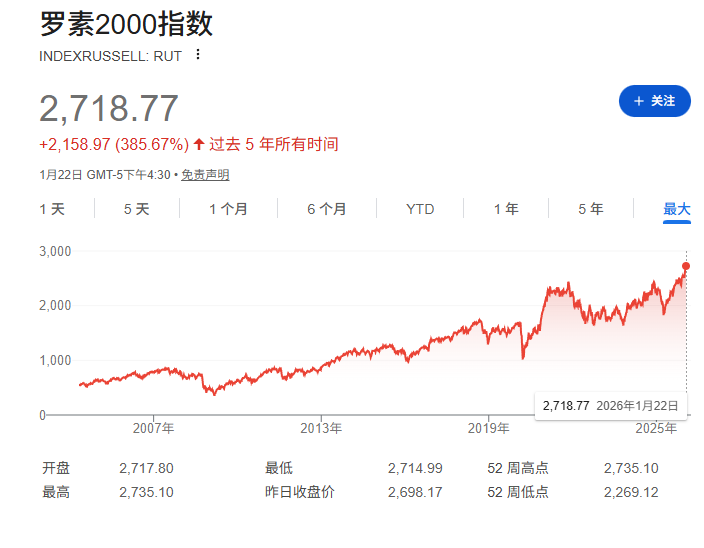
Three weeks into 2026, the Russell 2000 Index has risen 9%, breaking through 2700 points.

This U.S. small-cap stock index had been moving sideways for three years since its previous high at the end of 2021, only breaking through for the first time last November. It has now entered the "price discovery" phase, with no historical resistance levels to reference.

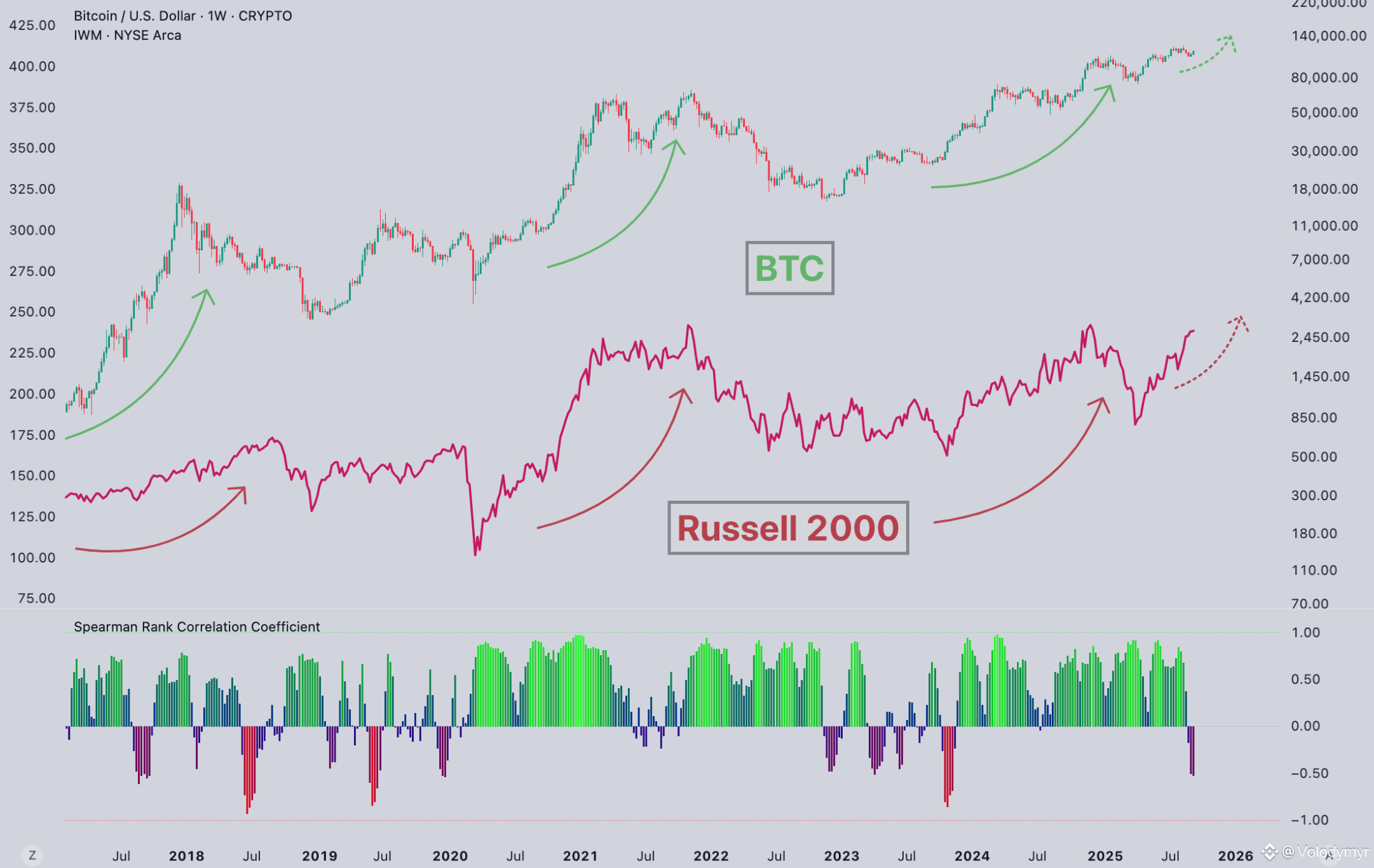
Recently, a view has been circulating: when the Russell 2000 broke out in 2016 and 2020, BTC also started a bull run, hitting both times. Now it has broken out again—will crypto follow?

Looking at the data, it does seem like a leading signal, at least historically validated.

The Russell 2000 tracks the 2,000 smallest companies by market cap in the U.S. stock market, with a median market cap of just over $1 billion. Compared to star stocks like Apple and Microsoft in the S&P 500, these small companies share a common trait: they rely mainly on bank loans for financing, not bond issuance.

When interest rates rise, their financing costs are the first to suffer; when rates fall, they are the first to benefit.

Therefore, traders like to use the Russell 2000 as a "risk appetite thermometer." A new high indicates that the market is willing to put money into higher-risk assets.

There is another layer of logic. Small-cap stocks are concentrated in the U.S. domestic market, unlike globally diversified companies like Apple and Microsoft. A rise in the Russell 2000, to some extent, reflects the domestic economic sentiment in the U.S.

2016 and 2020: Two Breakouts in the Small-Cap Index, Two BTC Takeoffs

First, the data.

In 2016, the Federal Reserve was nearing the end of its rate-hiking cycle, and Trump's election brought expectations of tax cuts, boosting risk appetite. BTC had just undergone a halving, with supply contraction meeting rising demand, leading to the 2017 bull run.

The 2020 breakout was even stronger. The pandemic caused a major crash, and the Fed went all out with money printing, pushing rates to the floor. Institutions entered the market on a large scale for the first time, with MicroStrategy and Tesla buying heavily, driving BTC from over $10,000 to $69,000.

The timing of the Russell 2000 breakout and the BTC bull market确实 aligns in both cases.

But there are only two historical samples.

Looking back to November 2024, the Russell 2000 first broke through its 2021 high. At the same time, BTC was already near $100,000.

From the April 2024 halving, BTC rose from $63,000 to the current $90,000, a gain of about 50%. Sounds good, but compared to the 5x and 27x gains in the same period of the previous two cycles, the difference is significant.

A few possible reasons.

First, institutional entry has dampened volatility. After the ETF approval in January 2024, giants like BlackRock and Fidelity entered the market, with ETFs alone absorbing hundreds of billions of dollars. Institutional money doesn't chase pumps and dumps like retail, smoothing out volatility. The upside is that crashes are less severe, but the downside is the lack of vertical rallies like in 2017.

Second, the marginal effect of halvings is diminishing. After the fourth halving, BTC's annual inflation rate dropped from 1.7% to 0.85%. Sounds like a halving, but 94% of BTC has already been mined. The dilution of new supply on the存量 is getting smaller, and the "supply shock" from halvings is weakening each time.

Third, BTC broke its previous high in March 2024, the first time it has done so before a halving. ETF expectations提前释放了一波 demand, so by the time the halving arrived, the利好 was already priced in.

Coincidence, or the Same Liquidity Logic?

The Russell 2000 and BTC—one is a U.S. small-cap stock index, the other a crypto leader—why would they move in sync?

My understanding is that they are sensitive to the same macro signals.

When the Fed signals easing, money moves out along the risk curve. First to government bonds, then to blue chips, then to small caps, and finally to high-beta assets like crypto.

A Russell 2000 breakout is like a green light in the middle of that chain.

A JPMorgan study last year noted that BTC has the highest correlation with small-cap tech stocks in the Russell 2000. The reason is that crypto projects rely on VC funding, and blockchain innovation is concentrated in small companies rather than large tech giants. Essentially, the people buying small-cap stocks and those buying crypto have similar risk appetites.

But I hesitate to call this a causal relationship. Two samples aren't enough statistically.

Moreover, in 2016 and 2020, BTC itself had its own halving cycle. The Russell 2000 might just have been another macro signal appearing concurrently, not necessarily leading.

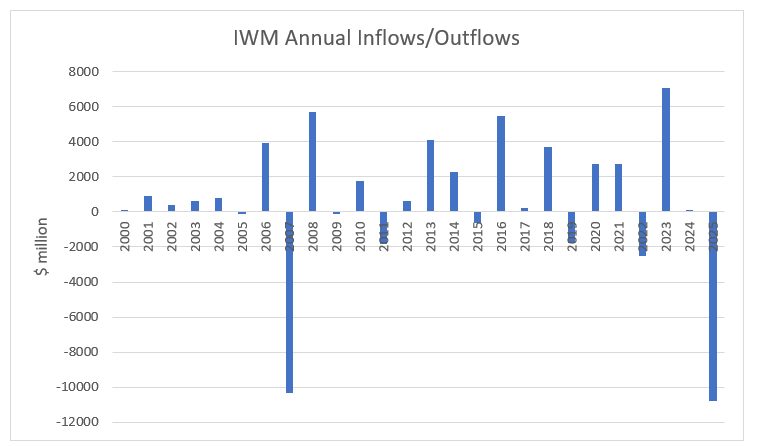
Additionally, an interesting phenomenon: although the Russell index is rising, money is flowing out.

In 2025, the Russell 2000 rose over 40%, but U.S. small-cap ETFs saw nearly $20 billion in net outflows for the year. This contrasts sharply with past bull markets—when the index rose, funds flowed in.

(Source: etf.com)

Another data point: about 40% of companies in the Russell 2000 reported negative earnings in Q3 2025, near a historical high. This proportion has more than doubled since 2007.

The index hits a new high, fundamentals are concerning, and money is still leaving.

How to explain this? One possibility is a few stocks driving the index; another is passive fund rebalancing. But either way, the "return of risk appetite" narrative takes a hit.

Lately, if you follow macro and finance content, you'll notice more voices on investment video blogs and crypto Twitter saying "the Russell 2000 breakout is a leading signal for BTC's rise."

The Russell 2000 breakout确实 was a signal present before the 2016 and 2020 crypto bull markets, and it's here again. It has value as an observation window, but my view is: don't use it as a trading signal.

Two samples can't establish causality, and this cycle has several variables different from before: ETFs changed the capital structure, volatility has been suppressed by institutions, and the halving effect is fading. The old script might not play out the same way.

The "resonance" between the Russell 2000 and BTC might only be answered once this cycle concludes.

Note:

Data sources: Yahoo Finance, TradingEconomics, JPMorgan Research, BeInCrypto. As of January 2026.


Twitter:https://twitter.com/BitpushNewsCN

Bitpush TG Discussion Group:https://t.me/BitPushCommunity

Bitpush TG Subscription: https://t.me/bitpush

Original link:https://www.bitpush.news/articles/7605542

Связанные с этим вопросы

QWhat is the Russell 2000 index and why is it considered a 'risk appetite thermometer'?

AThe Russell 2000 index tracks the 2,000 smallest publicly traded companies in the U.S. stock market, with a median market capitalization of just over $1 billion. It is considered a 'risk appetite thermometer' because these small companies rely primarily on bank loans for financing, not bond issuance. When interest rates rise, their financing costs are the first to become unsustainable, and when rates fall, they are the first to benefit. Therefore, its new highs indicate that the market is willing to put money into higher-risk assets.

QAccording to the article, what historical correlation exists between the Russell 2000 index and Bitcoin's price?

AHistorically, there have been two instances where a breakout of the Russell 2000 index preceded a major Bitcoin bull run. The first was in 2016, which led into the 2017 bull market. The second was in 2020, which was followed by Bitcoin's price rising from over $10,000 to $69,000. The article notes, however, that this is only a correlation based on two data points and does not necessarily imply causation.

QWhat are the three reasons the article suggests for Bitcoin's more modest 50% gain post-halving in 2024 compared to previous cycles?

AThe three reasons are: 1) Institutional adoption through ETFs has dampened volatility, as large inflows from firms like BlackRock and Fidelity have a stabilizing effect that prevents the extreme price surges seen in retail-driven markets. 2) The marginal effect of the Bitcoin halving is diminishing; with 94% of BTC already mined, the supply shock from each halving is weaker. 3) Bitcoin's price reached a new all-time high in March 2024 *before* the halving, meaning much of the positive demand effect from the ETF approval was already priced in.

QDespite the Russell 2000 hitting new highs, what contradictory data points suggest the 'risk-on' narrative might be flawed?

AContradictory data includes: 1) U.S. small-cap ETFs saw net outflows of nearly $20 billion in 2025, even as the index rose over 40%, which is the opposite of typical bull market behavior where money flows into rising assets. 2) Approximately 40% of the companies in the Russell 2000 reported negative earnings in Q3 2025, a proportion that has more than doubled since 2007, indicating weak underlying fundamentals despite the index's performance.

QWhat is the article's final conclusion on using the Russell 2000 breakout as a trading signal for crypto?

AThe article concludes that while the Russell 2000 breakout is a valuable observational signal that has appeared before past crypto bull markets, it should not be used as a direct trading signal. The reasoning is that the correlation is based on only two historical samples, and the current cycle has key differences—such as the impact of ETFs, dampened volatility, and a weaker halving effect—that mean the 'old script' may not play out the same way.

Похожее

It Took Me a Year to See the Bitter Truth About Agent Payments

After a year building infrastructure for the Agent economy, engaging with major players like Stripe, Visa, and Coinbase, the author shares a sobering analysis of the current state of Agent payments. The core finding is a stark lack of genuine, immediate demand across most envisioned use cases. The article breaks down four key market segments: 1. **Agent-to-Merchant (Consumer Shopping):** For most product categories (e.g., clothing, electronics), conversational AI shopping is a step backwards from visual e-commerce interfaces. While agents excel at understanding needs, they can't replace side-by-side product comparison. Real merchant interest is defensive "Agent Engine Optimization," not driven by current customer demand. Potential exists for high-frequency, low-decision purchases (like food delivery) or navigating complex store UIs, but these require massive B2C distribution channels dominated by giants like Amazon. 2. **Agent-to-API (Developer Services):** Developers already have subscriptions and billing relationships for APIs (compute, data). Prepaid balances solve micro-payment issues for low transaction volumes. A deeper structural problem is that major SaaS vendors' business models rely on enterprise contracts, resisting granular pay-per-call pricing. While protocols like MPP and x402 serve the long tail of niche services, this market is small and developers are historically low-willingness-to-pay. 3. **Agent-to-Agent:** This remains largely theoretical with minimal transaction volume. While it represents a long-term bet on a fundamentally new transaction infrastructure (sub-second, micro-penny to million-dollar, multi-party settlements), it does not constitute a present market. 4. **Agent-to-Finance:** This is the only category with existing, paying demand. Integrating AI into financial workflows (trading, portfolio management) is a natural evolution and enables new capabilities like autonomous rebalancing. However, competition favors established, regulated institutions. The "real problem" is not moving money between agents, but the broader challenge of **coordination**—orchestrating work between agents and humans, verifying outcomes, and settling results. Payment is just one component of settlement, which is itself part of coordination. Companies that solve the coordination layer will subsume payment, not the other way around. While well-funded incumbents build defensively for a long-term future, startups must find where the market is today—which, for the author's team, lies outside these four categories in an area of real, growing, and underserved activity.

marsbit24 мин. назад

It Took Me a Year to See the Bitter Truth About Agent Payments

marsbit24 мин. назад

It Took Me a Year to See the Hard Truth About Agent Payments

**Title: It Took Me a Year to See the Hard Truth About Agent Payments** Over the past year, I've worked on infrastructure for the Agent economy, engaging with major players like Stripe, Visa, Coinbase, and numerous startups. The findings reveal a stark reality: genuine, widespread demand for Agent-based payments does not yet exist. **Key Observations:** * **Agent-to-Merchant (Shopping):** The user experience for AI shopping often falls short, especially for visual product discovery. While AI excels at understanding needs, conversational interfaces can't yet replace browsing and comparing multiple products visually. Current merchant interest is largely defensive ("Agent Engine Optimization") for a future that hasn't arrived. High-frequency, low-friction purchases (like food delivery) are potential fits, but lack open APIs and face high AI inference costs. Simpler, more affordable, or cross-language interactions for complex UIs are a niche opportunity but require massive consumer distribution to scale. * **Agent-to-API (Developer Tools):** Developer payment needs for APIs (computing, data, models) are already met through subscriptions and prepaid credits. The core challenge is not payment friction but supplier economics: most large SaaS providers prefer enterprise contracts over micropayments for API calls. Protocols like MPP and x402 suit the long-tail of smaller services but cater to a developer market historically reluctant to pay for these tools. Major infrastructure needs at the top of the stack are already being addressed. * **Agent-to-Agent (Machine Commerce):** This is a long-term vision with almost no current transaction volume. While a future with high-speed, high-frequency, multi-party machine-to-machine transactions would require novel infrastructure, it remains theoretical. The market is not here yet. * **Agent-to-Finance:** This is the only category with clear, present demand. Financial professionals and DeFi users already pay for tools, and AI augmentation is a natural evolution. Autonomous AI agents can enable entirely new financial strategies. However, competition is fierce from established, regulated incumbents who can more easily layer AI onto their existing products. **The Core Insight:** Companies, especially giants with long time horizons, are building defensively for a potential future of mass machine commerce. For them, early investment is a low-cost hedge. For startups, the current market reality is different. The primary challenge isn't just moving money between agents (payments). The larger, unsolved problem is **orchestration** – coordinating work between agents and humans, verifying outcomes, and then settling. Payment is just a part of settlement, which is just a part of orchestration. Companies that solve the orchestration problem will subsume payments, not the other way around. After a year of building, we see the real, growing, and underserved market opportunity lies in this broader domain of orchestration.

链捕手48 мин. назад

It Took Me a Year to See the Hard Truth About Agent Payments

链捕手48 мин. назад

Claude Opus 4.8 Finds a $4.5 Billion Bug: The AI Era is Mass-Producing Hackers

A researcher discovered a critical "infinite mint" vulnerability in the Zcash cryptocurrency's Orchard protocol using Claude Opus 4.8, leading to a swift fix but also a 50% market drop, erasing billions in value. This incident highlights a new era where powerful, accessible AI models are dramatically lowering the barrier to finding software vulnerabilities. Previously, the security community feared specialized models like Claude Mythos Preview, capable of finding decades-old zero-day exploits. The Zcash case, however, involved a publicly available, general-purpose model. This shift makes advanced security auditing—and attack capabilities—accessible to far more people, not just experts. The mass democratization of vulnerability discovery brings a dual challenge: a flood of low-quality, AI-generated false reports that overwhelm maintainers, and the real, rapid uncovering of deep, dangerous bugs. Open-source projects, often understaffed and unfunded, are particularly vulnerable to this "attention DDoS." The article cites examples like curl shutting down its bug bounty program due to the unsustainable workload. Our perceived digital safety has often been luck, relying on the high cost and effort required to find deeply hidden flaws in complex systems, as seen with historical vulnerabilities like Heartbleed or Baron Samedit. AI changes this cost structure, effectively "mass-producing flashlights" to illuminate every corner of our codebase. While large companies operate extensive security chains involving external white-hat hackers and massive defensive operations, the global cybersecurity workforce faces a severe shortage, especially of experienced personnel capable of analyzing complex threats and coordinating fixes. The core dilemma emerges: AI makes *finding* bugs cheap and scalable, but *fixing* them remains a slow, expensive, and human-intensive process. The article concludes that AI won't destroy the internet but acts as a bright light, revealing that our digital existence is not inherently secure but is precariously maintained by ongoing human effort. The true cost in the AI era may not be discovery, but whether there will be enough people left willing and able to do the hard work of repair.

marsbit1 ч. назад

Claude Opus 4.8 Finds a $4.5 Billion Bug: The AI Era is Mass-Producing Hackers

marsbit1 ч. назад

Codex Goal Mode Usage Guide: How to Make AI Continuously Pursue a Specific Objective

"Codex Goal Mode: How to Make AI Work Continuously Toward a Specific Goal" OpenAI's Codex "goal mode" (/goal) transforms the AI from a reactive code assistant into a proactive execution agent capable of working autonomously for hours or even days to achieve a defined objective. To maximize its effectiveness, follow these key principles: 1. **Define Clear, Verifiable Exit Criteria:** The goal prompt should be a concise, measurable success condition, not a lengthy specification. Use quantifiable metrics like "reduce build time by 30%" or "achieve 100% test parity." 2. **Provide Initial Guidance and Tools:** Direct Codex toward likely problem areas and specify available tools (e.g., browsers, testing environments) to prevent it from exploring unproductive paths. 3. **Enable Progress Measurement:** Equip Codex with ways to track advancement, such as creating comparison tools for visual tasks or evaluation sets, ensuring it can gauge its own progress. 4. **Use a Realistic Execution Environment:** For tasks like performance optimization, provide access to environments that closely mimic production (e.g., similar configs, databases) to yield valid results. 5. **Be Cautious with Visual Goals:** Avoid vague "pixel-perfect" instructions. Instead, supplement visual references with functional checklists or design system specifications to prevent Codex from obsessing over minor details. 6. **Implement Progress Tracking:** For long-running tasks, have Codex commit code to draft PRs, update progress documents, or send Slack updates to maintain visibility into its work. 7. **Review and Consolidate Results:** Once the goal is met, instruct Codex to review its work, clean up ineffective experimental code, and reflect on what strategies succeeded or failed. Ultimately, using goal mode shifts the developer's role from writing prompts to managing a persistent engineering agent—defining objectives, establishing metrics, configuring environments, and conducting final reviews.

marsbit2 ч. назад

Codex Goal Mode Usage Guide: How to Make AI Continuously Pursue a Specific Objective

marsbit2 ч. назад

Торговля

Спот
Фьючерсы
活动图片