Singapore Shuts Down Bsquared’s Crypto Payment Operations – Details

bitcoinistОпубликовано 2026-05-21Обновлено 2026-05-21

Введение

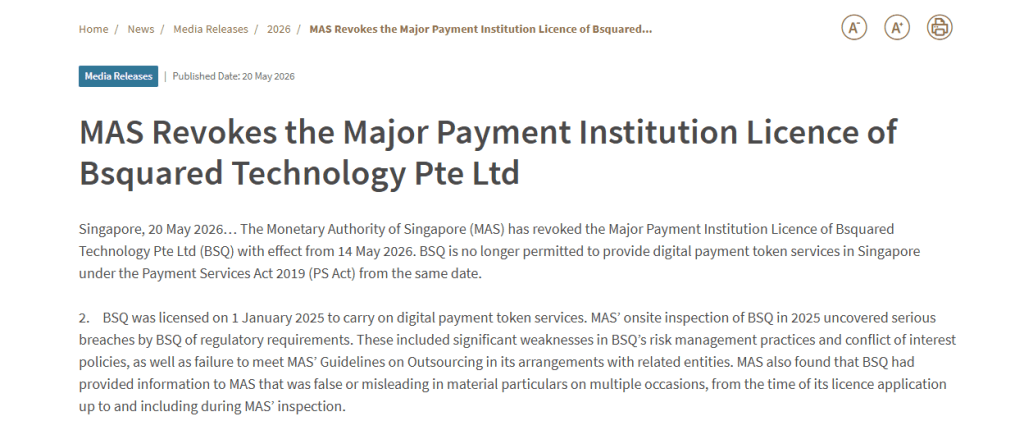
Singapore's central bank, the Monetary Authority of Singapore (MAS), has revoked the Major Payment Institution License of crypto firm Bsquared Technology. The decision followed an on-site inspection that uncovered significant compliance failures, including poor risk management, mishandling of conflicts of interest, and violations of outsourcing rules. Crucially, MAS found that Bsquared provided false or misleading information on multiple occasions, from its initial license application through the inspection process. The firm, which held the license for just 16 months, must now produce a closure certificate confirming all customer funds have been returned. MAS is also reviewing the conduct of the company's key officers, indicating potential individual consequences. This rare license revocation highlights Singapore's strict regulatory enforcement for its crypto sector, emphasizing that maintaining high standards is a priority for the financial hub.

Bsquared Technology Pte Ltd has no auditors to answer to yet — but it will. Singapore’s central bank has ordered the crypto firm to produce a closure certificate confirming that all customer funds have been returned. The company told regulators it holds no outstanding customer assets.

A License Gone In 16 Months

The Monetary Authority of Singapore revoked Bsquared’s Major Payment Institution License on Wednesday after an on-site inspection turned up a range of problems.

Regulators found gaps in how the company managed risk and handled conflicts of interest. There were also failures to follow the central bank’s outsourcing rules.

Worse, officials said Bsquared had given false or misleading information to MAS on multiple occasions — starting from when it first applied for the license and continuing through the inspection itself. The firm, also known as BSQ, had held the license for just 16 months.

MAS pulls the plug on Bsquared’s crypto operations. Source: MAS

MAS Not Done With Bsquared

The central bank made clear that revoking the license is not the end of the matter. MAS said it is now reviewing the conduct of the company’s key officers, signaling that individuals within the firm could face separate consequences.

Singapore has licensed 37 entities to offer digital payment token services. Revocations are rare. The action against Bsquared puts other operators on notice that the regulator will move against firms that fall short — or mislead — authorities.

Image: Fintech News Singapore

A Hub That Holds Its Standards

Singapore has built a reputation as one of Asia’s leading centers for crypto business. Coinbase and Ripple maintain regional offices there. Crypto.com has its global headquarters in the city-state.

Bitcoin is currently trading at $76,845. Chart: TradingView

That standing has come partly from how seriously regulators treat licensing requirements. Last year, MAS rejected an application from AmazingTech, the operator of Tokenize Xchange, and the Commercial Affairs Department later launched a probe into the company.

The Bsquared revocation fits a pattern: Singapore wants the business, but not at the cost of oversight.

Beyond Payments, Deeper Integration

The city-state has also been expanding its digital asset ambitions in other areas. Singapore Gulf Bank recently launched a service letting institutional clients mint and redeem stablecoins directly through their bank accounts via the Solana blockchain.

Featured image from KOLN, chart from TradingView

Связанные с этим вопросы

QWhat specific reasons did the Monetary Authority of Singapore give for revoking Bsquared's license?

AThe Monetary Authority of Singapore revoked Bsquared's license after an on-site inspection revealed deficiencies in risk management and conflict-of-interest handling, failures to comply with outsourcing rules, and, most significantly, that the firm had provided false or misleading information to MAS on multiple occasions.

QWhat must Bsquared Technology Pte Ltd do following the license revocation, according to MAS?

AFollowing the license revocation, Bsquared must produce a closure certificate confirming that all customer funds have been returned. The company has stated to regulators that it holds no outstanding customer assets.

QBesides revoking the company's license, what further action is MAS considering regarding Bsquared?

AMAS is reviewing the conduct of Bsquared's key officers, indicating that individuals within the firm could face separate consequences for their actions.

QHow does the article describe Singapore's approach to regulating crypto and digital payment token services?

AThe article describes Singapore as a leading crypto hub that maintains strict regulatory standards. It licenses firms seriously, revokes licenses for non-compliance or misconduct, and aims to attract business without compromising oversight, as shown by the Bsquared case and the prior rejection of AmazingTech's application.

QWhat example does the article give of Singapore expanding its digital asset services beyond payments?

AThe article cites Singapore Gulf Bank launching a service that allows institutional clients to mint and redeem stablecoins directly through their bank accounts using the Solana blockchain, demonstrating expansion into deeper digital asset integration.

Похожее

Bloomberg Uncovered: How Do China's Wealthy Circumvent the Annual $50,000 Limit to Transfer Assets?

**Summary: How Wealthy Chinese Circumvent $50,000 Annual Foreign Exchange Limits** Despite China's strict capital controls, including an annual $50,000 per person foreign exchange quota, an estimated $150 billion in funds still leaves the country annually via various gray and underground channels. This report outlines the evolution of China's "capital wall" and the methods used to bypass it. **The Evolving Capital Controls:** * **Foundation (1994):** The system of "current account convertibility with strict capital account controls" was established. * **Quota Set (2007):** The $50,000 individual annual forex purchase limit was formalized. * **Crackdown Begins (2015-2017):** Following market volatility, enforcement tightened. Banks were required to scrutinize transactions, and channels like using UnionPay cards for Hong Kong insurance premiums or buying overseas property were blocked. * **Digital & Legal Upgrades (2024-2026):** Enhanced algorithms now flag suspicious patterns (e.g., "smurfing"). The Common Reporting Standard (CRS) provides Chinese tax authorities with data on citizens' offshore accounts. Unlicensed cross-border brokers have been targeted. **Five Primary Methods for Moving Capital:** 1. **Underground Banking / "Hawala" (Duiqiao):** The largest-scale method. No money crosses borders. Clients pay RMB to a domestic account; an overseas associate deposits equivalent foreign currency into the client's offshore account. Risks include high fees, account freezes, and legal penalties. 2. **"Smurfing" or "Ant Moving":** Using multiple individuals' $50,000 quotas to pool funds for one offshore recipient. Increasingly detected by anti-money laundering algorithms. 3. **Trade Invoice Manipulation:** Businesses over-invoice imports or under-invoice exports via offshore shell companies, creating a pretext to transfer excess funds abroad under the guise of trade. 4. **Channel Migration:** After a crackdown on internet brokers, funds flow toward more compliant but costly channels like major banks' cross-border wealth management services or Qualified Domestic Institutional Investor (QDII) quotas. 5. **Structural Arrangements:** High-net-worth individuals use complex, high-cost legal structures involving offshore trusts, insurance, and investment migration programs to transfer asset ownership. **Regulatory Response: Focusing on People, Not Just Money** The current strategy extends oversight from enterprises to **individual residents**. Tools like CRS allow retroactive visibility into offshore assets. Cryptocurrencies, once seen as a potential loophole, are now actively monitored and prosecuted as an illegal channel. The underlying driver remains: with significant wealth concentrated among millions of affluent households seeking diversification amid domestic economic shifts, the incentive to move assets offshore persists despite regulatory barriers.

marsbit14 мин. назад

Bloomberg Uncovered: How Do China's Wealthy Circumvent the Annual $50,000 Limit to Transfer Assets?

marsbit14 мин. назад

Ethereum's Ballmer Moment: As Everyone Is Bearish, the Circulating Supply Is Disappearing

"Ethereum's Ballmer Moment: Circulation Shrinks Amid Bearish Sentiment" Amid widespread bearish sentiment, with prominent figures like Bankless founder David Hoffman selling ETH and young developers flocking to Solana, some argue Ethereum is entering its "Ballmer era"—akin to Microsoft's perceived stagnation under Steve Ballmer. While surface-level criticisms about slow protocol development, cautious leadership, and competitive pressure are valid, underlying fundamentals tell a different story. Approximately 30% of ETH is staked, major holders like BitMine are accumulating, and spot ETFs continue to absorb supply. Regulatory clarity, including the SEC/CFTC's March ruling on staking rewards and the potential passage of the CLARITY Act, is transforming crypto from a regulatory threat into a legitimized framework. This institutionalization, alongside a shrinking circulating supply (with net issuance around 0.23% annually), creates significant buy-side pressure independent of fee-based value capture. The broader crypto total addressable market is expanding through regulated stablecoins, tokenized assets, and institutional adoption. While public chains face competition from permissioned alternatives, the winning model appears to be permissioned assets settling on public chains like Ethereum and Solana. The author advocates a non-maximalist, barbell strategy: holding ETH for its institutional role and supply squeeze, SOL for consumer/throughput trends, BTC as a macro hedge, and a basket of next-gen L1s. Key bullish drivers for ETH include rapid circulation shrinkage, potential Q2 staked ETF approvals, regulatory tailwinds solidifying its role as a default settlement layer, and the optionality of an eventual "Satya moment" leadership shift. Despite bearish consensus, the current setup—where crypto is "not hot" and regulatory groundwork is being laid—presents a compelling investment opportunity. The crypto cycle's focus may have shifted to AI, but blockchain infrastructure is gaining a legal and institutional foothold precisely while attention is elsewhere.

marsbit14 мин. назад

Ethereum's Ballmer Moment: As Everyone Is Bearish, the Circulating Supply Is Disappearing

marsbit14 мин. назад

Claude Code Introduces Dynamic Workflows: Enabling AI to Form Teams and Collaborate

Claude Code introduces dynamic workflows, enabling AI to coordinate teams of specialized agents for complex tasks. This transforms Claude from a code assistant into a programmable workbench. Workflows address key limitations of single-agent systems: agentic laziness (premature task completion), self-preferential bias (favoring own outputs), and goal drift (losing sight of original objectives). The system allows Claude to dynamically create execution frameworks using JavaScript. It can split tasks, dispatch parallel agents for isolated work (e.g., in separate worktrees), implement adversarial validation, run tournaments, and synthesize results. This multi-agent approach is valuable for tasks requiring deep research, factual verification, code migration, root cause analysis, large-scale triage, and qualitative sorting. Key patterns include: classify-and-route, fan-out-and-synthesize, adversarial verification, generate-and-filter, tournaments, and loop-until-done. While token usage is higher, workflows excel where tasks resemble programming—needing problem decomposition, isolated context, hypothesis testing, and handling many details. They extend Claude Code's utility beyond technical work to areas like business plan review, resume screening, and naming brainstorm. The feature is not a universal solution but points to a future where AI tool competitiveness depends on organizing reliable, reusable, and auditable execution flows for complex goals.

marsbit55 мин. назад

Claude Code Introduces Dynamic Workflows: Enabling AI to Form Teams and Collaborate

marsbit55 мин. назад

Hyperliquid, Wall Street's 24/7 Trading Convenience Store

Hyperliquid: The 24/7 Trading "Convenience Store" for Wall Street Hyperliquid, a decentralized cryptocurrency exchange, has become a go-to platform for Wall Street traders seeking to trade around the clock, especially during traditional market closures. Founded by Jeff Yan, a former quantitative trader, after the FTX collapse, the platform emphasizes user self-custody of assets. It offers a wide range of perpetual contracts—leveraged derivatives with no expiry—on assets from Bitcoin and crude oil to the S&P 500 and even pre-IPO companies like SpaceX. A notable example involves a hedge fund trader who capitalized on geopolitical news over a weekend, securing a 243% return on oil derivatives before markets reopened. The platform, run by just 11 employees, generated approximately $800 million in revenue last year, and its native token HYPE has seen significant growth. Its rise highlights the merging of traditional finance and crypto. While U.S. users are currently restricted, recent CFTC rule changes could open access. The platform is known for its transparency, having processed $10 billion in liquidations during a market crash while competitors faltered. Regulators warn of the high risks and complexity of perpetual contracts for retail investors. Key to its appeal is a strong community culture, direct engagement with founders, and a simple interface. Despite rules against VPN use, it attracts global users with its permissionless approach. Hyperliquid plans to expand into prediction markets and options, aiming to eventually host all financial activity.

marsbit56 мин. назад

Hyperliquid, Wall Street's 24/7 Trading Convenience Store

marsbit56 мин. назад

Торговля

Спот
Фьючерсы

Популярные статьи

Как купить S

Добро пожаловать на HTX.com! Мы сделали приобретение Sonic (S) простым и удобным. Следуйте нашему пошаговому руководству и отправляйтесь в свое крипто-путешествие.Шаг 1: Создайте аккаунт на HTXИспользуйте свой адрес электронной почты или номер телефона, чтобы зарегистрироваться и бесплатно создать аккаунт на HTX. Пройдите удобную регистрацию и откройте для себя весь функционал.Создать аккаунтШаг 2: Перейдите в Купить криптовалюту и выберите свой способ оплатыКредитная/Дебетовая Карта: Используйте свою карту Visa или Mastercard для мгновенной покупки Sonic (S).Баланс: Используйте средства с баланса вашего аккаунта HTX для простой торговли.Третьи Лица: Мы добавили популярные способы оплаты, такие как Google Pay и Apple Pay, для повышения удобства.P2P: Торгуйте напрямую с другими пользователями на HTX.Внебиржевая Торговля (OTC): Мы предлагаем индивидуальные услуги и конкурентоспособные обменные курсы для трейдеров.Шаг 3: Хранение Sonic (S)После приобретения вами Sonic (S) храните их в своем аккаунте на HTX. В качестве альтернативы вы можете отправить их куда-либо с помощью перевода в блокчейне или использовать для торговли с другими криптовалютами.Шаг 4: Торговля Sonic (S)С легкостью торгуйте Sonic (S) на спотовом рынке HTX. Просто зайдите в свой аккаунт, выберите торговую пару, совершайте сделки и следите за ними в режиме реального времени. Мы предлагаем удобный интерфейс как для начинающих, так и для опытных трейдеров.

1.4k просмотров всегоОпубликовано 2025.01.15Обновлено 2026.06.02

Как купить S

Sonic: Обновления под руководством Андре Кронье – новая звезда Layer-1 на фоне спада рынка

Он решает проблемы масштабируемости, совместимости между блокчейнами и стимулов для разработчиков с помощью технологических инноваций.

2.3k просмотров всегоОпубликовано 2025.04.09Обновлено 2025.04.09

Sonic: Обновления под руководством Андре Кронье – новая звезда Layer-1 на фоне спада рынка

HTX Learn: Пройдите обучение по "Sonic" и разделите 1000 USDT

HTX Learn — ваш проводник в мир перспективных проектов, и мы запускаем специальное мероприятие "Учитесь и Зарабатывайте", посвящённое этим проектам. Наше новое направление .

1.8k просмотров всегоОпубликовано 2025.04.10Обновлено 2025.04.10

HTX Learn: Пройдите обучение по "Sonic" и разделите 1000 USDT

Обсуждения

Добро пожаловать в Сообщество HTX. Здесь вы сможете быть в курсе последних новостей о развитии платформы и получить доступ к профессиональной аналитической информации о рынке. Мнения пользователей о цене на S (S) представлены ниже.

活动图片