Same Case, Different Verdicts: Why Was Uniswap Acquitted While Tornado Cash Was Not?

marsbitОпубликовано 2026-03-03Обновлено 2026-03-03

Введение

In a landmark ruling, the New York Southern District Court dismissed a class-action lawsuit against Uniswap and its founder, Hayden Adams, holding them not liable for scam tokens traded on the platform. The court, presided over by Judge Katherine Polk Failla, compared the case to holding a self-driving car developer responsible for crimes committed using the vehicle, emphasizing that open-source developers should not bear responsibility for misuse by third parties. This decision contrasts sharply with the legal outcome for Tornado Cash developers. Despite the same judge being involved, Tornado Cash co-developer Roman Storm was convicted for operating an unlicensed money-transmitting business, while another developer, Alexey Pertsev, received a prison sentence in the Netherlands for money laundering. The U.S. Treasury had previously sanctioned Tornado Cash for allegedly facilitating over $7 billion in money laundering, including for North Korean hackers. The divergent rulings highlight a key regulatory stance: decentralization is permissible, but privacy tools enabling illicit activities face strict scrutiny. The author suggests that while Uniswap’s legal victory aligns with principles of developer immunity for open-source code, Tornado Cash’s case underscores that protocols knowingly aiding crime, especially at a state level, won’t be tolerated. The piece concludes by questioning if Uniswap, despite its legal win, should take more proactive steps to screen for scams to prot...

Original Author: Eric, Foresight News

At 3 a.m. Beijing time on March 3, a class action lawsuit demanding that Uniswap and its founder Hayden Adams be held responsible for scam tokens on Uniswap was dismissed by the U.S. District Court for the Southern District of New York. Brian Nistler, General Counsel of the Uniswap Foundation, called it a "landmark ruling for DeFi."
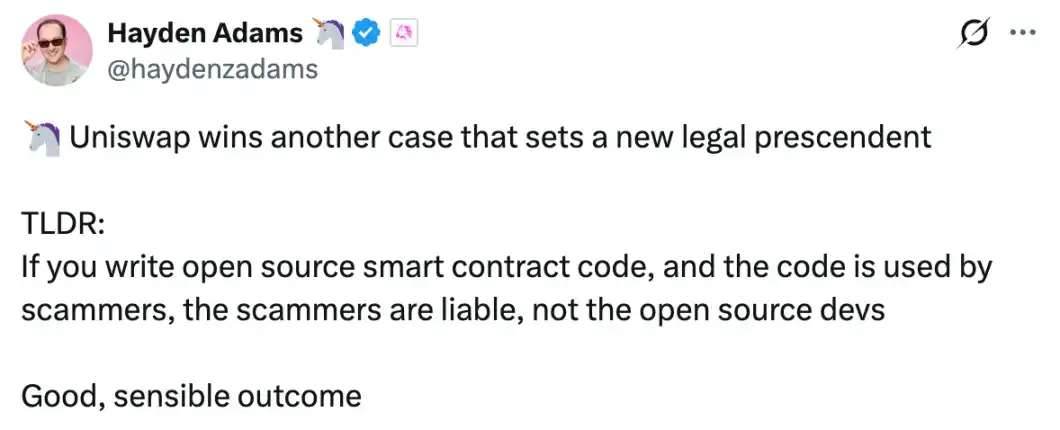
Hayden Adams also tweeted, "If you write open-source smart contract code and that code is used by scammers, the scammers are responsible, not the open-source developer. This is a reasonable and just outcome."

For Web3 developers, this is undoubtedly good news. But what is less known is that the judge who made this "just ruling" is the same person who, during the tenure of the former SEC chairman, found the developers of the mixer Tornado Cash guilty.

The Finalized Verdict

Nearly four years have passed since the class action lawsuit against Uniswap was filed and today's final resolution.

In April 2022, Uniswap users, represented by Nessa Risley, filed a class action lawsuit in court, accusing defendants including Paradigm, a16z, Uniswap, and its founder Hayden Adams of violating federal securities laws by issuing and selling unregistered securities, including UNI, in the form of tokens on Uniswap. The defendants were accused of failing to register Uniswap as an exchange or broker-dealer under applicable securities laws and failing to provide investors with registration statements for the securities they issued and sold.

This lawsuit was initiated by the law firms Kim&Serritella and Barton, representing users who traded EtherumMax, Bezoge, MatrixSamurai, Alphawolf Finance, RocketBunny, and BoomBaby.io tokens on Uniswap between April 5, 2021, and April 4, 2022.

The phrase "unregistered securities" had extraordinary destructive power for the crypto industry at the time, but this lawsuit unexpectedly quickly tilted in Uniswap's favor.

Presiding Judge Katherine Polk Failla, while agreeing that the so-called "scam tokens" were indeed securities, ruled that Uniswap did not need to be held responsible for them. Failla believed that the decentralized nature of Uniswap meant the protocol had no control over which tokens were listed on the platform or who could interact with it. "The case is more like holding the developer of a self-driving car responsible for traffic violations or bank robberies committed by third parties using the car."

Based on this, Failla dismissed the federal securities law charges in August 2023. The plaintiffs then appealed, and the Second Circuit Court of Appeals affirmed the dismissal of the federal part in 2025 but remanded the state law part for retrial.

Subsequently, the plaintiffs amended their complaint and sued again. This time, the investors who lost money accused Uniswap and other defendants of aiding and abetting fraud and misrepresentation, profiting from transactions involving scam tokens, and violating fraud laws in multiple states.

After another review by the same judge, Failla, the amended claims were dismissed again, with no further amendments allowed, bringing the case to a complete end.

The judge's reasoning this time was largely the same as before: Uniswap was not aware of the scam tokens, and even if it were, it did not provide substantial assistance. It also did not meet the definition of fraudulent behavior under any state law. Regarding unjust enrichment, Uniswap did not obtain direct benefits, and the speculative indirect benefits from such scam projects expanding the user base were too tenuous.
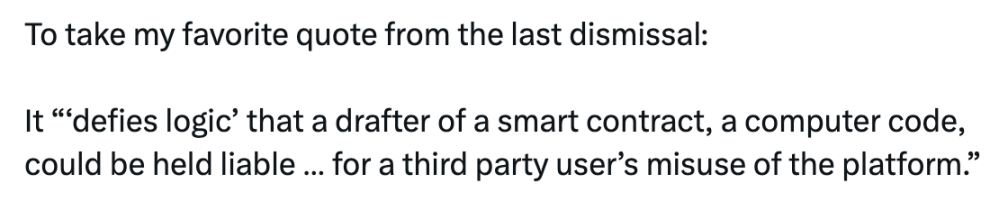
In a tweet, Brian Nistler stated, quoting a sentence from the previous ruling, that it "defies logic" to hold the drafters of smart contracts responsible for the abusive behavior of third-party users on the platform.

The Different Outcome for Tornado Cash

Facing the same judge, Roman Storm of Tornado Cash met a different fate.

Tornado Cash was first added to the sanctions list by the U.S. Treasury Department's Office of Foreign Assets Control (OFAC) on August 8, 2022, accused of helping criminals, including North Korean hackers, launder over $7 billion. Two days after being added to the sanctions list, Dutch police arrested Alexey Pertsev, one of the core developers of Tornado Cash.

On May 14, 2024, a Dutch court found Alexey Pertsev guilty of money laundering and sentenced him to 64 months in prison. The court believed that Pertsev was aware that the platform he developed and operated was used for crime but did not stop it, subjectively acquiescing to Tornado Cash being used as a money laundering tool. Alexey Pertsev is still appealing, but there have been no recent developments.

Seven months before Alexey Pertsev was found guilty, the U.S. Department of Justice sued two other developers, Roman Storm and Roman Semenov, in the Southern District of New York. Roman Storm was previously arrested in Washington State, while Roman Semenov remains at large.

Roman Storm in court

Although an appeal later determined that OFAC's sanctions against Tornado Cash were an overreach and invalid, Roman Storm still found himself in the defendant's seat last July. After a trial presided over by Judge Katherine Polk Failla, the jury found Roman Storm guilty of "conspiracy to operate an unlicensed money transmitting business," but no formal sentencing has been announced yet.
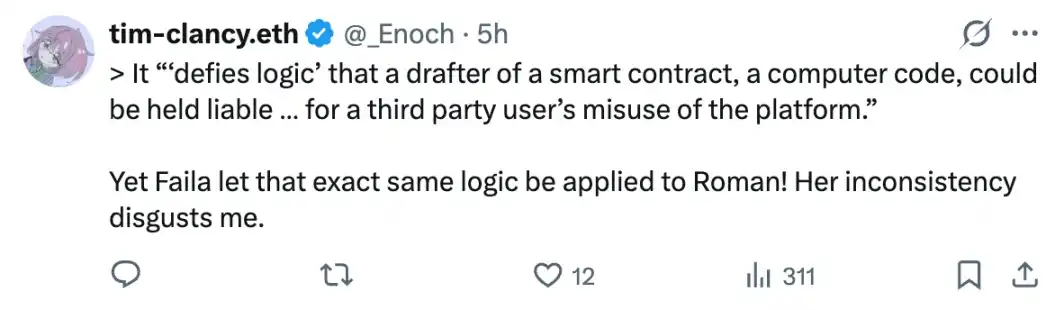
Under Brian Nistler's tweet celebrating Uniswap's victory, a comment by Sigil developer tim-clancy.eth criticizing Failla's contradictory rulings (the verdict against Roman Storm was actually made by a jury) received the most likes among all comments.

Decentralization Is Allowed, but Privacy Is Not

I am not a professional lawyer, but putting aside political factors and from a simple emotional perspective, I can roughly understand why Uniswap and Tornado Cash had different outcomes.

The core reason is that Tornado Cash's developers should have been well aware that a mixer would inevitably be used for money laundering. This clearly reveals the regulatory attitude: decentralization is acceptable, but it must be traceable. Tether once faced the same dilemma, so it later began cooperating with money laundering investigations and added freezing functionality.

Perhaps Roman Storm, behind bars, would feel unjust upon learning of today's verdict, but he should realize that even in a crypto-friendly U.S. under Trump, platforms helping North Korean state-level hackers launder money cannot be tolerated. With the current strength of Crypto, it is still not enough to对抗 national power.

Web3 practitioners sympathize with Tornado Cash's developers and cheer for Uniswap's victory. In our eyes, the two protocols are not fundamentally different; in fact, Tornado Cash is even superior in privacy protection. Uniswap's addition of front-end blocking of sanctioned addresses in 2022 once sparked some debate. Now, it seems that permissionlessness within the existing legal framework may be the only way for decentralized protocols to survive.

But that said, did Uniswap really have no responsibility at all in these scam incidents?

Strictly logically speaking, as the judge's analogy suggests, you cannot hold Mercedes responsible for a bank's losses just because a robber used a Mercedes to rob the bank. But on a commercial level, we tend to believe that giants should provide protection within their capabilities. Current security tools can already identify a large number of potential scam projects in advance. For these established projects that have benefited greatly from Web3's development, simple screening is not troublesome.

Doing their part to protect investors is not a mandatory obligation, but it is a responsibility that ordinary investors hope Uniswap and others will actively shoulder.

Связанные с этим вопросы

QWhat was the outcome of the class action lawsuit against Uniswap and its founder Hayden Adams?

AThe class action lawsuit was dismissed by the U.S. District Court for the Southern District of New York. The judge ruled that Uniswap and its founder were not responsible for the scam tokens traded on the platform, as the protocol's decentralized nature meant it had no control over which tokens were listed or who interacted with it.

QWho was the judge presiding over both the Uniswap case and the Tornado Cash case involving Roman Storm?

AThe judge presiding over both cases was Katherine Polk Failla of the U.S. District Court for the Southern District of New York.

QWhy was Tornado Cash developer Roman Storm found guilty, while Uniswap was not held liable?

ARoman Storm was found guilty of conspiracy to operate an unlicensed money transmitting business because Tornado Cash mixer was used for money laundering, including by North Korean hackers. The court believed the developers were aware of its illicit use. In contrast, Uniswap was deemed a neutral, decentralized protocol with no control over user actions, similar to an autonomous vehicle developer not being liable for misuse by third parties.

QWhat does the article suggest is the key difference in regulatory treatment between Uniswap and Tornado Cash?

AThe article suggests that regulatory tolerance exists for decentralized protocols like Uniswap that are transparent and compliant (e.g., blocking sanctioned addresses), but not for privacy-focused tools like Tornado Cash that enable illicit activities such as money laundering, especially on a scale involving state actors like North Korean hackers.

QWhat responsibility does the article imply Uniswap should have, despite its legal victory?

AThe article implies that while Uniswap has no legal obligation, it has a moral or commercial responsibility to use available security tools to screen and prevent scam projects on its platform, given its influence and benefits from the Web3 ecosystem, to protect ordinary investors.

Похожее

Dylan Patel: SemiAnalysis, хвалимый Дженсеном Хуангом, основан "пчеловодом" и "товарищем из форума"

Основатель исследовательской фирмы SemiAnalysis Дилан Пател вырос в сельской Джорджии и даже был пчеловодом в Миннесоте. Свои глубокие знания в области полупроводников он приобрел самостоятельно, активно участвуя в технических форумах с 8 лет. В 2020 году он создал блог SemiAnalysis, который превратился в крупную независимую аналитическую компанию с выручкой в $20 млн в 2024 году и прогнозом на превышение $100 млн в 2025 году. Компания получила признание таких лидеров отрасли, как Дженсен Хуанг из NVIDIA и Лиза Су из AMD. Отчет SemiAnalysis, критикующий программное обеспечение AMD ROCm, привел к личной 90-минутной беседе с CEO AMD, которая публично поблагодарила за «конструктивную обратную связь». Последующие отчеты отмечают улучшения AMD. Работа SemiAnalysis, известная технической глубиной и влиянием на рынок (например, на акции производителей памяти), делает ее важным источником для инвестиционных и отраслевых решений в сфере полупроводников и ИИ.

marsbit36 мин. назад

Dylan Patel: SemiAnalysis, хвалимый Дженсеном Хуангом, основан "пчеловодом" и "товарищем из форума"

marsbit36 мин. назад

Dylan Patel: Полузаводской пасечник и «старожил форумов» — основатель SemiAnalysis, восхваляемого Дженсеном Хуаном

Основатель аналитической компании SemiAnalysis Дилан Патель стал известной фигурой в полупроводниковой индустрии благодаря своему нестандартному пути. Выросший в сельской местности Джорджии, он одно время работал пчеловодом в Миннесоте. Свои глубокие познания в области чипов он получил самостоятельно, активно участвуя с детства в технических форумах и изучая документацию. В мае 2020 года Дилан основал блог SemiAnalysis, который со временем превратился из личного проекта в крупную независимую исследовательскую компанию с годовым доходом, приближающимся к $100 млн, и командой из 60 человек. Компания известна глубоким техническим анализом полупроводниковой отрасли и ИИ-инфраструктуры. SemiAnalysis завоевала высокое доверие индустрии. Генеральный директор NVIDIA Дженсен Хуан публично ссылался на её отчёты. После критического отчёта SemiAnalysis о программном стеке ROCm для GPU AMD, генеральный директор AMD Лиза Су лично связалась с Диланом для подробного обсуждения, поблагодарив за конструктивную обратную связь. Последующие отчёты компании также оказывают заметное влияние на рынок, что демонстрирует её растущую значимость в качестве источника экспертной информации для технологических гигантов и инвесторов.

Odaily星球日报40 мин. назад

Dylan Patel: Полузаводской пасечник и «старожил форумов» — основатель SemiAnalysis, восхваляемого Дженсеном Хуаном

Odaily星球日报40 мин. назад

Отчет по Ethereum за первый квартал: активность в сети достигла рекордных высот, токенизированные активы лидируют во всей отрасли

**Отчет по Ethereum за первый квартал 2026 года: рекордная активность в сети при лидерстве в токенизированных активах** В первом квартале 2026 года экосистема Ethereum демонстрировала двойственную динамику. С одной стороны, в сети зафиксирован исторический пик пользовательской активности: количество активных адресов выросло на 53,5% (до 13,2 млн), а общее число транзакций и пропускная способность (TPS) увеличились на 38% и 41,2% соответственно. Это стало результатом успешного масштабирования сети (апгрейд BPO#2). С другой стороны, в долларовом выражении ключевые показатели сократились из-за общей коррекции рынка. Общая стоимость заблокированных активов (TVL) снизилась на 11% до $316,2 млрд, а объемы торгов на DEX и доход от комиссий экосистемы упали на 24% и 16,9%. Рыночная капитализация ETH (полностью разводненная) снизилась на 30,3%. Ключевым драйвером роста остается сегмент токенизированных активов, где Ethereum сохраняет абсолютное лидерство. Их общая капитализация достигла $2034 млрд (+42,9% в годовом исчислении). Внутри сегмента: * **Стейблкоины:** $1789 млрд (доля Ethereum среди топ-5 сетей — 61,8%). * **Токенизированные фонды:** $194 млрд (+73,1% г/г), доминирующая доля — 73%. * **Токенизированные товары:** $47 млрд (+325,9% г/г), доля Ethereum — 84%. Несмотря на падение комиссий в основной сети на 47,9%, рост пользователей и транзакций подтверждает тезис о том, что снижение стоимости использования сети стимулирует спрос. Институциональное внедрение ускоряется, о чем свидетельствуют новые фонды от BlackRock, J.P. Morgan и альянса европейских банков, запускаемые на Ethereum. Отчет подтверждает, что Ethereum укрепляет позиции в качестве нейтрального базового settlement-слоя для глобальных токенизированных финансов.

marsbit42 мин. назад

Отчет по Ethereum за первый квартал: активность в сети достигла рекордных высот, токенизированные активы лидируют во всей отрасли

marsbit42 мин. назад

Метрика CryptoQuant указывает на накопление китами вблизи поддержки Bitcoin на уровне 64 тыс. долларов

Данные аналитической платформы CryptoQuant указывают на всплеск среднего размера спотовых ордеров на биткоин в районе ключевого уровня поддержки в $64 000. Этот показатель, рассчитываемый как объём торгов, делённый на количество сделок, может служить индикатором активности крупных игроков («китов»). Рост среднего размера ордера на фоне падения цены интерпретируется как возможное накопление биткоина институциональными инвесторами или состоятельными трейдерами в период коррекции. Однако авторы отмечают, что этот сигнал не следует рассматривать изолированно. Увеличение среднего размера ордера может иногда отражать внутренние перемещения средств на биржах или пакетное исполнение заказов, а не только направленную покупку. Поэтому его надежность возрастает в сочетании с другими факторами, такими как стабилизация цены и снижение продажного давления. Уровень $64 000 остается важной точкой наблюдения. Если биткоин сможет удержаться выше этой зоны и начать рост, сигнал о накоплении будет выглядеть убедительнее. В случае же прорыва поддержки, текущие данные могут лишь свидетельствовать о том, что крупные покупатели вошли в рынок преждевременно. Таким образом, активность китов является полезным сигналом, но не гарантирует разворота тренда, поскольку на рынок продолжают влиять макроэкономические риски и динамика потоков в BTC-ETF.

bitcoinist1 ч. назад

Метрика CryptoQuant указывает на накопление китами вблизи поддержки Bitcoin на уровне 64 тыс. долларов

bitcoinist1 ч. назад

Россия: с одной стороны, «USDC можно использовать», а с другой — обложить его налогом в 3%?

Министерство финансов России за неделю последовательно объявило о двух взаимодополняющих мерах в отношении криптоактивов. Сначала USDT, USDC и BNB были определены как «недружественные» цифровые активы с повышенным риском из-за возможности их заморозки по требованию иностранных регуляторов. Для них вводится дополнительный сбор до 3% с операций. Вскоре после этого USDC был включён в официальный «регулируемый список» активов, которые можно легально покупать и продавать в рамках новой законодательной рамки. Эти шаги не противоречат друг другу, а представляют собой целостную стратегию «регулируемого допуска». Россия не запрещает эти популярные стейблкоины, но вводит для них более высокую стоимость использования, своего рода «цену за риск». Одновременно государство планирует стимулировать использование «дружественных» активов, таких как стейблкоины, привязанные к рублю или дирхаму ОАЭ, которые могут облагаться меньшими сборами или не облагаться вовсе. Эта срочность в формировании собственной регулируемой экосистемы связана с усилением внешнего давления. ЕС планирует новые санкции, направленные на ограничение доступа России к международным криптосервисам, что угрожает важному для страны каналу трансграничных расчётов. Таким образом, российские меры — это попытка до окончательного ужесточения внешнего контроля создать внутреннюю, контролируемую систему, снизить зависимость от активов долларовой системы и перенаправить потоки в подконтрольные русла.

marsbit1 ч. назад

Россия: с одной стороны, «USDC можно использовать», а с другой — обложить его налогом в 3%?

marsbit1 ч. назад

Торговля

Спот
Фьючерсы
活动图片