Russia’s Largest Crypto Mining Firm Hit as BitRiver CEO Faces Tax Evasion Allegations

bitcoinistОпубликовано 2026-02-03Обновлено 2026-02-03

Введение

Russia's largest cryptocurrency mining company, BitRiver, faces intensified legal and financial pressure as its founder and CEO, Igor Runets, has been detained and charged with multiple counts of tax evasion. A Moscow court placed him under house arrest, restricting his movement during the investigation. This development adds to BitRiver's existing challenges, including U.S. sanctions imposed in 2022 and the loss of key international partnerships. The company, which operates data centers in Siberia, has also faced operational cutbacks, delayed salary payments, and lawsuits from regional energy providers. The case underscores growing regulatory risks for crypto mining firms in Russia and may influence future compliance and governance practices in the sector.

Russia’s biggest crypto mining company is under renewed scrutiny after authorities detained BitRiver founder and CEO Igor Runets on multiple tax evasion charges, deepening the legal and financial pressure on a firm already constrained by sanctions and operational setbacks.

Related Reading: With Bitcoin Below $80K, ARK Reframes The Narrative Around Gold

The case, which is being handled by a Moscow court, has drawn attention to the risks facing large-scale crypto miners operating at the intersection of energy, regulation, and geopolitics.

According to reports from Russian outlets RBK and Kommersant, Runets was detained late last week and formally charged with three counts of alleged tax evasion.

Court filings indicate that the Zamoskvoretsky Court of Moscow ordered him placed under house arrest, a measure that restricts his movement while investigators proceed. His legal team has a limited window to appeal the ruling before it becomes fully enforceable.

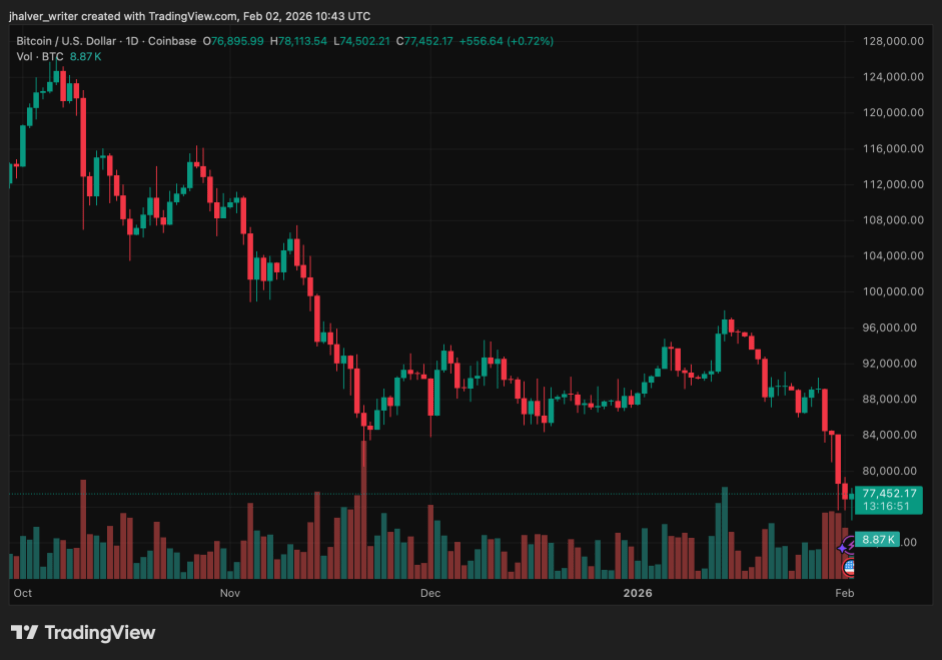
BTC's price trending downwards on the daily chart. Source: BTCUSD on Tradingview

Court Case Adds Pressure On Bitriver

Founded in 2017, BitRiver grew rapidly into Russia’s leading Bitcoin mining operator by building large data centers across Siberia.

The company used the region’s cold climate and relatively low electricity costs to support its mining operations and to provide infrastructure services to corporate clients. At its peak, BitRiver operated thousands of mining rigs across multiple sites and accounted for a significant share of Russia’s legal crypto-mining capacity.

Runets’ detention comes amid mounting challenges for BitRiver. The company was sanctioned by the US Treasury Department in mid-2022 following Russia’s invasion of Ukraine, limiting its access to Western partners and financial systems.

In 2023, Japanese financial group SBI exited its mining arrangement with BitRiver following its withdrawal from Russia, dealing a blow to the firm’s international business.

Financial Strain And Legal Disputes

Reports suggest that BitRiver began cutting costs and scaling back parts of its operations toward the end of 2024, leading to salary payment delays affecting employees.

The pressure continued into early 2025, when regional electricity provider Infrastructure of Siberia filed two lawsuits, alleging that it had paid BitRiver for equipment that was never delivered.

Despite these issues, Russia’s industrial mining sector continued to generate significant revenue in 2024, with BitRiver remaining the market leader. Bloomberg estimated Runets’ net worth at around $230 million in late 2024, largely tied to his role in the crypto mining industry.

Wider Implications for The Crypto Sector

The case against Runets highlights the growing legal and regulatory risks facing crypto executives, both in Russia and abroad. While authorities investigate the alleged tax violations, BitRiver must also manage ongoing litigation, strained partnerships, and scrutiny linked to sanctions.

Related Reading: With Bitcoin Below $80K, ARK Reframes The Narrative Around Gold

As the market awaits the verdict, the case’s outcome could shape how Russian crypto mining firms approach compliance, financing, and governance in an increasingly restrictive environment.

Cover image from ChatGPT, BTCUSD chart from Tradingview

Связанные с этим вопросы

QWhat are the main charges brought against BitRiver's CEO Igor Runets?

AIgor Runets, the founder and CEO of BitRiver, has been detained and formally charged with three counts of alleged tax evasion.

QWhat measures has the Moscow court taken regarding Igor Runets following the charges?

AThe Zamoskvoretsky Court of Moscow ordered Igor Runets to be placed under house arrest, which restricts his movement while the investigation proceeds. His legal team has a limited time to appeal this ruling.

QBesides the tax case, what other significant challenges has BitRiver faced recently?

ABitRiver has faced multiple challenges, including being sanctioned by the US Treasury Department in 2022, the exit of Japanese financial group SBI from their mining arrangement in 2023, cost-cutting measures leading to salary delays, and lawsuits from a regional electricity provider over undelivered equipment.

QHow did BitRiver become Russia's leading Bitcoin mining operator, and what advantages did it utilize?

AFounded in 2017, BitRiver grew rapidly by building large data centers across Siberia. It leveraged the region's cold climate and relatively low electricity costs to support its mining operations and provide infrastructure services to corporate clients.

QWhat broader implications does the case against Runets have for the crypto sector, according to the article?

AThe case highlights the growing legal and regulatory risks for crypto executives globally. Its outcome could influence how Russian crypto mining firms handle compliance, financing, and governance in an increasingly restrictive environment.

Похожее

Trade.xyz's Rebase Refusal Sparks Controversy, On-Chain Pre-IPO Market Faces Major Pricing Test

The debate surrounding Trade.xyz's refusal to adjust its SPCX (SpaceX pre-IPO) perpetual contract pricing amid updated share count revelations highlights a key challenge for on-chain pre-IPO markets. While several centralized exchanges (CEXs) paused and repriced their contracts after SpaceX's filing showed a ~10% increase in total shares, Trade.xyz maintained its market-driven pricing logic, which tracks expected per-share price sentiment rather than fundamental valuation metrics like market cap. This discrepancy triggered cross-platform arbitrage and caused leveraged long positions on Trade.xyz to suffer significant losses, as the platform's HIP-3 architecture lacks a native "Rebase" mechanism to neutrally adjust all user positions following such corporate actions. The incident underscores the difficulty for decentralized perpetual exchanges (Perp DEXs) to implement Rebase—a process CEXs handle by centrally pausing markets and adjusting ledger data. On-chain, this requires complex smart contract modifications, increasing gas costs, complexity, and potential attack surfaces. While some DEXs have managed similar adjustments, Trade.xyz's current design does not natively support it, though the team is reportedly exploring solutions for future events like stock splits. Ultimately, the controversy serves as a critical case study for the nascent on-chain pre-IPO sector, raising questions about price discovery reliability, transparent rule disclosure, and the readiness of DeFi infrastructures to handle traditional corporate actions as real-world assets (RWAs) gain traction.

marsbit8 мин. назад

Trade.xyz's Rebase Refusal Sparks Controversy, On-Chain Pre-IPO Market Faces Major Pricing Test

marsbit8 мин. назад

The 'Middle Eastern Prince' Swindles a Wealthy Woman: Renting Planes and Rolls-Royces, Scamming 120 Million Over Three Years

Two brothers who posed as "Middle Eastern princes" have been sentenced in the United States to 24 and 23 years in prison, respectively, and ordered to pay over $21.2 million in restitution and back taxes. Over three years, they fraudulently obtained approximately $21 million, primarily by promoting fictitious investment projects, including a non-existent cryptocurrency mining operation in a former General Electric industrial park in East Cleveland. The brothers, aged 42 and 33, created elaborate personas: one claimed to be a wealthy royal family heir and the city's "International Economic Advisor," while the other posed as a hedge fund manager with expertise from watching the TV show *Billions*. They bolstered their image by renting luxury cars and private jets and cultivating a relationship with a local mayor's chief of staff, who provided official-looking documents and government event access. A significant portion of the victims' funds, about $18 million, came from a single Chinese investor, a woman from Sichuan with experience in Bitcoin mining. The brothers also defrauded several women, including one former girlfriend. Their scheme unraveled when the primary investor discovered her $6 million worth of mining equipment had been sold off. The case highlights a trend of impostors using fabricated "Middle Eastern royal" identities to target wealthy individuals. Similar incidents include a "Dubai prince" who recently promoted a $500 million family office in Hong Kong and a Colombian man who impersonated a Saudi prince for decades in the US before being caught and sentenced in 2019.

marsbit23 мин. назад

The 'Middle Eastern Prince' Swindles a Wealthy Woman: Renting Planes and Rolls-Royces, Scamming 120 Million Over Three Years

marsbit23 мин. назад

a16z Partner: Being in the Flow of Capital Is the True Moat

A16z Partner: Standing in the Cash Flow is the True Moat Historically, many of the strongest companies built their moats by positioning themselves within "cash flows"—facilitating value creation and transfer in a network and taking a cut. The more value flows, the larger they grow. Crypto is the first modern technology natively built for this. With open ledgers, programmable settlement, and stablecoins enabling internet-speed global value transfer, it allows startups to inherit network effects from day one. Well-designed tokens align users, developers, and the protocol towards network growth, distributing value to contributors. This model isn't new (e.g., railroads, Visa, Google, AWS) but Crypto democratizes it. It lets entrepreneurs target areas with high inefficiency and profit extraction—like traditional finance's payments, custody, FX, and settlement—to compress costs, increase speed, and redistribute value by standing in the new flow. The opportunity extends beyond finance to emerging markets like GPU/compute, AI training data, energy, and space, where new, programmable infrastructure can be built without legacy constraints. Key questions for founders: Are you already in the cash flow? Does your revenue scale 10x with network activity? Where is profit extraction highest relative to value created in your market? The strategy is clear: compress the old cost structure, position yourself in the new value stream, and let the network compound.

marsbit50 мин. назад

a16z Partner: Being in the Flow of Capital Is the True Moat

marsbit50 мин. назад

Capturing 15 Top-Tier Zero-Day Vulnerabilities: A Consensus Protocol Debug Agent Framework Built by 0G Lab in Collaboration with Teams from NUS, PKU, and BUPT

"Agents Capture 15 Critical Zero-Day Bugs: 0G Lab's Multi-Agent Framework Automates Debugging in Consensus Protocols" Distributed consensus protocols are notoriously difficult to debug due to complex, intertwined states. A novel framework, Agora, developed by 0G Labs with researchers from NUS, Peking University, and Beijing University of Posts and Telecommunications, tackles this by fusing deep domain expertise with a collaborative multi-agent LLM architecture. Agora moves beyond the limitations of single LLMs and traditional testing like fuzzing. It employs three specialized agents: an Orchestrator for global state, a Strategy agent for generating attack scenarios using distributed systems knowledge, and a TestGen agent that creates executable tests. A core innovation is its efficient "Succinct Memory & Communication" mechanism and a dynamic test harness. This allows the system to translate abstract hypotheses into concrete tests across languages like Go and Rust, run them, capture failures, and refine the approach in a closed loop—all with minimal token overhead. In rigorous evaluations on production-level protocols including Raft, EPaxos, and components from etcd and Sui, Agora discovered 15 previously unknown deep logic bugs (e.g., execution divergence, liveness violations). In stark contrast, powerful standalone LLMs like GPT-5.2 and Claude 4.5 found zero such bugs. Agora achieved this with a high precision of 73.9% and at an average cost of only about $40 per bug found. The framework demonstrates high generalizability. Its decoupled design allows the "Multi-Agent + Hypothesis-Driven Testing" paradigm to be applied to other complex domains like database concurrency control, OS kernels, and Web3 smart contract auditing. By enabling efficient, automated detection of deep logic flaws, Agora points the way for AI-powered security in critical infrastructure, aligning with the growing trends of agentic systems and automated quality control.

marsbit53 мин. назад

Capturing 15 Top-Tier Zero-Day Vulnerabilities: A Consensus Protocol Debug Agent Framework Built by 0G Lab in Collaboration with Teams from NUS, PKU, and BUPT

marsbit53 мин. назад

Торговля

Спот
Фьючерсы

Популярные статьи

Как купить S

Добро пожаловать на HTX.com! Мы сделали приобретение Sonic (S) простым и удобным. Следуйте нашему пошаговому руководству и отправляйтесь в свое крипто-путешествие.Шаг 1: Создайте аккаунт на HTXИспользуйте свой адрес электронной почты или номер телефона, чтобы зарегистрироваться и бесплатно создать аккаунт на HTX. Пройдите удобную регистрацию и откройте для себя весь функционал.Создать аккаунтШаг 2: Перейдите в Купить криптовалюту и выберите свой способ оплатыКредитная/Дебетовая Карта: Используйте свою карту Visa или Mastercard для мгновенной покупки Sonic (S).Баланс: Используйте средства с баланса вашего аккаунта HTX для простой торговли.Третьи Лица: Мы добавили популярные способы оплаты, такие как Google Pay и Apple Pay, для повышения удобства.P2P: Торгуйте напрямую с другими пользователями на HTX.Внебиржевая Торговля (OTC): Мы предлагаем индивидуальные услуги и конкурентоспособные обменные курсы для трейдеров.Шаг 3: Хранение Sonic (S)После приобретения вами Sonic (S) храните их в своем аккаунте на HTX. В качестве альтернативы вы можете отправить их куда-либо с помощью перевода в блокчейне или использовать для торговли с другими криптовалютами.Шаг 4: Торговля Sonic (S)С легкостью торгуйте Sonic (S) на спотовом рынке HTX. Просто зайдите в свой аккаунт, выберите торговую пару, совершайте сделки и следите за ними в режиме реального времени. Мы предлагаем удобный интерфейс как для начинающих, так и для опытных трейдеров.

1.4k просмотров всегоОпубликовано 2025.01.15Обновлено 2026.06.02

Как купить S

Sonic: Обновления под руководством Андре Кронье – новая звезда Layer-1 на фоне спада рынка

Он решает проблемы масштабируемости, совместимости между блокчейнами и стимулов для разработчиков с помощью технологических инноваций.

2.3k просмотров всегоОпубликовано 2025.04.09Обновлено 2025.04.09

Sonic: Обновления под руководством Андре Кронье – новая звезда Layer-1 на фоне спада рынка

HTX Learn: Пройдите обучение по "Sonic" и разделите 1000 USDT

HTX Learn — ваш проводник в мир перспективных проектов, и мы запускаем специальное мероприятие "Учитесь и Зарабатывайте", посвящённое этим проектам. Наше новое направление .

1.8k просмотров всегоОпубликовано 2025.04.10Обновлено 2025.04.10

HTX Learn: Пройдите обучение по "Sonic" и разделите 1000 USDT

Обсуждения

Добро пожаловать в Сообщество HTX. Здесь вы сможете быть в курсе последних новостей о развитии платформы и получить доступ к профессиональной аналитической информации о рынке. Мнения пользователей о цене на S (S) представлены ниже.

活动图片