Running MoE on Mobile Phones? Meta Proposes MobileMoE, Speeding Up iPhone 16 Pro by 3.8x

marsbitОпубликовано 2026-06-01Обновлено 2026-06-01

Введение

Meta's MobileMoE, a mobile-optimized Mixture-of-Experts (MoE) language model architecture, enables efficient on-device large language model (LLM) inference for the first time on commercial smartphones. Designed for decoder-only Transformers, it replaces dense feed-forward layers with MoE layers. Key design choices include 8 experts with granularity g=8, top-4 routing, and a shared expert. The model undergoes a four-stage training process: pre-training, intermediate training, supervised fine-tuning, and quantization-aware training. Results show MobileMoE models, with similar memory footprint, achieve equal or higher average accuracy across 14 foundational benchmarks while using only 1/2 to 1/4 of the FLOPs compared to dense baselines. After INT4 quantization, they remain competitive. Notably, on an iPhone 16 Pro, MobileMoE-S demonstrates significant speedups: up to 3.8x faster in the prompt phase and 2.2-3.4x faster in per-token generation compared to a dense counterpart, with lower peak memory usage. While MobileMoE establishes a new Pareto frontier for on-device LLMs in accuracy-compute trade-offs, particularly excelling in code and math tasks, it currently lags behind models like Qwen3.5 2B in advanced instruction following and knowledge reasoning. Future work includes improving post-training techniques, exploring NPU deployment, and managing the runtime memory sensitivity of MoE models to varying inputs.

In recent years, the Mixture of Experts (MoE) model has been widely used in large cloud-based models. However, on the mobile side, Large Language Models (LLMs) are still predominantly based on dense architectures. In the past, mobile devices imposed stricter constraints on memory, computing power, and latency, and there was a lack of systematic research on on-device MoE within the sub-billion active parameter range. Now, with the increase in DRAM capacity of mobile devices, MoE also has the opportunity to be deployed on smartphones.

The MobileMoE proposed by Meta's team achieves efficient MoE inference on commercial smartphones for the first time. The results show that across 14 foundational tests, MobileMoE-S/M, with similar memory usage, achieved comparable or even higher average accuracy using only 1/2 to 1/4 of the inference compute of dense baselines. In real-world tests, MobileMoE-S showed the most significant speedup on the iPhone 16 Pro's GPU/MLX backend, with a maximum speedup of 3.8x during the input phase.

Paper Link: https://arxiv.org/abs/2605.27358

The research team also proposed a set of on-device MoE scaling laws to determine model structures more suitable for mobile deployment. MobileMoE establishes a new Pareto frontier for on-device large language models, achieving better results in the trade-off between accuracy and inference computational overhead.
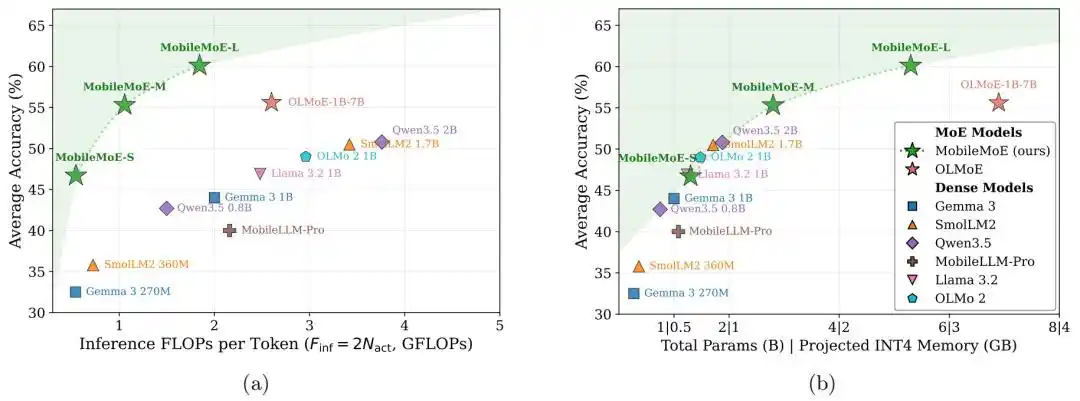
Figure | MobileMoE establishes a new Pareto frontier for on-device large language models.

How is MobileMoE Designed?

MobileMoE can be understood as follows: it is a class of MoE language models designed for on-device deployment. The overall architecture remains a decoder-only Transformer, but the original dense feed-forward layers are replaced with MoE layers. The router selects the top-scoring few experts for each token to participate in computation, while a shared expert always participates. The entire training process is divided into four steps: pretraining, intermediate training, supervised fine-tuning, and quantization-aware training.

Pretraining: The research team pretrained the model using approximately 6T tokens of open-licensed data with a context length of 2048. The data primarily consisted of web content, while also covering domains such as mathematics, code, knowledge, and science.

Intermediate Training: The research team extended the context length to 8192 and further increased the proportion of high-quality data in areas like knowledge, code, mathematics, and science, with a total scale of about 500B tokens.

Supervised Fine-Tuning (SFT): The research team fine-tuned MobileMoE-Base on open-licensed instruction-tuning data comprising over 80 million samples.

Quantization-Aware Training: The research team quantized linear layers and embeddings to INT4, activations to INT8 with dynamic quantization, while the router retained FP32 precision.

Figure | The four-stage training of MobileMoE.

Experimental Results

Ablation Study Results

The research team first compared three architectural variables: the number of experts E, expert granularity g, and the inclusion of a shared expert.
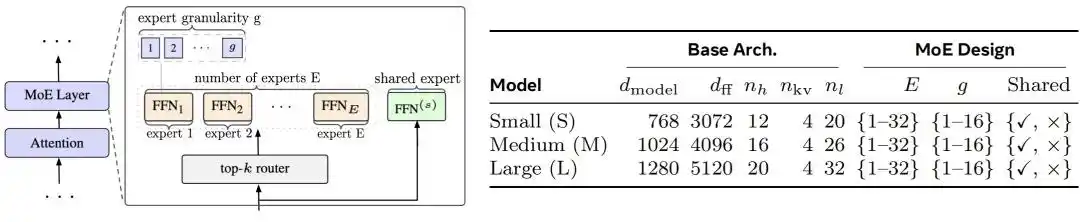
Figure | Scaling the number of experts E.

Under a fixed memory budget, when memory is above approximately 0.25GB, the loss of MoE begins to be lower than that of the corresponding dense model. Continuing to increase the number of experts E further reduces the loss, but the marginal gain significantly diminishes after E increases to 8. Experiments on expert granularity g indicate that finer-grained expert configurations are generally better, with g=8 achieving a good balance between effectiveness and training cost; when g increases from 8 to 16, the loss improvement is less than 0.01, but training time increases by about 50%. Under the same computational budget, the model loss further decreases after adding a shared expert.

Based on the ablation study results, the research team ultimately adopted the configuration with E=8, g=8, and a shared expert, i.e., 60 fine-grained routing experts, Top-4 routing, and 1 shared expert, and used this architecture for the three versions: MobileMoE-S, M, and L.
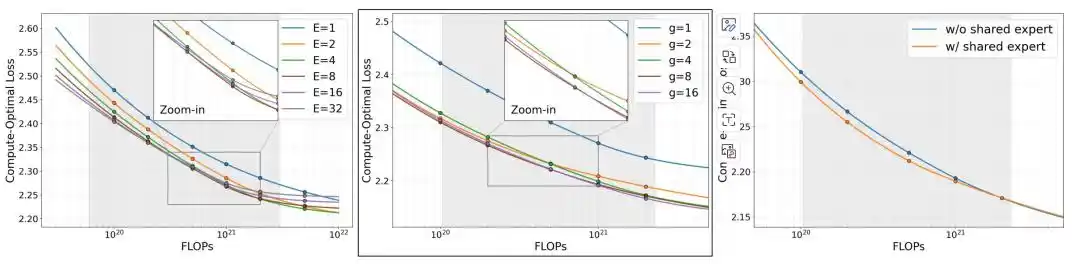
Figure | Scaling MoE models under compute-optimal conditions.
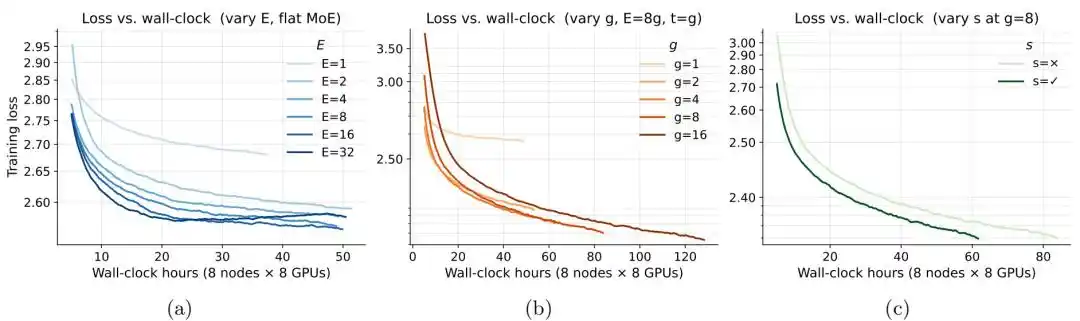
Figure | Training efficiency of the MoE architecture.

14 Foundational Evaluations: Establishing a New On-Device Pareto Frontier

The research team compared MobileMoE with models such as Gemma 3, SmolLM2, Qwen3.5, OLMo 2, and OLMoE-1B-7B under a unified setup across 14 foundational evaluations in five categories: commonsense reasoning, knowledge, science, reading, and reasoning.
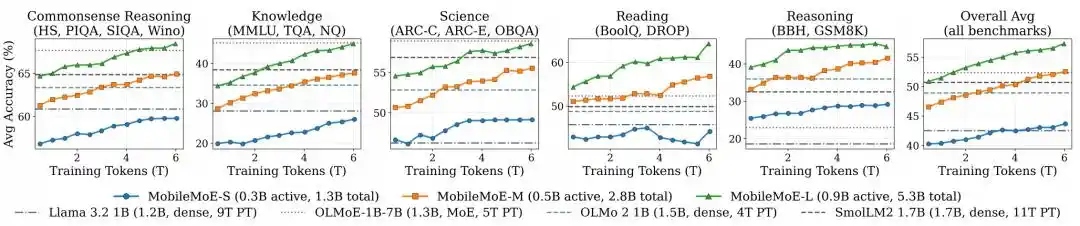
Figure | Pretraining trajectory of MobileMoE.

Comparison results for Base models show that the average score of MobileMoE-M is higher than that of Qwen3.5 2B, and the average score of MobileMoE-L is higher than that of OLMoE-1B-7B, while also requiring a smaller model size. The team also noted that the average score of the Base version of MobileMoE-L is already higher than that of the Instruct version of OLMoE-1B-7B. In terms of training scale, MobileMoE uses about 6T pretraining tokens, which is less than Llama 3.2 1B's 9T and SmolLM2 1.7B's 11T. In the overall comparison of instruction-tuned models, the average accuracy of MobileMoE-M is already close to that of OLMoE-1B-7B, but with both active and total parameters reduced by about 60%.

Figure | Comparison of MobileMoE-Base models.

Advanced Evaluations: More Prominent Advantages in Code and Math Tasks

In advanced evaluations after instruction tuning, MobileMoE performs more prominently on code and math tasks. Taking MobileMoE-L as an example, its average scores in both code and math categories are higher than those of Qwen3.5 2B and OLMoE-1B-7B. However, the research team also notes that in terms of instruction-following and knowledge reasoning capabilities, Qwen3.5 2B remains stronger.
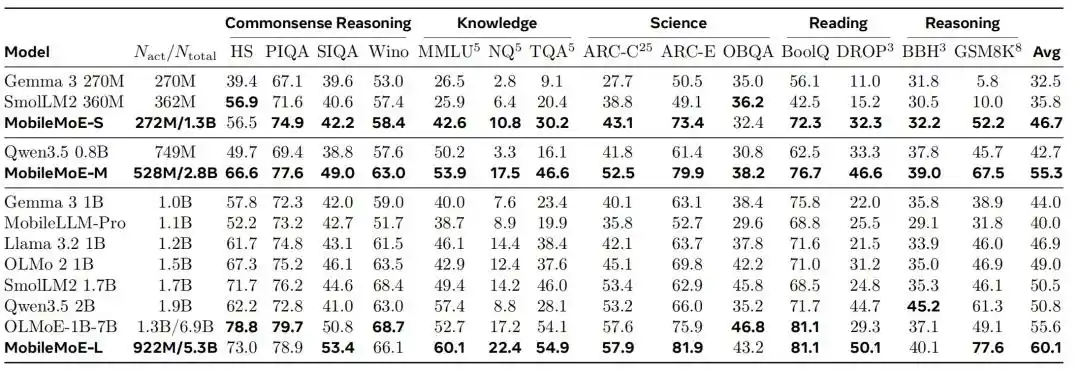
Figure | Comparison of Instruct models on advanced benchmarks.

Quantization and On-Device Deployment: Remains Competitive After INT4, Significant Speedup on Mobile

After quantization, the overall average scores of MobileMoE-S/M/L decreased compared to their respective BF16 versions, but the drops were roughly within 2 to 3 points. Even so, the performance of the INT4 version of MobileMoE-L remained higher than the BF16 version of OLMoE-1B-7B Instruct.

The research team also deployed MobileMoE on Samsung Galaxy S25 and iPhone 16 Pro for testing. The results show that under comparable INT4 weight memory conditions, MobileMoE-S, compared to MobileLLM-Pro, achieved speedups of 1.8-3.8x during the input phase and speedups of 2.2-3.4x during token-by-token generation.

In terms of memory usage, under conditions of Samsung Galaxy S25, 8K context length, and real prompts, the peak RSS of MobileMoE-S was 1.49GB, lower than MobileLLM-Pro's 1.91GB.

Figure | On-device runtime latency.

Limitations and Future Directions

Currently, in terms of higher-order instruction following, knowledge, and reasoning capabilities, the instruction-tuned MobileMoE still lags behind Qwen3.5 2B. The research team believes this gap may be related to more comprehensive post-training. In the future, to narrow this gap, training-side efforts should focus on strengthening distillation, inference-oriented post-training, and multimodal extension.

Furthermore, the research team points out that the memory footprint of MoE on mobile phones varies with input content. Compared to templated inputs, real inputs typically lead to higher memory usage. Testing solely based on templated inputs might underestimate the actual memory pressure in real deployment scenarios. In the future, to more accurately evaluate the real memory performance of on-device MoE, more real-world measurement data is needed.

At the same time, the research team has already completed systematic real-device testing on CPU and GPU backends, but the NPU path remains to be explored. Additionally, the runtime memory footprint of MoE is relatively sensitive to input content. In the future, dynamic routing, expert pruning, mixed-precision quantization, and mobile NPU deployment are all directions for further improving on-device efficiency.

For more technical details, please refer to the original paper.

This article is from the WeChat public account "Academic Headlines" (ID: SciTouTiao), Author: Xia Qiansi


Связанные с этим вопросы

QWhat is MobileMoE and what problem does it address?

AMobileMoE is an efficient Mixture of Experts (MoE) language model designed by Meta for on-device deployment on smartphones. It addresses the challenge of deploying large language models (LLMs) with MoE architecture on mobile devices, which traditionally have stringent constraints on memory, compute power, and latency, making them predominantly use dense architectures. MobileMoE aims to provide competitive accuracy with significantly less computational cost than dense baselines.

QWhat key speed improvement did MobileMoE achieve on the iPhone 16 Pro?

AIn real-world testing, MobileMoE-S showed the most significant speed improvement on the iPhone 16 Pro's GPU/MLX backend, achieving up to a 3.8x speedup during the input processing phase.

QWhat are the main stages in the training process of MobileMoE?

AThe training process for MobileMoE consists of four main stages: 1) Pre-training on ~6T tokens with a 2048 context length, 2) Mid-training which extends the context to 8192 and uses ~500B higher-quality tokens, 3) Supervised Fine-Tuning (SFT) on over 80 million open-licensed instruction-following samples, and 4) Quantization-Aware Training (QAT), quantizing most layers to INT4/INT8 while keeping the router at FP32.

QWhat are the primary limitations or future directions mentioned for MobileMoE?

AThe main limitations are that MobileMoE still lags behind models like Qwen3.5 2B in higher-order instruction following and knowledge/reasoning capabilities. Future directions to address this include enhanced distillation, inference-oriented post-training, and multimodal extension. Additionally, MoE's runtime memory usage is sensitive to input content, and deploying on mobile NPUs remains an unexplored avenue for further efficiency gains.

QHow does MobileMoE's performance on code and mathematical tasks compare to other models in advanced evaluations?

AIn advanced evaluations after instruction fine-tuning, MobileMoE showed more pronounced advantages on code and mathematical tasks. For example, the MobileMoE-L model achieved higher average scores on code and math benchmarks compared to both Qwen3.5 2B and OLMoE-1B-7B.

Похожее

Should You Buy SpaceX Stock at $1.7 Trillion? Here's What the Market Is Worried About

SpaceX is preparing for a massive IPO aiming to raise around $75 billion at a valuation of approximately $1.75 trillion. While its achievements in reusable rockets and the profitable Starlink satellite internet service are clear, the market is concerned about the aggressive valuation. Key issues include: the current $1.75 trillion valuation, which is about 94 times 2025 revenue, seems to price in not just existing businesses but also unproven future ventures like AI infrastructure and orbital data centers. Financially, while Starlink is profitable, the AI division, bolstered by the acquisition of xAI, is incurring massive losses and consuming the majority of capital expenditures. This acquisition also introduced complex related-party financing arrangements and debt onto SpaceX's balance sheet. Furthermore, corporate governance poses a challenge. SpaceX's dual-class share structure ensures founder Elon Musk retains absolute control, limiting ordinary shareholders' influence over high-risk, long-term strategic decisions. The future success of ambitious projects like the Starship rocket—critical for lowering costs and enabling new services—remains a significant variable for the valuation. In summary, the market's apprehension (FUD) centers not on doubting SpaceX's past technological triumphs but on questioning how much premium public investors should pay for a future that combines proven profits with highly speculative and capital-intensive new ventures, all under a governance structure that offers limited shareholder oversight.

marsbit37 мин. назад

Should You Buy SpaceX Stock at $1.7 Trillion? Here's What the Market Is Worried About

marsbit37 мин. назад

Breaking the DeFi Cascading Liquidation Curse: Vitalik Proposes a New Solution

Vitalik Buterin has proposed a new DeFi design to eliminate the automatic liquidation mechanism that causes market instability during sharp downturns. The current system, used by protocols like Aave, triggers forced sales when collateral value falls below a threshold, often exacerbating price drops and creating systemic selling pressure. Buterin's alternative model is based on splitting an asset like ETH into two synthetic option-like tokens, P and N, pegged to a price index. Their combined value always equals one ETH. Instead of sudden liquidation, a position's value gradually drifts from its target peg if the market moves. Users must proactively rebalance their holdings to maintain their desired exposure, transferring the management burden from the protocol to the user or automated tools. A key advantage is the reduced reliance on real-time oracles. Pricing decisions are deferred until contract expiry, allowing for more robust, fault-tolerant oracle designs. This removes a clear liquidation threshold that speculators can target for manipulation or MEV extraction. However, significant challenges remain. Frequent rebalancing could incur high slippage and transaction costs, necessitating new liquidity provider models. The design is better suited for hedging instruments than for stablecoins requiring a rigid 1:1 peg. While not an immediate replacement for existing systems, the proposal challenges the foundational assumption that instantaneous forced liquidation is an unavoidable necessity in DeFi, opening the door for fundamentally different risk management architectures.

marsbit41 мин. назад

Breaking the DeFi Cascading Liquidation Curse: Vitalik Proposes a New Solution

marsbit41 мин. назад

The End of Single-Factor Cryptography

The article "The End of Single-Factor Crypto" posits a fundamental shift in the cryptocurrency ecosystem. It argues the era where crypto asset valuations were predominantly driven by, and correlated with, Bitcoin's price is ending. The space is bifurcating into two distinct economies: endogenous and exogenous. The endogenous economy represents traditional crypto, where token and project values are directly tied to crypto market prices. The emerging exogenous economy comprises projects and businesses that may utilize blockchain technology or tokens but derive their fundamental value from external, non-crypto factors like consumer demand, subscription revenue, or real-world utility. Examples include AI inference platforms like Venice, fintech lenders using blockchain for efficiency, and stablecoin/payment infrastructure companies acquired by giants like Mastercard and Stripe. This shift means investment analysis must change. For exogenous assets, evaluating traditional business fundamentals—such as revenue streams, unit economics, and competitive moats—becomes more critical than tracking Bitcoin charts. While endogenous assets like Bitcoin remain relevant, the growth of the exogenous category is driven by measurable demand independent of crypto price cycles, paving the way for a new, more diversified market phase. Consequently, crypto is evolving from a single-factor, reflexive asset class into a multifaceted ecosystem with varied drivers and investment theses.

marsbit42 мин. назад

The End of Single-Factor Cryptography

marsbit42 мин. назад

Morning Post | Bitmine Plans to Raise $300 Million Through Preferred Stock Issuance; Polymarket Accuses Kalshi of Commercial Espionage

ChainCatcher's Daily Crypto Brief: Key developments from the past 24 hours include significant funding moves, regulatory actions, and market predictions. Bitmine announced a $300 million preferred stock fundraising. Polymarket accused rival prediction platform Kalshi of corporate espionage, citing numerous suspicious coincidences in product launches, a claim Kalshi strongly denied. The U.S. Department of Justice, in a joint "Disruption Week" anti-fraud operation with companies like Coinbase and Meta, froze over $3.8 million in cryptocurrency linked to scams. In infrastructure news, Macau completed its integration with the multi-central bank digital currency bridge, mBridge, aiming to build efficient cross-border payment channels. Cosmos Labs acquired the block explorer Mintscan. Market-wise, Geoffrey Kendrick, Standard Chartered's Head of Digital Assets Research, stated Bitcoin is nearing a bottom around $63,000, maintaining a year-end target of $100,000. He noted stability in U.S. spot Bitcoin ETF holdings. Ahead of SpaceX's anticipated IPO, internal insiders at Rocket Lab (RKLB) sold over $18.41 million in stock. In tokenization, Goldman Sachs partnered with Apex and Archax to launch a tokenized real estate fund. The meme token tracker GMGN reported the top trending tokens: on Ethereum, HEX, SHIB, LINK, PEPE, mUSD; on Solana, TROLL, swarms, WORLDCUP, neet, Buttcoin; and on Base, PEPE, toby, ODDS, ELSA, SKI.

链捕手56 мин. назад

Morning Post | Bitmine Plans to Raise $300 Million Through Preferred Stock Issuance; Polymarket Accuses Kalshi of Commercial Espionage

链捕手56 мин. назад

Торговля

Спот
Фьючерсы
活动图片