Ripple’s Fed Master Account Bid Gains Momentum After Trump Order

bitcoinistОпубликовано 2026-05-21Обновлено 2026-05-21

Введение

President Donald Trump has signed an executive order directing financial regulators and the Federal Reserve to review expanding fintech and crypto firms' access to core payment infrastructure. This order significantly advances the industry's push for direct Fed connectivity, a central issue for Ripple. The company has been seeking a Federal Reserve master account as part of its strategy for its RLUSD stablecoin, which would allow it to hold reserves directly with the central bank and access its payment rails. The order, titled "Integrating Financial Technology Innovation into Regulatory Frameworks," mandates a Fed review within 120 days on allowing access for entities like uninsured depository institutions and non-bank financial companies, including those in digital assets. This creates a formal policy timeline for resolving whether crypto payment firms must rely on traditional bank intermediaries. Ripple's application for a national bank charter and a master account is part of this broader landscape. The issue gained precedent when Kraken Financial received a limited-purpose master account, while Custodia Bank's application was denied after a legal battle. The Fed has also proposed a more restricted "payment account" option. Trump's order does not guarantee approval for Ripple but forces a high-level examination of the regulatory barriers, bringing the company's long-running effort to the forefront of Washington's financial policy agenda.

President Donald Trump has signed an executive order pushing US financial regulators and requesting action from the Federal Reserve to review whether fintech and crypto-linked firms should get broader access to core payment infrastructure. For Ripple, which has been seeking a Fed master account tied to its RLUSD stablecoin strategy, the order moves a long-running industry fight closer to the center of Washington’s financial policy agenda.

The May 19 order, titled “Integrating Financial Technology Innovation into Regulatory Frameworks,” frames the issue as one of competition and modernization. “The Federal Government must update regulations to allow integration of digital assets and innovative technology into traditional financial services and payment systems. The Federal Government must also remove overly burdensome and fragmented regulations and supervisory practices that form barriers to entry and primarily benefit incumbent financial services firms,” the order says.

The most important section for crypto firms is the part on Federal Reserve services. The order asks the Fed to evaluate the legal, regulatory and policy framework for access to Reserve Bank payment accounts and payment services by uninsured depository institutions and non-bank financial companies, including those engaged in digital assets. The Fed is requested to submit findings and recommendations within 120 days, including whether existing law allows expanded access and whether regional Reserve Banks can act independently when granting or denying applications.

What This Means For Ripple

For Ripple, the timing is notable. In July 2025, CEO Brad Garlinghouse said the company had applied for a US national bank charter, while also seeking a Fed master account that would let it access Federal Reserve payment infrastructure and hold RLUSD reserves directly with the central bank. Ripple’s charter application was confirmed by the Office of the Comptroller of the Currency, while the master account bid was positioned as part of the company’s broader stablecoin and payments strategy.

Ripple’s application is not occurring in isolation. Kraken Financial, the exchange’s Wyoming-chartered banking arm, announced in March that it had received a Federal Reserve master account, becoming the first digital asset bank in the US to gain direct access to the Fed’s payment infrastructure. Kraken said the approval followed more than five years of regulatory engagement and would allow direct connectivity to Fedwire without relying on intermediary banks.

That approval has become the template and warning sign for the rest of the sector. Kraken’s account is limited-purpose and initially granted for one year, giving it access to Fedwire and limited overnight balances, but not interest on reserves, emergency Fed lending, FedNow or ACH. Other firms seeking similar access include Ripple, Anchorage Digital and Wise.

Notably, the issue has already been tested in court. Custodia Bank, another Wyoming crypto-focused institution, applied for a master account in October 2020, sued the Fed in 2022 over delays, and saw its application denied in January 2023. In 2025 and 2026, appeals court decisions reinforced the view that Reserve Banks retain discretion to reject master account requests, a legal backdrop Trump’s order now explicitly asks the Fed to examine.

Ripple has also shown interest in a more limited route. In November, Ripple chief legal officer Stu Alderoty said the Fed’s “skinny” account concept was attractive despite restrictions, because it could still improve RLUSD reserve redeemability without granting the full benefits of a traditional master account.

The Fed had already opened that door before Trump’s order. In December, it requested public input on a special-purpose “payment account” for eligible institutions focused on payments innovation. The prototype would be distinct from a master account, would not pay interest, would not provide Fed credit, and would be subject to balance caps.

Ripple’s stablecoin push gives the master account question added weight. The company said in December that the OCC had conditionally approved Ripple National Trust Bank, a federally supervised trust bank that would manage RLUSD reserves under both NYDFS and OCC oversight.

Overall, Trump’s order does not grant Ripple a master account. It does, however, force the policy question into a formal timeline: whether firms building crypto payment and stablecoin infrastructure should remain dependent on bank intermediaries, or gain direct, risk-limited access to the sovereign rails beneath dollar settlement.

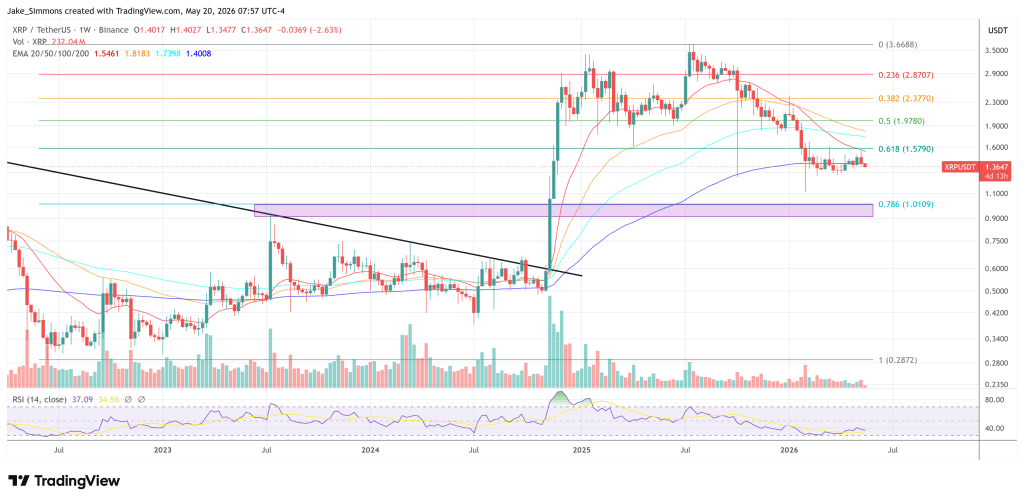
At press time, XRP traded at $1.3647.

XRP bulls must break the 0.618 Fib, 1-week chart | Source: XRPUSDT on TradingView.com

Связанные с этим вопросы

QWhat specific action did President Trump's executive order request from the Federal Reserve regarding fintech and crypto firms?

AThe executive order requested the Federal Reserve to evaluate the legal, regulatory, and policy framework for access to Reserve Bank payment accounts and services by uninsured depository institutions and non-bank financial companies, including those engaged in digital assets. The Fed must submit its findings and recommendations within 120 days.

QWhy is the timing of Trump's executive order particularly notable for Ripple?

AThe timing is notable because Ripple, as part of its broader stablecoin and payments strategy, had applied for a US national bank charter and a Fed master account in July 2025. The order directly pushes the policy question of access to Fed infrastructure into a formal review timeline, which is central to Ripple's plans for its RLUSD stablecoin.

QWhich crypto company has already received a Federal Reserve master account, and what are its limitations?

AKraken Financial, the Wyoming-chartered banking arm of the Kraken exchange, received a Federal Reserve master account. It is a limited-purpose account granted initially for one year, providing access to Fedwire and limited overnight balances, but not interest on reserves, emergency Fed lending, FedNow, or ACH services.

QWhat is the 'skinny' account concept mentioned in relation to Ripple, and why was it considered attractive?

AThe 'skinny' account concept, or the Fed's proposed special-purpose 'payment account,' is a more limited access option. Ripple found it attractive because, despite restrictions like no interest and balance caps, it could still improve the redeemability of RLUSD reserves without granting the full benefits of a traditional master account.

QWhat was the outcome of Custodia Bank's legal battle with the Federal Reserve over a master account, and why is it relevant now?

ACustodia Bank applied for a master account in 2020, sued the Fed over delays in 2022, and had its application denied in 2023. Subsequent court decisions reinforced that Reserve Banks retain discretion to reject such requests. This legal backdrop is relevant because Trump's order explicitly asks the Fed to examine the issue of access and discretion.

Похожее

Two Companies Capture 90% of AI Startup's $80 Billion ARR

The AI startup landscape is highly concentrated, with OpenAI and Anthropic capturing 89% of an estimated $80 billion in annualized revenue among 34 leading companies. OpenAI, with $24-25B in revenue, primarily drives growth through ChatGPT's consumer subscriptions, while Anthropic, exceeding $30B, focuses on enterprise API integration and has rapidly grown its U.S. enterprise market share from under 1% to 34.4% in under two years. The remaining 32 companies share just 11% of the revenue, facing intense pressure as resources, talent, and market attention consolidate around the two giants. This creates a self-reinforcing cycle where higher revenue fuels greater compute investment and model improvement. Despite their dominance, both leaders face challenges. OpenAI is navigating significant legal disputes and partnership tensions, while Anthropic operates under the high expectations of its massive backers like Amazon. Historical parallels in tech infrastructure (e.g., search engines, mobile OS) suggest such oligopolistic tendencies are common due to scale, network effects, and high switching costs, indicating the market could become even more concentrated. However, the rapid pace of AI innovation leaves room for disruption. For other players, the strategic path forward is not direct competition with the giants but specialization in vertical domains where general-purpose models fall short—such as legal, medical, or industrial applications—building indispensable, niche solutions.

marsbit6 мин. назад

Two Companies Capture 90% of AI Startup's $80 Billion ARR

marsbit6 мин. назад

Silicon Bull, Carbon Bear: The Wealth Code of 2026 is Only 'Chips' and 'Light'

The article, titled "Silicon Bull, Carbon Bear: In 2026, the Wealth Code Lies Only in 'Chips' and 'Optics'", discusses the extreme market divergence in 2026 driven by the AI investment frenzy. Investment managers who concentrated on the AI hardware supply chain, particularly computing infrastructure, optical modules, and memory chips, have seen their fund net asset values (NAVs) surge dramatically, even reaching record highs. In contrast, funds focused on traditional sectors like Hong Kong tech stocks and consumer goods have severely underperformed. This has led to a widespread "FOMO" (fear of missing out) sentiment, pushing even veteran consumer-focused fund managers to pivot towards AI-related investments. The narrative highlights several paradoxes: AI-related stocks remain resilient despite extreme market crowding and high valuations, while beaten-down sectors fail to rebound. The author dubs this split market "Silicon Bull, Carbon Bear," suggesting a bull market only for those invested in silicon-based tech (AI hardware) and a bear market for carbon-based traditional economy sectors. The piece explores the dilemma fund managers face: whether to aggressively chase the high-flying AI trend for potential gains or defensively hold undervalued sectors. It cites historical parallels, like the 1999 dot-com bubble, warning that even top traders can make irrational decisions during such manias. Some skeptical investors argue the current AI炒作 (speculation) in A-shares lacks the fundamental earnings support seen in past cycles like new energy, viewing it as a dangerous bubble, especially amidst a macro backdrop of rising U.S. bond yields. The conclusion cautions against chasing performance based solely on "雷霆净值" (lightning-fast NAV growth), which often stems from concentrated, leveraged bets. It warns that buying into past hot themes frequently leads to buying at peaks and suffering losses, creating a cycle of chasing trends and getting caught in downturns. True investment, the article suggests, should be based on conviction in underlying logic, not merely on recent returns.

marsbit25 мин. назад

Silicon Bull, Carbon Bear: The Wealth Code of 2026 is Only 'Chips' and 'Light'

marsbit25 мин. назад

Торговля

Спот
Фьючерсы

Популярные статьи

Как купить S

Добро пожаловать на HTX.com! Мы сделали приобретение Sonic (S) простым и удобным. Следуйте нашему пошаговому руководству и отправляйтесь в свое крипто-путешествие.Шаг 1: Создайте аккаунт на HTXИспользуйте свой адрес электронной почты или номер телефона, чтобы зарегистрироваться и бесплатно создать аккаунт на HTX. Пройдите удобную регистрацию и откройте для себя весь функционал.Создать аккаунтШаг 2: Перейдите в Купить криптовалюту и выберите свой способ оплатыКредитная/Дебетовая Карта: Используйте свою карту Visa или Mastercard для мгновенной покупки Sonic (S).Баланс: Используйте средства с баланса вашего аккаунта HTX для простой торговли.Третьи Лица: Мы добавили популярные способы оплаты, такие как Google Pay и Apple Pay, для повышения удобства.P2P: Торгуйте напрямую с другими пользователями на HTX.Внебиржевая Торговля (OTC): Мы предлагаем индивидуальные услуги и конкурентоспособные обменные курсы для трейдеров.Шаг 3: Хранение Sonic (S)После приобретения вами Sonic (S) храните их в своем аккаунте на HTX. В качестве альтернативы вы можете отправить их куда-либо с помощью перевода в блокчейне или использовать для торговли с другими криптовалютами.Шаг 4: Торговля Sonic (S)С легкостью торгуйте Sonic (S) на спотовом рынке HTX. Просто зайдите в свой аккаунт, выберите торговую пару, совершайте сделки и следите за ними в режиме реального времени. Мы предлагаем удобный интерфейс как для начинающих, так и для опытных трейдеров.

1.3k просмотров всегоОпубликовано 2025.01.15Обновлено 2025.03.21

Как купить S

Sonic: Обновления под руководством Андре Кронье – новая звезда Layer-1 на фоне спада рынка

Он решает проблемы масштабируемости, совместимости между блокчейнами и стимулов для разработчиков с помощью технологических инноваций.

2.2k просмотров всегоОпубликовано 2025.04.09Обновлено 2025.04.09

Sonic: Обновления под руководством Андре Кронье – новая звезда Layer-1 на фоне спада рынка

HTX Learn: Пройдите обучение по "Sonic" и разделите 1000 USDT

HTX Learn — ваш проводник в мир перспективных проектов, и мы запускаем специальное мероприятие "Учитесь и Зарабатывайте", посвящённое этим проектам. Наше новое направление .

1.8k просмотров всегоОпубликовано 2025.04.10Обновлено 2025.04.10

HTX Learn: Пройдите обучение по "Sonic" и разделите 1000 USDT

Обсуждения

Добро пожаловать в Сообщество HTX. Здесь вы сможете быть в курсе последних новостей о развитии платформы и получить доступ к профессиональной аналитической информации о рынке. Мнения пользователей о цене на S (S) представлены ниже.

活动图片