Ripple Exec Warns: Banks Without A Stablecoin Strategy ‘Will Get Left Behind’

bitcoinistОпубликовано 2025-12-11Обновлено 2025-12-11

Введение

Ripple executive Reece Merrick warns that banks and financial institutions without a stablecoin strategy risk being left behind. He emphasized that stablecoins are becoming core to payments and treasury infrastructure. Ripple’s USD-backed stablecoin, RLUSD, recently gained regulatory approval in Abu Dhabi, allowing licensed institutions to use it for regulated activities. Backed by stringent regulators like NYDFS and FSRA, RLUSD aims to be an institutional-grade product. Though its circulation is modest compared to giants like Tether, Ripple targets integration into high-volume institutional flows through recent acquisitions and its existing cross-border payment network, which has processed $95 billion. Merrick highlighted trust, regulation, and real-world utility as key to driving adoption and future growth in the multi-trillion-dollar stablecoin market.

Ripple’s Middle East and Africa boss has a blunt message for the banking sector: if you still do not have a stablecoin strategy, you are already behind the curve.

“Look, I think there’s no bank, financial institution, payment entity that is not thinking, talking or incorporating a stablecoin strategy,” Ripple’s Reece Merrick told CNBC in Abu Dhabi. “And quite frankly, if they’re not, they will get left behind.”

Ripple’s Advantage In The Stablecoin Space

The interview came right after a significant regulatory win. Ripple’s USD-backed stablecoin, RLUSD, has been recognized by Abu Dhabi’s Financial Services Regulatory Authority (FSRA) as an “Accepted Fiat-Referenced Token,” allowing ADGM-licensed institutions to use it for regulated financial activity. For Ripple, this is less about marketing and more about foothold: it embeds RLUSD inside one of the Gulf’s most aggressively pro-crypto regulatory hubs.

“Firstly, what this does is it further validates Ripple’s value proposition here in the region and a compliance-first approach as it relates to issuing our own stablecoin, RLUSD, at the back end of last year,” Merrick said. The approval means ADGM entities can “utilize RLUSD within their flows, within their operations,” which he called “a great step forward for Ripple, great step forward for the region.”

The compliance drumbeat is deliberate. Before pushing RLUSD globally, Ripple went to what Merrick described as “the gold standard of regulators,” the New York Department of Financial Services, which oversees RLUSD issuance. The combination of NYDFS in the US and FSRA (plus Dubai’s DFSA, which earlier approved Ripple as the first blockchain-enabled payment solution provider) is meant to send a clear signal: this is an institutional product, not a fly-by-night dollar token.

The hard numbers are more modest. RLUSD has about 1.2 billion dollars in circulation, tiny next to Tether’s roughly 120 billion. Merrick did not try to spin that away; instead he pointed at the direction of travel. The stablecoin market is around 300 billion dollars today, he noted, dominated by USDT and USDC, but Ripple expects it “to be moving into the trillions” with “share for everyone.”

How to carve out that share is where Ripple’s strategy gets more specific. Merrick said Ripple wants RLUSD “to be the gold standard for institutions to adopt this stablecoin,” and he anchored that in concrete rails: recent acquisitions and existing payment volume.

He highlighted G-Treasury, a treasury management platform that sees “how Fortune 500 businesses are moving trillions of dollars between their own operations,” and Hidden Road, now rebranded as Ripple Prime, a prime broker that “turn[s] over three trillion in prime brokerage.” Ripple’s plan is to bake RLUSD directly into those flows. Since announcing GTreasury, Merrick said, the company has seen “so much inbound” from institutions exploring RLUSD for their internal operations.

Underneath sits Ripple’s long-running cross-border payments business, which has processed about 95 billion dollars in turnover using XRP and the XRP Ledger. RLUSD, Merrick argued, is a “natural step” after persistent customer demand for stablecoin payouts. With roughly half of global cross-border payments made in dollars and many of those not actually destined for the US, he called existing channels “inefficient and slow,” and positioned regulated dollar tokens as a cleaner alternative.

Trust and understanding are still the industry’s biggest problems, as CNBC’s Dan Murphy noted, citing boardroom confusion and skepticism even at Abu Dhabi Finance Week. Merrick’s response was predictable but also, frankly, the only credible one: stack regulation, collateral transparency and real-world utility until the narrative changes.

“Trust is paramount,” he said, pointing again to NYDFS, ADGM and DFSA approvals as the anchor. Once “large financial institutions, these large corporates” see the impact on their own business, he expects “that kind of hockey stick growth.”

He also highlighted the GENIUS Act in the US as having “paved the way for some of the largest global financial institutions to kind of play in this space,” shorthand for the broader legislative shift toward regulated stablecoin frameworks.

Taken together, Merrick’s remarks sketch a simple line in the sand. Stablecoins are no longer a side experiment; they are becoming core payments and treasury infrastructure. And for banks still stuck at the “internal working group” stage, the message from Ripple’s regional chief could not have been clearer: get a stablecoin strategy, or get comfortable watching your customers migrate to those who already do.

At press time, XRP traded at $2.0149.
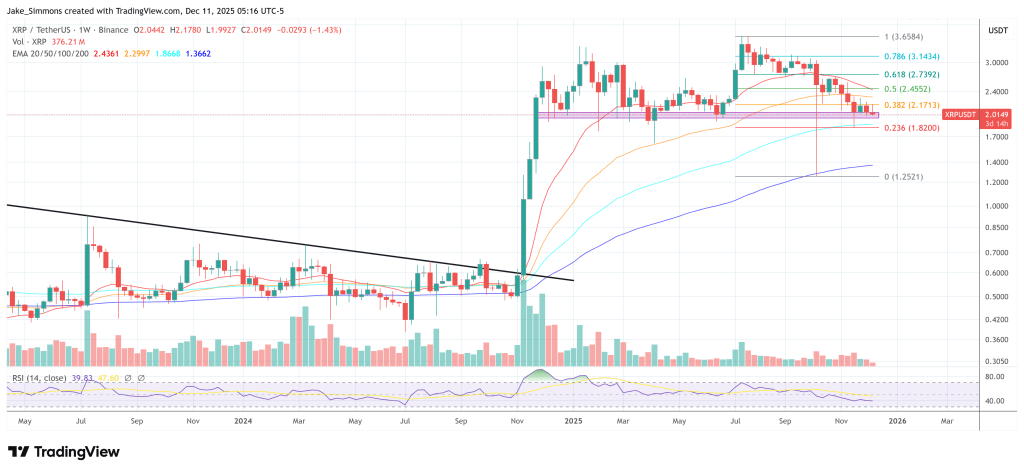
XRP holds above key support, 1-week chart | Source: XRPUSDT on TradingView.com

Похожее

147 Trillion vs 70 Billion: The Rise of On-Chain 'Risk Managers' and the Potential Dawn of a New Era in DeFi Asset Management

"147 Trillion vs 70 Billion: The Rise of On-Chain 'Risk Managers' and the Potential Dawn of a New Era in DeFi Asset Management" Key Points: The role of professional asset managers is emerging in DeFi, ending the era where protocols and governance dictated everything. While early DeFi protocols like Aave and Compound bundled risk management within their code, innovations like Morpho have separated infrastructure from risk judgment. This allows specialized "Risk Managers" to operate independent lending vaults, acting as on-chain asset managers. The market, though early with ~$7B in assets under management (AUM), is rapidly consolidating around top performers like SteakhouseFi (RWA focus), SentoraHQ (AI-driven models), and Gauntlet (crisis management). This modular structure mirrors TradFi's division of labor: distributors (e.g., exchanges) source capital, Risk Managers design strategies and set standards, and underlying protocols handle custody and execution. For traditional asset managers, this familiar structure presents clear entry paths: 1) **Distribution**: Partnering with Risk Managers as a backend service. 2) **Supply**: Bringing real-world assets (RWA) on-chain as collateral. 3) **Operation**: Becoming a Risk Manager themselves (e.g., Bitwise). The core competency required is shifting from coding to traditional risk underwriting and financial expertise—areas where established institutions hold a natural advantage. While the current DeFi market (~$80B) is minuscule compared to global asset management (~$147T), it represents a significant growth runway. The teams that build the trusted standards and rails for risk-managed capital now are poised to define the market's future as institutional capital seeks secure on-ramps.

marsbit6 мин. назад

147 Trillion vs 70 Billion: The Rise of On-Chain 'Risk Managers' and the Potential Dawn of a New Era in DeFi Asset Management

marsbit6 мин. назад

Sui Launches Gasless Stablecoin Transfers, Supported by Fireblocks

Sui has officially launched "Gasless Stablecoin Transfers," a new protocol-level feature enabling users and enterprises to send supported stablecoins on Sui without paying gas fees or needing a separate SUI token balance. As the feature rolls out, stablecoin transfer fees on Sui are now effectively $0. Major stablecoins like USDsui, suiUSDe, AUSD, FDUSD, USDB, USDC, and USDY are already supported. This aims to simplify payments and remove a key barrier to mass adoption: requiring users to hold another token for gas. The enterprise platform Fireblocks, securing over $14 trillion in digital asset transactions, has integrated the feature in advance, enhancing institutional accessibility. Other wallets and custodians are also set to support zero-gas transactions. Sui co-founder Adeniyi Abiodun stated this brings Sui closer to being a global payment rail. Fireblocks' Ran Goldi noted it removes a major friction point for businesses building on-chain payments. This is a permanent structural change to Sui's mainnet, not a subsidy. It positions Sui as low-cost infrastructure for enterprises, traders, and AI agents. Sui's stablecoin transfer volume has surpassed $1 trillion since August 2025, with its architecture supporting high-frequency payments. Recent growth includes three SUI Exchange-Traded Products (ETPs) launching in 2026 and the expansion of major stablecoin projects like USDsui and SuiUSDe on the network. Zero-gas stablecoin transfers are now being gradually deployed on the Sui mainnet.

marsbit8 мин. назад

Sui Launches Gasless Stablecoin Transfers, Supported by Fireblocks

marsbit8 мин. назад

Major AI Collaboration Breakthrough! Stanford and NVIDIA Jointly Eliminate AI Communication Overhead, Boosting Reasoning Speed by 2.4x

Title: AI Collaboration Breakthrough: Stanford & NVIDIA Eliminate Communication Overhead, Boost Reasoning Speed by 2.4x A new approach called RecursiveMAS, developed by UIUC, Stanford, NVIDIA, and MIT, tackles the major bottleneck in multi-agent AI systems: the "language tax." Currently, AI agents collaborate by generating and reading natural language text, a slow, costly, and information-lossy process akin to inefficient radio communication. RecursiveMAS bypasses this by enabling agents to communicate directly through their "thoughts"—latent space vector representations—instead of text. Inspired by recursive language models, it treats each agent like a reusable layer in a recursive loop. A special lightweight module called RecursiveLink passes these high-dimensional, semantic-rich internal states between agents. Only the final agent decodes the last latent representation into human-readable text. This process, described as "telepathic" communication, dramatically cuts the overhead of encoding and decoding text at each step. The system is highly efficient; the core AI model weights remain frozen, and only the small RecursiveLink modules are trained, requiring updates to just 0.31% of total parameters. This reduces training costs by over 50% compared to full fine-tuning. Comprehensive evaluations across math, science, coding, and QA benchmarks show significant improvements: - **Accuracy:** Average increase of 8.3%, with gains up to 18.1% on complex math problems (AIME2025). - **Speed:** End-to-end reasoning is 1.2x to 2.4x faster, with greater speedups as recursive depth increases. - **Cost:** Token usage is reduced by 34.6% to 75.6%. The research suggests a new scaling paradigm for multi-agent systems: deepening recursive collaboration depth rather than merely adding more agents. This could address key production barriers like compute cost, latency, and memory limits. However, challenges remain, including the need for independent verification, compatibility between different AI models (heterogeneous agents), reduced interpretability of the "black-box" latent communication, and adaptation to complex real-world workflows involving tools and human interaction. If validated, RecursiveMAS could fundamentally change how AI agents work together, moving beyond inefficient "textual handoffs" to more seamless and powerful collaborative reasoning.

marsbit1 ч. назад

Major AI Collaboration Breakthrough! Stanford and NVIDIA Jointly Eliminate AI Communication Overhead, Boosting Reasoning Speed by 2.4x

marsbit1 ч. назад

Торговля

Спот
Фьючерсы

Популярные статьи

Как купить MEGA

Добро пожаловать на HTX.com! Мы сделали приобретение MegaETH (MEGA) простым и удобным. Следуйте нашему пошаговому руководству и отправляйтесь в свое крипто-путешествие.Шаг 1: Создайте аккаунт на HTXИспользуйте свой адрес электронной почты или номер телефона, чтобы зарегистрироваться и бесплатно создать аккаунт на HTX. Пройдите удобную регистрацию и откройте для себя весь функционал.Создать аккаунтШаг 2: Перейдите в Купить криптовалюту и выберите свой способ оплатыКредитная/Дебетовая Карта: Используйте свою карту Visa или Mastercard для мгновенной покупки MegaETH (MEGA).Баланс: Используйте средства с баланса вашего аккаунта HTX для простой торговли.Третьи Лица: Мы добавили популярные способы оплаты, такие как Google Pay и Apple Pay, для повышения удобства.P2P: Торгуйте напрямую с другими пользователями на HTX.Внебиржевая Торговля (OTC): Мы предлагаем индивидуальные услуги и конкурентоспособные обменные курсы для трейдеров.Шаг 3: Хранение MegaETH (MEGA)После приобретения вами MegaETH (MEGA) храните их в своем аккаунте на HTX. В качестве альтернативы вы можете отправить их куда-либо с помощью перевода в блокчейне или использовать для торговли с другими криптовалютами.Шаг 4: Торговля MegaETH (MEGA)С легкостью торгуйте MegaETH (MEGA) на спотовом рынке HTX. Просто зайдите в свой аккаунт, выберите торговую пару, совершайте сделки и следите за ними в режиме реального времени. Мы предлагаем удобный интерфейс как для начинающих, так и для опытных трейдеров.

240 просмотров всегоОпубликовано 2026.04.30Обновлено 2026.04.30

Как купить MEGA

Как купить TWT

Добро пожаловать на HTX.com! Мы сделали приобретение Trust Wallet (TWT) простым и удобным. Следуйте нашему пошаговому руководству и отправляйтесь в свое крипто-путешествие.Шаг 1: Создайте аккаунт на HTXИспользуйте свой адрес электронной почты или номер телефона, чтобы зарегистрироваться и бесплатно создать аккаунт на HTX. Пройдите удобную регистрацию и откройте для себя весь функционал.Создать аккаунтШаг 2: Перейдите в Купить криптовалюту и выберите свой способ оплатыКредитная/Дебетовая Карта: Используйте свою карту Visa или Mastercard для мгновенной покупки Trust Wallet (TWT).Баланс: Используйте средства с баланса вашего аккаунта HTX для простой торговли.Третьи Лица: Мы добавили популярные способы оплаты, такие как Google Pay и Apple Pay, для повышения удобства.P2P: Торгуйте напрямую с другими пользователями на HTX.Внебиржевая Торговля (OTC): Мы предлагаем индивидуальные услуги и конкурентоспособные обменные курсы для трейдеров.Шаг 3: Хранение Trust Wallet (TWT)После приобретения вами Trust Wallet (TWT) храните их в своем аккаунте на HTX. В качестве альтернативы вы можете отправить их куда-либо с помощью перевода в блокчейне или использовать для торговли с другими криптовалютами.Шаг 4: Торговля Trust Wallet (TWT)С легкостью торгуйте Trust Wallet (TWT) на спотовом рынке HTX. Просто зайдите в свой аккаунт, выберите торговую пару, совершайте сделки и следите за ними в режиме реального времени. Мы предлагаем удобный интерфейс как для начинающих, так и для опытных трейдеров.

131 просмотров всегоОпубликовано 2026.05.07Обновлено 2026.05.07

Как купить TWT

Обсуждения

Добро пожаловать в Сообщество HTX. Здесь вы сможете быть в курсе последних новостей о развитии платформы и получить доступ к профессиональной аналитической информации о рынке. Мнения пользователей о цене на A (A) представлены ниже.

活动图片