Rejecting Nvidia's Offer at $6 Per Share, He Says He Can Earn More Trading Stocks

marsbitОпубликовано 2026-05-22Обновлено 2026-05-22

Введение

A mysterious X user known as Serenity (@aleabitoreddit) has become a significant influence in financial markets, with over 150,000 followers across three continents tracking his stock picks. His recent endorsement of UK hardware company Raspberry Pi ($RPI) triggered an approximate 90% surge in its stock price over two days, later validated by strong earnings that matched his forecasts. Previously banned from Reddit's r/wallstreetbets for a controversial post, Serenity moved to X. He claims to be a former AI research scientist who declined a job offer from Nvidia when its stock was around $6. His identity and reported investment returns (e.g., 630% in one year) remain unverified. Serenity's strategy focuses on identifying "chokepoints"—critical, often overlooked components in complex supply chains, like the indium phosphide substrates for AI datacenter optics. His calls on small-cap stocks such as AXTI and Sivers Semiconductors (SIVE) have preceded major price rallies driven by events like export controls or strategic partnerships. While his free, public research differs from typical financial influencers who sell courses, the anonymous, self-reported nature of his success warrants caution. He represents a new phenomenon where detailed, niche analysis can move markets, but his track record lacks independent audit.

Across three continents, 150,000 people, from retail investors to hedge fund managers, are copying the homework of a 'Twitter Stock God.'

His recent public endorsement of a stock directly led to a nearly 90% surge in just two days.

On February 17, 2026, at the London Stock Exchange, a small stock named Raspberry Pi in the FTSE 250 index saw its price soar 27% in the first hour of trading. It accumulated gains of nearly 90% over two days and still maintained over a 50% gain within a week.

This UK hardware company, with a market capitalization of just over £500 million, had seen its stock price languish below its IPO price for the past six months.

No analyst expected it to become one of the hottest UK stocks at the start of 2026.

Reuters, Bloomberg, the Financial Times, and The Register all sent reporters to investigate, with their clues all pointing to the same source.

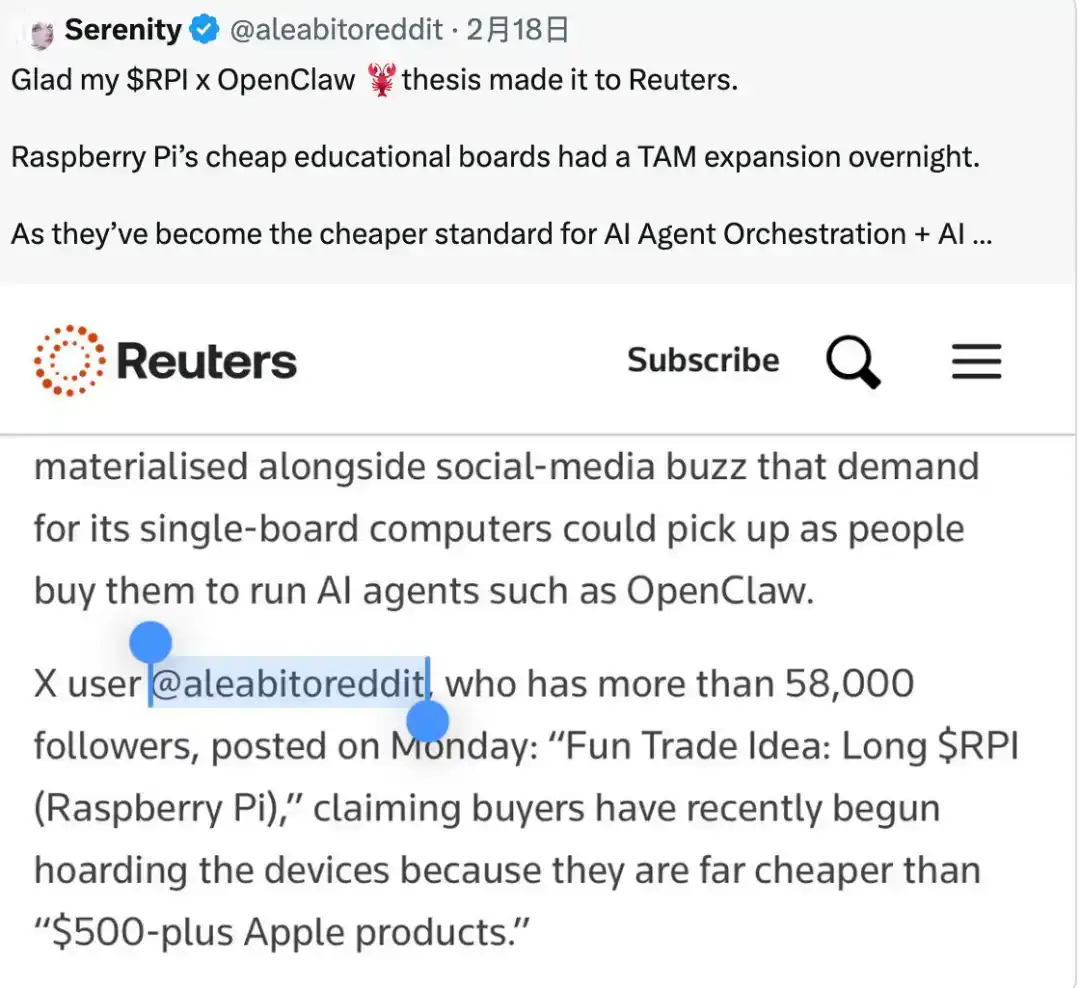
The day before, Eastern Time, an account with 58,000 followers on platform X posted a tweet titled, 'Fun Trade Idea, Long $RPI.'

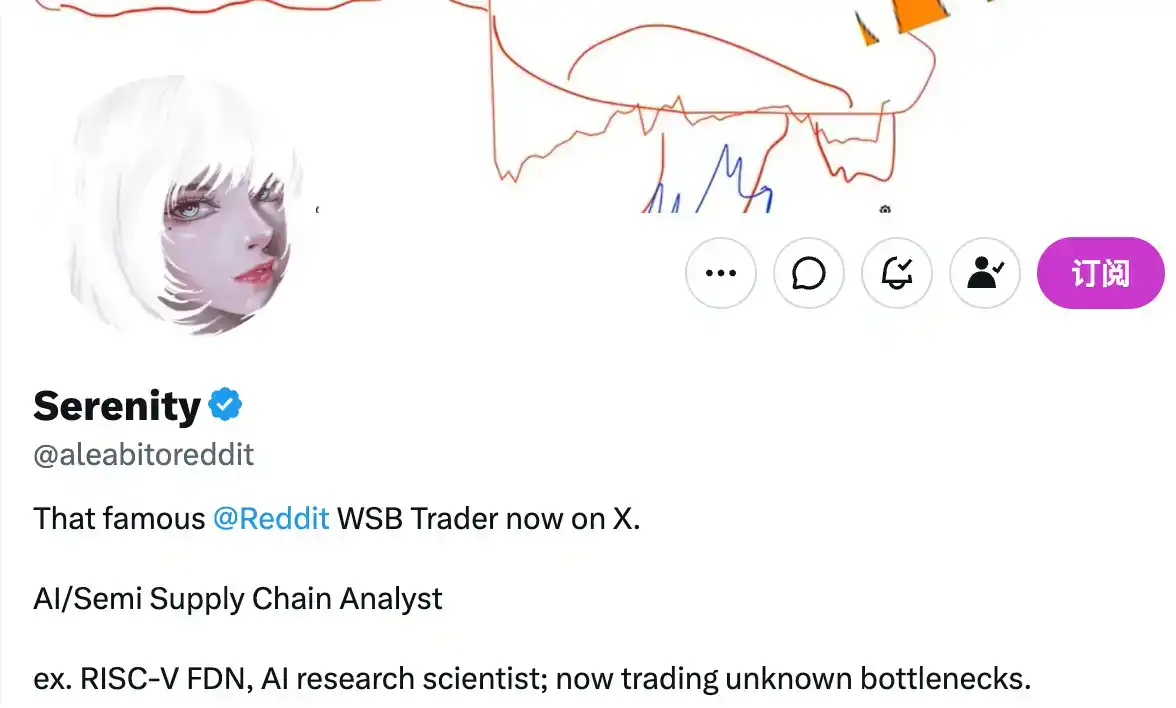
The account name is Serenity, with the handle @aleabitoreddit, using a female profile picture.

The opening line of Bloomberg's report read, 'It all started Monday with a post titled 'Fun Trade Idea' from a user called aleabitoreddit on X.'

Reuters' article directly quoted Serenity's arguments about Raspberry Pi. When asked about the unusual stock activity, a Raspberry Pi company spokesperson stated, 'The company has no information beyond what is already in the public domain.'

The story doesn't end there.

At the end of March, Raspberry Pi released its full-year financial results. Revenue grew by 58%. Serenity's prediction two months prior was 55%.

The consensus among sell-side analysts aggregated by Bloomberg was only 14% at the time. On the day the earnings were released, RPI's stock price rose another 44.76% in a single day, followed by another 27.43% the next day.

This is why, over the past year, an increasing number of Silicon Valley investors have added this Twitter account to their daily must-read list.

A single tweet moved a FTSE 250 constituent's market cap by 50% in a week, and two months later, an earnings report validated his forecast.

Yet, the person repeatedly creating such market ripples—no one knows his real name.

The Person Who Was Banned

The Serenity account's bio describes him as an 'AI Semiconductor Industry Chain Research Institute,' 'Nature paper,' 'RISC-V Foundation member.'

He once joked that in 2018, Nvidia tried to recruit him to lead an AI team when Nvidia's stock price was only around $6.

But he declined.

To understand the Serenity account, the story must start with a ban four years ago.

In early 2022, the moderators of r/wallstreetbets, the self-proclaimed world's largest casino for retail traders, banned an account named AleaBito.

The incident started when this account posted about a stock with a name that sounded like a pyramid scheme.

AXTI, with a market cap just over $200 million, specialized in indium phosphide substrates; its stock price was around $12 at the time. The moderators accused him of drumming up hype and with a single strike, banned the account.

AXTI later rallied to $70. In Serenity's own recent review, he called this his most legendary trade to date, with a single-stock profit of 1000%.

After the ban, he switched platforms directly. He moved from Reddit to X, giving himself the new name Serenity, meaning 'peace' in Chinese.

A person chased off a forum giving himself such a name left a line in his bio, 'That famous WSB trader, now on X.'

He claims to have been an AI research scientist, a RISC-V Foundation member, published a Nature paper, and turned down Nvidia's offer to lead an AI team.

Serenity's followers have grown rapidly this year, with people in the US, Taiwan, and European stock communities translating his posts. In Chinese communities, moomoo, Xueqiu, and PTT each have copy-trading groups.

Some have built dashboards to track his portfolio changes; some manage hedge funds based on his ideas. His paid product is just an Excel sheet, which he jokingly calls 'A Dollar's Worth of Ideas.' All core research is freely disclosed on X.

The Consistent Winner

Calling RPI is just one among his past calls. Serenity has a string of similar cases, each following the same trajectory: post a tweet, get criticized, then get validated.

First, AXTI. The very stock that got him banned from WSB.

Indium phosphide substrate, the foundational material at the very bottom of AI datacenter optical modules. In February 2025, the East implemented export controls on indium phosphide. By January 2026, license approvals tightened further, forcing AXT to lower its quarterly revenue guidance.

Overnight, this small plant in Fremont, California, transformed from a small-cap stock into a national security-level strategic asset. He called this company two years ago.

Second, SIVE. Sweden's Sivers Semiconductors, listed in Stockholm, making CPO external light source continuous-wave lasers, a core component for next-generation 1.6T co-packaged optics.

After he publicly announced his position, the first wave saw a single-day surge of 73.78%, its market cap instantly jumping from $130 million to $230 million. On April 15, 2026, Jabil announced a collaboration with SIVE to develop 1.6T LRO optical modules, boasting a 2.5x efficiency advantage. A month later, on May 19, CHIPS Act Year 2 funding of $6.6 million arrived.

Third, Soitec. A French semiconductor company, the near-monopoly player in CPO SOI substrates, with even Japan's Shin-Etsu needing to license from them.

He explicitly tweeted a change in view this March, building a position around €43, calling it 'a hidden monopoly to hold long-term.' That day, Soitec's stock price surged 16%.

And a string of Taiwanese stocks. FOCI (3363, microlens and fiber arrays), Win Semiconductors (3105, GaAs foundry), TSEM (Tower Semiconductor).

These stocks were already discussed among local retail circles in Taiwan, but in the English-speaking world, he might be the first to systematically link them to the CPO narrative.

Regarding performance, he self-reported a 630% return in the year before joining X, and his YTD at one point this year exceeded 500%, recently experiencing some pullback.

Of course, these numbers are unaudited and can only be taken as reference.

But one thing has been verified. Reuters and Bloomberg directly cited his online alias in their reports.

150,000 followers across three continents translate his posts, hedge funds copy his homework.

The Bottleneck Point

To understand Serenity's investment logic and what he got right, one must first understand Wall Street's dominant narrative over the past three years.

From 2023 to 2026, retail investors worldwide have been chasing the same batch of tickers: AI

Nvidia, AMD, Microsoft, Google, Meta.

Every sell-side report, every YouTube creator, every financial headline was calculating whether these companies would beat expectations next quarter.

Serenity went the opposite way. He dug downwards, layer by layer, searching for the 'nuts and bolts' on Nvidia.

He gave this kind of thing a name: chokepoint, the bottleneck point.

This concept can be explained with an analogy.

Indium phosphide substrate is to AI optical modules what the Strait of Hormuz is to global oil. 20% of the world's oil passes through that strait; whoever controls it controls everyone.

Another more everyday version. In high-end kaiseki restaurants in Tokyo's Ginza, the most expensive item on the bill might be otoro tuna, but what the entire shop can't do without is the shiso leaf underneath the sashimi.

90% of Japan's premium shiso leaves come from a few family farms in Izu. When a typhoon hits and the farms close, all the kaiseki restaurants in Ginza have to shut down that day.

A bottleneck point is something like that. Usually unmentioned, but if a problem arises, everyone is finished.

Serenity's working method is the exact opposite of mainstream Wall Street analysts.

Sell-side analysts look down from big companies; he works backward from bottleneck points. He draws his own supply chain maps, starting from Nvidia H100 clusters and working backward layer by layer to the deepest narrow passages. He uses AI to challenge himself, often saying, 'I make Gemini challenge my thesis,' feeding his research to AI to play the devil's advocate.

Using stocks from the US, Taiwan, Europe, and Japan, he mapped out a complete global bottleneck point map for the AI era.

Each node is a potential Strait of Hormuz. Every geopolitical event, every earnings report, every export control measure, he can find the corresponding coordinate on his map and then vote with his portfolio.

Recently, he has extended his radar to rare earths and humanoid robots. The investment logic remains a continuation of before: find narrow passages, find monopolies, find the links that, if broken, spell disaster for everyone.

This is something most Wall Street sell-side analysts can't do. They are siloed by department: TMT analysts don't cover materials, materials analysts don't cover optics, optics analysts don't cover geopolitics.

His most frequent saying is, 'My earliest views are usually the ones that get criticized the most.'

Is He the God of Retail Investors, or Just Another Glorified Gambler?

Writing up to this point, the tone must shift.

Strip away all the unverifiable aspects of Serenity: completely anonymous identity, no photos, real name, or institutional background to check.

'Rejected Nvidia's AI team offer at $6 per share,' 'Nature paper,' 'RISC-V Foundation member'—all self-reported.

Self-reported performance, no audit, no third-party reconciliation. Highly concentrated portfolio, mostly small to mid-cap non-consensus stocks with poor liquidity. Retail followers can easily enter at the wrong time.

Among financial KOLs over the past decade, those with unverified identities, self-reported performance, and rampant copy-trading culture mostly ended badly.

But there are a few things about Serenity that are different.

So far, he hasn't sold courses, run copy-trading groups, offered training, or charged for high-priced subscriptions. Core research is freely public on X. He doesn't take ads, drive traffic, or work with MCNs.

Currently, he doesn't qualify as a scammer. But he shouldn't be treated as a god either.

Of course, an anonymous person banned from a forum, getting over 150,000 people, including Wall Street hedge funds, to work for him for free, validating his arguments, disseminating his research, translating his posts.

That is also legendary in its own right.

Связанные с этим вопросы

QWho is Serenity, and what is his main claim regarding his background?

ASerenity is an anonymous financial influencer on X (formerly Twitter) with 5.8 thousand followers, known for his stock market predictions. He claims to have a background as an AI research scientist, a Nature paper author, a RISC-V Foundation member, and to have turned down an offer from Nvidia to lead an AI team when its stock was around $6.

QWhat was the key stock recommendation that first brought Serenity widespread attention, and what was the result?

AHis key stock recommendation was for Raspberry Pi (RPI) on the London Stock Exchange. After his post, the stock surged nearly 90% in two days and maintained a gain of over 50% within a week. Later, when the company's earnings matched his prediction, the stock price rose again significantly.

QWhat is Serenity's core investment philosophy or strategy as described in the article?

ASerenity's core investment strategy is to identify 'chokepoints' or bottlenecks in global supply chains. He focuses on small, often overlooked companies that produce critical components for major industries like AI, where a disruption could have widespread effects. He researches from the bottom up, mapping supply chains to find these narrow, monopolistic points.

QWhat is one major concern or criticism mentioned in the article about following Serenity's advice?

AA major concern is that Serenity's identity and claimed credentials are entirely anonymous and unverifiable. His reported investment returns are unaudited, and his recommended stocks are often small-cap, illiquid, and non-consensus picks. This makes it risky for followers who might enter positions at the wrong time, and history suggests such anonymous financial influencers often end poorly.

QHow does Serenity's approach to sharing his research differ from that of many other financial influencers, according to the article?

AUnlike many financial influencers, Serenity does not sell courses, run paid groups, offer high-priced subscriptions, or engage in MCN/advertising deals. He makes his core research freely available on his X account, with his only paid product being a simple Excel spreadsheet he jokingly calls 'a dollar idea'.

Похожее

A Nation Blocks Chips, a Giant Buys a Nuclear Power Plant: Why It's Time to Seriously Consider DeAI

**Title: Great Powers Blockade Chips, Giants Buy Nuclear Plants: Why It's Time to Seriously Consider DeAI** In May 2026, the US closed loopholes for Chinese firms to acquire advanced NVIDIA chips via overseas subsidiaries. That same month, Kenya halted a $1B geothermal data center project involving Microsoft, fearing its immense energy consumption. Meanwhile, Huawei announced mass production of its Ascend AI chip. These disparate events underscore a new reality: the competition for computing power ("compute") has escalated beyond the tech industry, becoming a geopolitical and infrastructural battleground. A new era of oligopoly is forming, with control over the AI stack—from GPU chips (NVIDIA) and cloud platforms (AWS, Azure, Google Cloud) to foundational models (OpenAI, Anthropic)—concentrating in a few Western "AI Octopus" corporations. This centralization creates systemic risks: pricing power and platform lock-in for users, infrastructure fragility, and a widening "compute divide" that threatens to marginalize nations without independent AI capacity. An "AI Iron Curtain" is deepening through export controls. In response, some nations like Saudi Arabia and the UAE are investing heavily to buy compute power, aiming to transition from oil to AI economies. The EU seeks to triple its compute capacity by 2030 to reduce dependency. However, the spending gap is vast, with four US tech giants alone planning ~$750B in AI capex for 2026. The race is increasingly constrained by energy, with AI tasks consuming up to 1000x more power than web searches, pushing firms to even acquire nuclear plants. This landscape is fueling interest in Decentralized AI (DeAI). It proposes a third way: using open protocols to coordinate a global network of idle GPUs, independent developers, and data centers, creating an AI infrastructure without a single controlling entity. Leveraging blockchain and cryptographic verification, DeAI aims to break market concentration, disperse energy demands, reduce geopolitical dependencies, and enhance transparency. While still nascent in performance and stability, DeAI's core promise is not immediate superiority but providing a crucial alternative architecture to resist monopoly, censorship, and centralized power. As specialized AI hardware costs fall and open-source models flourish, the window to build this foundation is open. The very existence of such competition serves as a vital check against the inevitable abuse of concentrated power.

marsbit11 мин. назад

A Nation Blocks Chips, a Giant Buys a Nuclear Power Plant: Why It's Time to Seriously Consider DeAI

marsbit11 мин. назад

Outpoll Review: A Prediction Market Platform Built for Active Traders

Outpoll Review: A Prediction Market Platform Built for Active Traders In recent years, prediction markets have grown from a niche sector to a mainstream arena, attracting billions in trading volume and institutional capital. However, the user experience and tools for traders have not kept pace. Outpoll, a new global prediction market platform, aims to fill this gap by providing enhanced trading infrastructure for active and professional traders. Built on standard prediction market principles, Outpoll allows users to trade on the outcome of specific events. It uses fully collateralized contracts with USDC settlement, charges a competitive 0.1% fee per trade, and provides clear settlement rules upfront to minimize disputes. A key focus for Outpoll is its professional-grade trading tools. The platform supports limit and market orders, as well as take-profit and stop-loss orders for open positions—features uncommon in prediction markets. For automated trading, Outpoll offers comprehensive REST and WebSocket APIs, enabling portfolio management, price arbitrage, and integration with existing tools. The platform also features a creator-led market model, where approved experts and community leaders can create and manage markets for niche topics under platform supervision. Its integrated interface combines news feeds directly with trading functions, allowing users to monitor events and manage positions seamlessly. Outpoll launched with a native Android app (available on Google Play) and plans an iOS version later this year. In summary, Outpoll distinguishes itself with trader-focused tools, practical APIs, transparent and collateralized markets, integrated news, and an expanding creator program. For active traders, its advanced order types and API access alone make it a platform worth watching. Outpoll is now globally accessible via outpoll.com and Google Play.

marsbit19 мин. назад

Outpoll Review: A Prediction Market Platform Built for Active Traders

marsbit19 мин. назад

Bitwise: Crypto Becomes a Contrarian Investment, Three Logics to Understand the Current Market

**Summary** Matt Hougan, Bitwise's CIO, analyzes the current crypto market through three key lenses, arguing it has shifted from a momentum-driven to a contrarian investment. **1) Crypto Becomes a Contrarian Play:** The market is weak, with major assets like Bitcoin and Ethereum down significantly. Capital has moved to hot sectors like AI, leaving crypto as an "unloved" asset class. This transforms crypto investing from trend-following to a test of patience and fundamental analysis. Investors now favor projects with solid fundamentals (e.g., Hyperliquid) over speculative ones. **2) Regulatory Overhang:** The uncertain fate of the U.S. CLARITY Act, a major crypto regulatory framework, is a key headwind. With its passage in 2024 seen as far from guaranteed (estimates range from 30-55%), institutional capital remains on the sidelines, choosing less risky alternatives like AI stocks. The market needs clarity—whether the bill passes or fails—more than any specific outcome to move decisively. **3) Capital Rotates to New Fundamentals:** This cycle differs from past bear markets where money fled to Bitcoin. Now, capital seeks smaller assets with strong use cases. While major cryptos fell in May 2024, tokens like Hyperliquid (+72%), Zcash (+50%), and XLM (+44%) rallied on their specific fundamentals. This rotation confirms the new contrarian, fundamentals-driven logic and signals the bear market may be in its later stages. **Conclusion:** Short-term pressure persists due to regulatory uncertainty and competition from AI narratives. Investing in crypto now requires a contrarian mindset—acting against the crowd and focusing on fundamental value. Patience and targeting high-quality projects based on their merits are essential for capturing long-term gains.

marsbit1 ч. назад

Bitwise: Crypto Becomes a Contrarian Investment, Three Logics to Understand the Current Market

marsbit1 ч. назад

ChatGPT Might Be Disappearing Soon

OpenAI announced at its "Intelligence at Work" event that its coding assistant, Codex, will be fully integrated into the ChatGPT app within weeks. This move marks a strategic shift from a conversational AI (Chat) towards a unified "agentic" platform capable of execution. Codex, originally launched to compete with Anthropic's Claude Code, has grown rapidly to 5 million weekly active users, with 20% being non-developers like analysts and designers. Its enterprise revenue now constitutes 40% of OpenAI's total. The integration is the first step in creating a super-app combining ChatGPT (interface), Codex (execution engine), and the Atlas browser (web access). OpenAI also unveiled new Codex features: specialized Agent plugins for six professional roles, an "Annotations" tool for direct document editing, and a "Sites" function to turn work into shareable web apps. Internally, this reflects a power shift; the Codex team now leads core product strategy. While the ChatGPT brand remains for its vast user base, the platform's future is focused on autonomous agents that perform tasks, not just chat. The article notes that competition with Claude Code pushed OpenAI's development, with Codex competing on cost-effectiveness and accessibility rather than raw coding quality. It concludes that the essence of "ChatGPT" is evolving from a chatbot into an AI agent platform, with the name potentially becoming a legacy symbol of its original function.

marsbit1 ч. назад

ChatGPT Might Be Disappearing Soon

marsbit1 ч. назад

Торговля

Спот
Фьючерсы

Популярные статьи

Как купить S

Добро пожаловать на HTX.com! Мы сделали приобретение Sonic (S) простым и удобным. Следуйте нашему пошаговому руководству и отправляйтесь в свое крипто-путешествие.Шаг 1: Создайте аккаунт на HTXИспользуйте свой адрес электронной почты или номер телефона, чтобы зарегистрироваться и бесплатно создать аккаунт на HTX. Пройдите удобную регистрацию и откройте для себя весь функционал.Создать аккаунтШаг 2: Перейдите в Купить криптовалюту и выберите свой способ оплатыКредитная/Дебетовая Карта: Используйте свою карту Visa или Mastercard для мгновенной покупки Sonic (S).Баланс: Используйте средства с баланса вашего аккаунта HTX для простой торговли.Третьи Лица: Мы добавили популярные способы оплаты, такие как Google Pay и Apple Pay, для повышения удобства.P2P: Торгуйте напрямую с другими пользователями на HTX.Внебиржевая Торговля (OTC): Мы предлагаем индивидуальные услуги и конкурентоспособные обменные курсы для трейдеров.Шаг 3: Хранение Sonic (S)После приобретения вами Sonic (S) храните их в своем аккаунте на HTX. В качестве альтернативы вы можете отправить их куда-либо с помощью перевода в блокчейне или использовать для торговли с другими криптовалютами.Шаг 4: Торговля Sonic (S)С легкостью торгуйте Sonic (S) на спотовом рынке HTX. Просто зайдите в свой аккаунт, выберите торговую пару, совершайте сделки и следите за ними в режиме реального времени. Мы предлагаем удобный интерфейс как для начинающих, так и для опытных трейдеров.

1.4k просмотров всегоОпубликовано 2025.01.15Обновлено 2026.06.02

Как купить S

Sonic: Обновления под руководством Андре Кронье – новая звезда Layer-1 на фоне спада рынка

Он решает проблемы масштабируемости, совместимости между блокчейнами и стимулов для разработчиков с помощью технологических инноваций.

2.3k просмотров всегоОпубликовано 2025.04.09Обновлено 2025.04.09

Sonic: Обновления под руководством Андре Кронье – новая звезда Layer-1 на фоне спада рынка

HTX Learn: Пройдите обучение по "Sonic" и разделите 1000 USDT

HTX Learn — ваш проводник в мир перспективных проектов, и мы запускаем специальное мероприятие "Учитесь и Зарабатывайте", посвящённое этим проектам. Наше новое направление .

1.8k просмотров всегоОпубликовано 2025.04.10Обновлено 2025.04.10

HTX Learn: Пройдите обучение по "Sonic" и разделите 1000 USDT

Обсуждения

Добро пожаловать в Сообщество HTX. Здесь вы сможете быть в курсе последних новостей о развитии платформы и получить доступ к профессиональной аналитической информации о рынке. Мнения пользователей о цене на S (S) представлены ниже.

活动图片