Raised $1.3 Billion in Seven Weeks, Yet SpaceX's Weighting Halved: The Dilution Trap of the NASA ETF

marsbitОпубликовано 2026-05-25Обновлено 2026-05-25

Введение

A new ETF named NASA, launched just seven weeks ago, has rapidly become the world's largest space-themed fund, amassing $1.3 billion in assets. Its primary draw is its unique position as a "pure" space ETF holding SpaceX stock through a special purpose vehicle (SPV). However, its exposure to SpaceX has been drastically diluted from 10.3% to 4.6% due to a massive, rapid inflow of investor cash. New money is forced into buying other public space stocks like Rocket Lab, meaning investors seeking SpaceX exposure end up with a portfolio of other companies. Further complications arise from the SPV's valuation mechanism, which only updates during specific manager trades, potentially lagging behind SpaceX's market price. This SPV will also face a six-month lock-up post-IPO, preventing investors from selling that portion if SpaceX shares drop after listing. The article highlights a valuation bubble in the broader space sector, with stocks like Planet Labs surging nearly 1000% in a year, driven more by the "SpaceX IPO narrative" than underlying fundamentals. Meanwhile, SpaceX's own financials show significant losses in 2024, and its record-breaking IPO valuation bundles its space business with other Musk assets like xAI, creating a complex investment proposition. The core warning is that the NASA ETF essentially uses SpaceX as bait but delivers a different product. The real beneficiaries may be the ETF issuers collecting high fees, while investors face dilution and hidden risks ahea...

Author: Deep Chao TechFlow

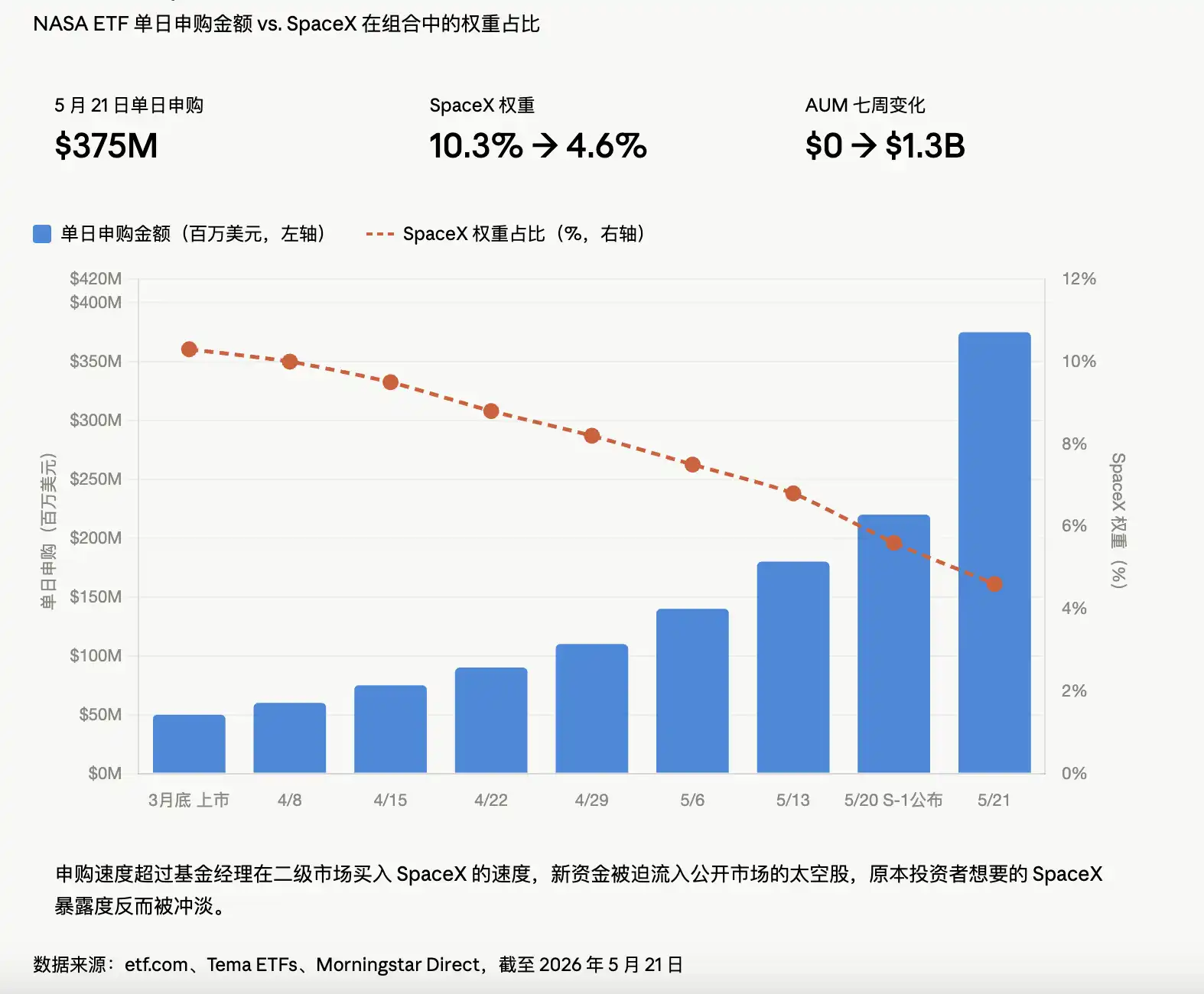
On May 20th, SpaceX's S-1 prospectus went live on the SEC website. The very next day, an ETF with the ticker symbol "NASA" saw a single-day inflow of $375 million, tripling its AUM within a week. It had been launched just seven weeks prior.

Seven weeks later, it's the world's largest space-themed ETF, far surpassing the seven-year-old veteran, UFO. The money it raised in those seven weeks exceeds all the money UFO gathered over seven years.

Everyone rushing into NASA wants to buy SpaceX. But the SpaceX they actually get in their hands is becoming less and less.

Where Did the Money Go?

The NASA ETF's claim to fame is being "the only pure-play space ETF in the market holding SpaceX." As of May 21st, NASA indirectly holds 232,000 common stock equivalents of SpaceX through an SPV, with a book value of $147.4 million, implying a valuation of around $1.51 trillion.

The numbers look solid. But there's a detail most ordinary investors wouldn't notice. According to ETF.com, a week ago, NASA's SpaceX position accounted for 10.3% of the fund. A week later, it was diluted to 4.6%.

Because subscription money came in too fast, the fund manager simply couldn't acquire SpaceX shares on the secondary market quickly enough. A large portion of the new money was forced to buy publicly listed space stocks, which in turn diluted the very SpaceX exposure investors were seeking.

Retail investors rush in wanting SpaceX, but what they end up buying is Rocket Lab plus AST SpaceMobile plus a bunch of other holdings.

More subtly, there's the valuation mechanism. The SPV's holding value only updates when Tema itself makes a trade. In other words, no matter how SpaceX's secondary market quote fluctuates, that portion of NASA's holding sits unchanged on the books.

No one cares about this setup in a bull market. But if the stock falls after the IPO, the SPV portion will "react" in an almost eerie, delayed manner. Not to mention, this SPV is locked up for 6 months after SpaceX's official IPO. If the stock tanks at the open, retail investors can sell the ETF shares, but the SPV can't sell its SpaceX shares.

The ETF charges a 0.87% annual management fee, but a whopping 65% of its apparent gains this year came from stocks like Rocket Lab and Intuitive Machines that had already skyrocketed. SpaceX? It hasn't contributed much at all.

The essence of NASA now is a thematic fund that uses SpaceX as bait, while serving a platter full of other space-related small-cap stocks. The bait's scent is important, but it's not what's actually on the plate.
Valuation Dislocation

What many people don't realize is that some of the major names in this sector have already had a big run-up.

Rocket Lab is up 357% in the past 12 months; Planet Labs up 979%; LUNR up 212%. ARKX is up 62% over the past year, ROKT up 75%. SpaceX merely lit a fire under kindling that was already smoldering.

When you lay these numbers out, the question arises. Planet Labs rose 979% in a year, but this company's main business is selling satellite image data. Do its fundamentals justify a nearly 10x increase in share price?

There were 102 orbital launches globally in 2019, and 342 in 2025—twice the peak of the 1967 space race. Grand View Research predicts the global space economy will grow from $466 billion in 2024 to $769 billion by 2030.

But here's the issue: the industry growing from $466 billion to $769 billion—why should that correspond to a 10x gain in the secondary market?

This is the classic script of valuation dislocation. Fundamentals move linearly, while stock prices move exponentially. The gap is filled by "narrative premium." And the source of that narrative premium is one thing only: SpaceX's impending IPO.

What are the actual buyers at the end of this chain really getting?

Returning to SpaceX itself.

2024 revenue was $18.67 billion, up from $10.3 billion in 2023. But 2024 saw a loss of $4.59 billion, compared to a profit of $791 million in 2023—a direct swing from profit to loss.

CNN's reporting cites a loss of nearly $5 billion last year, with the reason being heavy spending by the AI division on building data centers.

SpaceX's prospectus reveals that xAI has been merged into SpaceX, and X (formerly Twitter) is also included. This so-called "space IPO" is essentially a grand repackaging of all Musk's assets. The prospectus also discloses that Musk controls 85% of the voting rights—no one can oust him unless he votes to fire himself.

The $1.75 trillion valuation for SpaceX corresponds to a four-in-one narrative of "Space + AI + Satellite Internet + Social Media." The bigger the narrative, the more inflated the price.

But the secondary market doesn't care about this. What the secondary market cares about is: if everyone is rushing to get on board, then I must get on too.

After all this circling, the biggest winners aren't the future retail shareholders of SpaceX, because they're not on board yet; nor are they the ETF investors rushing into NASA, because their SpaceX exposure is being diluted.

The biggest winners are the ETF issuers. NASA's expense ratio is 0.87%, the third highest among its peers. $1.3 billion in AUM means over $11 million in annual management fee income.

The essence of launching an ETF is the same as launching a token: you need a story, a timing, and a seemingly reasonable benchmark. SpaceX provides all three.

Before the IPO

On June 12th, SpaceX is scheduled to list on Nasdaq under the ticker SPCX. The underwriting syndicate, led by the world's largest investment banks, aims to raise $40 to $80 billion, far surpassing the record set by Saudi Aramco in 2020.

This will be the largest IPO in human history.

If the stock falls on the first day of trading, all the ETF investors who bought in following the SpaceX story will find that their SPV portion is still marked at the "stale price" from months ago. They cannot immediately cut losses, nor can they immediately exit.

If the stock soars, those who didn't buy the ETF will rush in, pushing the ETF's premium even higher and diluting SpaceX's actual weight within the ETF further, creating a comical reverse flywheel: the more people buy, the less SpaceX each person actually gets.

After SpaceX, a host of industry giants are queuing up to go public. Each listed "flagship concept" will spawn a batch of new ETFs. Each new batch of ETFs will repeat the same dilution game.

The industry isn't short on new stories; what's lacking are people who ask, "Did I really buy what I thought I was buying?" After June 12th, there will be answers. But by then, the people rushing into NASA today won't care about the answers anymore—they'll either be counting their money, or seeking legal redress.


Связанные с этим вопросы

QWhat is the main 'dilution trap' described in the NASA ETF's structure?

AThe 'dilution trap' refers to the phenomenon where a rapid influx of new investor money into the NASA ETF cannot be used to buy more private SpaceX shares fast enough. Instead, the fund manager must buy other publicly traded space stocks. This dilutes the percentage weight of SpaceX within the ETF's portfolio, meaning investors seeking SpaceX exposure end up with a fund increasingly composed of other companies like Rocket Lab and AST SpaceMobile.

QAccording to the article, why does the valuation of SpaceX within the NASA ETF not update in real-time?

AThe SpaceX valuation within the ETF does not update in real-time because it is held through a Special Purpose Vehicle (SPV). The value of this SPV holding is only updated when the fund manager, Tema, conducts transactions for it. Therefore, it remains static and does not reflect daily price fluctuations in SpaceX's secondary market, creating a potential lag or disconnect, especially during significant market moves.

QWhat does the author mean by the 'valuation inversion' occurring in the space sector?

AThe 'valuation inversion' or disconnect refers to the fact that stock prices of major public space companies (like Planet Labs and Rocket Lab) have surged dramatically (e.g., 979%, 357% in a year) far outpacing the underlying linear growth of the global space industry's projected revenue (from $466 billion to $769 billion by 2030). This gap is filled by a 'narrative premium' fueled almost solely by the anticipation of SpaceX's IPO, creating a potential bubble.

QHow is SpaceX's 2024 financial performance described, and what is cited as a key reason for its losses?

ASpaceX's 2024 financials show a significant shift from profitability to a substantial loss. While revenue nearly doubled to $18.67 billion from $10.3 billion in 2023, the company reported a loss of $4.59 billion in 2024 compared to a $791 million profit the previous year. A key reason cited for these losses is the heavy investment in building data centers for its AI department, xAI, which has been merged into SpaceX.

QWhat is the article's prediction for the consequences if SpaceX's stock price falls sharply after its IPO?

AThe article predicts that if SpaceX's stock price falls sharply after its IPO, ETF investors, particularly those in NASA, will face a problematic situation. The ETF's SPV holding of SpaceX shares will remain locked up for 6 months and valued at its pre-IPO 'stale' price, preventing investors from immediately selling or cutting losses on that portion of their investment, while the rest of the ETF's public holdings decline with the market.

Похожее

Fei-Fei Li's Team Clarifies the Concept of 'World Models', Sora Merely a Renderer

"World Models" has become a widely used yet confusing term in AI. To address this, a team led by Fei-Fei Li and World Labs proposed a functional taxonomy based on the Partially Observable Markov Decision Process framework. This taxonomy categorizes systems called "world models" into three distinct projections: Renderers, Simulators, and Planners. Renderers, like OpenAI's Sora and other video generation models, focus on producing photorealistic visual outputs for human perception. They prioritize visual fidelity over physical accuracy. Simulators, such as NVIDIA Omniverse, aim to compute precise future environmental states for computational tasks like engineering analysis or digital twins. Planners, like Vision-Language-Action models, take in observations and goals to output executable actions for robots or agents. The article clarifies that most current "world models," including Sora, are primarily Renderers. They generate convincing visuals but lack the core ability to simulate state transitions based on actions, a key requirement for a true world model in classic reinforcement learning definitions. This conceptual confusion has practical implications, leading to potential misalignment in technology selection, investment, and public understanding of AI capabilities. Clear categorization is crucial. It helps enterprises avoid costly mistakes (e.g., using a renderer for robot training), allows investors to accurately assess markets, and enables researchers to build comparable benchmarks. While future systems may integrate these functions, recognizing current boundaries is essential for honest assessment and progress.

marsbit42 мин. назад

Fei-Fei Li's Team Clarifies the Concept of 'World Models', Sora Merely a Renderer

marsbit42 мин. назад

Bloomberg Uncovered: How Do China's Wealthy Circumvent the Annual $50,000 Limit to Transfer Assets?

**Summary: How Wealthy Chinese Circumvent $50,000 Annual Foreign Exchange Limits** Despite China's strict capital controls, including an annual $50,000 per person foreign exchange quota, an estimated $150 billion in funds still leaves the country annually via various gray and underground channels. This report outlines the evolution of China's "capital wall" and the methods used to bypass it. **The Evolving Capital Controls:** * **Foundation (1994):** The system of "current account convertibility with strict capital account controls" was established. * **Quota Set (2007):** The $50,000 individual annual forex purchase limit was formalized. * **Crackdown Begins (2015-2017):** Following market volatility, enforcement tightened. Banks were required to scrutinize transactions, and channels like using UnionPay cards for Hong Kong insurance premiums or buying overseas property were blocked. * **Digital & Legal Upgrades (2024-2026):** Enhanced algorithms now flag suspicious patterns (e.g., "smurfing"). The Common Reporting Standard (CRS) provides Chinese tax authorities with data on citizens' offshore accounts. Unlicensed cross-border brokers have been targeted. **Five Primary Methods for Moving Capital:** 1. **Underground Banking / "Hawala" (Duiqiao):** The largest-scale method. No money crosses borders. Clients pay RMB to a domestic account; an overseas associate deposits equivalent foreign currency into the client's offshore account. Risks include high fees, account freezes, and legal penalties. 2. **"Smurfing" or "Ant Moving":** Using multiple individuals' $50,000 quotas to pool funds for one offshore recipient. Increasingly detected by anti-money laundering algorithms. 3. **Trade Invoice Manipulation:** Businesses over-invoice imports or under-invoice exports via offshore shell companies, creating a pretext to transfer excess funds abroad under the guise of trade. 4. **Channel Migration:** After a crackdown on internet brokers, funds flow toward more compliant but costly channels like major banks' cross-border wealth management services or Qualified Domestic Institutional Investor (QDII) quotas. 5. **Structural Arrangements:** High-net-worth individuals use complex, high-cost legal structures involving offshore trusts, insurance, and investment migration programs to transfer asset ownership. **Regulatory Response: Focusing on People, Not Just Money** The current strategy extends oversight from enterprises to **individual residents**. Tools like CRS allow retroactive visibility into offshore assets. Cryptocurrencies, once seen as a potential loophole, are now actively monitored and prosecuted as an illegal channel. The underlying driver remains: with significant wealth concentrated among millions of affluent households seeking diversification amid domestic economic shifts, the incentive to move assets offshore persists despite regulatory barriers.

marsbit1 ч. назад

Bloomberg Uncovered: How Do China's Wealthy Circumvent the Annual $50,000 Limit to Transfer Assets?

marsbit1 ч. назад

Торговля

Спот
Фьючерсы

Популярные статьи

Как купить S

Добро пожаловать на HTX.com! Мы сделали приобретение Sonic (S) простым и удобным. Следуйте нашему пошаговому руководству и отправляйтесь в свое крипто-путешествие.Шаг 1: Создайте аккаунт на HTXИспользуйте свой адрес электронной почты или номер телефона, чтобы зарегистрироваться и бесплатно создать аккаунт на HTX. Пройдите удобную регистрацию и откройте для себя весь функционал.Создать аккаунтШаг 2: Перейдите в Купить криптовалюту и выберите свой способ оплатыКредитная/Дебетовая Карта: Используйте свою карту Visa или Mastercard для мгновенной покупки Sonic (S).Баланс: Используйте средства с баланса вашего аккаунта HTX для простой торговли.Третьи Лица: Мы добавили популярные способы оплаты, такие как Google Pay и Apple Pay, для повышения удобства.P2P: Торгуйте напрямую с другими пользователями на HTX.Внебиржевая Торговля (OTC): Мы предлагаем индивидуальные услуги и конкурентоспособные обменные курсы для трейдеров.Шаг 3: Хранение Sonic (S)После приобретения вами Sonic (S) храните их в своем аккаунте на HTX. В качестве альтернативы вы можете отправить их куда-либо с помощью перевода в блокчейне или использовать для торговли с другими криптовалютами.Шаг 4: Торговля Sonic (S)С легкостью торгуйте Sonic (S) на спотовом рынке HTX. Просто зайдите в свой аккаунт, выберите торговую пару, совершайте сделки и следите за ними в режиме реального времени. Мы предлагаем удобный интерфейс как для начинающих, так и для опытных трейдеров.

1.4k просмотров всегоОпубликовано 2025.01.15Обновлено 2026.06.02

Как купить S

Sonic: Обновления под руководством Андре Кронье – новая звезда Layer-1 на фоне спада рынка

Он решает проблемы масштабируемости, совместимости между блокчейнами и стимулов для разработчиков с помощью технологических инноваций.

2.3k просмотров всегоОпубликовано 2025.04.09Обновлено 2025.04.09

Sonic: Обновления под руководством Андре Кронье – новая звезда Layer-1 на фоне спада рынка

HTX Learn: Пройдите обучение по "Sonic" и разделите 1000 USDT

HTX Learn — ваш проводник в мир перспективных проектов, и мы запускаем специальное мероприятие "Учитесь и Зарабатывайте", посвящённое этим проектам. Наше новое направление .

1.8k просмотров всегоОпубликовано 2025.04.10Обновлено 2025.04.10

HTX Learn: Пройдите обучение по "Sonic" и разделите 1000 USDT

Обсуждения

Добро пожаловать в Сообщество HTX. Здесь вы сможете быть в курсе последних новостей о развитии платформы и получить доступ к профессиональной аналитической информации о рынке. Мнения пользователей о цене на S (S) представлены ниже.

活动图片