Qubic Unveils 3-Phase Rollout For Dogecoin Mining Attack

bitcoinistОпубликовано 2026-03-25Обновлено 2026-03-25

Введение

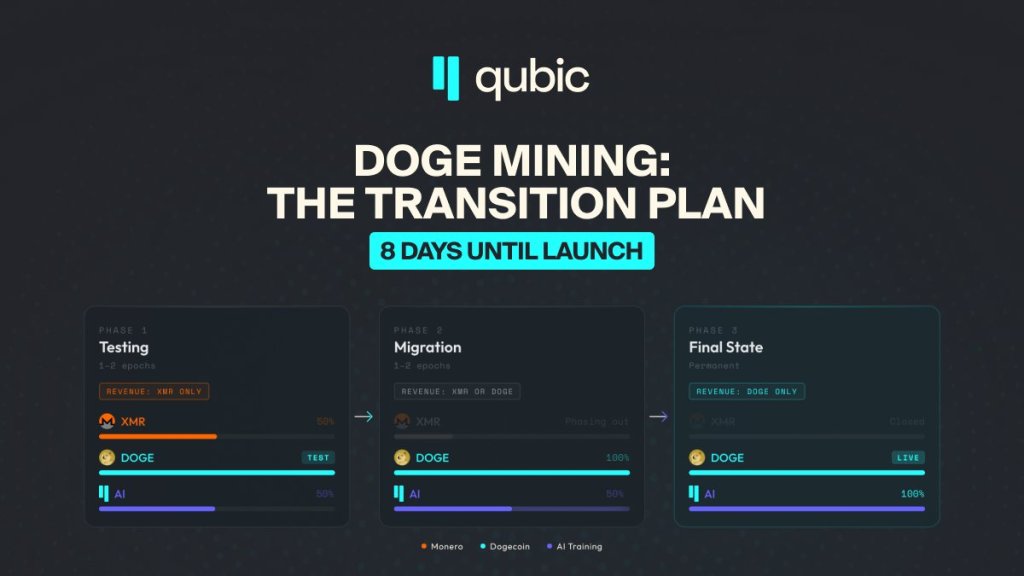
Qubic has announced a three-phase plan to transition its mining operations from Monero (XMR) to Dogecoin (DOGE), starting on April 1. The shift is designed to be deliberate and methodical rather than instantaneous. Phase 1 (beginning April 1) serves as a testing period where Monero mining remains active 50% of the time, while Dogecoin runs at 100% in "test mode." Computor revenue during this phase remains in XMR only. Phase 2 allows computors to choose between XMR and DOGE revenue, with XMR gradually phased out. Those opting for DOGE will no longer receive XMR. Phase 3 completes the transition, with revenue switching entirely to DOGE, XMR mining disabled, and both DOGE mining and AI training running at full capacity. Qubic claims its network is now three times faster after recent optimizations, which it says will help handle the increased load. The team cited Dogecoin’s significantly larger daily emission value—approximately $1.44 million compared to Monero’s—as the key economic incentive for the switch.

Qubic will begin its staged transition from Monero to Dogecoin mining on April 1. Via X, the Qubic team layed out a three-phase rollout that it says is designed to move deliberately rather than flip the network over in a single step.

In a post published Tuesday, the project said “the transition from Monero to Dogecoin doesn’t happen overnight” and that its core team had designed a three-phase process in which “each phase is evaluated before moving forward.” The framing is notable given Qubic’s increasingly explicit language around its mining strategy. The headline objective, as the team describes it, is to reach a final state where “DOGE + AI” run “simultaneously, full time.”

3-Phase Rollout For Dogecoin Mining Shift

The first phase begins April 1 and is positioned as a testing period lasting one to two epochs. During that stage, computor revenue remains denominated in XMR only, Monero mining remains active 50% of the time, and Dogecoin enters what Qubic calls “test mode” while running on mainnet at 100%. AI training continues alongside it. In other words, Qubic is not immediately removing the existing Monero-based incentive structure, but introducing DOGE at full operational intensity before revenue is switched over.

The second phase is the actual migration. For one to two epochs, computors will be able to choose between XMR and DOGE revenue, with XMR beginning to phase out and DOGE phasing in with a top-up applied. Qubic also said that computors who opt to bring DOGE “are no longer eligible for XMR.”

By the third and final phase, Qubic says computor revenue will be DOGE only. The XMR dispatcher will be turned off completely, DOGE will remain active 100% of the time, and AI training will also run at 100%. “No rushing. No shortcuts. Just disciplined execution,” the team wrote.

Source: X @_Qubic_

Qubic paired that roadmap with a performance claim aimed directly at the April 1 launch window. On March 23, the project said its network had become “3x faster” on live mainnet, with tick times reduced from 2 seconds a year ago to 1 second and now 0.6 seconds after the latest core optimization.

“Every share a miner submits gets validated through Oracle Machines in a single tick,” Qubic wrote. “Faster ticks mean faster confirmations, a more efficient pipeline, and a network that can handle the load when April 1st hits. The network got faster right before it needed to be.”

The economic case for targeting Dogecoin is straightforward in Qubic’s telling. In a March 20 post, the team pointed to its earlier Monero campaign, saying it went from less than 2% of Monero’s hashrate to “51%+ dominance in a live takeover event,” while generating more than $3.5 million in mining revenue and finding over 26,000 XMR blocks.

Dogecoin, it argued, is a much larger prize. “DOGE produces roughly 14.4 million coins per day. At current prices, that’s approximately $1.44M in daily emission, roughly 10x what Monero was producing,” the team wrote. “The same playbook. A much bigger target.”

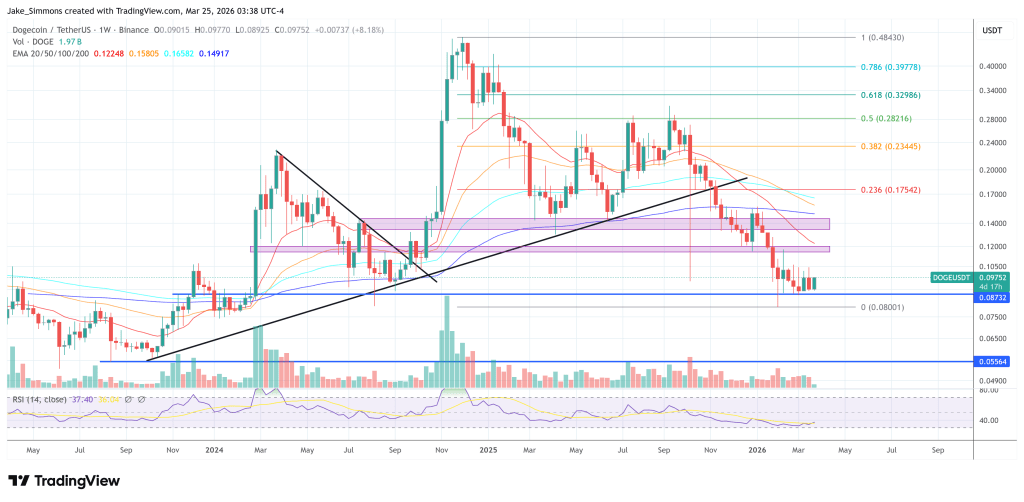
At press time, DOGE traded at $0.09752.

DOGE holds above key support, 1-week chart | Source: DOGEUSDT on TradingView.com

Связанные с этим вопросы

QWhat is the start date for Qubic's transition from Monero to Dogecoin mining?

AApril 1.

QHow many phases are in Qubic's rollout plan for the Dogecoin mining shift?

AThree phases.

QIn the final phase, what will be the only form of computor revenue?

ADOGE only.

QWhat performance improvement did Qubic claim its network achieved on March 23?

AIt became 3x faster on live mainnet, with tick times reduced to 0.6 seconds.

QWhat economic reason did Qubic give for targeting Dogecoin instead of Monero?

ADogecoin produces approximately $1.44M in daily emission, which is roughly 10x what Monero was producing.

Похожее

Bitwise: Crypto Becomes a Contrarian Investment, Three Logics to Understand the Current Market

**Summary** Matt Hougan, Bitwise's CIO, analyzes the current crypto market through three key lenses, arguing it has shifted from a momentum-driven to a contrarian investment. **1) Crypto Becomes a Contrarian Play:** The market is weak, with major assets like Bitcoin and Ethereum down significantly. Capital has moved to hot sectors like AI, leaving crypto as an "unloved" asset class. This transforms crypto investing from trend-following to a test of patience and fundamental analysis. Investors now favor projects with solid fundamentals (e.g., Hyperliquid) over speculative ones. **2) Regulatory Overhang:** The uncertain fate of the U.S. CLARITY Act, a major crypto regulatory framework, is a key headwind. With its passage in 2024 seen as far from guaranteed (estimates range from 30-55%), institutional capital remains on the sidelines, choosing less risky alternatives like AI stocks. The market needs clarity—whether the bill passes or fails—more than any specific outcome to move decisively. **3) Capital Rotates to New Fundamentals:** This cycle differs from past bear markets where money fled to Bitcoin. Now, capital seeks smaller assets with strong use cases. While major cryptos fell in May 2024, tokens like Hyperliquid (+72%), Zcash (+50%), and XLM (+44%) rallied on their specific fundamentals. This rotation confirms the new contrarian, fundamentals-driven logic and signals the bear market may be in its later stages. **Conclusion:** Short-term pressure persists due to regulatory uncertainty and competition from AI narratives. Investing in crypto now requires a contrarian mindset—acting against the crowd and focusing on fundamental value. Patience and targeting high-quality projects based on their merits are essential for capturing long-term gains.

marsbit31 мин. назад

Bitwise: Crypto Becomes a Contrarian Investment, Three Logics to Understand the Current Market

marsbit31 мин. назад

ChatGPT Might Be Disappearing Soon

OpenAI announced at its "Intelligence at Work" event that its coding assistant, Codex, will be fully integrated into the ChatGPT app within weeks. This move marks a strategic shift from a conversational AI (Chat) towards a unified "agentic" platform capable of execution. Codex, originally launched to compete with Anthropic's Claude Code, has grown rapidly to 5 million weekly active users, with 20% being non-developers like analysts and designers. Its enterprise revenue now constitutes 40% of OpenAI's total. The integration is the first step in creating a super-app combining ChatGPT (interface), Codex (execution engine), and the Atlas browser (web access). OpenAI also unveiled new Codex features: specialized Agent plugins for six professional roles, an "Annotations" tool for direct document editing, and a "Sites" function to turn work into shareable web apps. Internally, this reflects a power shift; the Codex team now leads core product strategy. While the ChatGPT brand remains for its vast user base, the platform's future is focused on autonomous agents that perform tasks, not just chat. The article notes that competition with Claude Code pushed OpenAI's development, with Codex competing on cost-effectiveness and accessibility rather than raw coding quality. It concludes that the essence of "ChatGPT" is evolving from a chatbot into an AI agent platform, with the name potentially becoming a legacy symbol of its original function.

marsbit41 мин. назад

ChatGPT Might Be Disappearing Soon

marsbit41 мин. назад

WWDC26 Ultimate Preview: The All-New Siri is the Main Course, iOS 27 is Another Year of Refinements

Apple has confirmed WWDC26 will begin on June 8, with the keynote at 10 AM PT (1 AM Beijing Time, June 9). This year's focus is expected to shift significantly from routine OS updates to Apple's progress in AI, particularly a major overhaul of Siri. Reports indicate the highlight will be a new Siri, reportedly powered by Google's Gemini technology. This upgraded assistant is expected to appear as a lightweight bubble from the Dynamic Island and be accessible via a unified "Search or Ask" system-wide entry point. It aims to deeply integrate with iOS 27, iPadOS 27, and macOS 27, accessing personal data like messages, photos, and documents, with a potential standalone Siri app also in development. For iOS 27, leaks suggest incremental improvements rather than major redesigns. Key updates may include a redesigned, more customizable Camera app, enhanced photo editing tools within the Photos app, and potential early system optimizations for a future foldable iPhone. The update is also rumored to prioritize bug fixes, stability, and performance optimization. iPadOS 27 is anticipated to focus on improving productivity features like window management, file systems, and external display support to better utilize the iPad's hardware. macOS 27 is seen as a core platform for Apple Intelligence, likely receiving an optimized Siri, new AI features, and continued refinement of the "Liquid Glass" design language. Notably, macOS 27 may finally drop support for Intel-based Macs. The overarching theme for WWDC26 is whether Apple can effectively integrate AI across its ecosystem. The success of the new Siri and Apple Intelligence will be judged on their ability to move beyond standalone features and become a cohesive, context-aware system layer that understands user workflows across iPhone, iPad, Mac, and other devices, while maintaining Apple's emphasis on privacy and stability. The conference represents Apple's critical attempt to catch up and redefine the AI assistant experience after a perceived slow start in the generative AI era.

marsbit1 ч. назад

WWDC26 Ultimate Preview: The All-New Siri is the Main Course, iOS 27 is Another Year of Refinements

marsbit1 ч. назад

Торговля

Спот
Фьючерсы
活动图片