Pump.fun team moves 1.75B PUMP: Can bulls offset selling pressure?

ambcryptoОпубликовано 2026-03-07Обновлено 2026-03-07

Введение

Pump.fun's team transferred 1.75 billion PUMP tokens (worth ~$3.54M) to Bitget, raising sell-off concerns. Despite this, the market showed limited immediate volatility, with price dropping only 1.73%. Recent data indicates continued retail buying, averaging $691k daily over the past five days. However, the longer-term Accumulation/Distribution metric suggests persistent selling pressure, with billions of tokens entering circulation. On-chain activity remains stable, with strong launchpad volume and daily revenue of $1.3M, providing some underlying support for the token.

Pump.fun [PUMP] has remained largely neutral to developments over the past day involving the project’s team.

For now, market sentiment will depend mainly on the actions of retail investors and on-chain users of the platform, as participants assess whether the next move will be a short-term rally or a further decline.

Team transfers tokens to the exchange

Recent on‐chain activity indicates movement linked to the team behind the asset.

Data indicates that in the early hours of the 6th of March, a wallet linked to Pump.fun executed two transactions that transferred its native token, PUMP, to the cryptocurrency exchange Bitget.

The first transaction involved the sale of 1.75 billion PUMP, valued at roughly $3.54 million. The second transaction transferred 5,000 PUMP tokens, worth about $10.

Transfers from private wallets to centralized exchanges often raise concerns about a potential sell-off, as such movements typically increase the likelihood of tokens entering the market.

Despite the transfers, the market has yet to show strong volatility. PUMP’s price has declined by 1.73%, while trading volume has dropped 21% to around $100 million during the same period.

Market absorbs potential selling pressure

So far, spot exchange netflow data shows no clear evidence of a large-scale sell-off.

This metric tracks the inflow and outflow of an asset on exchanges to determine whether buyers or sellers currently dominate market activity.

According to CoinGlass data, investors have continued to buy PUMP over the past five days, beginning on the 2nd of March, with average daily purchases of about $691,000.

However, a broader market indicator presents a different picture. The Accumulation/Distribution (A/D) indicator, which measures whether investors are accumulating or distributing an asset over time, suggests that selling pressure still dominates.

Chart data shows that the distribution has persisted for several months, dating back to November 2025. In the past 24 hours alone, roughly 6 billion PUMP tokens entered circulation, indicating continued distribution into the market.

The divergence between recent spot buying and the longer-term A/D reading suggests that current accumulation remains relatively weak. This aligns with the modest average buying activity recorded over the past five days.

On-chain activity remains stable

Despite the market uncertainty, on-chain activity across the Pump.fun ecosystem remains relatively steady.

Launchpad volume on the platform continues to climb, indicating sustained activity that could support demand for the token.

Data from Artemis shows that launchpad volume currently stands at $101.8 million, marking the second-highest level recorded this year.

The highest level occurred on the 2nd of March, when volume reached $105.2 million. Before this recent surge, the last time launchpad activity approached similar levels was in October 2025.

Rising platform usage could gradually support overall demand and strengthen PUMP’s value over time. One metric worth monitoring closely is the platform’s daily revenue.

At present, Pump.fun generates around $1.3 million in revenue per day, reflecting sustained activity across the ecosystem.


Final Summary

  • The PUMP team moved part of its holdings to a centralized exchange, raising speculation about a potential sell-off.
  • Daily buying averages around $691,000, but declining accumulation across the broader trend leaves PUMP exposed to downside risk.

Связанные с этим вопросы

QWhat was the value of the amount of PUMP tokens transferred to Bitget by the team's wallet?

AThe first transaction involved 1.75 billion PUMP tokens, valued at roughly $3.54 million.

QAccording to the article, what does the Accumulation/Distribution (A/D) indicator suggest about the market trend for PUMP?

AThe Accumulation/Distribution (A/D) indicator suggests that selling pressure still dominates and that distribution has persisted for several months.

QHow has the price and trading volume of PUMP reacted following the team's token transfers?

AFollowing the transfers, PUMP's price declined by 1.73% and its trading volume dropped by 21% to around $100 million.

QWhat is the current daily revenue generated by the Pump.fun platform, as mentioned in the article?

APump.fun currently generates around $1.3 million in revenue per day.

QWhat does the launchpad volume data from Artemis indicate about activity on the Pump.fun platform?

AData from Artemis shows that launchpad volume is currently at $101.8 million, which is the second-highest level recorded this year, indicating sustained platform activity.

Похожее

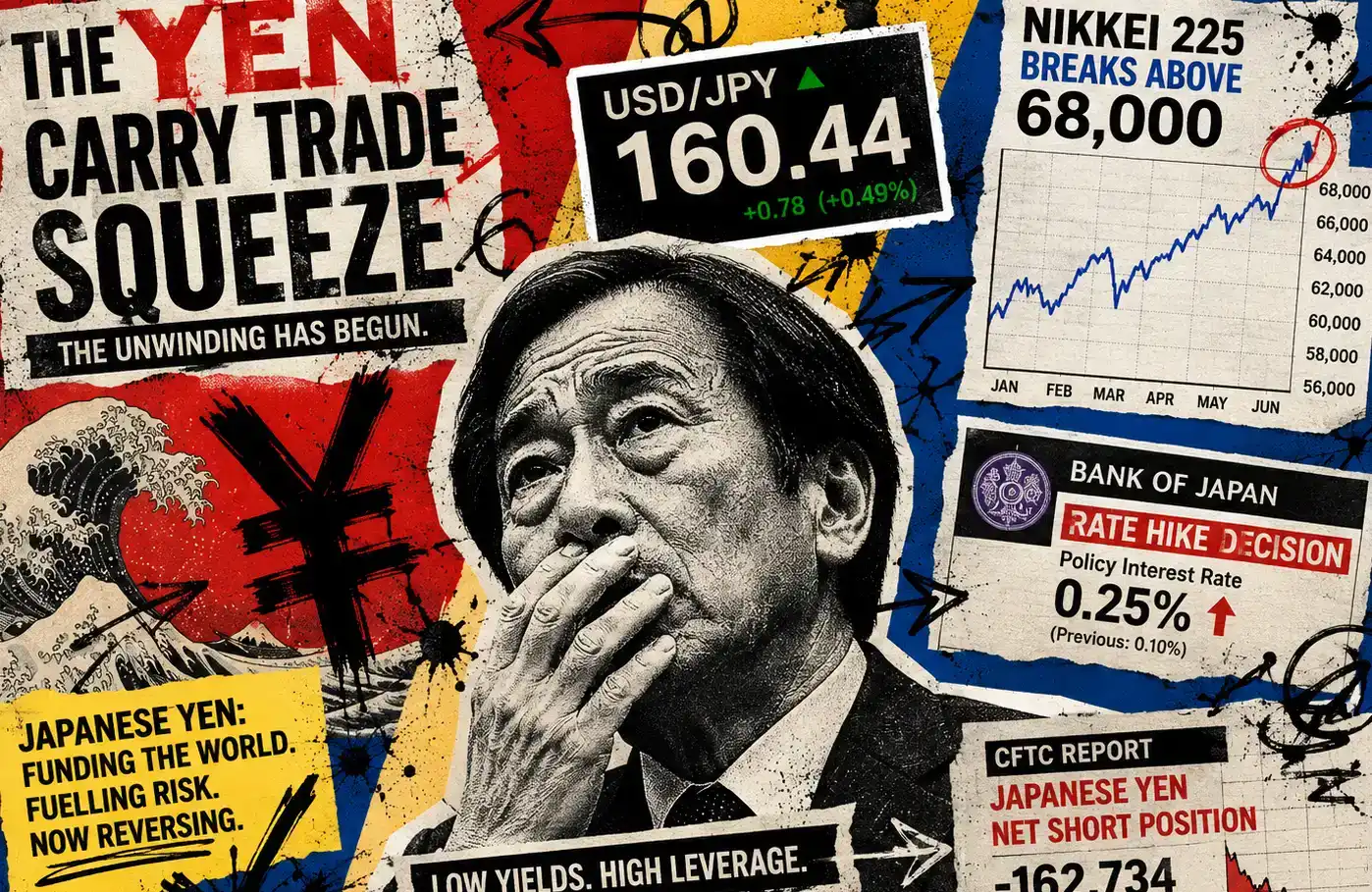
New Wall Street Play: Yen Shorts Still Adding, But Japan Stocks Don't Rely on Carry Trade Unwinding

On June 3rd, USD/JPY hit 160.44, its highest level since July 2024, while the Nikkei 225 surged past 68,000 points. Contrary to popular narratives of an imminent "carry trade unwind" akin to August 2024, data reveals a more complex picture. Speculative net short positions in yen futures have actually increased, reaching -114,667 contracts by late May, suggesting traders are doubling down rather than retreating. Meanwhile, Japan's Finance Ministry conducted its largest-ever single-round FX intervention (11.73 trillion yen) in April-May but failed to hold the 160 yen line. The Nikkei's rally is not driven by carry trade dynamics. Foreign investors are aggressively buying Japanese stocks, with net purchases in 2026 running nearly 16 times higher than 2025 levels. This inflow is concentrated in AI and semiconductor-related stocks like SoftBank and Socionext, fueled by positive sector outlooks, rather than being a flight from unwinding yen shorts. Furthermore, the Nikkei has continued climbing despite the Bank of Japan's (BOJ) rate hikes to 0.75%. This disconnect exists because the current equity boom is fueled by AI-driven foreign investment, not reliant on cheap yen funding. However, this relationship remains fragile. Should the BOJ hike rates further (e.g., to 1.0%) while dollar weakness increases carry trade costs, the trajectories of the yen and Japanese stocks could reconverge, potentially triggering volatility.

marsbitТолько что

New Wall Street Play: Yen Shorts Still Adding, But Japan Stocks Don't Rely on Carry Trade Unwinding

marsbitТолько что

Broadcom's Q3 Guidance Misses Expectations by $12 Billion, After-Hours Trading Plummets Over 13%, AI Narrative "Cooling"?

On June 3, Broadcom released record Q2 FY26 results with revenue of $22.19B, up 48% YoY, and AI chip sales of $10.8B, up 143%. Adjusted EPS of $2.44 beat estimates. However, its Q3 AI semiconductor revenue guidance of $16B, while up over 200% YoY, fell roughly $1.2B (7%) short of analyst consensus expectations of $17.2B. This miss, coupled with slightly weaker-than-expected software revenue, triggered a severe market reaction. CEO Hock Tan maintained the FY26 AI revenue outlook of over $100B but did not raise it, disappointing investors who had priced in more robust growth. The stock plummeted over 13% in after-hours trading, erasing roughly $270B in market cap. The sell-off extended to peers like Marvell. A key concern for markets, particularly for Chinese optical module suppliers, was Tan's comment that the contribution of AI networking (e.g., Ethernet switches, optical interconnect chips) to AI revenue, currently near 40%, is expected to normalize to around 30% over time, signaling a potential peak in growth for that segment. Despite the guidance shortfall, Tan reiterated that AI demand remains "insatiable" and reaffirmed the long-term target of exceeding $100B in AI revenue by FY27. The reaction highlights the heightened sensitivity and premium valuation placed on AI-exposed stocks, where anything less than stellar guidance can prompt significant profit-taking. The broader question is whether this represents a cooling AI narrative or a correction in overstretched valuations.

marsbit1 мин. назад

Broadcom's Q3 Guidance Misses Expectations by $12 Billion, After-Hours Trading Plummets Over 13%, AI Narrative "Cooling"?

marsbit1 мин. назад

Fei-Fei Li's Team Clarifies the Concept of 'World Models', Sora Merely a Renderer

"World Models" has become a widely used yet confusing term in AI. To address this, a team led by Fei-Fei Li and World Labs proposed a functional taxonomy based on the Partially Observable Markov Decision Process framework. This taxonomy categorizes systems called "world models" into three distinct projections: Renderers, Simulators, and Planners. Renderers, like OpenAI's Sora and other video generation models, focus on producing photorealistic visual outputs for human perception. They prioritize visual fidelity over physical accuracy. Simulators, such as NVIDIA Omniverse, aim to compute precise future environmental states for computational tasks like engineering analysis or digital twins. Planners, like Vision-Language-Action models, take in observations and goals to output executable actions for robots or agents. The article clarifies that most current "world models," including Sora, are primarily Renderers. They generate convincing visuals but lack the core ability to simulate state transitions based on actions, a key requirement for a true world model in classic reinforcement learning definitions. This conceptual confusion has practical implications, leading to potential misalignment in technology selection, investment, and public understanding of AI capabilities. Clear categorization is crucial. It helps enterprises avoid costly mistakes (e.g., using a renderer for robot training), allows investors to accurately assess markets, and enables researchers to build comparable benchmarks. While future systems may integrate these functions, recognizing current boundaries is essential for honest assessment and progress.

marsbit1 ч. назад

Fei-Fei Li's Team Clarifies the Concept of 'World Models', Sora Merely a Renderer

marsbit1 ч. назад

Торговля

Спот
Фьючерсы

Популярные статьи

Как купить PUMP

Добро пожаловать на HTX.com! Мы сделали приобретение Pump.fun (PUMP) простым и удобным. Следуйте нашему пошаговому руководству и отправляйтесь в свое крипто-путешествие.Шаг 1: Создайте аккаунт на HTXИспользуйте свой адрес электронной почты или номер телефона, чтобы зарегистрироваться и бесплатно создать аккаунт на HTX. Пройдите удобную регистрацию и откройте для себя весь функционал.Создать аккаунтШаг 2: Перейдите в Купить криптовалюту и выберите свой способ оплатыКредитная/Дебетовая Карта: Используйте свою карту Visa или Mastercard для мгновенной покупки Pump.fun (PUMP).Баланс: Используйте средства с баланса вашего аккаунта HTX для простой торговли.Третьи Лица: Мы добавили популярные способы оплаты, такие как Google Pay и Apple Pay, для повышения удобства.P2P: Торгуйте напрямую с другими пользователями на HTX.Внебиржевая Торговля (OTC): Мы предлагаем индивидуальные услуги и конкурентоспособные обменные курсы для трейдеров.Шаг 3: Хранение Pump.fun (PUMP)После приобретения вами Pump.fun (PUMP) храните их в своем аккаунте на HTX. В качестве альтернативы вы можете отправить их куда-либо с помощью перевода в блокчейне или использовать для торговли с другими криптовалютами.Шаг 4: Торговля Pump.fun (PUMP)С легкостью торгуйте Pump.fun (PUMP) на спотовом рынке HTX. Просто зайдите в свой аккаунт, выберите торговую пару, совершайте сделки и следите за ними в режиме реального времени. Мы предлагаем удобный интерфейс как для начинающих, так и для опытных трейдеров.

742 просмотров всегоОпубликовано 2024.03.29Обновлено 2026.06.02

Как купить PUMP

Король мемов PUMP: создание инновационной платформы Web3 SocialFi

Pump.Fun - это инновационная социально-финансовая (SocialFi) платформа, начавшаяся с запуска мемкоинов и теперь стремящаяся создать экосистему, где можно торговать различными видами контента.

2.4k просмотров всегоОпубликовано 2025.09.18Обновлено 2025.09.18

Король мемов PUMP: создание инновационной платформы Web3 SocialFi

Обсуждения

Добро пожаловать в Сообщество HTX. Здесь вы сможете быть в курсе последних новостей о развитии платформы и получить доступ к профессиональной аналитической информации о рынке. Мнения пользователей о цене на PUMP (PUMP) представлены ниже.

活动图片