Public Chains 2025: The Bustle Belongs to the Casino, the Desolation to the Ecosystem

比推Опубликовано 2025-12-18Обновлено 2025-12-18

Введение

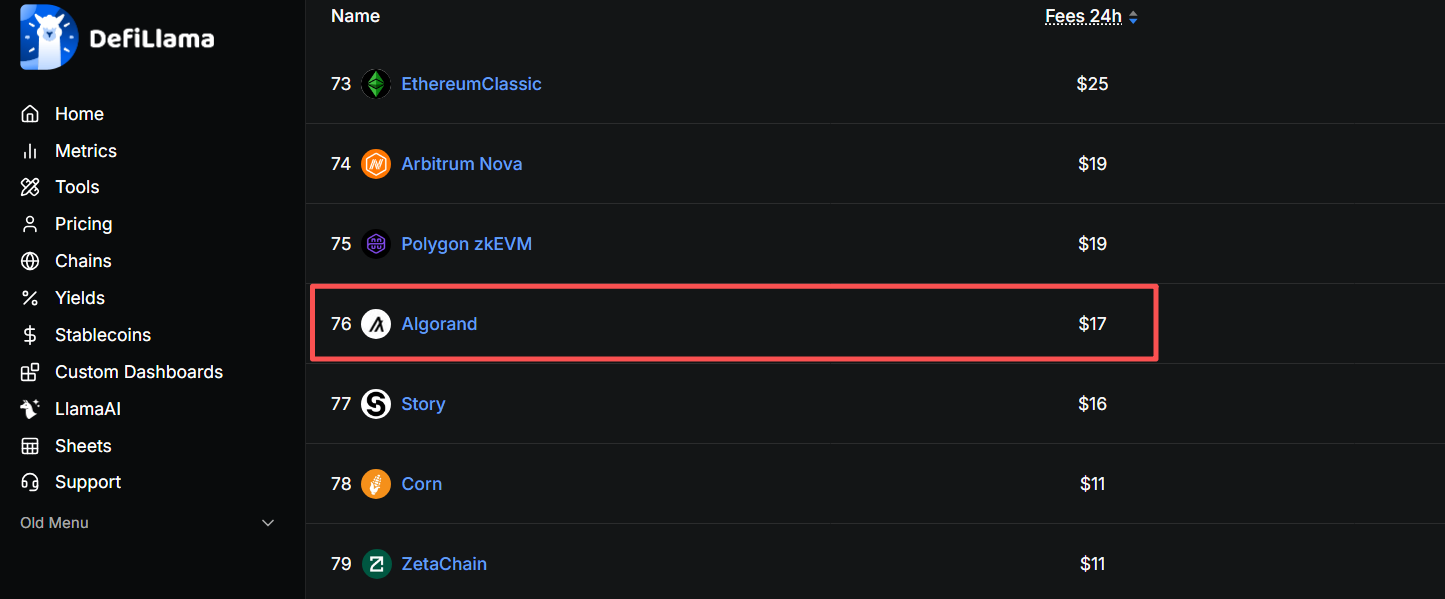
The 2025 public blockchain landscape reveals a stark divide between hype and reality, with a severe concentration of value and widespread "zombification" of projects. Analysis of DeFiLlama's on-chain fee data exposes a critical structural issue: the crypto space is dominated by a "profit concentration and long-tail zombie" era. Notable examples highlight this crisis. Algorand, a chain with a $1 billion market cap and advanced technology, generated a mere $17 in daily fees, while Cardano, a top-10 asset, saw only around $6,000. These "classic chains" are likened to empty, expensive cities with no real economic activity. The biggest value capturers are not the most technologically elegant chains. Tron leads with $1.24 million in daily fees, succeeding as a low-cost payment rail for USDT transfers—crypto's only true mass-adoption use case. Solana ($600k daily) thrives as a high-frequency casino for meme coins and speculation, and Base ($105k daily) demonstrates that distribution (via Coinbase) is more critical than pure technology. The only validated business models generating significant fees are low-cost payments, high-frequency speculation, and, to a lesser extent, Ethereum's asset settlement layer. The VC-driven model is failing. New chains like Sui, Sei, and Starknet, which raised hundreds of millions, show a severe disconnect between their high valuations and meager daily fee revenue (ranging from $320 to $12,000). Their lifecycle often follows a "pump and dump" pattern...

Author: BlockWeeks Block Weekly

In the cryptocurrency market, if you only look at Market Cap, you see a thriving, flourishing digital utopia. Valuations in the tens of billions, grand technical whitepapers, the halo of Turing Award winners... everything looks like the dawn of the next generation of the internet.

But if you put on a different pair of glasses—glasses that only see "on-chain real revenue (Fees)"—you see a completely different, even spine-chilling picture: in this so-called trillion-dollar market, the vast majority of "unicorns" are actually zombies that stopped breathing long ago.

Recently, BlockWeeks conducted a detailed analysis of the "Fees" data for public chains on DeFiLlama, and we discovered an unavoidable structural problem: crypto public chains have entered an era of "extremely concentrated profits and a collectively zombified long tail."

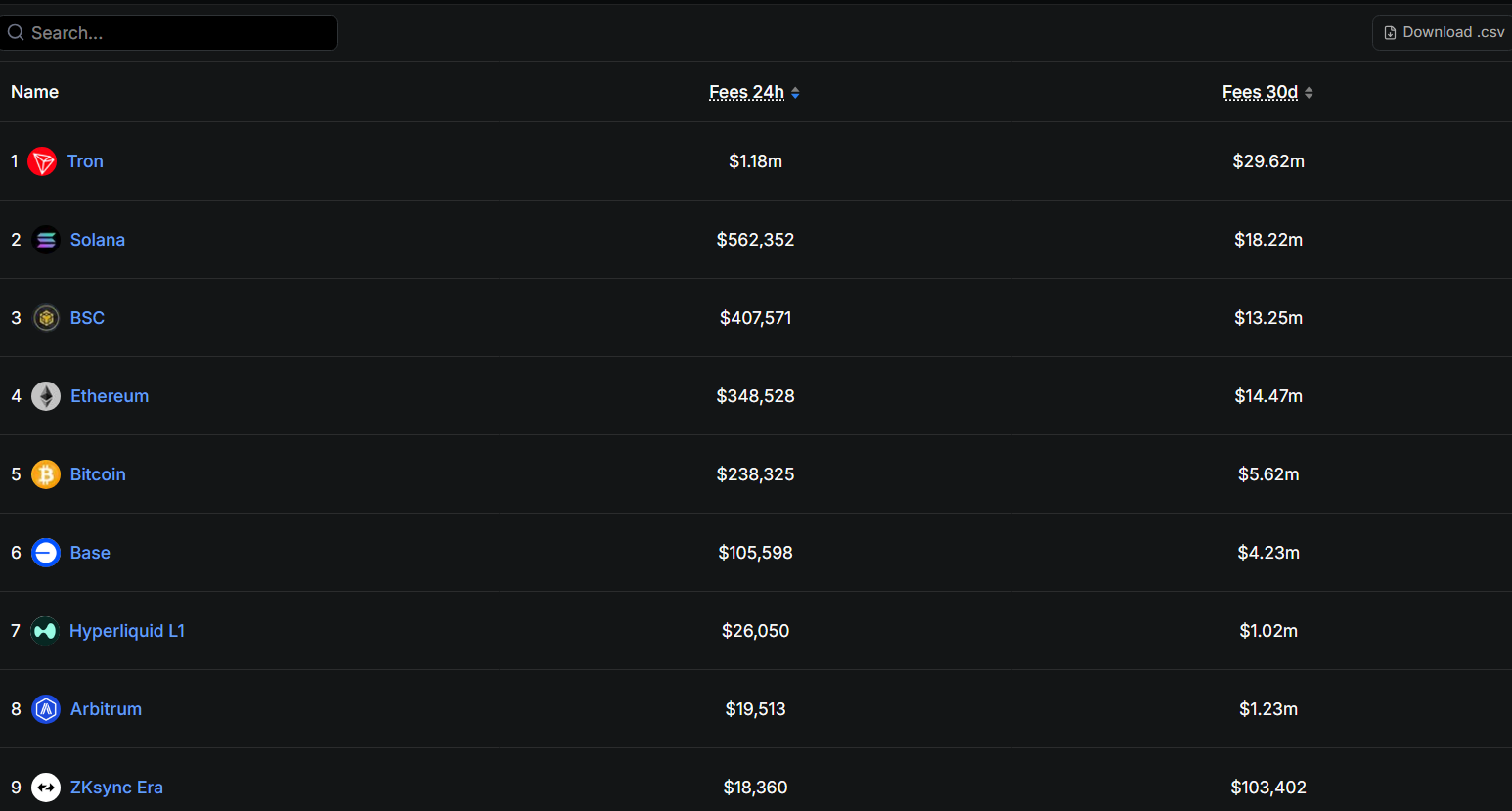
The core data of this article are sourced from DeFiLlama's "Fees / Revenue by Chain" panel (capture time: December 16, 2025). The "Fees" defined here refer to the total fees paid by users on-chain (top-line), serving as an approximate indicator of the scale of on-chain economic activity, not the protocol's net retained income (Protocol Revenue). This article aims to use this open, unified standard to examine the on-chain value capture ability of various public chains.

I. The $17 Humiliation: The Demise of the Technological Utopia

According to the public data we captured from DeFiLlama, the most alarming figure did not come from the million-dollar giants at the top, but from the $17 at the bottom.

This is the daily protocol revenue for Algorand—a chain once crowned the "blockchain trilemma solver," founded by Turing Award winner Silvio Micali, and boasting top-tier technical credentials.

You read that right, not $170,000, but $17.

At this very moment, Algorand's market cap remains in the billion-dollar range. A "digital nation" with a billion-dollar market cap generates direct tax revenue from its digital economy that isn't enough to buy four lattes at Starbucks. It shows that despite possessing the most advanced decentralized technology, without real, sustained application demand, its economic value capture ability approaches zero.

This is not just an embarrassment for Algorand; it's the death knell for the entire "classic public chain" camp.

Look at Cardano (ADA), a behemoth consistently in the top 10 by market cap, with millions of token holding addresses. Yet the data tells us its recent average daily on-chain fees hover around $6,000. This means that aside from asset transfers between holders and network maintenance staking, there is a lack of commercial activity on that chain significant enough to generate substantial fees—no large-scale lending, no high-frequency trading, no real, paid value exchange.

These public chains are like luxurious empty cities built at great expense in the middle of a desert. The infrastructure is complete, the roads are wide, the city hall (foundation) is well-funded, but no citizens (active paying users) are seen on the streets. Their method of sustaining operation is often for the city hall to continuously sell off reserves (dumping tokens) to cover operational costs.

II. The Ugly Victory: Who is Actually Capturing Value?

When shifting focus to the top of the list, a fact that makes "technological purists" even more uncomfortable emerges: the ones making the most money are often not the most "elegant" or "decentralized" in terms of technology.

Topping the chart is Tron, with average daily fees as high as $1.24 million. In the eyes of many elitists, Tron might hardly be considered "technical." But the market has given the ultimate answer by voting with its feet: payments are a rigid demand. Tron carries the vast majority of the global on-chain transfer demand for USDT. In this industry full of speculation and bubbles, Tron has inadvertently become the only payment layer application with mass adoption—even if it merely serves as a shadow banking channel for fiat currencies.

One could say: payments, the oldest and most basic internet need, are currently the only mass adoption in the Crypto world. Tron's success is a powerful mockery of all project teams that pursue "perfect technology" while ignoring "real demand."

Close behind is Solana, with nearly $600,000 in average daily fees. Its success logic is even more straightforward: it is the world's most active on-chain casino. Meme coins, high-frequency DEX trading, front-running—these activities contribute the vast majority of the fees. Solana's moat is no longer TPS, but "attention traffic." The rise of Base is even more disruptive (approx. $105k daily): it proves that distribution channels are far more important than the technology itself. Backed by Coinbase's huge user base, Base delivers a dimensional打击 to other L2s.

This provides a brutal yet clear revelation: the current Crypto market has only two and a half business models that are verified and can generate large-scale on-chain fees—low-cost payments (Tron), high-frequency speculation (Solana/Base), and the asset settlement layer (Ethereum), which is being constantly eroded by L2s.

Beyond these, those once highly anticipated "enterprise-level applications," "supply chain traceability," and "Web3 social" have, in the face of cold on-chain fee data, at least at this stage, not yet demonstrated规模化付费 demand.

III. The VC Syndicate Dilemma: Why "Peak at Launch"?

This data also reveals another deep crisis: the narrative model for new L1/L2s driven by massive venture capital (VC) financing is facing a brutal reality check regarding monetization.

We see that new public chains like Sui (~$12k daily), Sei (~$320 daily), Starknet (~$10k daily), which launched with great fanfare and raised hundreds of millions or even billions of dollars, have severely inverted链上手续费收入 compared to their fully diluted valuations (FDV) of tens or hundreds of billions.

The standard playbook of the past few years has been: VC investment -> team piles on technical highlights -> attract airdrop farmers to刷取数据 -> token lists on exchanges creating wealth -> retail investors buy into the narrative -> airdrop farmers撤离 -> on-chain activity data plummets.

This is why many new chains have astonishing TPS and hundreds of thousands of daily active users at launch, only to quickly become "ghost towns" months later. Because those users are mercenaries, not residents. When airdrop expectations are realized, when incentive subsidies stop, the real, organic demand is exposed for what it is—daily fee revenues of a few thousand or tens of thousands of dollars simply cannot support billion-dollar valuation dreams.

We are facing severe "block space inflation." The industry has built too many chains, too many L2s, too many data availability (DA) layers, but innovation at the application layer is extremely scarce. This is like狂热ly laying成千上万条光纤 in the early days of broadband internet普及, before Netflix, YouTube, or any killer app that must use this bandwidth has been born.

IV. Investor Awakening: From "Listening to Stories" to "Checking the Books"

For a long time, the valuation logic of the crypto market was built on "dream multiples." The grander the narrative, the richer the imagination, the higher the market cap could fly.

But 2024-2025 is becoming a watershed. As macro liquidity tightens and institutional investors demand more substantial returns, the market is being forced to return to rationality.

For investors, the logic must change:

  1. Beware of "Zombie Coins": If a project has a market cap of billions but daily on-chain fees of only a few hundred or thousand dollars, this extreme "unworthiness" is often the starting point for a long-term decline. Its only support—community faith—will eventually run out.

  2. Focus on "Positive Cash Flow" Ability: Look for ecosystems where users are willing to持续付费 for services even without token incentives. Tron's stablecoin transfer fees, Base and Solana's transaction fees are direct reflections of real demand.

  3. Acknowledge "Channels and Ecosystems are King": Base's success proves that pure technical advantages can hardly be a moat anymore. Giants entering with massive user bases (like Coinbase), or native communities that can breed狂热 cultures, are more valuable assets at the current stage. Purely technical public chains, if they cannot solve the "who will use it and why" problem, will ultimately become Algorand-style academic exhibits.

  4. See Through the VC Game: Stop paying for虚假繁荣 driven by subsidies and airdrops.

Faced with the harsh reality of $17 daily revenue, rather than paying for grand narratives and empty "digital ghost cities," it's better to tighten your purse strings and turn to the few ecosystems that can generate real cash flow and have active paying users.

This is not a denial of the long-term value of all technological exploration, but a necessary清算 of the current畸形的 valuation system. Only when the market learns to pay for "value actually generated," rather than透支 for "stories promised in the future," can this industry usher in a truly healthy dawn.

Important Notes and Evaluation Framework

The core of this article is to use "on-chain fees" as a unified, public ruler to measure the "immediate value capture ability" of various public chains. When reading and citing the conclusions of this article, please be sure to understand the following key background and limitations:

1. General Background Notes

  • Development Stage Differences: Some public chains may be technologically advanced but in their early stages, with a user base not yet formed for scale effects. The data in this article reflects the "current state," not the "ultimate potential."

  • Impact of Fee Models: Some public chains are designed to pursue ultra-low transaction fees (Gas Fee), and their native token prices are low. This means that even if the number of on-chain transactions is considerable, the "total fee revenue" denominated in USD appears tiny. This suggests that evaluating such chains should combine metrics like transaction count and active address number for a comprehensive judgment, but the upper limit of their USD-denominated economic throughput remains an objective fact.

2. Evaluation Notes for Specific Types of Chains

For a fairer discussion, we provide the following evaluation ideas for specific types of projects:

Chain Type This Article's Evaluation & Suggestion
Storage/Service Networks

(e.g., Filecoin, Arweave)

There is indeed a difference in口径. The core value of these networks lies in storage/retrieval services, and their revenue model differs from单纯 transaction fees. DeFiLlama's "Fees" metric may severely underestimate their actual commercial activity. If you are an investor, you should be on their storage market capacity, active交易订单, and real storage revenue streams.
Off-Chain/Consortium Business-Driven Public Chains

(e.g., some enterprise chains)

Data has limitations. DeFiLlama only statistics public on-chain activity, a point BlockWeeks fully agrees with. But we同样疑惑, if the main value of a public chain is not reflected on-chain, then what supports the market cap of its publicly issued tokens used for on-chain governance and security?
Technical Low-Fee/High-TPS Public Chains The design初衷 is good. However, extremely low per-transaction fees mean the value captured by the chain itself and validators is extremely low. The success of this model must rely on extremely high transaction volume to compensate for the low price disadvantage. If low fees fail to attract massive transactions, its economic model may face challenges.
Chains with Ecosystem Traffic Concentrated on CEXs Hard to evaluate. If a public chain's on-chain economic activity is weak and cannot generate sufficient fees, then its practical value and value capture ability as a "decentralized settlement layer" or "smart contract platform" are low. Its value may be closer to a单纯的 "digital collectible."

We始终 believe that in a world of highly concentrated profits, projects in the long tail are almost sentenced to fate unless they find unique application scenarios (like gaming or specific AppChains). Only platforms that can generate cash flow through real, sustained user demand have the potential to survive long-term and outperform the market.


Twitter:https://twitter.com/BitpushNewsCN

Bitpush TG Discussion Group:https://t.me/BitPushCommunity

Bitpush TG Subscription: https://t.me/bitpush

Original Link:https://www.bitpush.news/articles/7596644

Связанные с этим вопросы

QWhat is the core metric used in the article to evaluate the health and value capture of public blockchains?

AThe article uses on-chain fees (total fees paid by users) as the core metric, sourced from DeFiLlama's 'Fees / Revenue by Chain' dashboard, to measure the scale of economic activity and value capture.

QAccording to the article, which blockchain has the highest daily on-chain fees, and what is the primary use case driving this activity?

ATron (TRX) has the highest daily on-chain fees at $1.24 million, driven primarily by its role as a low-cost payment layer for USDT stablecoin transfers, serving as a 'shadow banking channel'.

QWhat does the example of Algorand's $17 daily fee revenue illustrate about the current state of many 'classic' public blockchains?

AAlgorand's $17 daily fee revenue, despite its multi-billion dollar valuation and advanced technology, illustrates that many 'classic' public blockchains have become 'zombies'—they lack real, sustained application demand and their economic value capture is nearly zero, making them like 'luxury empty cities in the desert'.

QWhat are the two and a half business models that the article states have been validated to generate large-scale on-chain fees?

AThe two and a half validated business models are: 1. Low-cost payments (exemplified by Tron), 2. High-frequency speculation/gambling (exemplified by Solana and Base), and the half being the asset settlement layer (exemplified by Ethereum, which is being constantly eroded by L2s).

QWhat major shift in investor logic does the article suggest is happening in the 2024-2025 market?

AThe article suggests a shift from valuing projects based on grand narratives and 'dream ratios' to a more rational approach that focuses on 'checking the books'—prioritizing real cash flow-generating ability, active paying users, and avoiding 'zombie coins' with massive valuations but minuscule on-chain revenue.

Похожее

Fei-Fei Li's Team Clarifies the Concept of 'World Models', Sora Merely a Renderer

"World Models" has become a widely used yet confusing term in AI. To address this, a team led by Fei-Fei Li and World Labs proposed a functional taxonomy based on the Partially Observable Markov Decision Process framework. This taxonomy categorizes systems called "world models" into three distinct projections: Renderers, Simulators, and Planners. Renderers, like OpenAI's Sora and other video generation models, focus on producing photorealistic visual outputs for human perception. They prioritize visual fidelity over physical accuracy. Simulators, such as NVIDIA Omniverse, aim to compute precise future environmental states for computational tasks like engineering analysis or digital twins. Planners, like Vision-Language-Action models, take in observations and goals to output executable actions for robots or agents. The article clarifies that most current "world models," including Sora, are primarily Renderers. They generate convincing visuals but lack the core ability to simulate state transitions based on actions, a key requirement for a true world model in classic reinforcement learning definitions. This conceptual confusion has practical implications, leading to potential misalignment in technology selection, investment, and public understanding of AI capabilities. Clear categorization is crucial. It helps enterprises avoid costly mistakes (e.g., using a renderer for robot training), allows investors to accurately assess markets, and enables researchers to build comparable benchmarks. While future systems may integrate these functions, recognizing current boundaries is essential for honest assessment and progress.

marsbit3 мин. назад

Fei-Fei Li's Team Clarifies the Concept of 'World Models', Sora Merely a Renderer

marsbit3 мин. назад

Bloomberg Uncovered: How Do China's Wealthy Circumvent the Annual $50,000 Limit to Transfer Assets?

**Summary: How Wealthy Chinese Circumvent $50,000 Annual Foreign Exchange Limits** Despite China's strict capital controls, including an annual $50,000 per person foreign exchange quota, an estimated $150 billion in funds still leaves the country annually via various gray and underground channels. This report outlines the evolution of China's "capital wall" and the methods used to bypass it. **The Evolving Capital Controls:** * **Foundation (1994):** The system of "current account convertibility with strict capital account controls" was established. * **Quota Set (2007):** The $50,000 individual annual forex purchase limit was formalized. * **Crackdown Begins (2015-2017):** Following market volatility, enforcement tightened. Banks were required to scrutinize transactions, and channels like using UnionPay cards for Hong Kong insurance premiums or buying overseas property were blocked. * **Digital & Legal Upgrades (2024-2026):** Enhanced algorithms now flag suspicious patterns (e.g., "smurfing"). The Common Reporting Standard (CRS) provides Chinese tax authorities with data on citizens' offshore accounts. Unlicensed cross-border brokers have been targeted. **Five Primary Methods for Moving Capital:** 1. **Underground Banking / "Hawala" (Duiqiao):** The largest-scale method. No money crosses borders. Clients pay RMB to a domestic account; an overseas associate deposits equivalent foreign currency into the client's offshore account. Risks include high fees, account freezes, and legal penalties. 2. **"Smurfing" or "Ant Moving":** Using multiple individuals' $50,000 quotas to pool funds for one offshore recipient. Increasingly detected by anti-money laundering algorithms. 3. **Trade Invoice Manipulation:** Businesses over-invoice imports or under-invoice exports via offshore shell companies, creating a pretext to transfer excess funds abroad under the guise of trade. 4. **Channel Migration:** After a crackdown on internet brokers, funds flow toward more compliant but costly channels like major banks' cross-border wealth management services or Qualified Domestic Institutional Investor (QDII) quotas. 5. **Structural Arrangements:** High-net-worth individuals use complex, high-cost legal structures involving offshore trusts, insurance, and investment migration programs to transfer asset ownership. **Regulatory Response: Focusing on People, Not Just Money** The current strategy extends oversight from enterprises to **individual residents**. Tools like CRS allow retroactive visibility into offshore assets. Cryptocurrencies, once seen as a potential loophole, are now actively monitored and prosecuted as an illegal channel. The underlying driver remains: with significant wealth concentrated among millions of affluent households seeking diversification amid domestic economic shifts, the incentive to move assets offshore persists despite regulatory barriers.

marsbit23 мин. назад

Bloomberg Uncovered: How Do China's Wealthy Circumvent the Annual $50,000 Limit to Transfer Assets?

marsbit23 мин. назад

Ethereum's Ballmer Moment: As Everyone Is Bearish, the Circulating Supply Is Disappearing

"Ethereum's Ballmer Moment: Circulation Shrinks Amid Bearish Sentiment" Amid widespread bearish sentiment, with prominent figures like Bankless founder David Hoffman selling ETH and young developers flocking to Solana, some argue Ethereum is entering its "Ballmer era"—akin to Microsoft's perceived stagnation under Steve Ballmer. While surface-level criticisms about slow protocol development, cautious leadership, and competitive pressure are valid, underlying fundamentals tell a different story. Approximately 30% of ETH is staked, major holders like BitMine are accumulating, and spot ETFs continue to absorb supply. Regulatory clarity, including the SEC/CFTC's March ruling on staking rewards and the potential passage of the CLARITY Act, is transforming crypto from a regulatory threat into a legitimized framework. This institutionalization, alongside a shrinking circulating supply (with net issuance around 0.23% annually), creates significant buy-side pressure independent of fee-based value capture. The broader crypto total addressable market is expanding through regulated stablecoins, tokenized assets, and institutional adoption. While public chains face competition from permissioned alternatives, the winning model appears to be permissioned assets settling on public chains like Ethereum and Solana. The author advocates a non-maximalist, barbell strategy: holding ETH for its institutional role and supply squeeze, SOL for consumer/throughput trends, BTC as a macro hedge, and a basket of next-gen L1s. Key bullish drivers for ETH include rapid circulation shrinkage, potential Q2 staked ETF approvals, regulatory tailwinds solidifying its role as a default settlement layer, and the optionality of an eventual "Satya moment" leadership shift. Despite bearish consensus, the current setup—where crypto is "not hot" and regulatory groundwork is being laid—presents a compelling investment opportunity. The crypto cycle's focus may have shifted to AI, but blockchain infrastructure is gaining a legal and institutional foothold precisely while attention is elsewhere.

marsbit23 мин. назад

Ethereum's Ballmer Moment: As Everyone Is Bearish, the Circulating Supply Is Disappearing

marsbit23 мин. назад

Торговля

Спот
Фьючерсы

Популярные статьи

Что такое ZEST

I. Введение в проект1. Что такое Zest Protocol?Zest Protocol — это кредитный протокол, основанный на Bitcoin, построенный на Stacks Layer 2, который позволяет пользователям зарабатывать доход с помощью BTC или занимать активы, закладывая BTC. Умные контракты протокола написаны на языке Clarity, полностью работают в цепочке и являются открытым исходным кодом, с дизайном, вдохновленным Aave v3. Zest в настоящее время является крупнейшим DeFi-протоколом на Stacks, с более чем 800 BTC, внесенными в депозит, и пиковым TVL, превышающим 100 миллионов долларов. В мае 2026 года протокол дополнительно представил Bitcoin Collateral Vaults, расширив кредитные возможности с Stacks на основную сеть Bitcoin. Это позволяет пользователям занимать стейблкоины, не перемещая BTC с сети Bitcoin, что обеспечивает кредитование с самоуправлением.2. Как работает Zest Protocol?Zest Protocol состоит из двух рынков. Рынок Stacks построен на Aave v3, позволяя пользователям вносить такие активы, как sBTC, STX и USDC, чтобы зарабатывать доход или брать кредиты с избыточным обеспечением. Максимальное LTV по умолчанию составляет 50% (70% для sBTC). Рынок Bitcoin работает через недавно запущенные Bitcoin Collateral Vaults. Пользователи занимают стейблкоины, блокируя BTC в самоуправляемых хранилищах на цепочке Bitcoin. Обеспечение остается на основной сети Bitcoin на протяжении всего процесса, и пользователи сохраняют право собственности, если позиция не ликвидирована.3. Кто основал Zest Protocol?Tycho Onnasch (Соучредитель): Выпускник Оксфордского университета. Участвовал в исследованиях и грантах для Фонда открытого интернета Stacks. Бывший менеджер в Trust Machines и основатель Deedmob. Профиль LinkedIn: https://www.linkedin.com/in/tychokoonnasch/.Fernando Foy (Соучредитель): Ранее работал в IT-консалтинге в Objectif Emploi. Профиль LinkedIn: https://www.linkedin.com/in/fernando-foy/.Emil E. (Соучредитель): Имеет степень магистра физики из Университета Уорика. Бывший инженерный партнер в Trust Machines, Full-Stack разработчик для проектов Web3 и дата-ученый в HSBC. Профиль LinkedIn: https://www.linkedin.com/in/emil-e-49771a145/.Детали финансирования: В мае 2024 года Zest Protocol объявил о завершении раунда начального финансирования в размере 3,5 миллиона долларов, возглавляемого Тимом Дрейпером, с участием Binance Labs, Flow Traders, Trust Machines и других.4. Токеномика $ZEST$ZEST — это нативный токен Zest Protocol с фиксированным общим предложением в 1 миллиард токенов и без инфляционного механизма.Сообщество (27,83%): Используется для аирдропов и стимулов для пользователей;Развитие экосистемы (24,82%): Используется для ликвидности, партнерств, маркетинга, листинга на биржах и т. д.;Инвесторы (22,35%): Поддержка инвестиционных сторон, которые поддержали раннее развитие Zest Protocol;Команда (25%): Выделено для основных участников.График вестинга: Токены команды и инвесторов подлежат 1-летнему периоду блокировки, за которым следует 3 года линейного разблокирования.5. Хронология ключевых этапов2022: Официальное основание Zest Protocol.Март 2024: Завершен аудит безопасности и запущен рынок кредитования Stacks на основной сети.В феврале 2026 года запускается Stacks Market V2, вводящий группы риска.В мае 2026 года были представлены Bitcoin Collateral Vaults, и теперь доступен рабочий прототип основной сети. Это позволяет пользователям использовать самоуправляемый BTC на Bitcoin L1 в качестве обеспечения для займа стейблкоинов на EVM-цепочках, заканчивая мосты, обертки и стороннее хранение. Этот запуск разделен на два этапа. Этап 1: Использует заранее подписанные транзакции для ограничения движения BTC; Этап 2: Использует BitVM для проверки. II. Информация о токенеНазвание токена: ZEST (Zest Protocol)III. Связанные ссылкиВебсайт: https://www.zestprotocol.com/Эксплореры: https://bscscan.com/token/0x5506599c722389a60580b5213ea1da60d64754a1Твиттер: https://twitter.com/ZestProtocolПримечание: Введение в проект основано на материалах, опубликованных или предоставленных официальной командой проекта, и предназначено только для справки и не является инвестиционным советом. HTX не несет ответственности за любые прямые или косвенные убытки, возникшие в результате.

234 просмотров всегоОпубликовано 2026.05.19Обновлено 2026.06.02

Что такое ZEST

Как купить ZEST

Добро пожаловать на HTX.com! Мы сделали приобретение Zest Protocol (ZEST) простым и удобным. Следуйте нашему пошаговому руководству и отправляйтесь в свое крипто-путешествие.Шаг 1: Создайте аккаунт на HTXИспользуйте свой адрес электронной почты или номер телефона, чтобы зарегистрироваться и бесплатно создать аккаунт на HTX. Пройдите удобную регистрацию и откройте для себя весь функционал.Создать аккаунтШаг 2: Перейдите в Купить криптовалюту и выберите свой способ оплатыКредитная/Дебетовая Карта: Используйте свою карту Visa или Mastercard для мгновенной покупки Zest Protocol (ZEST).Баланс: Используйте средства с баланса вашего аккаунта HTX для простой торговли.Третьи Лица: Мы добавили популярные способы оплаты, такие как Google Pay и Apple Pay, для повышения удобства.P2P: Торгуйте напрямую с другими пользователями на HTX.Внебиржевая Торговля (OTC): Мы предлагаем индивидуальные услуги и конкурентоспособные обменные курсы для трейдеров.Шаг 3: Хранение Zest Protocol (ZEST)После приобретения вами Zest Protocol (ZEST) храните их в своем аккаунте на HTX. В качестве альтернативы вы можете отправить их куда-либо с помощью перевода в блокчейне или использовать для торговли с другими криптовалютами.Шаг 4: Торговля Zest Protocol (ZEST)С легкостью торгуйте Zest Protocol (ZEST) на спотовом рынке HTX. Просто зайдите в свой аккаунт, выберите торговую пару, совершайте сделки и следите за ними в режиме реального времени. Мы предлагаем удобный интерфейс как для начинающих, так и для опытных трейдеров.

240 просмотров всегоОпубликовано 2026.05.19Обновлено 2026.06.02

Как купить ZEST

Обсуждения

Добро пожаловать в Сообщество HTX. Здесь вы сможете быть в курсе последних новостей о развитии платформы и получить доступ к профессиональной аналитической информации о рынке. Мнения пользователей о цене на A (A) представлены ниже.

活动图片