Plasma surges 12% – Can XPL break past THIS resistance?

ambcryptoОпубликовано 2026-03-17Обновлено 2026-03-17

Введение

Plasma (XPL) surged 12.89% to $0.1238 on March 17, with trading volume up over 155%, signaling renewed buyer interest. The token rebounded from recent lows, reclaiming the $0.1045 support level and approaching the $0.1259 resistance. Technical indicators show buyers gaining dominance, with the +DI line above -DI and ADX around 21, indicating strengthening trend momentum. Exchange outflows of $664K suggest reduced selling pressure and accumulation behavior. Liquidity clusters above $0.128 could trigger a short squeeze if resistance is broken. Holding above $0.1045 is crucial for further upside, with a break above $0.1259 likely accelerating gains toward $0.128.

On the 17th of March, Plasma [XPL] surged 12.89% to $0.1238, while trading volume climbed over 155%, reflecting a sharp rise in participation.

The token has rebounded from recent lows, and buyers have stepped in aggressively during the latest sessions. This move suggests that interest has returned after a prolonged cooling phase.

However, the rally has not occurred in isolation, as both market structure and liquidity dynamics have started aligning with the upside.

The expansion in activity indicates that traders are repositioning rather than exiting.

As a result, this shift places XPL in a critical phase where continuation depends on how price interacts with nearby resistance zones and underlying demand strength.

Can XPL hold support and challenge resistance?

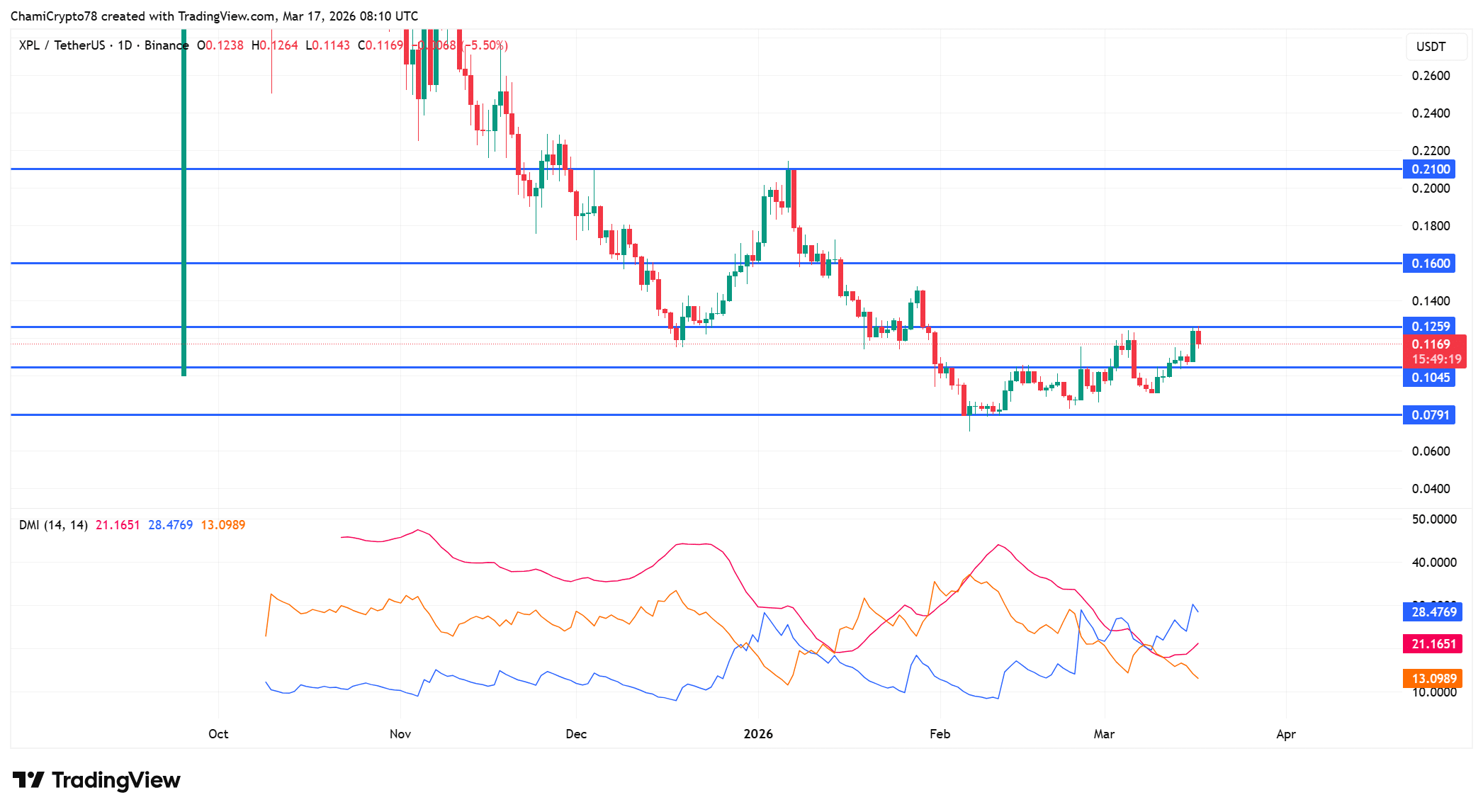
Price has reclaimed the $0.1045 level, which previously acted as a strong support base during consolidation.

Since then, XPL has pushed toward the $0.1259 resistance, where rejection has appeared before.

This area now serves as a key barrier that could define the next directional move.

However, the structure shows higher lows forming, which reflects strengthening buyer control. Each dip has attracted demand, preventing deeper retracements.

The DMI structure has shifted notably, as the +DI line has moved above the -DI line, signaling that buyers have started dominating recent price action.

At the same time, the ADX has hovered around 21, indicating that the trend strength has started building rather than fading.

This alignment reflects a transition from a neutral phase into a developing directional trend.

As the price compresses below the resistance, pressure continues building within this range.

A sustained hold above $0.1045 keeps the structure intact, while repeated tests of $0.1259 increase breakout probability.

This setup suggests that XPL is positioning for a decisive move rather than drifting sideways.

Source: TradingView

Exchange outflows tighten available supply

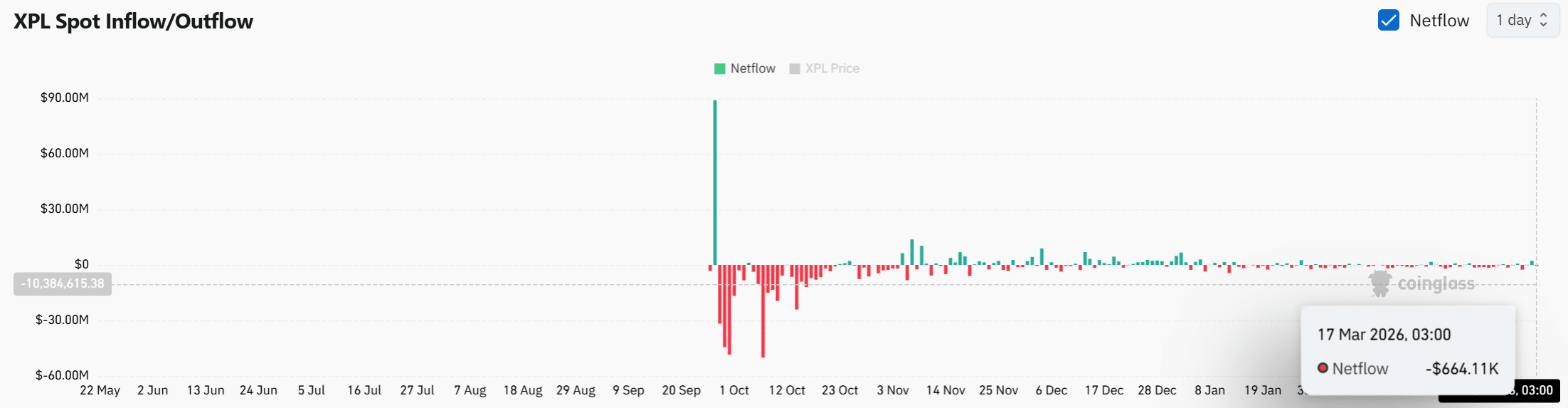
Spot Netflows have remained negative at press time, with recent outflows of approximately $664K from exchanges.

This shift indicates that tokens have been moving off trading platforms rather than preparing for immediate selling.

As supply on exchanges declines, available liquidity tightens, which can amplify price reactions during periods of strong demand.

Besides, reduced sell-side pressure creates conditions where upward moves face less resistance.

However, this dynamic also depends on whether demand continues to match the reduced supply.

As long as outflows persist, the market structure supports accumulation behavior rather than distribution.

This pattern reinforces the bullish context already visible in price action and technical indicators.

Source: CoinGlass

Liquidity clusters above price signal squeeze setup

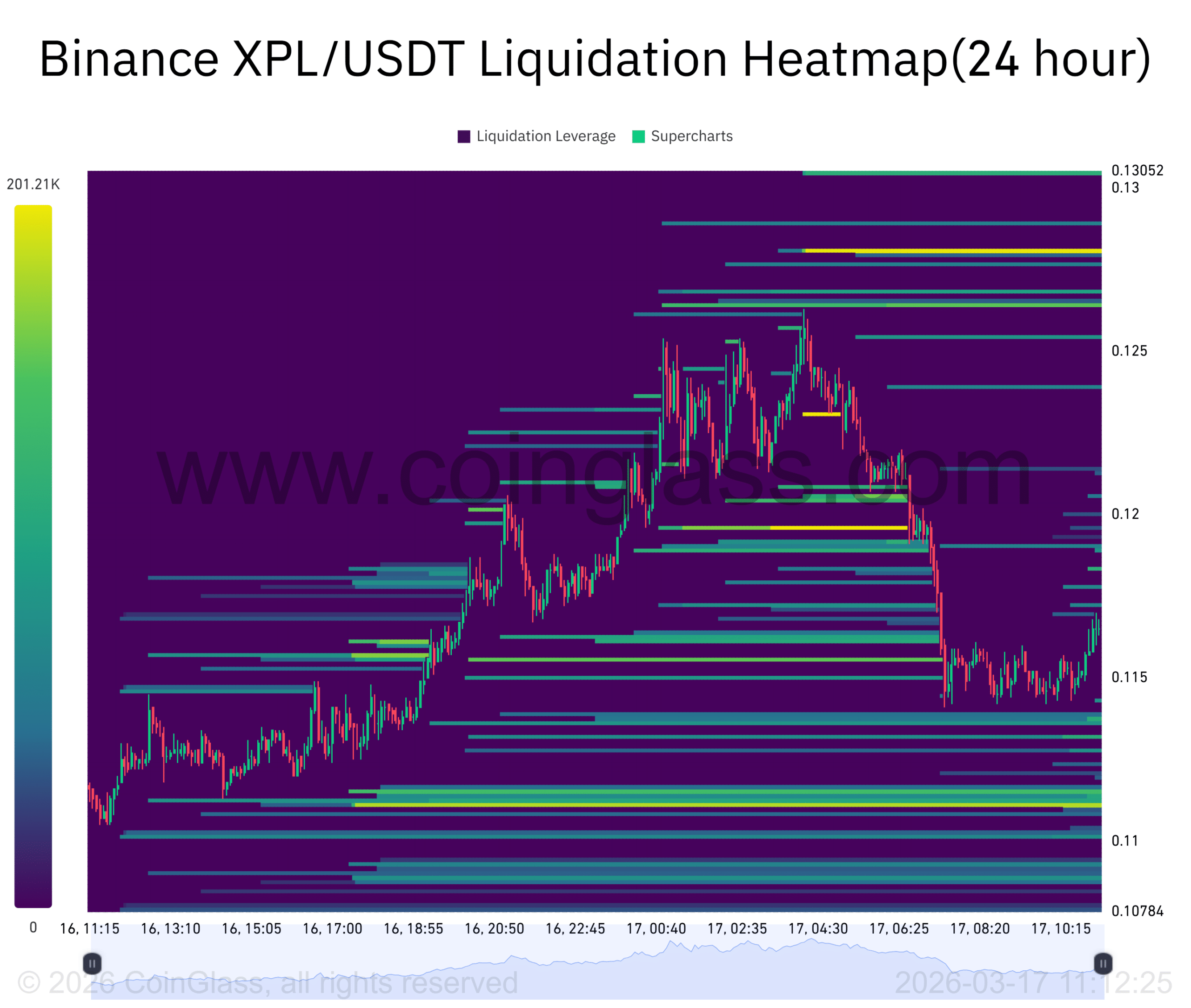
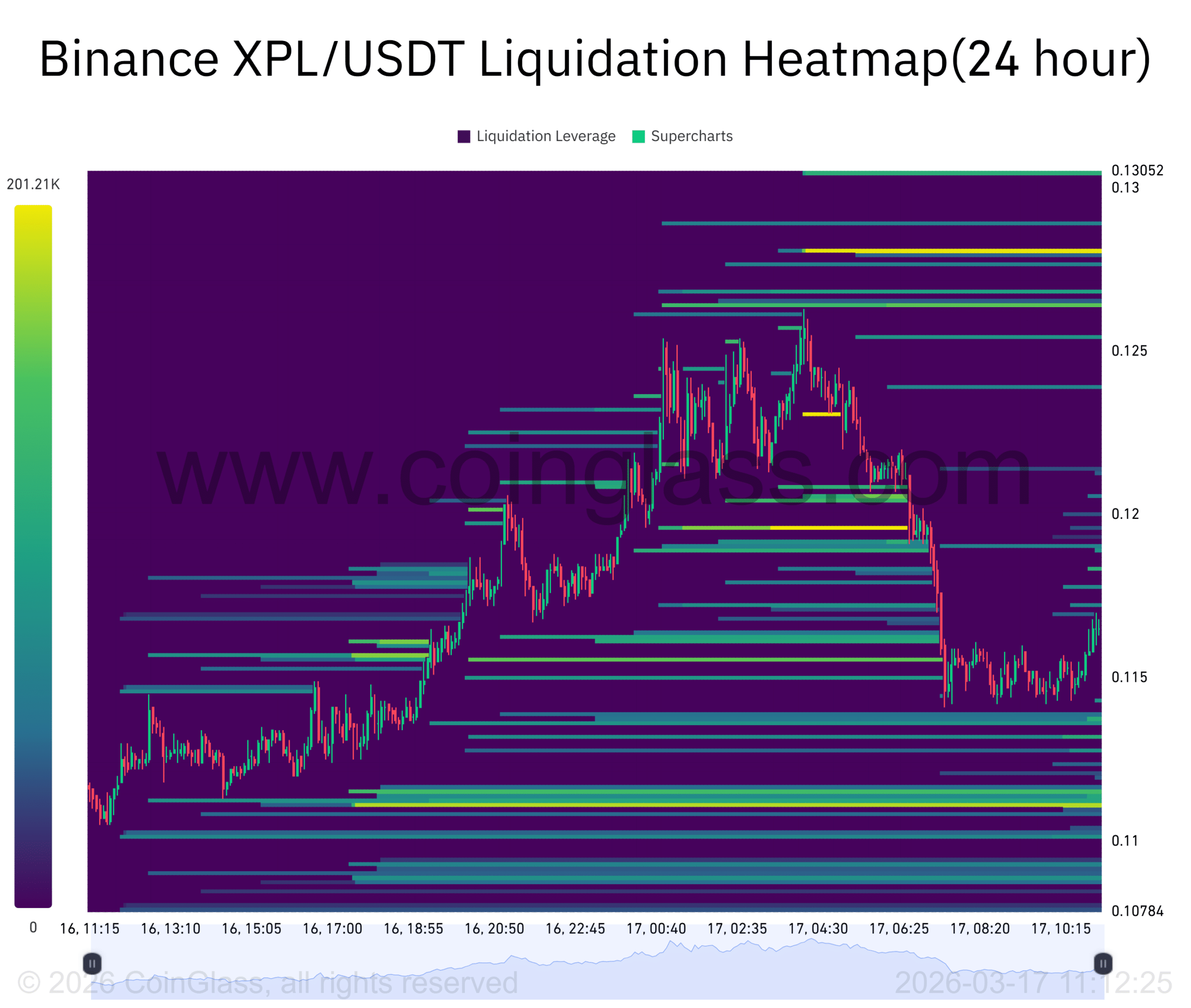
The Liquidation Heatmap has revealed dense liquidity clusters sitting above the current price, particularly around the $0.128 region.

These zones represent areas where short positions could face forced closures if the price moves higher. As XPL approaches these levels, upward pressure could accelerate due to cascading liquidations.

However, the price must first break through nearby resistance to trigger this effect.

The presence of stacked liquidity above current levels creates a magnet-like effect, drawing price toward those zones.

Source: CoinGlass

XPL appears positioned for continuation as strengthening structure, rising demand, and tightening supply align with bullish pressure.

A decisive move above $0.1259 would likely unlock liquidity around $0.128, accelerating the rally.

However, sustained strength depends on holding $0.1045 support. As long as buyers defend this base, the current setup favors further upside expansion.


Final Summary

  • XPL structure shows buyers stepping in early, building pressure that could drive continuation beyond nearby resistance levels.
  • Liquidity sitting above Plasma [XPL] price creates a path for rapid upside expansion if bullish strength remains sustained here.

Связанные с этим вопросы

QWhat was the percentage increase in Plasma [XPL] price on March 17th, and what was the new price?

APlasma [XPL] surged 12.89% to $0.1238 on March 17th.

QWhat is the critical resistance level that XPL needs to break for a potential rally continuation?

AThe critical resistance level that XPL needs to break is $0.1259.

QWhat does the negative Spot Netflows value of approximately $664K indicate for XPL?

AThe negative Spot Netflows value of approximately $664K indicates that tokens are being moved off exchanges, suggesting accumulation behavior and a reduction in immediate selling pressure.

QAccording to the Liquidation Heatmap, what is the significance of the liquidity cluster around the $0.128 region?

AThe liquidity cluster around $0.128 represents a dense zone of short position liquidations. If the price reaches this level, it could trigger cascading liquidations, accelerating upward price movement.

QWhat key support level must XPL hold to maintain its current bullish structure?

AXPL must hold the key support level at $0.1045 to maintain its current bullish structure and favor further upside expansion.

Похожее

Near Returns to the AI Stage: Transformation into a Public Chain Due to 'Payroll Difficulties,' Agent and Privacy Emerge as New Growth Narratives

NEAR Returns to AI Origins: From Payroll Struggles to Blockchain, Now Focusing on AI Agents and Privacy NEAR Protocol's journey began not with grand blockchain ambitions, but from a practical hurdle: its AI startup founders, including Transformer paper co-author Illia Polosukhin, couldn't efficiently pay international developers in 2017. This led them to pivot and build a high-performance, scalable blockchain. After years navigating various crypto narratives like sharding and cross-chain interoperability, NEAR is now leveraging its AI roots to re-enter the AI arena. A key driver is its "NEAR Intents" layer, which abstracts complex cross-chain transactions. Users simply state their goal (e.g., swap BTC for ETH), and a solver network finds the optimal route. This system has processed over $20B in cross-chain volume, generating significant fee revenue. A major growth area is private transactions via "Confidential Intents/Swaps," which hide trade details until settlement to protect against MEV and front-running. Remarkably, private swaps recently accounted for over 40% of NEAR's transaction volume, highlighting strong demand but also potential regulatory scrutiny. With its AI-founder pedigree, NEAR is positioning itself at the intersection of blockchain, AI agents, and privacy, aiming to become infrastructure for the emerging agent economy while navigating the challenges of its rapid adoption.

marsbit9 мин. назад

Near Returns to the AI Stage: Transformation into a Public Chain Due to 'Payroll Difficulties,' Agent and Privacy Emerge as New Growth Narratives

marsbit9 мин. назад

From Ethereum to AI's 'CROPS': What Exactly is This Set of 'Slow Variables' That Vitalik Repeatedly Emphasizes?

In recent discussions, Vitalik Buterin has frequently emphasized the concept of "CROPS," a framework defining core values for Ethereum's development. CROPS stands for Censorship Resistance, Capture Resistance, Open Source, Privacy, and Security. Initially outlined in the Ethereum Foundation's "EF Mandate," it represents a commitment to user sovereignty, ensuring that the network resists external control, remains open, protects privacy, and prioritizes security. The relevance of CROPS extends beyond Ethereum's foundational principles, becoming crucial in the context of AI integration. As AI agents begin handling wallet operations and automated transactions, the risk increases that users may cede control over their digital assets, privacy, and intentions to centralized AI service providers. A "CROPS AI" would therefore emphasize local execution where possible, privacy-preserving remote model calls (e.g., using zero-knowledge proofs), and transparent, verifiable processes to maintain user agency. Vitalik highlights a significant convergence between "CROPS Ethereum access layer" and "CROPS AI." Both address the same fundamental challenge: how users can access powerful services—be it blockchain data via RPCs or AI models—without exposing sensitive information or relinquishing ultimate control. This intersection points toward a future digital entry point that is more private, secure, and user-controlled. Ultimately, CROPS is not merely an abstract ideal but a practical guidepost. It steers development—from protocol resilience and wallet design to AI agent safety—towards a future where users retain self-sovereignty even as digital systems grow more complex and powerful. In an era of accelerating AI adoption, these "slow variables" of censorship resistance, openness, privacy, and security may define Ethereum's enduring value.

marsbit19 мин. назад

From Ethereum to AI's 'CROPS': What Exactly is This Set of 'Slow Variables' That Vitalik Repeatedly Emphasizes?

marsbit19 мин. назад

Silicon Valley 'Startup Guru' Steve Hoffman: Web3 + AI Could Be a Trap

Silicon Valley investor and "Godfather of Startups" Steve Hoffman warns that combining Web3 with AI is likely a trap, not a promising venture. In an interview, Hoffman argues that while AI is a foundational technology touching all industries, Web3 adds complexity, friction, and regulatory risk without solving mainstream consumer or business needs. He advises founders to focus on deep, specialized applications where startups can out-iterate giants, rather than on generic features easily replicated by large tech companies. Hoffman observes that Silicon Valley will lead foundational AI research, while China excels at rapid, large-scale application and commercialization, particularly in robotics. He stresses that AI-driven autonomous agents capable of collaborative, multi-step tasks are 2-4 years away, which will cause significant job displacement. The solution is not to slow AI but to redesign business models around human-AI collaboration and reform social systems like education and retraining. For startups, Hoffman recommends focusing on vertical, expertise-heavy domains to build defensibility. He sees major opportunities in AI fraud detection and cybersecurity. Key founder mindsets include systemic thinking over feature-focus, relentless customer centricity, building adaptive teams, and deeply understanding AI's capabilities and limits. Hoffman is also leading a non-profit initiative to establish university centers aimed at training future leaders in responsible, human-value-aligned AI innovation.

marsbit1 ч. назад

Silicon Valley 'Startup Guru' Steve Hoffman: Web3 + AI Could Be a Trap

marsbit1 ч. назад

Token Inefficient, Economy Tokenless

The article "Tokens Aren't Economical, Economics Aren't Tokenized" analyzes a pivotal shift in the AI industry from a technology-driven narrative to one dominated by capital efficiency. It highlights two concurrent trends: a severe capital shortage due to the exorbitant and recurring costs of compute (e.g., OpenAI's high burn rate) and a wave of corporate spin-offs where major tech companies are separating their AI units (like Kuaishou's Kling and Baidu's Kunlunxin). The core argument is that AI's "anti-internet" business model, where user growth increases costs rather than profits, has created a disconnect between high valuations and actual cash flow. Spin-offs address this by allowing AI assets to be valued independently. Within a parent company, they are seen as cost centers, but as standalone entities, they are priced based on their growth potential and scarcity in the primary market, leading to massive valuation premiums (e.g., Kling's estimated value tripling post-spin-off). The industry is at an inflection point, moving from "model worship" to "value realization." The competition is evolving from a pure compute (GPU) race to a broader focus on systemic efficiency and full-stack engineering (involving CPUs and orchestration) to achieve viable commercialization. The year 2026 is framed as a critical moment where the industry must definitively answer how to economically translate AI capability into tangible business value, reshaping the sector's future power structure.

marsbit1 ч. назад

Token Inefficient, Economy Tokenless

marsbit1 ч. назад

Торговля

Спот
Фьючерсы

Популярные статьи

Что такое PLASMA

Плазма: Передовое Решение для Масштабируемости Блокчейна Введение в Плазму С развитием криптовалютного ландшафта возрастает необходимость повышения эффективности в блокчейн-сетях. Плазма, решение для масштабирования второго уровня, выступает в качестве пионера в этой сфере, особенно в области разработки Web3. Стратегически перемещая значительную часть задач с основной цепи на ряд небольших цепей, Плазма обещает значительно увеличить масштабируемость и производительность Ethereum — широко используемой блокчейн-платформы на переднем крае децентрализованных приложений. Что такое Плазма? Плазма — это инновационное решение для масштабирования вне цепи, специально разработанное для блокчейна Ethereum. Оно было представлено в августе 2017 года Виталиком Бутериным, соучредителем Ethereum, и Джозефом Пуном, видным сторонником решений для масштабирования, таких как Сеть Смешения. Плазма служит основой для создания масштабируемых приложений, устанавливая иерархическую структуру дочерних цепей над основной цепью Ethereum. В своей основе, Плазма позволяет разрабатывать потенциально бесконечные побочные цепи, которые могут работать независимо, при этом полагаясь на сеть Ethereum для безопасности и консенсуса. Эта архитектура поддерживается смарт-контрактами и деревьями Меркла, которые эффективно обрабатывают транзакции и хранят данные. Основные Цели Плазмы Основная цель Плазмы — увеличить пропускную способность сети Ethereum. Перенаправляя значительный объем транзакций с перегруженной основной цепи, архитектура Плазмы предлагает более высокие скорости транзакций, более эффективную обработку данных и более низкие затраты на транзакции. Это особенно важно в эпоху, когда спрос на децентрализованные приложения — особенно в финансах, играх и управлении цепочками поставок — достигает беспрецедентных уровней. Создатели Плазмы Плазма является плодом творчества двух известных фигур в сообществе блокчейна: Виталика Бутерина и Джозефа Пуна. Бутерин известен прежде всего тем, что соучредил Ethereum и перевел границы того, что может достичь технология блокчейна. Пун, в свою очередь, известен своей поддержкой масштабируемых решений, которые обеспечивают более быстрые и экономически эффективные транзакции в блокчейн-сетях. Их сотрудничество над рамками Плазмы значительно способствовало ее инновационному характеру, сочетая передовые технические идеи с практическими приложениями. Инвесторы Плазмы Несмотря на то, что конкретные инвестиционные фонды или организации, поддерживающие Плазму, остаются неизвестными, проект привлек интерес различных выдающихся фигур и игроков в пространстве блокчейна и криптовалют. Благодаря своему потенциалу по улучшению масштабируемости Ethereum он привлек внимание различных субъектов, стремящихся расширить границы блокчейн-технологий. Как работает Плазма? Уникальная функциональность Плазмы обусловлена ее архитектурной структурой, основанной на дочерних цепях и их взаимодействии с основной сетью Ethereum. Ниже приведены некоторые ключевые факторы, способствующие инновационному подходу Плазмы: Дочерние Цепи: Плазма создает множество дочерних цепей, которые могут выполнять транзакции независимо от основной цепи Ethereum. Каждая дочерняя цепь работает как отдельный смарт-контракт с уникальными функциями, позволяя разработчикам создавать индивидуальные решения в зависимости от их конкретных требований. Смарт-контракты и Деревья Меркла: Архитектура использует смарт-контракты, которые являются самовыполняющимися соглашениями с предопределенными условиями, в сочетании с деревьями Меркла, которые обеспечивают эффективную проверку данных. Эта технология позволяет Плазме достигать как высокой масштабируемости, так и безопасности. Сжатие Транзакций: Объединяя транзакции на дочерних цепях, Плазма снижает нагрузку на сеть Ethereum. Это означает, что меньше транзакций необходимо записывать на основной цепи, тем самым освобождая место и уменьшая загруженность. Улучшенная Безопасность: Несмотря на то, что Плазма работает вне цепи, она использует меры безопасности основной сети Ethereum, обеспечивая высокую степень целостности и безопасности всех транзакций на дочерних цепях. Хронология Плазмы Понимание разработки Плазмы включает в себя отслеживание ее значительных этапов: Август 2017: Плазма была впервые представлена Виталиком Бутериным и Джозефом Пуном как масштабируемое решение для решения проблем производительности Ethereum. 2018: Рамки Плазмы были официально разработаны и размещены на GitHub, что стало важным шагом к ее реализации в практических приложениях. 2019: По мере роста интереса к Плазме, она начала привлекать разработчиков, заинтересованных в масштабировании приложений Ethereum, повышая свою популярность. 2020: Плазма продолжала развиваться, с существенными улучшениями ее архитектуры и функциональности, что сделало ее еще более привлекательной для разработчиков. Ключевые Особенности Плазмы Плазма обладает несколькими характеристиками, которые делают ее трансформационным решением в области блокчейна: Масштабируемость: Создавая несколько дочерних цепей, Плазма может обрабатывать больший объем транзакций, не нагружая основную цепь Ethereum. Скорость: Каждая дочерняя цепь может обрабатывать транзакции быстрее, что обеспечивает пользователям лучший опыт и сервис. Низкие Затраты на Транзакции: Структура Плазмы эффективно снижает затраты, связанные с транзакциями, минимизируя нагрузку на основную цепь. Интероперабельность: Архитектура позволяет Плазме бесшовно взаимодействовать с несколькими блокчейнами, улучшая функциональность между сетями. Безопасность: Используя безопасность основной цепи Ethereum, Плазма обеспечивает целостность своих операций, используя дочерние цепи. Сферы Применения Плазмы Инновационная архитектура Плазмы открывает двери для различных практических приложений в разных секторах: Децентрализованные Финансы (DeFi): Плазма имеет потенциал для увеличения масштабируемости и эффективности DeFi-приложений, создавая более плавные и эффективные торговые процессы. Игры: Рамки Плазмы способствуют разработке быстрых и экономически эффективных игровых продуктов, что делает их привлекательными для разработчиков в игровой индустрии. Управление Цепочками Поставок: С возможностью архивирования эффективной обработки транзакций, Плазма может способствовать разработке децентрализованных решений в области управления цепочками поставок. Заключение Плазма занимает центральное место в технологии блокчейна, выступая как ключевое решение для масштабирования второго уровня, направленное на повышение эффективности сети Ethereum и не только. Благодаря своей уникальной структуре дочерних цепей, смарт-контрактов и деревьев Меркла, Плазма предлагает убедительное решение для масштабируемого кризиса, который долгое время мучил блокчейн-сети. По мере того как технологии блокчейна продолжают развиваться, такие решения, как Плазма, обещают изменить подход разработчиков к проблемам масштабируемости, потенциально революционизируя то, как функционируют децентрализованные приложения. Постоянные усилия ее создателей и интерес различных заинтересованных сторон сигнализируют о светлом будущем для Плазмы, поскольку она стремится поднять возможности блокчейна на новые высоты в цифровой сфере.

362 просмотров всегоОпубликовано 2024.12.03Обновлено 2024.12.03

Что такое PLASMA

Как купить XPL

Добро пожаловать на HTX.com! Мы сделали приобретение Plasma (XPL) простым и удобным. Следуйте нашему пошаговому руководству и отправляйтесь в свое крипто-путешествие.Шаг 1: Создайте аккаунт на HTXИспользуйте свой адрес электронной почты или номер телефона, чтобы зарегистрироваться и бесплатно создать аккаунт на HTX. Пройдите удобную регистрацию и откройте для себя весь функционал.Создать аккаунтШаг 2: Перейдите в Купить криптовалюту и выберите свой способ оплатыКредитная/Дебетовая Карта: Используйте свою карту Visa или Mastercard для мгновенной покупки Plasma (XPL).Баланс: Используйте средства с баланса вашего аккаунта HTX для простой торговли.Третьи Лица: Мы добавили популярные способы оплаты, такие как Google Pay и Apple Pay, для повышения удобства.P2P: Торгуйте напрямую с другими пользователями на HTX.Внебиржевая Торговля (OTC): Мы предлагаем индивидуальные услуги и конкурентоспособные обменные курсы для трейдеров.Шаг 3: Хранение Plasma (XPL)После приобретения вами Plasma (XPL) храните их в своем аккаунте на HTX. В качестве альтернативы вы можете отправить их куда-либо с помощью перевода в блокчейне или использовать для торговли с другими криптовалютами.Шаг 4: Торговля Plasma (XPL)С легкостью торгуйте Plasma (XPL) на спотовом рынке HTX. Просто зайдите в свой аккаунт, выберите торговую пару, совершайте сделки и следите за ними в режиме реального времени. Мы предлагаем удобный интерфейс как для начинающих, так и для опытных трейдеров.

1.8k просмотров всегоОпубликовано 2025.09.26Обновлено 2026.06.02

Как купить XPL

Обсуждения

Добро пожаловать в Сообщество HTX. Здесь вы сможете быть в курсе последних новостей о развитии платформы и получить доступ к профессиональной аналитической информации о рынке. Мнения пользователей о цене на XPL (XPL) представлены ниже.

活动图片