Perspective: The current AI supercycle will last 15 years, but most are still buying stocks in the first FOMO stage

marsbitОпубликовано 2026-05-09Обновлено 2026-05-09

Введение

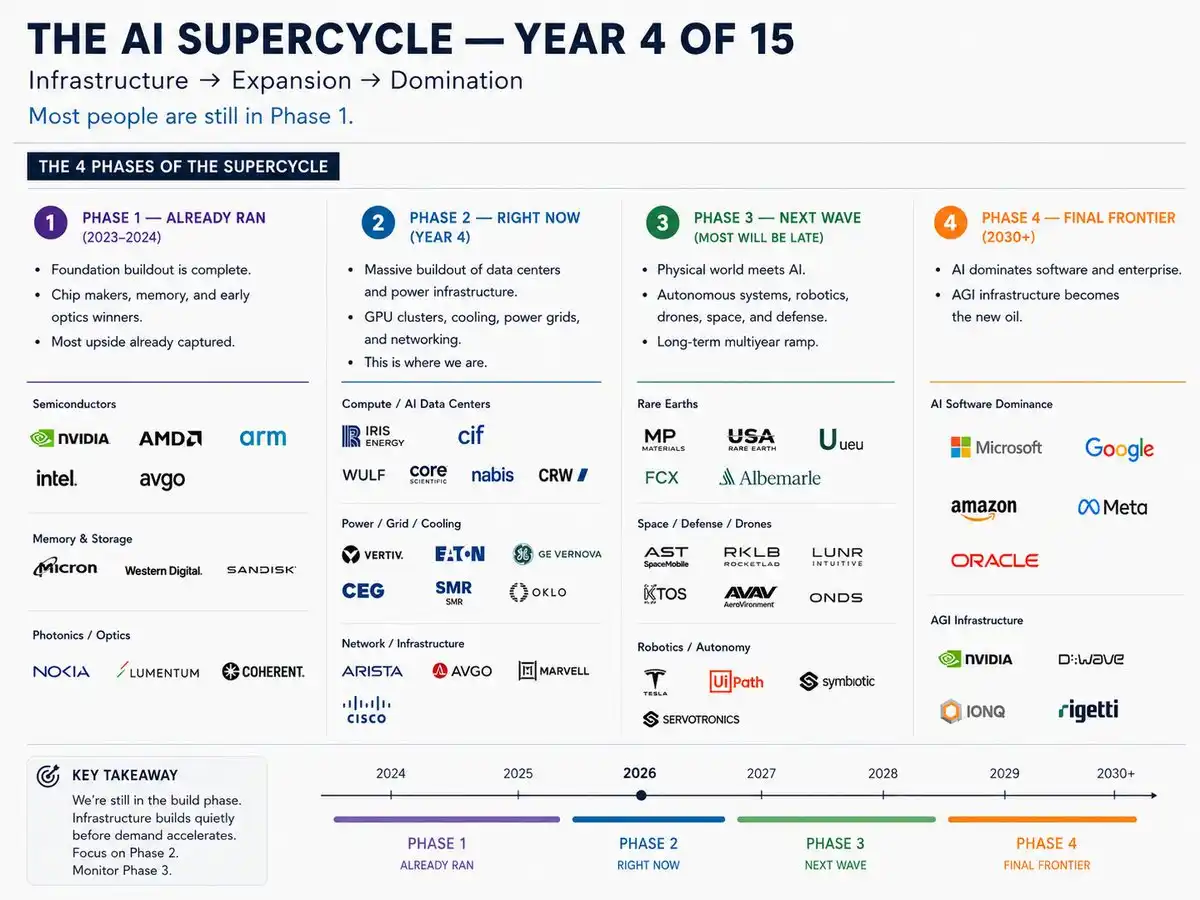
This article outlines a 15-year AI supercycle, segmented into four investment stages. It argues that while most investors are still focused on the first stage, smart money is already moving to the third. **Stage 1: The Foundation (2023-2025) - Priced In** The semiconductor layer (e.g., NVIDIA, AMD) is complete. While growth continues, the historic entry opportunity is over as risk/reward has compressed. **Stage 2: The Build-Out (2025-2027) - In Progress** This phase involves building the necessary physical infrastructure: power/utilities (CEG), cooling (VRT), networking (ANET), and nuclear SMRs (OKLO, SMR). Significant upside remains, but obvious names have already moved. **Stage 3: The Asymmetric Bet (2026-2028) - Positioning Window** AI moves into the physical world. Key areas include robotics/autonomy (Tesla Optimus), space/defense/drones (Rocket Lab, LUNR), and critical materials. This stage presents the best asymmetric risk/reward and is where positioning should occur now. **Stage 4: The Endgame (2028+) - Software Dominance** The mega-cap cloud platforms (Microsoft, Alphabet, Amazon, Meta), with their massive capital expenditure, will build the AI software layer and AGI infrastructure, aiming to win the entire cycle. **Core Conclusion:** The cycle is confirmed in Stage 2. Stage 3 (robotics, space, defense, nuclear SMRs) is where capital is currently rotating for maximum opportunity, while the majority of investors are expected to be 12 months behind this shift.

Author: Rand Group (@cryptorand)

Compiled by: Deep Tide TechFlow

Deep Tide Intro: Crypto KOL Rand Group breaks down the AI supercycle into four stages, from chips to infrastructure to robots to platform software, marking the core targets and risk-reward ratios for each stage. His judgment is: Stage 1 (Semiconductors) is over, Stage 2 (Power/Cooling/Networks) is being priced, and the true asymmetric opportunity lies in Stage 3 — robotics, space, defense, nuclear energy.

The AI supercycle will last 15 years. This is year three.

Most investors are still buying Stage 1 stocks, but smart money is already rotating into Stage 3.

I've broken the entire cycle into four stages, with the most important tickers labeled for each.

The AI supercycle is the biggest investment theme of this generation. Bigger than mobile internet, bigger than cloud computing. A 15-year structural shift that will reshape every industry in the global economy. Hyperscale cloud providers just committed $725 billion in capex for 2026, nearly double last year's. Microsoft, Google, Amazon, Meta — each over $100 billion individually.

This is not speculation.

🔴 Stage 1: Over (2023-2025)

The foundation layer is complete. AMD was up 78% in 2025, NVDA up 39%, Intel just delivered a blowout Q1, pushing the Philadelphia Semiconductor Index above 10,000 for the first time. Chips still drive every stage, but the historic entry opportunity is gone; the risk-reward has compressed.

Tickers: NVDA, AMD, ARM, INTC, AVGO, MU, GLW

Sectors: Semiconductors, Memory, Photonics/Optics

Status: Foundation complete, still growing, but priced in.

🟡 Stage 2: Buildout Peak (2025-2027)

The stage most investors are just waking up to. CEG acquiring Calpine to become the largest private U.S. power producer at 55 GW. GEV up over 200% in a year. VRT co-designing cooling for NVIDIA's Rubin architecture. GLW up 74% YTD on fiber demand. Nuclear SMR is the biggest dark horse — OKLO, SMR, BWXT are laying direct power lines for data centers.

Still upside, but the most obvious names have moved.

Tickers: CEG, GEV, VRT, VST, TLN, ANET, GLW, MOD, EQIX, OKLO, SMR, BWXT, NNE

Sectors: Power/Grid, Cooling, Networking, Nuclear SMR Buildout Peak

Note: Nuclear SMR is the hidden major opportunity.

🟡 Stage 3: Positioning Window (2026-2028)

The stage where AI leaves the data center and enters the physical world. Most will be late.

Tesla is converting its Fremont factory into an Optimus robot production line — $25 billion capex, targeting mass production in H2 2026. Rocket Lab posted a record $602M revenue, backlog at $1.85B. LUNR up 47% YTD with $943M in contracts. KTOS's Valkyrie drone selected by the Marine Corps.

The positioning window is open now.

Tickers: TSLA, RKLB, LUNR, KTOS, AVAV, PATH, ISRG, MP, FCX, ALB, ASTS

Sectors: Robotics/Autonomy, Space/Defense/Drones, Rare Earths

Judgment: The asymmetric risk-reward is here.

🟢 Stage 4: Endgame (2028+)

The endgame. Microsoft capex $190B, Alphabet $190B, Amazon $200B, Meta $145B. Google Cloud backlog exceeds $460B. They are building AI software dominance and AGI infrastructure. Quantum computing is early, but IONQ and D-Wave are laying the groundwork.

The platforms controlling the software layer win the entire supercycle.

Tickers: MSFT, GOOGL, AMZN, META, ORCL, IONQ

Sectors: AI Software Dominance, AGI Infrastructure, Decade-long thesis

Strategy: Buy the dips.

Key Conclusions

  • Stage 2 is confirmed (hyperscale $725B capex)
  • Stage 3 is where smart money is positioning — robotics, space, defense, nuclear
  • SMR is the core trade from 2026 to 2028
  • Most will rotate into these names 12 months late

A 15-year supercycle. Not a single trade. Stage 1 is over, Stage 2 is being priced, Stage 3 is where you should be.

Связанные с этим вопросы

QAccording to the article, what is the author's view on the duration and current stage of the AI supercycle?

AThe author believes the AI supercycle will last 15 years and is currently in its third year. The first stage (2023-2025) is already over, the second stage (2025-2027) is in progress, and the third stage (2026-2028) is where the most asymmetric opportunities lie.

QWhat sectors or 'stages' does the author identify as having the best asymmetric risk/reward opportunity right now?

AThe author identifies the third stage as having the best asymmetric risk/reward opportunity. This stage includes robotics/autonomous systems, space/defense/drones, and rare earths, with specific mentions of companies like Tesla, Rocket Lab, and Intuitive Machines.

QWhich specific sector within the 'construction boom' (second stage) is highlighted as a major hidden opportunity?

AWithin the second stage (the construction boom), the author highlights nuclear energy, specifically Small Modular Reactors (SMRs), as the major hidden opportunity. Companies mentioned include Oklo, NuScale Power (SMR), and BWX Technologies.

QWhat key metric is cited as evidence confirming the transition to the second stage of the AI supercycle?

AThe author cites the $725 billion in committed capital expenditure for 2026 by hyperscale cloud providers (Microsoft, Google, Amazon, Meta) as the key metric confirming the transition to the second stage. This amount is nearly double that of the previous year.

QWhat does the author suggest is the strategy for investing in the 'Endgame' (fourth stage) companies?

AFor the 'Endgame' or fourth stage companies (like Microsoft, Alphabet, Amazon, Meta), which control the AI software platform, the author's suggested strategy is to 'buy the dips,' indicating a long-term, patient accumulation approach.

Похожее

From Return to Resignation: Chen Hang's 437 Days at DingTalk

The 437-Day Return and Departure of Chen Hang at DingTalk This article chronicles the 437-day period from March 31, 2025, to June 11, 2026, when Chen Hang (also known as "No Move") returned as CEO of DingTalk, the enterprise communication platform he originally founded, only to later step down. Chen Hang, the creator of DingTalk in 2015, was brought back by Alibaba in 2025 after the company acquired his subsequent startup, HHO. His return was driven by Alibaba's renewed focus on AI and DingTalk's strategic role as its key to-B AI application. However, his aggressive management style, marked by strict work policies like mandatory clock-ins and extended hours, quickly caused internal friction and was criticized as being at odds with Alibaba's culture. Despite the internal turmoil, Chen Hang drove significant product launches. In August 2025, he unveiled "AI DingTalk 1.0," featuring new products like the AI-native entry point "DingTalk ONE." By March 2026, he announced "Wukong," touted as the world's first enterprise-grade AI-native work platform, representing a fundamental rebuild of DingTalk's architecture. The turning point came in early June 2026. A detailed internal post criticizing DingTalk's work culture went viral, followed by a public critique from a former executive. This prompted an unprecedented public rebuke from the Alibaba Partners Committee, which stated such management was not aligned with company values. One day later, on June 11, Alibaba announced Chen Hang's departure. He was succeeded by Chen Yusen, a 32-year-old technical expert known for founding cybersecurity firm Changting Technology. While Chen Hang's tenure laid the technical foundation for DingTalk's AI transformation with "Wukong," his leadership style ultimately led to his replacement as the company seeks a new direction under younger leadership.

marsbit6 мин. назад

From Return to Resignation: Chen Hang's 437 Days at DingTalk

marsbit6 мин. назад

The 2026 Landscape of Decentralized AI: Why Blockchain is the Inevitable 'Antidote' for AI?

Decentralized AI 2026 Landscape: Why Blockchain is AI's Essential "Antidote" Centralized AI faces structural bottlenecks—expensive compute, concentrated control, unverifiable outputs, and difficult data access—that cannot be solved by capital or code alone. Blockchain offers a path to make intelligence open, verifiable, and economically accessible. The decentralized AI stack comprises: * **Infrastructure:** The foundation with compute, verifiable inference, distributed training, data/storage, and privacy/verification layers. Projects like Akash, Render, and Filecoin provide cheaper, decentralized alternatives for raw resources. * **Middleware:** The coordination layer for agent discovery, identity, and commerce. Key players include Bittensor (a network of specialized AI subnets), Virtuals (an agent economy OS), and frameworks providing agent identity and tooling. * **Applications & Services:** Dominated by Agentic Finance (AI agents executing on-chain actions based on natural language) and Agentic Payments (machine-to-machine transactions using blockchain as a settlement layer). Projects like Giza, Infinit Labs, and x402 are enabling these use cases. Key trends for 2026-2027 show AI demand outgrowing infrastructure, compute becoming an asset class, and tokenomics emerging as a structural advantage for coordinating capital, compute, and data. While still early—with adoption uneven and revenue often trailing token incentives—projects like Bittensor, NEAR, and Venice demonstrate decentralized AI is evolving from a narrative into a new model for coordinating intelligence.

Foresight News26 мин. назад

The 2026 Landscape of Decentralized AI: Why Blockchain is the Inevitable 'Antidote' for AI?

Foresight News26 мин. назад

Торговля

Спот
Фьючерсы

Популярные статьи

Неделя обучения по популярным токенам (2): 2026 может стать годом приложений реального времени, сектор AI продолжает оставаться в тренде

2025 год — год институциональных инвесторов, в будущем он будет доминировать в приложениях реального времени.

1.8k просмотров всегоОпубликовано 2025.12.16Обновлено 2025.12.16

Неделя обучения по популярным токенам (2): 2026 может стать годом приложений реального времени, сектор AI продолжает оставаться в тренде

Обсуждения

Добро пожаловать в Сообщество HTX. Здесь вы сможете быть в курсе последних новостей о развитии платформы и получить доступ к профессиональной аналитической информации о рынке. Мнения пользователей о цене на AI (AI) представлены ниже.

活动图片