Pentagon Pizza Index Soars 1250%: Who Will Be the Next Venezuela?

Odaily星球日报Опубликовано 2026-01-08Обновлено 2026-01-08

Введение

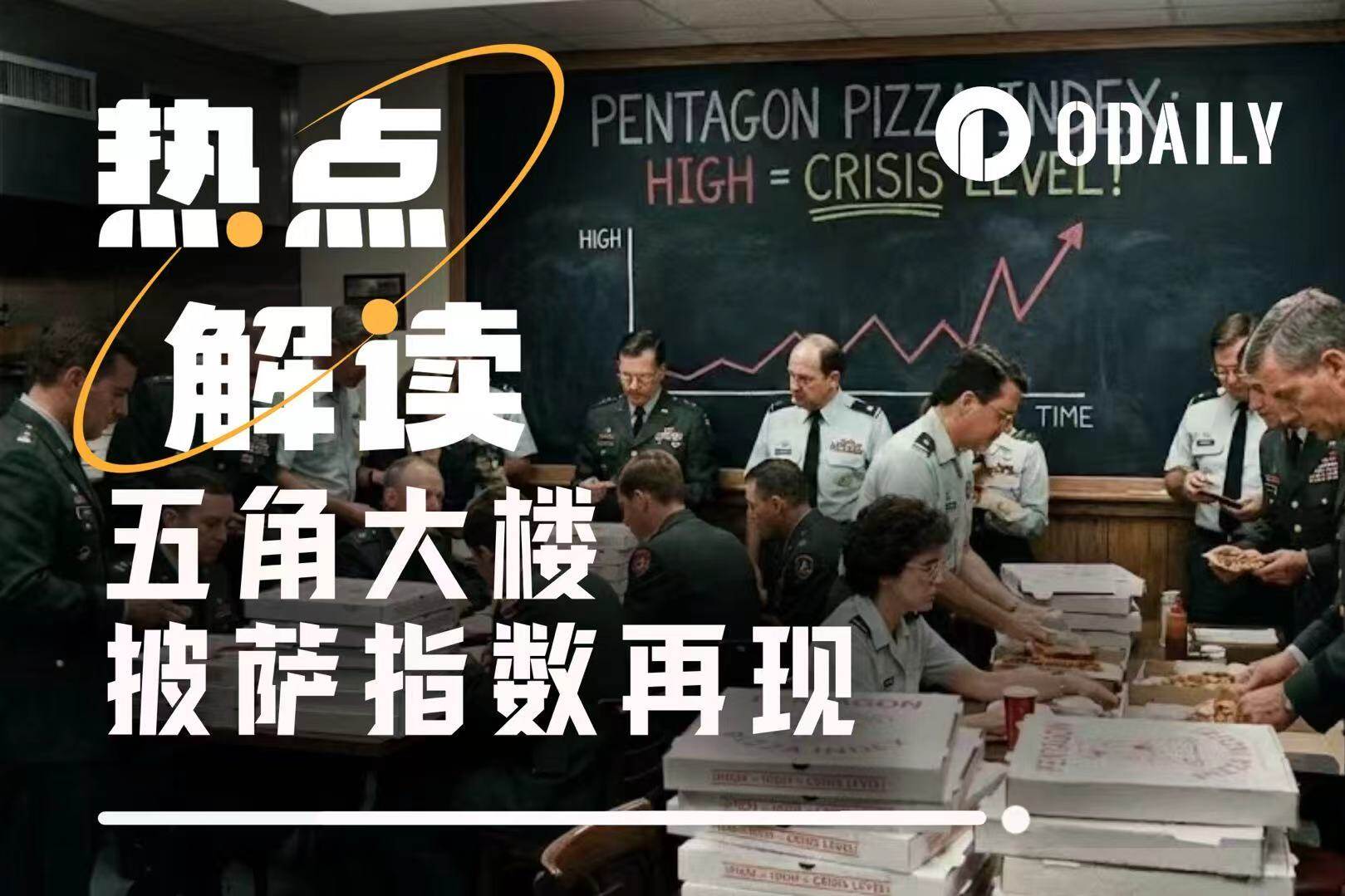
The Pentagon Pizza Index, an unconventional but historically telling indicator, has surged by 1250% in the past 48 hours, sparking global speculation about imminent U.S. military action. This surge, nearly double the 700% spike observed before the recent operation that captured Venezuelan President Maduro, tracks pizza delivery spikes near the Pentagon—often linked to extended staff hours during crises. Historical precedents include spikes before the 1990 Iraq-Kuwait conflict and 1998 Iraq operations. Current data shows increases ranging from 200% to 1250% at nearby pizzerias. The Trump administration’s “Don-roe Doctrine” suggests potential targets: Greenland (with prediction markets showing a 38% chance of U.S. control), Cuba (20% chance of U.S. strike by year-end), Colombia (15%), and Iran (54% chance of leadership change). Memes and prediction markets are already reacting, with the “Pentagon Pizza Watch” token rising 78% and significant betting activity on platforms like Polymarket. The index underscores how real-time, unconventional data can signal geopolitical shifts before official announcements.

Original | Odaily Planet Daily (@OdailyChina)

Author | jk

On January 7, 2026, a seemingly absurd but repeatedly effective intelligence indicator has drawn global attention. According to social media monitoring, pizza orders near the Pentagon have surged by 1250% in the past 48 hours, a figure nearly double the 700% increase seen just before the military action in Venezuela. This is the "Pentagon Pizza Index," a remarkable indicator, and its underlying implication is that the United States is brewing new military operations.

Pizza Orders and Military Intelligence?

The concept of the Pentagon Pizza Index dates back to 1990, when Frank Meeks, the owner of a Domino's Pizza in the Washington area, noticed a peculiar phenomenon: on the evening of August 1, 1990, the Central Intelligence Agency ordered a record 21 pizzas, and the next day, Iraq invaded Kuwait.

Moreover, this pattern has repeated:

  • Before the Panama operation in December 1989, orders surged from 30-35 to over 100;
  • During President Clinton's impeachment hearings and the "Desert Fox" operation in Iraq in December 1998, extra cheese pizza orders from the White House increased by 32%.

The logic behind this is very simple: during high-pressure crisis moments, Department of Defense (now the War Department, renamed by Trump) staff often need to work 16-20 hours consecutively, and pizza is cheap, filling, and easy to deliver, making it the go-to choice for overtime work.

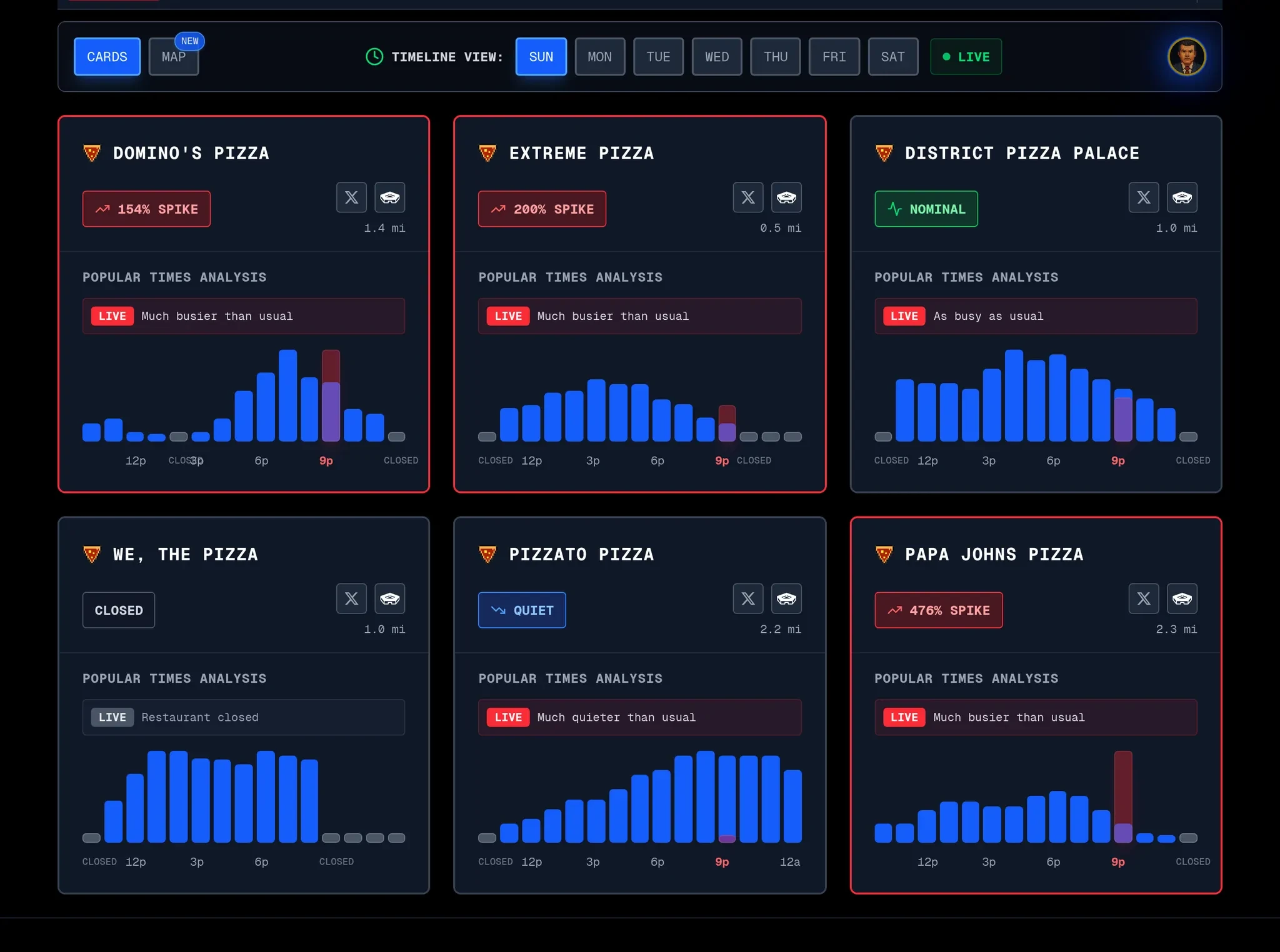
Today, there are dedicated websites monitoring six pizza shops near the Pentagon in real-time, including Papa John's and Domino's. Currently, these websites are all showing crazy multiples, ranging from 150% to 1250%.

What About Before the Venezuela Operation?

In the early hours of January 3, 2026, U.S. forces launched a raid in Caracas, the capital of Venezuela, successfully capturing President Maduro and his wife. Just hours before the operation, the Papa John's pizza shop near the Pentagon was unusually busy.

This was not a sudden military action either; the U.S. began a large-scale military buildup in the Caribbean region in August 2025: August: The USS Iwo Jima amphibious assault ship group arrived; November: The USS Ford aircraft carrier strike group arrived; Totaling about 15,000 U.S. military personnel, the largest military deployment in the region in generations. So, Pentagon staff worked overtime, causing all nearby pizza shops to work overtime as well.

A 1250% Increase: Who Is the Next Target?

Latest data from Sunday evening shows activity at the Papa John's pizza shop 2.3 miles from the Pentagon surged by 476%, while the closer Extreme Pizza saw a 200% increase. The peak increase of 1250% compared to the lowest point set a new historical record.

The Trump administration has stated this is part of its "Don-roe Doctrine." This is a metaphor for a modernized version of the 19th-century Monroe Doctrine, an advanced version of MAGA. Trump declared on Saturday: "American dominance in the Western Hemisphere will never be questioned again."

Based on the latest statements from Trump and his senior officials, the following countries and regions may be the next targets:

  • Greenland: Trump emphasized the U.S. needs Greenland to ensure national security. Prediction markets show the probability of the U.S. "controlling any part of Greenland" has risen from less than 20% last week to 38%. The Danish government is currently in "full crisis mode."
  • Cuba: Secretary of State Rubio warned that the Cuban government "is in big trouble." He pointed out that Maduro's bodyguards were Cuban, and 32 Cuban officers were killed in the Venezuela operation. Trump said: "Cuba looks like it's about to collapse."
  • Colombia: Trump directly threatened: "Colombia is also very sick, run by a sick man who likes to make cocaine and sell it to the United States, and he won't be doing that much longer." When asked if military action was considered, Trump replied: "Sounds good."
  • Iran: After Trump threatened to "hit Iran hard," prediction markets estimate a 54% probability that Iran's Supreme Leader Khamenei will step down before next year.

How Are These Countries Responding?

Colombian President Petro has shown a tough stance. He was reportedly quoted in November 2025 saying: "Brother, if you want to put me in jail, see if you can." Recently, he announced that any commander who prefers the American flag over the Colombian flag will be immediately dismissed from the army.

The Cuban government has held two days of national mourning for the 32 officers killed in the Venezuela operation, clearly remaining highly alert to Rubio's warnings.

Meme and Prediction Markets: Already One Step Ahead

When it comes to such events, meme markets and prediction markets are always the quickest to move.

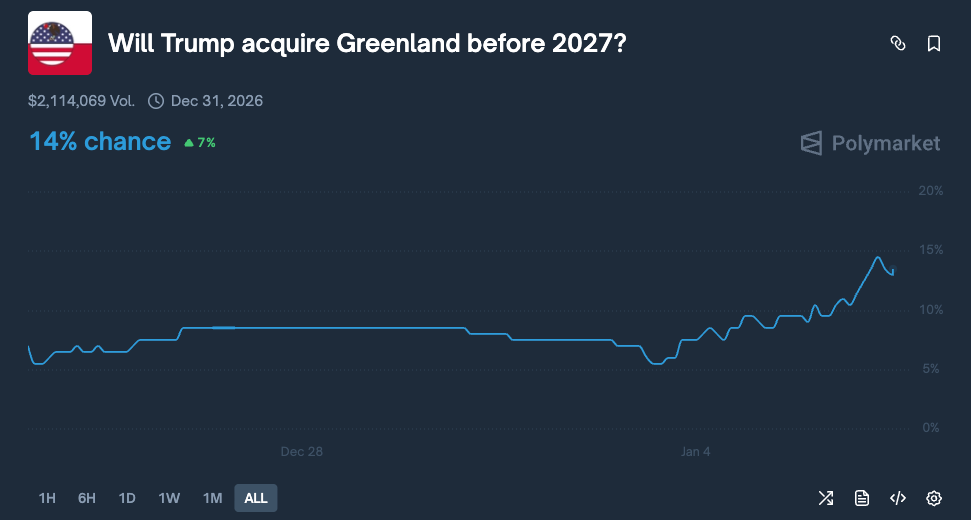
On Polymarket, the market for "Trump 'acquiring' Greenland by 2027" is highly sensitive. The probability in this market rose from about 7% on December 28 to the current 14%, a gain of 7 percentage points, with trading volume exceeding $2.1 million. This rise coincided with the timing of the Venezuela operation.

The "US strikes Cuba by xx date" market shows a阶梯式 probability distribution: only 2% by January 31, 8% by March 31, but jumps to 20% by the end of the year. The loss of 32 Cuban officers in the Venezuela operation could be the trigger for U.S. action.

The "US strikes Colombia by xx date" market shows a more aggressive probability curve: 3% by end of January, 7% by end of March, 15% by year-end.

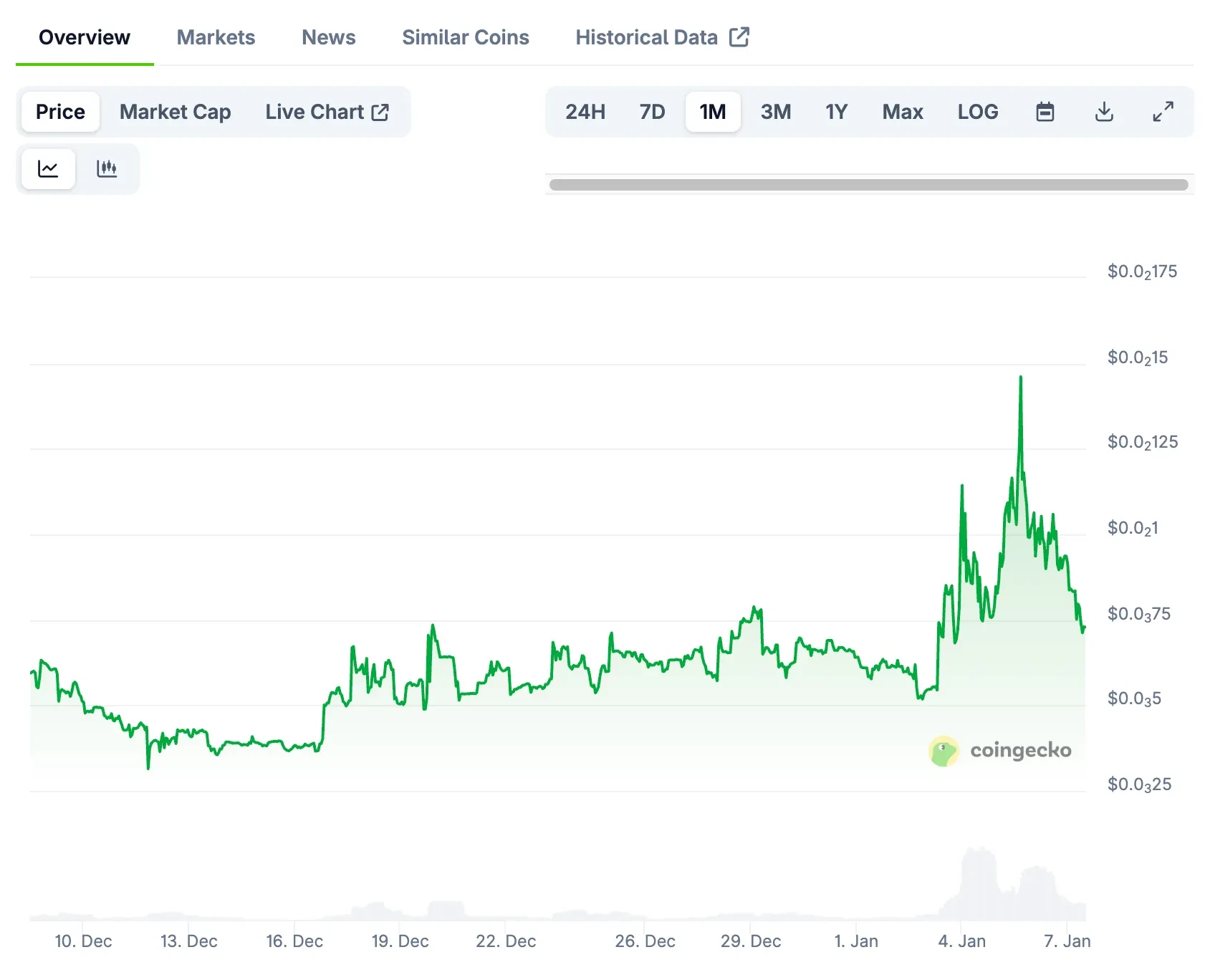
Simultaneously, related memes have already appeared, such as Pentagon Pizza Watch (PPW); this is a logo featuring a glowing pizza hovering over a green pentagon, adorned with missile elements.

In terms of market performance, PPW saw a 78.20% gain in one week, with a 24-hour trading volume of $114,369, ranking 3689th in market capitalization.

Here, we strongly recommend reading this Odaily article: "When War is Settled Before the News: How Prediction Markets 'Priced' the Maduro Capture 6 Days Early."

Связанные с этим вопросы

QWhat is the Pentagon Pizza Index and what does a 1250% surge indicate?

AThe Pentagon Pizza Index is an informal intelligence indicator that tracks pizza delivery orders near the Pentagon. A 1250% surge suggests a significant increase in military staff working long hours, often preceding major U.S. military operations, similar to patterns observed before historical events like the Iraq invasion of Kuwait.

QWhich countries are potential targets according to the article based on recent U.S. government statements?

APotential targets include Greenland, Cuba, Colombia, and Iran, as indicated by statements from Trump and officials, such as threats to 'hit Iran hard' and warnings about Cuba and Colombia's governments.

QHow did prediction markets react to the increased Pentagon Pizza Index and recent military actions?

APrediction markets showed heightened activity, with probabilities for U.S. 'acquisition' of Greenland rising from 7% to 14%, and markets for strikes on Cuba and Colombia seeing increased probabilities by year-end, reflecting speculative responses to military tensions.

QWhat historical events are cited as examples where pizza order spikes preceded military actions?

AHistorical examples include the 1990 Iraq invasion of Kuwait after a spike in CIA pizza orders, the 1989 Panama action with orders jumping from 30-35 to over 100, and the 1998 'Desert Fox' operation in Iraq during Clinton impeachment hearings.

QWhat is the 'Don-roe Doctrine' mentioned in the article and how does it relate to U.S. policy?

AThe 'Don-roe Doctrine' is described as a modernized version of the Monroe Doctrine, reflecting Trump's MAGA agenda, asserting U.S. dominance in the Western Hemisphere and justifying interventions, as seen in the recent Venezuela operation.

Похожее

La Liga Team Bets $1 Million Against Themselves Before Match: Does Using Prediction Markets for Insurance Comply with Sports Regulations?

A Spanish La Liga club, reportedly Osasuna, purchased insurance against relegation and was linked to a transaction of over $1 million on the prediction market platform Kalshi, betting against its own victory in a crucial season-ending match. While Osasuna confirmed buying €1.2 million insurance for a potential €6 million payout in case of relegation through broker Howden, it did not confirm involvement with Kalshi. The reported trade involved intermediaries like Game Point Capital and Greenlight Commodities, with quant firm Susquehanna as the counterparty. This incident highlights the blurring line between financial hedging and gambling in prediction markets. Such markets allow trading on future event outcomes, like sports results. In the US, Kalshi operates as a regulated event contract market under the CFTC. However, Spanish authorities recently initiated penalties against Kalshi and Polymarket, considering their activities unlicensed gambling. The case raises core questions about prediction markets: who can trade, how insider information is handled, and whether participants can influence outcomes, especially in sports where results are human-driven. While leagues like La Liga and Serie A have partnered with Polymarket in North America, the regulatory clash and potential for conflicts of interest, as seen in this club's alleged transaction, present significant challenges as prediction markets evolve toward institutional risk management.

Foresight News31 мин. назад

La Liga Team Bets $1 Million Against Themselves Before Match: Does Using Prediction Markets for Insurance Comply with Sports Regulations?

Foresight News31 мин. назад

From Shouting 150 Dollars to Liquidating HYPE in Just Three Days, How Much Credibility Does Arthur Hayes Have Left?

How much of Arthur Hayes's market credibility remains? Recently, the "godfather of crypto perpetual swaps" and BitMEX co-founder has faced public criticism, including accusations from on-chain investigator ZachXBT about creating exit liquidity for his followers. Starting last week, Hayes executed multiple sudden sell-offs. He had repeatedly publicly predicted the HYPE token would reach $150. After a $100,000 bet defending Hyperliquid on June 1st, he announced just three days later that he had completely sold his HYPE and NEAR holdings, successfully exiting near the peak. He also sold ZEC and WLD. His sale of WLD appeared to be a classic "pump and dump" maneuver. On June 3rd, he publicly set a $10 target for WLD, causing its price to surge over 35%. By June 6th, he announced he had sold his WLD, citing "anomalous" SpaceX pre-IPO price action, which triggered a sharp price drop. On June 9th, Hayes published a lengthy article explaining his actions, citing factors like rising energy costs and a potential AI bubble burst. Consequently, his family office, Maelstrom, now holds positions in US energy producers and only core crypto assets BTC and ETH, having sold AI-related stocks and non-core cryptocurrencies. This pattern is not new. In 2025, he similarly touted HYPE before selling it at what turned out to be a cycle peak, only to repurchase it at the next cycle's low. Similar scenarios played out with tokens like ETHFI and ENA. Long-term observers have developed a strategy: ignore Hayes's public statements but closely monitor his on-chain actions—be cautious following his buys, but decisively follow his sells. If he continues these tactics, especially as seen with the WLD case, his market credibility risks being permanently damaged. As Hayes himself admitted in his latest article, "I remain an unapologetic gambler."

marsbit49 мин. назад

From Shouting 150 Dollars to Liquidating HYPE in Just Three Days, How Much Credibility Does Arthur Hayes Have Left?

marsbit49 мин. назад

Fundraising is Like a Strange Dance: The 'Absurd Drama' of Silicon Valley Founders' Capital Raises

The article details a series of absurd and revealing anecdotes shared by Silicon Valley founders about their venture capital fundraising experiences, sparked by Greg Isenberg's story of pitching to a sleeping a16z partner. Founders describe surreal pitch meetings: one faced a barefoot, peanut-eating investor who offered triple the requested amount after 30 seconds; another performed a pitch in a VC's parked car; a founder discovered his audience understood no English beyond "yes." These stories highlight the often irrational and performative nature of fundraising. Beyond the absurdity, darker power imbalances are exposed. Stories include investors suggesting founders fire co-founders for their equity, blatant market misjudgments, disrespectful behavior from LPs, and discriminatory remarks. A debate also emerges around "Sequoia's" practice of splitting a round into two valuations. However, the thread isn't solely critical. Positive counter-narratives celebrate supportive VCs who offered crucial advice during crises, respected founders' timelines, and showed simple gestures of respect—like a partner personally fetching coffee before a major pitch. Ultimately, the collective sharing acts as a pressure release, illustrating that fundraising is a complex dance of power, trust, and sometimes sheer theater. It underscores that beyond capital, mutual respect and integrity remain the most enduring foundations of the founder-investor relationship.

marsbit1 ч. назад

Fundraising is Like a Strange Dance: The 'Absurd Drama' of Silicon Valley Founders' Capital Raises

marsbit1 ч. назад

Торговля

Спот
Фьючерсы
活动图片