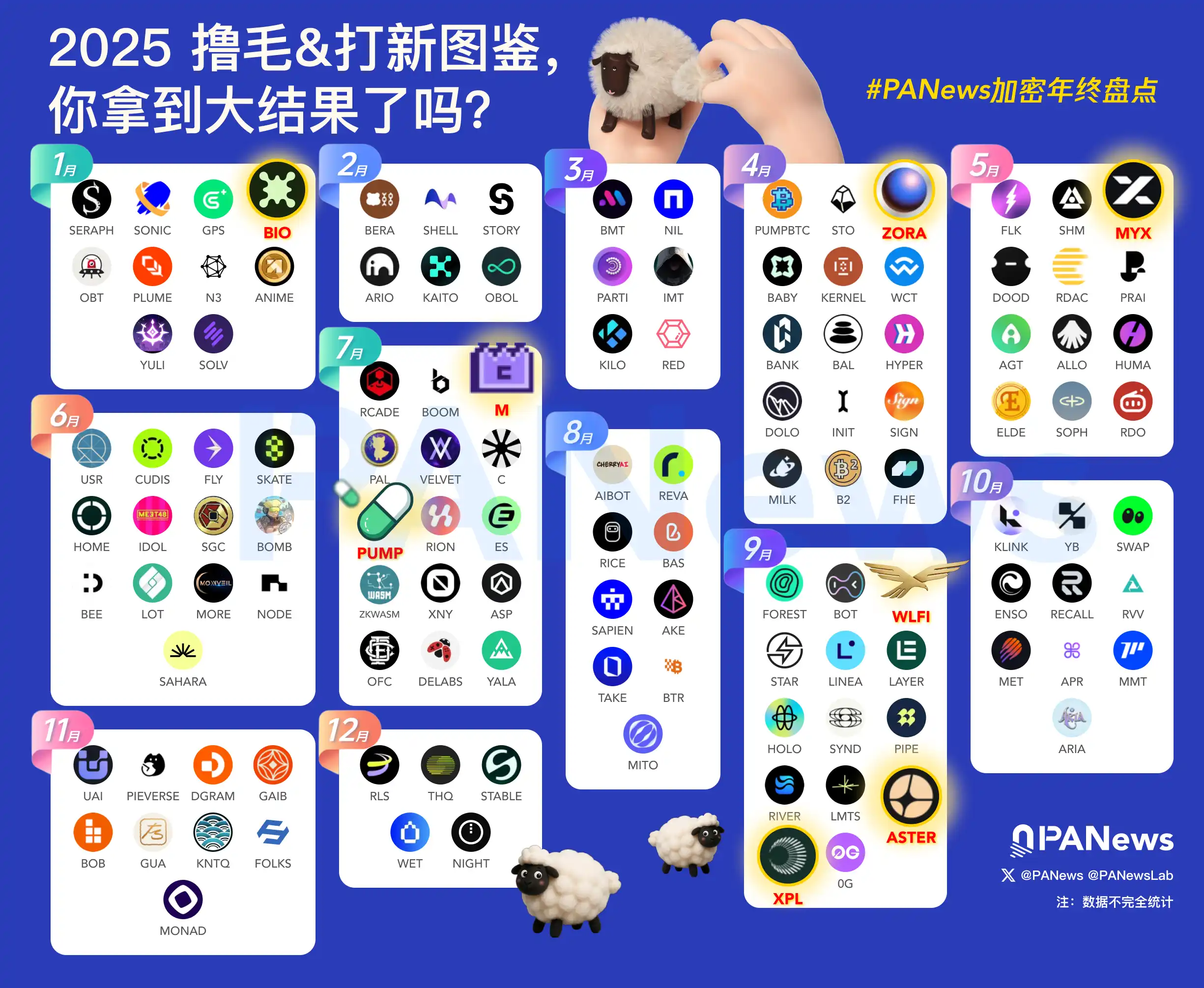
PANews Crypto Year-End Review: Did Your 2025 Airdrop Harvesting Score Pass?

marsbitОпубликовано 2025-12-18Обновлено 2025-12-18

Введение

PANews Year-End Crypto Review: Was Your 2025 Airdrop Farming Performance Up to Standard? Looking back at 2025, more and more participants have had to admit that the returns from airdrop farming this year were far from ideal. While there was no shortage of projects and participation remained high, very few stood out as clear successes—shrinking airdrops, token launches hitting peak prices immediately, and insufficient liquidity support have become the norm. What was once considered a low-risk "consensus dividend" has now turned into a highly competitive screening mechanism. As the easy gains fade, the underlying issues have become clearer: Should participants continue engaging indiscriminately, or is it time to reassess their investment of time, risk exposure, and expected returns?

Looking back at 2025, more and more participants have to admit: the returns from airdrop harvesting this year were far from ideal. There was no shortage of projects, and participation rates remained high, but truly successful ones were few and far between—shrinking airdrops, tokens peaking at launch, and insufficient liquidity support have increasingly become the norm.

Once considered a low-risk "consensus dividend," airdrop harvesting now resembles a highly competitive filtering mechanism. As the红利 (dividends) fade, the underlying issues become clearer:

Should one continue participating indiscriminately, or reassess their time, risk, and expectations?

#PANewsCryptoYearEndReview

Связанные с этим вопросы

QWhat is the main topic of the PANews year-end review article?

AThe article is a year-end review focusing on the disappointing returns and increasing challenges of 'Airdrop Hunting' (撸毛) in the cryptocurrency space for the year 2025.

QAccording to the article, what was the general trend for airdrop rewards in 2025?

AThe trend was that airdrop rewards continued to shrink, with tokens often hitting their peak price at launch and a general lack of liquidity to support them, making returns largely unsatisfactory.

QHow does the article describe the current state of 'Airdrop Hunting'?

AIt describes it as a highly competitive and selective mechanism that is no longer a low-risk 'consensus dividend,' but rather an activity where the红利 (hongli, meaning dividend/bonus) has faded, forcing participants to re-evaluate their strategy.

QWhat key question does the article pose to its readers about their participation?

AIt asks readers to consider whether they should continue participating indiscriminately or if they should re-examine their investment of time, the risks involved, and their expected returns.

QWhat specific cryptocurrency event or practice is being critiqued in this article?

AThe article is critiquing the practice of 'Airdrop Hunting' or '撸毛 (lū máo)', which refers to the strategy of participating in numerous crypto project airdrops in hopes of earning valuable token rewards.

Похожее

Huawei Cloud Rejects Token Price War, Zhou Yuefeng Seeks a New Winning Formula for AI Cloud

At the 2026 Huawei Cloud INSPIRE Creator Conference, CEO Zhou Yuefeng outlined Huawei Cloud's distinct strategy in the competitive AI cloud market. Instead of engaging in price wars based on token volume or Maas revenue—a common focus for rivals like Alibaba Cloud and ByteDance's Volcano Engine—Huawei Cloud is shifting the competition towards real-world productivity gains. Zhou highlighted three core differentiators: a fully domestic computing stack (Ascend, Kunpeng), a focus on government and enterprise clients rather than consumer internet, and a deep commitment to open-source ecosystems. To this end, Huawei Cloud launched a suite of new products under the "Agentic Infra" paradigm, including the AICS Lingqu computing cluster, AMS memory storage, and the ModelArts Next platform. These aim to solve enterprise challenges in deploying AI agents, such as latency, memory, scheduling, and security. The strategy further involves creating specialized industry zones ("AI Dream Factories") for sectors like healthcare and embodied intelligence. For example, a smart medical zone developed with Shanghai Ruijin Hospital aims to democratize expert-level diagnostic capabilities. In essence, Huawei Cloud is positioning itself not as a commodity token provider, but as the foundational infrastructure for industrial AI, leveraging its domestic supply chain and hybrid cloud solutions to serve sectors where productivity, not just scale, is the ultimate measure of value.

marsbit1 ч. назад

Huawei Cloud Rejects Token Price War, Zhou Yuefeng Seeks a New Winning Formula for AI Cloud

marsbit1 ч. назад

70% of the Public Opposes AI, Americans Hope the U.S. Loses the AI War

70% of Americans believe AI development is moving too fast, with growing public resistance evolving from online criticism to real-world protests and violence. This widespread anti-AI sentiment stems from fears of job losses, rising utility costs, environmental damage, threats to democracy, and financial instability. Key incidents illustrate the backlash: Google's former CEO Eric Schmidt was loudly booed at a graduation for promoting AI; AI company ads are vandalized; protests and even violent attacks target AI firms and data centers. Polls show deep public pessimism and strong local opposition to data center construction, often surpassing resistance to nuclear power plants. The core grievances are economic and practical: AI is seen as automating jobs, concentrating wealth, and increasing household electricity and water bills due to massive data center resource demands. Environmentalists also oppose AI's high energy use and carbon emissions. This opposition has turned AI into a major political issue in the US. While the Trump administration prioritizes AI innovation for global competition, bipartisan pushback is growing. Democrats and factions within the MAGA movement are forming temporary alliances to support stricter regulations and local bans on new data centers, pressuring the administration to choose between its tech industry backers and its voter base. The situation highlights a profound national divide over AI's future.

marsbit1 ч. назад

70% of the Public Opposes AI, Americans Hope the U.S. Loses the AI War

marsbit1 ч. назад

Торговля

Спот
Фьючерсы
活动图片