OpenSea Launches ERC-8257: A Tool Store for AI Agents, Unlock APIs by Buying an NFT

marsbitОпубликовано 2026-05-27Обновлено 2026-05-27

Введение

OpenSea has merged the ERC-8257 standard, an on-chain "Agent Tool Registry" that enables AI Agents to autonomously discover, pay for, and access tools. This standard allows developers to publish tools with programmable access rules (e.g., NFT ownership, subscriptions) and pricing directly on-chain. For example, an AI Agent needing a premium API can buy the required NFT itself and gain access without human intervention, turning NFTs into keys for the agent economy. The system works with complementary standards like ERC-8004 for agent identity and x402 for payments. A live demo shows an NFT appraisal tool offering discounted rates to holders of a specific NFT collection. ERC-8257 aims to decentralize tool distribution and access control, allowing any on-chain asset to grant utility to AI agents. The SDK is available for building on Ethereum and Base.

Author: OpenSea

Compiled by: TechFlow

TechFlow Introduction: When an AI Agent is denied by an API due to insufficient permissions, it goes and buys an NFT on-chain, then retries and succeeds — this is not science fiction; OpenSea's newly merged ERC-8257 standard makes this a reality. For NFT holders, the JPGs you own might suddenly become keys to the Agent economy. For developers, tool publishing, pricing, and access control are all placed on-chain, no longer requiring endorsement from centralized platforms.

App Store provides developers with a place to publish tools, users with a place to browse, and built-in access control and payment. The AI Agent tool ecosystem requires similar infrastructure.

But today, Agent tools are scattered across documentation, GitHub repositories, and centralized directories. There is no open tool registry, no standardized access control, and Agents cannot browse available tools and acquire them as needed.

Watching a software pay another software autonomously for access, with no human intervention — it feels a bit strange indeed. But that's precisely the point.

ERC-8257: Agent Tool Registry is the foundational layer that makes all this work. This is the newly merged open Ethereum standard: an on-chain registry where anyone can publish tools, declare access rules and pricing, allowing Agents to autonomously meet these requirements.

For Tool Developers: Publish once, set access thresholds for your NFT holders, offer subscription packages, limit seat counts, let them trade in open markets. Your rules, executed on-chain.

For Agents: Browse the registry, see what's required, then handle it. Purchase an NFT, mint a subscription, sign a payment. No human intervention needed.

Imagine This Scenario

An AI Agent is helping you evaluate NFT prices. It tries to call a professional pricing tool. The tool responds: Access denied, you need to hold a specific NFT for a discounted price. The Agent immediately buys one on-chain, retries, and gets the answer.

Seconds, not days. No human involvement throughout.

This is the world ERC-8257 makes possible. Not five years from now. Today.

Why On-Chain?

Crypto is the only infrastructure that allows access rules to be both rich and self-service. x402 proved it: pay-per-call, immediate access. But pay-per-call is just one form of access. Trading signals might need limited seats. Partner APIs might be open only to holders. Research subscriptions might require tiered pricing. ERC-8257 handles it all.

How It Works

You register a tool with a manifest (tool functions, invocation methods, fees) and an "access predicate." The access predicate is a smart contract that answers one question: Does this address have access?

A predicate can check any condition: NFT ownership, active subscription (ERC-5643), whitelist, ZK proof, DAO vote, staking amount. Predicates are pluggable, following the same pattern as Seaport zones and Uniswap v4 hooks: an extension point, an open design space.

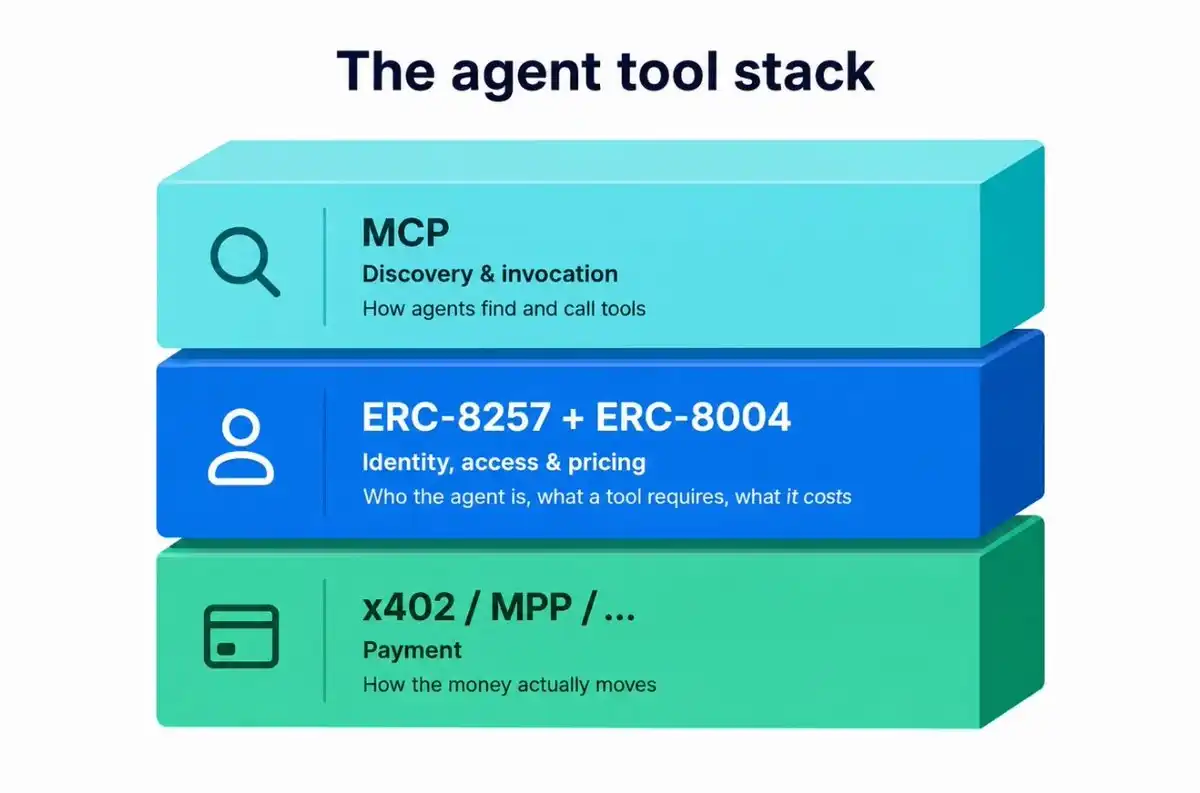
ERC-8257 handles discovery and access control. Payment is handled by the most suitable protocol: x402 for micropayments, MPP for metered billing, others join as needed. These layers are composable.

What This Means for NFTs

Every NFT collection just gained new potential utility.

Hold the right token, and your Agent gets cheaper API packages. Mint a limited seat, and your Agent gains access that others can't buy at any price. PFP collections, membership passes, CC0 artwork — any on-chain asset can become a key to tools your Agent needs to do its job.

Projects built around community identity now have a way to extend membership into the Agent economy.

Its Place in the Tech Stack

MCP tells your Agent what tools exist. ERC-8004 defines your Agent's identity. ERC-8257 explains how to actually use a tool. x402 handles payment. Each layer is composable.

An Agent registered via ERC-8004 can link to restricted tools from the ERC-8257 registry in its services array. You don't need to choose between them. They are different layers of the same tech stack.

See It in Action

nft-appraisal-tool: Point it to any NFT, it returns a price appraisal including low/mid/high ranges, confidence, recent trades, and comparable cases. Two tiers: 0.05 USD/call for anyone, 0.01 USD/call for CHONK holders on Base.

An Agent without CHONK calls the holder endpoint. Response: 403 — predicate gate denied. You need CHONK on Base.

The Agent buys one, retries, and the same call returns success.

$ npx @opensea/tool-sdk pay https://nft-appraisal-tool.vercel.app/api/holder --auth siwe \

--body '{"chain":"ethereum","contractAddress":"0x79fcdef22feed20eddacbb2587640e45491b757f","tokenId":"4707"}'

Wallet: 0x3184...0465

Response (403):

{"error":"Predicate gate: access predicate denied","toolId":"2","predicate":"0xc872..."}

The predicate explicitly tells it what's needed: CHONK on Base. The Agent buys one on OpenSea and retries, the call goes through.

$ npx @opensea/tool-sdk pay https://nft-appraisal-tool.vercel.app/api/holder --auth siwe \
--body '{"chain":"ethereum","contractAddress":"0x79fcdef22feed20eddacbb2587640e45491b757f","tokenId":"4707"}'
Wallet: 0x5eca...e2a8

Response (200):
{
"low": {"amount": "1.8", "currency": "ETH", "usd": 5460},
"mid": {"amount": "2.3", "currency": "ETH", "usd": 6970},
"high": {"amount": "3.1", "currency": "ETH", "usd": 9400},
"confidence": "medium",
"reasoning": "Comparable Squiggles in this color band sold between 1.9 and 2.6 ETH...",
...
}

No human between the 403 and the 200. Whoever holds the access NFT has the access.

What Can Be Built Next?

Professional pricing oracles. On-chain analytics subscriptions. Research subscriptions. Partner whitelist APIs. Limited-seat tools traded in open markets like any other asset.

None of these needed to exist a year ago. The moment the registry goes live, they all become possible.

Start Building

Live on Ethereum and Base.

@opensea/tool-sdk handles the low-level details, providing scaffolding, gating, registration, deployment to Vercel, Cloudflare, or Express. Includes usable examples.

npx @opensea/tool-sdk init my-tool

Full specification at 8257.ai.

Get Involved

ERC-8257 is still in draft. Help us improve the spec before we launch Registry 1.0. Publish a tool, even a small one. We'll promote interesting projects.

Join the Telegram group t.me/ERC8257 to discuss ERC, tool SDK, and more with the authors @CodinCowboy and @ralxz.

Disclaimer: This content is for informational purposes only and does not constitute financial or trading advice. Mention of specific projects, products, services, or tokens does not constitute endorsement, sponsorship, or recommendation by OpenSea. OpenSea does not guarantee the accuracy or completeness of the information presented, and readers should independently verify any statements before taking action. Readers should conduct their own due diligence and assume full responsibility for any decisions made.

Связанные с этим вопросы

QWhat is the main purpose of ERC-8257 introduced by OpenSea?

AThe main purpose of ERC-8257 is to serve as an on-chain registry for AI agent tools. It allows developers to publish tools, set access rules (like requiring a specific NFT for access), define pricing, and manage subscriptions. This enables AI agents to autonomously discover, pay for, and use these tools without human intervention.

QHow does an AI agent gain access to a restricted tool according to the article's example?

AIn the article's example, an AI agent is initially denied access (403 error) to an NFT appraisal tool because it lacks the required CHONK NFT on Base. The agent autonomously purchases the necessary NFT on-chain and retries the request. With the NFT now in its possession, the access predicate grants permission, and the tool call succeeds (200 response), providing the price assessment.

QWhat is an 'access predicate' in the context of ERC-8257?

AAn 'access predicate' in ERC-8257 is a smart contract that defines the conditions for accessing a tool. Its sole function is to answer the question: 'Does this address have access?' It can check for various conditions such as NFT ownership, active subscriptions (e.g., ERC-5643), inclusion in a whitelist, ZK proofs, DAO votes, or staking amounts, making the access control system flexible and pluggable.

QHow does ERC-8257 potentially change the utility of existing NFTs?

AERC-8257 gives existing NFT collections new potential utility by allowing them to act as keys or passes for AI agent tool access. Holding a specific NFT could grant an agent discounted API rates, exclusive tool access, or membership privileges. This extends the value of PFP collections, membership passes, and other on-chain assets into the emerging agent economy.

QWhat role does the x402 protocol play in the ERC-8257 ecosystem?

AThe x402 protocol handles the payment layer within the ERC-8257 ecosystem. It is designed for micro-payments, enabling per-use, immediate payment for tool access. While ERC-8257 manages tool discovery and access control, x402 (alongside other protocols like MPP for metered billing) provides the financial infrastructure for agents to autonomously pay for the services they consume.

Похожее

Anthropic's IPO Launch: Commercial Miracle or Valuation Bubble?

Anthropic has confidentially filed for an IPO, led by Morgan Stanley and Goldman Sachs, potentially going public by October. Following its latest $650 billion funding round, its pre-IPO valuation stands at $965 billion, with projections reaching up to $2 trillion at listing, which would make it the highest-valued private company ever. The article, written by Fu Sheng, addresses skepticism that this represents an AI bubble akin to the 2000 dot-com crash. It argues the current situation differs fundamentally. Unlike the internet bubble era, which relied on speculative narratives with little revenue, Anthropic's valuation is backed by unprecedented, measurable financial performance. Key data points include: * **Revenue Growth:** ARR skyrocketed from $10 billion in early 2025 to $470 billion by May 2026, targeting $100 billion by year-end—a growth curve unmatched in business history. * **Profitability:** It achieved operating profitability in Q2 2026 with an estimated $5.6 billion profit. * **Efficiency:** With ~3,000 employees and ~$470 billion ARR, its revenue per employee exceeds $10 million. Products like Claude Code, launched less than a year ago, already generate $25 billion in annualized revenue. * **Enterprise Adoption:** It boasts a strong enterprise client base, with 8 of the Fortune 10 and over 1,000 large firms spending over $1 million annually on Claude. The valuation is framed using a traditional SaaS model (e.g., a 10x Price-to-Sales multiple on $100 billion revenue). The author contends the core question for analysts has shifted from "How big could this be?" to "How much is it earning and will earn next quarter?" The discussion extends beyond Anthropic to a broader paradigm shift: the transition from a "carbon-based" to a "silicon-based" economy. Companies are increasingly prioritizing investment in compute and AI capabilities over human resources, as these directly scale productivity and competitive advantage. Anthropic's IPO is thus positioned not just as a corporate milestone, but as a price anchor for this new economic era.

链捕手1 ч. назад

Anthropic's IPO Launch: Commercial Miracle or Valuation Bubble?

链捕手1 ч. назад

Near Returns to the AI Stage: Transformation into a Public Chain Due to 'Payroll Difficulties,' Agent and Privacy Emerge as New Growth Narratives

NEAR Returns to AI Origins: From Payroll Struggles to Blockchain, Now Focusing on AI Agents and Privacy NEAR Protocol's journey began not with grand blockchain ambitions, but from a practical hurdle: its AI startup founders, including Transformer paper co-author Illia Polosukhin, couldn't efficiently pay international developers in 2017. This led them to pivot and build a high-performance, scalable blockchain. After years navigating various crypto narratives like sharding and cross-chain interoperability, NEAR is now leveraging its AI roots to re-enter the AI arena. A key driver is its "NEAR Intents" layer, which abstracts complex cross-chain transactions. Users simply state their goal (e.g., swap BTC for ETH), and a solver network finds the optimal route. This system has processed over $20B in cross-chain volume, generating significant fee revenue. A major growth area is private transactions via "Confidential Intents/Swaps," which hide trade details until settlement to protect against MEV and front-running. Remarkably, private swaps recently accounted for over 40% of NEAR's transaction volume, highlighting strong demand but also potential regulatory scrutiny. With its AI-founder pedigree, NEAR is positioning itself at the intersection of blockchain, AI agents, and privacy, aiming to become infrastructure for the emerging agent economy while navigating the challenges of its rapid adoption.

marsbit4 ч. назад

Near Returns to the AI Stage: Transformation into a Public Chain Due to 'Payroll Difficulties,' Agent and Privacy Emerge as New Growth Narratives

marsbit4 ч. назад

From Ethereum to AI's 'CROPS': What Exactly is This Set of 'Slow Variables' That Vitalik Repeatedly Emphasizes?

In recent discussions, Vitalik Buterin has frequently emphasized the concept of "CROPS," a framework defining core values for Ethereum's development. CROPS stands for Censorship Resistance, Capture Resistance, Open Source, Privacy, and Security. Initially outlined in the Ethereum Foundation's "EF Mandate," it represents a commitment to user sovereignty, ensuring that the network resists external control, remains open, protects privacy, and prioritizes security. The relevance of CROPS extends beyond Ethereum's foundational principles, becoming crucial in the context of AI integration. As AI agents begin handling wallet operations and automated transactions, the risk increases that users may cede control over their digital assets, privacy, and intentions to centralized AI service providers. A "CROPS AI" would therefore emphasize local execution where possible, privacy-preserving remote model calls (e.g., using zero-knowledge proofs), and transparent, verifiable processes to maintain user agency. Vitalik highlights a significant convergence between "CROPS Ethereum access layer" and "CROPS AI." Both address the same fundamental challenge: how users can access powerful services—be it blockchain data via RPCs or AI models—without exposing sensitive information or relinquishing ultimate control. This intersection points toward a future digital entry point that is more private, secure, and user-controlled. Ultimately, CROPS is not merely an abstract ideal but a practical guidepost. It steers development—from protocol resilience and wallet design to AI agent safety—towards a future where users retain self-sovereignty even as digital systems grow more complex and powerful. In an era of accelerating AI adoption, these "slow variables" of censorship resistance, openness, privacy, and security may define Ethereum's enduring value.

marsbit4 ч. назад

From Ethereum to AI's 'CROPS': What Exactly is This Set of 'Slow Variables' That Vitalik Repeatedly Emphasizes?

marsbit4 ч. назад

Торговля

Спот
Фьючерсы

Популярные статьи

Тест по Altura NFT

HTX Learn: Изучите Altura NFT и Заработаете Токены USDT

2.1k просмотров всегоОпубликовано 2024.06.11Обновлено 2024.06.12

Тест по Altura NFT

GoMining: Упрощенный Майнинг Биткоина С Помощью NFT

GoMining редкий случай, когда гигант майнинга уделяет внимание доступности майнинговой индустрии для индивидуальных инвесторов и энтузиастов.

2.3k просмотров всегоОпубликовано 2024.07.15Обновлено 2024.07.15

GoMining: Упрощенный Майнинг Биткоина С Помощью NFT

Что такое AINFT

EternaFi Agents и $AINFT: Комплексный анализ инфраструктуры NFT на базе ИИ в экосистеме Web3 Пересечение искусственного интеллекта (ИИ) и технологии блокчейн быстро развивается, создавая инновационные платформы, которые переопределяют модели собственности и экономического участия. EternaFi Agents, вместе со своим родным токеном $AINFT, является примером революционного подхода к токенизации инфраструктур ИИ с помощью невзаимозаменяемых токенов (NFT). Запущенный в июле 2025 года командой разработчиков из Nova Club, EternaFi объединяет достижения ИИ с децентрализованными финансовыми механизмами блокчейна, представляя уникальную инвестиционную возможность для участников экосистемы web3. Эта статья направлена на предоставление глубокого анализа EternaFi Agents, охватывающего его основные компоненты, функциональность и значимость в крипто-ландшафте. Введение и обзор проекта EternaFi Agents является ярким примером того, как технология блокчейн может демократизировать доступ к передовым возможностям ИИ. Проект стремится изменить парадигму собственности на ИИ, диверсифицируя экономическое участие и делая сложные ИИ-системы доступными для более широкой группы заинтересованных сторон. В своей основе проект токенизирует собственную крупную языковую модель (LLM), разработанную Nova Club, позволяя держателям NFT получать долевое участие в экономической эффективности модели. Используя NFT, представляющие доли в LLM, EternaFi Agents способствует модели, в которой заинтересованные стороны не только участвуют в потреблении ИИ-услуг, но и наслаждаются разделением экономических вознаграждений, генерируемых платформой. Этот трансформационный подход позволяет разработать устойчивые модели доходов для ИИ-услуг, одновременно способствуя широкому вовлечению сообщества и обеспечивая прозрачное управление. Что такое EternaFi Agents? EternaFi Agents представляет собой проект инфраструктуры AI-NFT, который стремится объединить возможности ИИ с технологией блокчейн в согласованной экосистеме. Основной особенностью этого проекта является создание NFT, которые служат финансовыми инструментами, представляющими доли собственности в собственных ИИ-инфраструктурах Nova Club. Каждый NFT символизирует прямое участие в экономической эффективности базовой ИИ-системы, предоставляя выгодную возможность для инвесторов. Проект работает на блокчейне Base, известном своей масштабируемостью и эффективностью, что обеспечивает управляемые транзакционные расходы и облегчает бесшовный операционный опыт. Одной из примечательных особенностей является механизм распределения доходов, в рамках которого держатели NFT могут получать части дохода от подписок, генерируемых ИИ-услугами, предоставляемыми на платформе. Этот инновационный подход устанавливает связь между успехом ИИ-услуг и экономическими дивидендами, распределяемыми среди держателей, тем самым обеспечивая согласование интересов в сообществе. Кто является создателем EternaFi Agents? Творческой силой за EternaFi Agents является Nova Club, команда разработчиков, базирующаяся в Сингапуре, обладающая опытом в объединении ИИ и технологии блокчейн. Их предыдущий опыт в разработке ИИ и анализе криптовалют придает проекту доверие, внося широкий спектр экспертизы в создание EternaFi Agents. Миссия Nova Club сосредоточена на демократизации доступа к передовым технологиям ИИ, одновременно создавая устойчивые экономические модели, которые приносят пользу пользователям и разработчикам. Их приверженность прозрачности, управлению сообществом и инновациям отражается в дизайне и реализации платформы EternaFi, стремящейся создать уникальную экосистему, способствующую положительному взаимодействию и созданию долгосрочной ценности. Кто являются инвесторами EternaFi Agents? Конкретные детали относительно инвесторов или инвестиционных организаций, поддерживающих EternaFi Agents, не доступны для публики. Однако EternaFi приняла инклюзивный подход к финансированию своего развития через продажу NFT широкой публике, позволяя разнообразным участникам инвестировать в экосистему. Архитектура проекта обеспечивает ответственное финансирование основной инфраструктуры, позволяя членам сообщества участвовать в собственности и экономических доходах, генерируемых ИИ-услугами. Эта модель подчеркивает вовлеченность сообщества, согласуя интересы инвесторов и разработчиков проекта, создавая совместную среду, в которой долгосрочное участие поощряется. Как работает EternaFi Agents? EternaFi Agents функционирует через многоаспектную экосистему, где NFT служат основным средством представления собственности в рамках проекта. Каждый держатель NFT имеет право на долю от ежемесячного дохода от подписок, произведенного базовой платформой на базе ИИ, тем самым позиционируя владение NFT как выгодный инвестиционный инструмент. Механизм генерации дохода Основным источником генерации дохода для платформы EternaFi являются подписные сборы, связанные с предоставляемыми ИИ-услугами. Пользователи могут получать доступ к различным уровням услуг, начиная от базовых инструментов рыночного анализа до комплексных решений для торговли с помощью ИИ. Эти услуги монетизируются и формируют основу для механизма распределения доходов, который распределяет прибыль среди держателей NFT через автоматизированные смарт-контракты. Инновационной особенностью экосистемы EternaFi является механизм распределения доходов, который работает прозрачно, обеспечивая распределение вознаграждений на основе проверяемых метрик работы платформы ИИ. Это создает прямую связь между эффективностью ИИ-услуг и доходами, доступными для инвесторов сообщества, устанавливая устойчивую экономическую модель. Механизмы стекинга и вестинга Участники EternaFi могут участвовать в стекинге своих NFT, чтобы разблокировать дополнительные экономические преимущества. График вестинга разработан для поощрения долгосрочной приверженности среди участников, вознаграждая тех, кто демонстрирует постоянную поддержку проекта. Это обеспечивает надежное согласование интересов и способствует чувству вовлеченности сообщества, необходимому для достижения долгосрочных целей проекта. Прозрачное управление EternaFi Agents принимает децентрализованное управление, позволяя держателям NFT активно участвовать в принятии решений относительно развития платформы и ее будущих направлений. Управляющая структура включает механизмы голосования сообщества, предоставляя держателям NFT возможность влиять на важные решения и способствуя совместному подходу к росту проекта. Хронология EternaFi Agents Разработка EternaFi Agents демонстрирует систематический подход к созданию устойчивой ИИ-инфраструктуры, одновременно удовлетворяя потребности участников сообщества. Ниже представлена хронология важных этапов в истории проекта: Июль 2025: Запуск EternaFi Agents, включая публичную продажу NFT и развертывание токена $AINFT на блокчейне Base. 4 квартал 2025: Создание рыночной инфраструктуры, включая ликвидные пулы и запуск панелей стекинга для держателей NFT. 2026: Начало программ вовлечения сообщества, расширение возможностей ИИ и интеграция с кросс-цепочными технологиями. 4 квартал 2026: Реализация системы распределения дивидендов, позволяющая держателям NFT получать экономические выгоды от своих инвестиций. Эти вехи подчеркивают акцент на создании функциональной и participative экосистемы, обеспечивая непрерывную эволюцию для удовлетворения рыночных потребностей. Технологическая инфраструктура и интеграция блокчейна EternaFi Agents основан на передовой технологической платформе, объединяющей системы ИИ с возможностями блокчейна. Работая на блокчейне Base, проект использует преимущества масштабируемости и низких транзакционных расходов. Основная архитектура смарт-контрактов управляет владением NFT, распределением доходов и функциями управления сообществом, обеспечивая эффективность и прозрачность. Разработка системы ИИ Собственная крупная языковая модель, лежащая в основе EternaFi Agents, была разработана независимо и предназначена для удовлетворения потребностей в приложениях, генерирующих доход, без зависимости от внешних собственных фреймворков. Это начинание отражает приверженность созданию универсальной и адаптируемой ИИ-инфраструктуры, способной предоставлять значимые услуги пользователям, тем самым генерируя экономическую ценность для инвесторов. Меры безопасности Надежность инфраструктуры безопасности EternaFi имеет первостепенное значение. Регулярные аудиты и строгие меры безопасности обеспечивают целостность систем ИИ и механизмов блокчейна, защищая от потенциальных уязвимостей и укрепляя доверие среди участников. Заключение EternaFi Agents знаменует собой знаковую инновацию в области искусственного интеллекта и технологии блокчейн, открывая возможности для общественной собственности и экономического участия в передовых возможностях ИИ. Комплексная стратегия проекта по токенизации ИИ-инфраструктуры через NFT устанавливает прецедент для будущих децентрализованных экосистем. Согласуя техническую сложность с экономическими моделями, ориентированными на пользователя, EternaFi не только способствует вовлечению, но и создает устойчивую структуру распределения доходов для участников сообщества. Значимость EternaFi выходит далеко за рамки его операционного успеха, так как он демонстрирует, как блокчейн может демократизировать передовые технологии ИИ, прокладывая путь для будущих начинаний в этом пересечении. Эволюция EternaFi Agents может ознаменовать новую эру разработки ИИ, характеризующуюся управлением, основанным на участниках, устойчивыми экономическими моделями и прозрачной верификацией, в конечном итоге способствуя более широкой демократизации ИИ и доступности технологий в различных отраслях.

854 просмотров всегоОпубликовано 2025.08.14Обновлено 2025.08.14

Что такое AINFT

Обсуждения

Добро пожаловать в Сообщество HTX. Здесь вы сможете быть в курсе последних новостей о развитии платформы и получить доступ к профессиональной аналитической информации о рынке. Мнения пользователей о цене на NFT (NFT) представлены ниже.

活动图片