OpenAI Accuses Anthropic: $30 Billion of $80 Billion Revenue is Fabricated

marsbitОпубликовано 2026-04-14Обновлено 2026-04-14

Введение

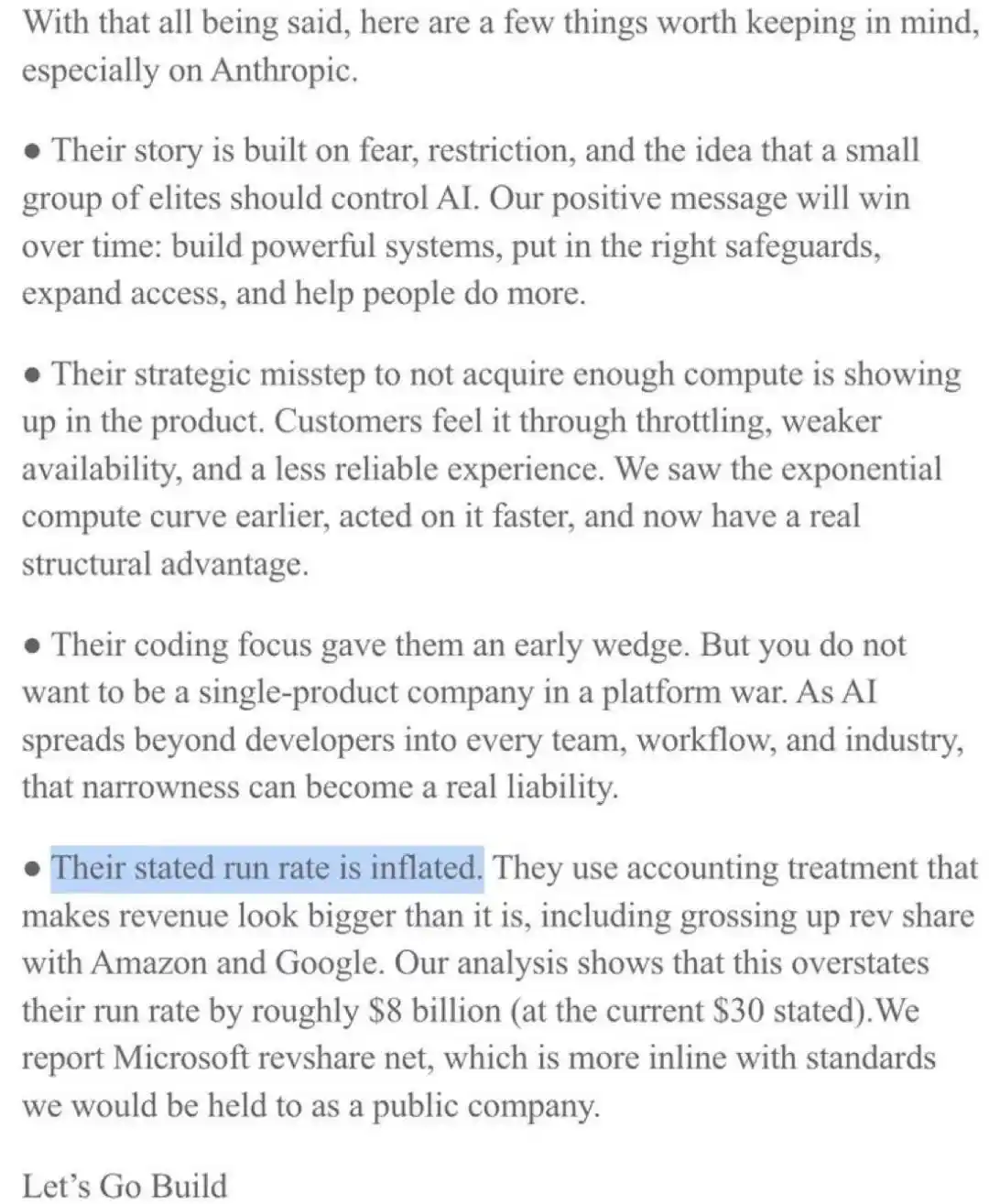
OpenAI's Chief Revenue Officer, Denise Dresser, issued an internal memo accusing rival Anthropic of overstating its annualized revenue. According to the memo, Anthropic reported $30 billion in revenue but included $8 billion in fees shared with cloud providers like AWS and Google Cloud, using a "gross basis" accounting method. OpenAI claims it uses a "net basis" approach, deducting such fees, and argues that Anthropic's actual revenue should be $22 billion—below OpenAI's $25 billion. The memo also criticized Anthropic for insufficient computing capacity, leading to service limitations, and for overfocusing on programming instead of broader enterprise solutions. OpenAI highlighted its own strategic advantages, including greater projected computing power by 2030. Additionally, OpenAI acquired AI finance app Hiro Finance, aiming to enhance its capabilities in personal financial planning and expand into life and wealth management services, strengthening its position as a comprehensive AI assistant.

According to foreign media reports, OpenAI's Chief Revenue Officer Denise Dresser sent a four-page memo to employees, addressing competition with Anthropic, insufficient computing power, and product strategy.

The memo also mentioned that Anthropic includes the commissions given to Amazon and Google in its total revenue, thereby inflating the revenue figure on the books.

The incident originated a week ago on April 7, when Anthropic proudly announced its annualized revenue had reached $30 billion, successfully surpassing OpenAI's $25 billion.

In terms of growth rate, it surged by 233% compared to the $9 billion at the end of 2025.

However, the memo states that $8 billion of Anthropic's annualized revenue was "inflated" through accounting practices, meaning their actual annualized revenue should be $22 billion, not exceeding OpenAI's $25 billion.

OpenAI's accusation is not baseless but targets a technical yet crucial accounting issue.

According to the memo, Anthropic uses the "gross basis" method to report revenue sharing with cloud service providers.

Specifically, when customers purchase Anthropic's services through cloud platforms like AWS, Google Cloud, or Azure, Anthropic records the entire amount paid by the customer as its own revenue, including the portion that must be shared with the cloud service provider.

In contrast, OpenAI uses the "net basis" method to report revenue sharing with Microsoft, only including the net revenue after deducting Microsoft's share.

The memo emphasizes that this net basis method is "more aligned with the standards that public companies should follow."

According to OpenAI's analysis, if the same accounting standard were applied, Anthropic's true annualized revenue should be around $22 billion, not the $30 billion it claims. The aforementioned "inflated $8 billion revenue" is derived from this.

This $8 billion difference is precisely the commission taken by the cloud service providers.

In the cloud service distribution model, platforms like AWS and Google Cloud take a certain percentage of commission from the fees paid by customers.

For a company like Anthropic, which heavily relies on cloud platforms for distribution, this amount is indeed quite substantial.

The memo also has a broader context: Anthropic's private market valuation has reached approximately $600 billion, representing a premium of over 50% compared to its last funding round. Meanwhile, OpenAI's secondary market trading valuation is about $765 billion, a discount of approximately 10% from its last funding round.

Against this backdrop, OpenAI's release of this strongly worded internal memo at this time is clearly intended to stabilize internal morale and influence external market perception by questioning the credibility of a competitor's data.

Wait, there's more. The memo has many other interesting points.

The memo states that Anthropic's "failure to secure sufficient computing power is a strategic mistake," leading to issues like rate limiting, weaker availability, and less reliable experiences for customers using Claude.

In contrast, OpenAI claims it "saw the exponential growth curve of computing power demand earlier, acted faster, and now possesses a true structural advantage."

OpenAI claims that by 2030, it will have 30 gigawatts of computing power, while Anthropic is expected to have only 7 to 8 gigawatts by the end of 2027.

Regarding product strategy, the memo mentions that Anthropic is too focused on programming scenarios.

While this helped it gain an early market foothold, this product cannot help Anthropic win the platform war.

The memo mentions that OpenAI is building a complete enterprise AI system, including ChatGPT for Work, Codex, API, Frontier agent platform, and integration with Amazon's chip environment, capable of meeting enterprises' needs to enter from different access points and scale to a full stack.

After finance and strategy, it's time for ideology.

The memo writes: "Their story is built on fear, restrictions, and the idea that a small elite should control AI."

Back in February, Altman commented on Anthropic, saying the company provides expensive products to the wealthy. OpenAI, on the other hand, is an advocate for "democratizing AI," making AI accessible to everyone.

On the same day this war of words began, OpenAI did another interesting thing.

On the very same day, OpenAI acquired the AI finance application company Hiro Finance.

According to Hiro Finance's own statement, the company's initial vision was to create an "AI personal CFO."

Simply put, it's not just an ordinary bookkeeping software but aims to integrate users' financial information scattered across bank accounts, investment accounts, budgeting tools, and spreadsheets, then use AI to help users with financial planning, net worth forecasting, cash flow analysis, and major decision simulation.

For example, buying a house, changing jobs, taking a year off, or deciding whether to keep more cash. In the past, you might have needed a financial advisor and反复 calculations in Excel to get an uncertain answer.

Hiro Finance hopes to turn this complex and tedious process into a service that can provide answers through a single conversation. Its website mentions that it has already helped clients plan and manage over $1 billion in assets.

After joining OpenAI, Hiro is no longer accepting new user registrations, and the product will cease operation on April 20. Existing users can export their data until May 13, after which personal data on Hiro's servers will be permanently deleted. Hiro also specifically emphasized that user personal data will not be shared with OpenAI.

The amount of the transaction was not disclosed, and OpenAI has not yet specified which specific product line the Hiro team will join.

OpenAI is essentially bolstering its "life scenarios." ChatGPT already has chat, search, programming, office, and enterprise entry points, but if it is to become a true personal assistant, it cannot just answer questions; it must also understand people's long-term goals, asset status, risk preferences, and real-world constraints.

Finance is恰好 a testing ground for this capability. It requires natural language interaction, verifiable calculations, strong privacy protection, and a sufficiently high trust threshold.

More importantly, personal finance comes with a clear willingness to pay. Users might pay for chatting or programming, but if AI can genuinely help people decide how to spend money and manage assets, then it's not just a "smarter search box" but is approaching the role of a private advisor.

OpenAI's acquisition of Hiro Finance is not necessarily about inserting this product, unchanged, into ChatGPT.

They are likely acquiring expertise in financial products, user trust, and verifiable computation. While Anthropic is stuck in enterprise and programming, OpenAI aims to be a universal entry point covering work, life, and wealth management.

However, financial scenarios are most afraid of miscalculations and overstepping boundaries. Accuracy, compliance, and trust are the real challenges of this small acquisition.

This article is from the WeChat public account "Letter AI", author: Miao Zheng

Связанные с этим вопросы

QWhat is the main accusation OpenAI makes against Anthropic's reported revenue in the internal memo?

AOpenAI accuses Anthropic of inflating its annualized revenue by $80 billion by using the 'gross basis' accounting method, which includes the share that goes to cloud providers like AWS and Google Cloud, rather than the 'net basis' method that only counts the revenue after deducting the cloud providers' share.

QHow does OpenAI's accounting method for revenue sharing with Microsoft differ from Anthropic's approach with cloud providers?

AOpenAI uses the 'net basis' accounting method, reporting only the net revenue after deducting Microsoft's share, while Anthropic uses the 'gross basis' method, reporting the total customer payment including the portion that goes to cloud providers.

QWhat strategic advantage does OpenAI claim to have over Anthropic regarding computational resources?

AOpenAI claims to have a structural advantage in computational resources, having anticipated the exponential growth in demand earlier and acted faster. They project owning 30 gigawatts of compute by 2030, compared to Anthropic's expected 7-8 gigawatts by the end of 2027.

QWhat did OpenAI acquire on the same day as the memo was released, and what is its purpose?

AOn the same day, OpenAI acquired Hiro Finance, an AI financial application company. The acquisition aims to enhance OpenAI's capabilities in personal finance management, integrating financial planning, asset prediction, and decision-making simulations into its services, moving towards becoming a comprehensive personal assistant.

QHow does OpenAI characterize Anthropic's product strategy and ideological approach in the memo?

AOpenAI characterizes Anthropic's product strategy as overly focused on programming scenarios, which may not win the platform war. Ideologically, they accuse Anthropic of building a narrative based on fear, restrictions, and the idea that a small elite should control AI, contrasting it with OpenAI's mission to democratize AI for everyone.

Похожее

The King of Blind Date Attire in Korea: How SK Hynix Made a Comeback Against Samsung?

In South Korea's dating scene, SK Hynix employees are now highly sought after, a status shift fueled by the company's astronomical profits and employee bonuses, projected to reach up to 6.1 million RMB per person by 2027. This marks a dramatic reversal for the long-time second-place player in memory semiconductors, which has now surpassed its rival Samsung in annual operating profit. The turnaround story began in 2008 when a struggling Hynix, emerging from bankruptcy restructuring, took a risky bet by agreeing to develop High Bandwidth Memory (HBM) with AMD. At the time, HBM had no clear market beyond high-end graphics cards and was a costly, complex technology. Major players like Samsung, pursuing its own HMC technology, declined. For Hynix, with only memory as its core business, it was a gamble born of necessity. The pivotal moment came in 2012 when SK Group Chairman Chey Tae-won acquired Hynix. Defying industry downturns, he invested heavily in R&D and fabrication, sustaining the HBM project through over a decade of commercial uncertainty and internal challenges. A key break occurred around 2016-2017 when Samsung faced production issues supplying HBM2 for Google's TPU, allowing SK Hynix to gain a crucial foothold in the data center market. The AI explosion post-ChatGPT in 2022 was the catalyst, turning HBM into a critical bottleneck for AI accelerators like NVIDIA's GPUs. By 2025, SK Hynix captured 62% of the global HBM market, leaving Samsung at 17%. For the first time, its annual operating profit exceeded Samsung's. Analysts point to the "innovator's dilemma" to explain Samsung's miss: its vast, successful business portfolio made it risk-averse, preventing an all-in bet on the initially niche HBM technology. In contrast, SK Hynix, as a challenger with its back against the wall, had no choice but to commit fully. The story highlights how Korea's chaebol system allows for ultra-long-term bets beyond quarterly pressures. However, SK Hynix's lead isn't guaranteed. Samsung is aggressively catching up on HBM4, and challenges like customer concentration (heavy reliance on NVIDIA) and technical hurdles in advanced packaging remain. The narrative underscores a market truth: the greatest alpha often comes from betting on uncertain, long-term directions others dismiss, much like HBM in 2008.

marsbit11 мин. назад

The King of Blind Date Attire in Korea: How SK Hynix Made a Comeback Against Samsung?

marsbit11 мин. назад

Understanding Hash in One Article: The "Browser Miner" on Ethereum

Hash is an Ethereum-based ERC-20 token described as a "browser-minable post-quantum token." Its key features include enabling browser-based GPU mining without specialized hardware, a fixed supply cap of 21 million tokens, immutable and permissionless smart contracts with no team allocation or pre-mining, and an emphasis on post-quantum security using Keccak256 hashing. The mining mechanism is a simplified on-chain proof-of-work where miners solve unique challenges tied to their wallet address. Key design elements prevent answer theft, with epochs resetting every 100 blocks (~20 minutes) and a per-block minting limit. Emission follows a Bitcoin-like halving schedule every 100,000 mints, starting at 100 tokens per mint. Projections suggest all tokens could be mined within approximately 294 days if a target rate of one mint per minute is sustained. Hash emphasizes "post-quantum" security by leveraging hash-based primitives like Keccak256, which are considered more resistant to quantum attacks compared to elliptic-curve cryptography. While not a fully post-quantum asset, it aligns with Ethereum's broader post-quantum research narrative. The project completed its Genesis sale at $0.03 and began trading on Uniswap, with its price reaching around $0.19. The initial circulating supply is small, with 5% sold in Genesis and 5% allocated to liquidity. The majority (47.6% of total supply) is allocated to early-stage mining, leading to a front-loaded emission schedule. This structure, combined with low initial liquidity, makes Hash a high-volatility, high-risk project dependent on sustained miner participation and market demand to absorb new supply.

marsbit25 мин. назад

Understanding Hash in One Article: The "Browser Miner" on Ethereum

marsbit25 мин. назад

OpenAI's Largest Internal Wealth Creation: 600 People Cash Out a Total of $6.6 Billion, 75 Take Home the Maximum $30 Million Each

A Wall Street Journal report reveals OpenAI's unprecedented pre-IPO wealth creation. In a single employee stock sale last October, over 600 current and former employees sold shares, collectively cashing out approximately $6.6 billion. Due to high investor demand, the company tripled the individual sale cap to $30 million, with about 75 employees selling the maximum amount. This event represents the largest such transaction in tech industry history for a private company. OpenAI's valuation was $500 billion for this tender offer. Employees with over two years of tenure were eligible, allowing many post-ChatGPT hires their first liquidity event. The company's stock has reportedly grown over 100-fold in seven years. Following a restructuring, employees collectively hold about 26% of OpenAI. The scale of executive wealth is also staggering. In court testimony related to Elon Musk's lawsuit, President and co-founder Greg Brockman confirmed his OpenAI stake is worth around $30 billion. Analysis indicates about 165 current and former employees hold a combined ~$164.9 billion in equity, averaging nearly $1 billion per person in paper wealth. OpenAI's per-employee stock-based compensation is estimated to be 34 times the average of major tech firms before their IPOs. OpenAI continues its rapid ascent, closing a $122 billion funding round at an $852 billion valuation in March. With monthly revenue hitting $2 billion, over 900 million weekly ChatGPT users, and plans for a potential trillion-dollar IPO in late 2026, this wealth-creation engine shows no signs of stopping.

链捕手47 мин. назад

OpenAI's Largest Internal Wealth Creation: 600 People Cash Out a Total of $6.6 Billion, 75 Take Home the Maximum $30 Million Each

链捕手47 мин. назад

Торговля

Спот
Фьючерсы

Популярные статьи

Как купить S

Добро пожаловать на HTX.com! Мы сделали приобретение Sonic (S) простым и удобным. Следуйте нашему пошаговому руководству и отправляйтесь в свое крипто-путешествие.Шаг 1: Создайте аккаунт на HTXИспользуйте свой адрес электронной почты или номер телефона, чтобы зарегистрироваться и бесплатно создать аккаунт на HTX. Пройдите удобную регистрацию и откройте для себя весь функционал.Создать аккаунтШаг 2: Перейдите в Купить криптовалюту и выберите свой способ оплатыКредитная/Дебетовая Карта: Используйте свою карту Visa или Mastercard для мгновенной покупки Sonic (S).Баланс: Используйте средства с баланса вашего аккаунта HTX для простой торговли.Третьи Лица: Мы добавили популярные способы оплаты, такие как Google Pay и Apple Pay, для повышения удобства.P2P: Торгуйте напрямую с другими пользователями на HTX.Внебиржевая Торговля (OTC): Мы предлагаем индивидуальные услуги и конкурентоспособные обменные курсы для трейдеров.Шаг 3: Хранение Sonic (S)После приобретения вами Sonic (S) храните их в своем аккаунте на HTX. В качестве альтернативы вы можете отправить их куда-либо с помощью перевода в блокчейне или использовать для торговли с другими криптовалютами.Шаг 4: Торговля Sonic (S)С легкостью торгуйте Sonic (S) на спотовом рынке HTX. Просто зайдите в свой аккаунт, выберите торговую пару, совершайте сделки и следите за ними в режиме реального времени. Мы предлагаем удобный интерфейс как для начинающих, так и для опытных трейдеров.

1.3k просмотров всегоОпубликовано 2025.01.15Обновлено 2025.03.21

Как купить S

Sonic: Обновления под руководством Андре Кронье – новая звезда Layer-1 на фоне спада рынка

Он решает проблемы масштабируемости, совместимости между блокчейнами и стимулов для разработчиков с помощью технологических инноваций.

2.2k просмотров всегоОпубликовано 2025.04.09Обновлено 2025.04.09

Sonic: Обновления под руководством Андре Кронье – новая звезда Layer-1 на фоне спада рынка

HTX Learn: Пройдите обучение по "Sonic" и разделите 1000 USDT

HTX Learn — ваш проводник в мир перспективных проектов, и мы запускаем специальное мероприятие "Учитесь и Зарабатывайте", посвящённое этим проектам. Наше новое направление .

1.8k просмотров всегоОпубликовано 2025.04.10Обновлено 2025.04.10

HTX Learn: Пройдите обучение по "Sonic" и разделите 1000 USDT

Обсуждения

Добро пожаловать в Сообщество HTX. Здесь вы сможете быть в курсе последних новостей о развитии платформы и получить доступ к профессиональной аналитической информации о рынке. Мнения пользователей о цене на S (S) представлены ниже.

活动图片