On the Eve of the Explosion of On-Chain Options

marsbitОпубликовано 2026-03-12Обновлено 2026-03-12

Введение

On-Chain Options on the Brink of Breakout The cryptocurrency options market is larger than most realize, with CME's crypto derivatives volume up 46% year-over-year. Institutional investors require defined-risk tools like options for hedging large positions. A pivotal shift occurred in mid-2025 when Bitcoin options open interest reached $65 billion, surpassing futures for the first time, indicating a move from pure leverage to risk-defined instruments. Growth is concentrated on Deribit (now backed by Coinbase after its acquisition) and traditional finance capital via IBIT options. While decentralized derivatives have grown from 2% to over 10% market share in two years, on-chain options remain nascent. @DeriveXYZ leads with over $700 million in notional options volume over 30 days. It has evolved from an AMM to a gas-free central limit order book on its own L2, featuring portfolio margin and cross-margin. @KyanExchange is approaching similarly with on-chain portfolio margining and partial liquidation mechanics. Structured products and asset managers urgently need options for their defined risk/return profiles. Institutional demand is clear, with IBIT options OI surpassing the gold ETF GLD and CME handling $3 trillion in crypto derivatives notional volume in 2025. Regulatory clarity is improving. A joint statement from the SEC and CFTC in 2025 allows regulated exchanges to trade spot crypto assets, and the CLARITY Act has passed the House. This improved environment, alongsid...

Author: Delphi Digital

Compiled by: AididiaoJP, Foresight News

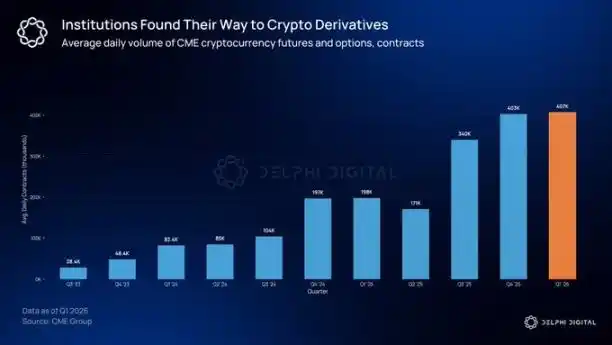
The size of the cryptocurrency options market far exceeds most people's perceptions. Trading volume for cryptocurrency derivatives on the Chicago Mercantile Exchange (CME) is 46% higher than the record high set last year. Institutional investors need clear risk management tools to hedge large positions, and options are the only cryptocurrency instrument that provides this functionality.
Reshaping the Landscape

By mid-2025, the total open interest in Bitcoin options reached $65 billion, surpassing futures open interest for the first time. Futures are leverage tools, while options allow funds to set a cap on losses for their $500 million Bitcoin holdings by paying a premium. This turning point indicates that tools with defined risk functions are gradually replacing pure leverage tools.

This growth has been concentrated on two platforms. Deribit has been the mainstream platform for cryptocurrency options trading for years. After being acquired by Coinbase for $2.9 billion in 2025, it gained institutional-grade endorsement. Meanwhile, IBIT options, launched in late 2024, brought traditional financial capital into this field. The options market is expanding rapidly, but the vast majority of trading still requires intermediaries.

On-Chain Options Are Still in Their Infancy

The market share of decentralized derivatives has climbed from 2% to over 10% in two years. Hyperliquid has proven that decentralized exchanges (DEXs) can rival centralized exchanges in speed and transparency. However, no similar representative project has emerged for on-chain options yet.

@DeriveXYZ remains the leading on-chain options protocol, with a nominal options trading volume exceeding $700 million in the past 30 days. The protocol was launched in August 2021 under the name Lyra as an options automated market maker (AMM). After weathering the bear market, it was completely rebuilt in 2023 and is now built on its own OP Stack Layer 2 with a gas-free central limit order book.
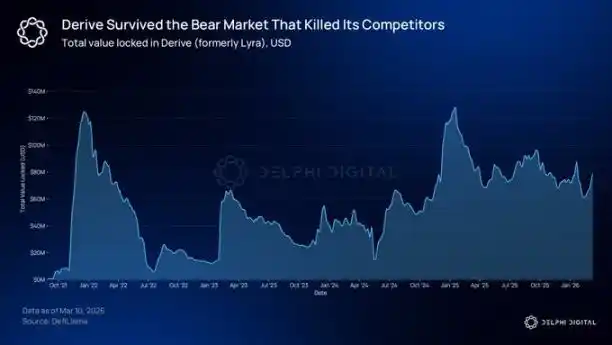
This rebuild fundamentally changed the pricing mechanism. Market makers quote prices directly on the order book, leading to narrower spreads, more precise pricing, and support for larger trades. Traders enjoy zero gas fees and sub-second execution speeds.

Its portfolio margin system has also attracted institutional attention. The system assesses overall position risk through scenario analysis. For example, if a trader holds both a long call option and a short put option on the same underlying asset, the system does not charge margin for each leg separately.

The collateral required for a hedged position is lower than the simple sum of the individual parts, which is the common logic in traditional financial derivatives trading desks. Derive also offers perpetual contracts and lending services on the same Layer 2, supporting cross-product cross-margining.

@KyanExchange is moving in the same direction but in a different way. This platform combines an order book matching engine with on-chain portfolio margining, supporting multi-leg operations in a single atomic transaction. Traders can deploy an iron condor strategy with just a few clicks.

Kyan's liquidation mechanism also differs from most DeFi protocols. When a margin threshold is breached, the platform does not liquidate the entire account but executes a partial close-out, only closing the minimum number of positions necessary to bring the account back to the margin requirement. Kyan is currently in the Arbitrum test phase, with a mainnet launch imminent.

Who Needs Options?

Asset management companies building structured products urgently need the clearly defined risk-return profiles provided by options. Take J.P. Morgan's Equity Premium Income ETF as an example. This fund is built on a covered call strategy and is one of the largest actively managed funds globally. The total assets under management for yield products based on derivatives exceed one hundred billion dollars. As more institutional capital moves on-chain, the corresponding hedging needs will migrate as well.

Currently, more and more institutional investors already hold or plan to allocate to digital assets in the short term. The open interest for IBIT options has surpassed that of the gold ETF GLD. In 2025, the CME processed a nominal trading volume of $3 trillion in cryptocurrency derivatives.

The Timing is Ripening

Most early on-chain options protocols failed to survive, primarily due to regulatory uncertainty. For instance, Opyn was fined by the CFTC for operating an unlicensed derivatives exchange. At that time, teams developing products could not predict whether their product would be deemed illegal the next quarter.

This situation is now improving. In September 2025, the U.S. Securities and Exchange Commission (SEC) and the Commodity Futures Trading Commission (CFTC) jointly issued a statement allowing regulated exchanges to conduct spot crypto asset trading. The CLARITY Act has passed the House of Representatives, proposing to place spot markets for digital commodities under CFTC oversight. The Senate version is still under negotiation and is currently stalled. CME Group will launch 24/7 cryptocurrency options trading on May 29th. While this does not guarantee that on-chain protocols will necessarily succeed, the overall environment has undergone a fundamental shift.


Связанные с этим вопросы

QWhat major shift occurred in the Bitcoin derivatives market in mid-2025, and what does it signify?

AIn mid-2025, the total open interest for Bitcoin options reached $65 billion, surpassing that of futures for the first time. This signifies a shift is underway from purely leveraged tools (futures) to instruments with defined risk (options), as institutions seek better risk management tools for their large holdings.

QWhich two platforms are highlighted as the main drivers of growth in the cryptocurrency options market?

AThe growth is concentrated on two platforms: Deribit, which gained institutional credibility after its acquisition by Coinbase, and IBIT options, which introduced TradFi capital into the space starting in late 2024.

QWhat is the current state of on-chain options, and which protocol is mentioned as the current leader?

AOn-chain options are described as being in their infancy. The leading on-chain options protocol mentioned is @DeriveXYZ, which has processed over $700 million in notional options volume in the past 30 days.

QHow did the protocol @DeriveXYZ (formerly Lyra) improve its system after a 2023 overhaul?

AThe 2023 overhaul replaced its AMM model with a gas-free central limit order book (CLOB) built on its own OP Stack Layer 2. This allowed market makers to quote prices directly, leading to tighter spreads, more precise pricing, support for larger trades, and sub-second execution speeds for traders.

QWhat are two key reasons mentioned for why the environment for on-chain options is now more favorable than before?

ATwo key reasons are: 1) Improved regulatory clarity, exemplified by a joint SEC-CFTC statement allowing regulated exchanges to trade spot crypto assets and the progress of the CLARITY Act. 2) The growing institutional demand for defined-risk tools, as seen with the massive success of CME's crypto derivatives and IBIT options.

Похожее

2026 New Policy Interpretation: The "Mutual Pursuit" of Intelligent Agents and AI Terminals, and the Three Major Value Reconstructions in the AIoT Industry

In May 2026, China's national ministries released two pivotal policy documents that jointly establish a strategic "dual-track" framework for the AIoT industry. The "Intelligent Agent Standardized Application and Innovation Development Implementation Opinions" defines the "soul"—positioning intelligent agents as core AI products. The "Artificial Intelligence Terminal Intelligence Grading" national standard defines the "body"—establishing a four-tier capability ladder (L1 to L4) for AI hardware. This synchronized policy approach is globally unique, moving beyond market-led (US) or risk-focused (EU) models. It frames AIoT as a new type of "intelligent infrastructure," comparable to electricity or the internet in historical significance. The core analysis identifies a value evolution from IoT 1.0 (connection) to AIoT 4.0 (collaboration, represented by the forward-looking L4 level). This "L4" signifies a paradigm shift: from users operating tools to delegating tasks to agent-like devices ("Intelligent Action of All Things"). The article outlines three strategic paths for companies: becoming Standard Definers, Scenario Integrators (focusing on 19 specified application areas), or Infrastructure Builders. A critical 18-24 month window is identified for strategic positioning. A "Four Levers" strategy is proposed: leveraging Standards (L-level certification), leveraging Scenarios (deep vertical focus), leveraging Open Source (for cost reduction and ecosystem influence), and leveraging Momentum (engaging in global protocol ecosystems). In conclusion, these policies are a starting gun for a decade-long industrial transformation, shifting the industry narrative from "Intelligent Connection of All Things" to "Intelligent Action of All Things," with companies needing to choose their赛道and execution strategy decisively.

marsbit55 мин. назад

2026 New Policy Interpretation: The "Mutual Pursuit" of Intelligent Agents and AI Terminals, and the Three Major Value Reconstructions in the AIoT Industry

marsbit55 мин. назад

Splashing Out 27 Billion Yuan, OpenAI Establishes New Company to Accelerate AI Deployment

On May 11th, OpenAI announced the formation of a new company, "OpenAI Deployment Company," with an initial investment of over $4 billion (approximately 27.2 billion RMB). This venture aims to help businesses build and deploy AI solutions. OpenAI is also acquiring the AI consulting firm Toromo to rapidly scale the deployment company's capabilities. This new entity, majority-owned by OpenAI, brings together 19 investment, consulting, and system integration partners, led by TPG with co-lead founding partners including Advent International, Bain Capital, and Brookfield. OpenAI's Chief Revenue Officer, Denise Dresser, stated that while AI is becoming increasingly capable, the current challenge lies in integrating these systems into core business infrastructure and workflows. The deployment company is designed to bridge this gap and translate AI capabilities into operational impact. This move comes as OpenAI emphasizes the next competitive phase will depend on the efficiency of deploying AI in real business scenarios. The company reports over 1 million businesses already use its products and APIs. OpenAI is significantly increasing its investments in computing power, with co-founder Greg Brockman stating the company expects to spend $50 billion on compute this year, a dramatic increase from $3 million in 2017. The announcement follows OpenAI's recent completion of a record $122 billion funding round in late March, led by Amazon, Nvidia, and SoftBank, valuing the company at $852 billion post-money. Major strategic investors committed $110 billion as a base for this round. Concurrently, OpenAI is advancing its core model development. It has shifted focus from its Sora video generator to developing advanced robotics and AI models that interact with the physical world. It has also begun allowing select users access to a new model specialized in identifying software vulnerabilities and is reportedly preparing to launch an enhanced image generation model in the coming weeks. According to reports citing founder Sam Altman, OpenAI is considering an IPO as early as 2027, with a potential valuation around $1 trillion.

marsbit1 ч. назад

Splashing Out 27 Billion Yuan, OpenAI Establishes New Company to Accelerate AI Deployment

marsbit1 ч. назад

Торговля

Спот
Фьючерсы
活动图片




