NVIDIA Case Reopened: Accused of Concealing $1 Billion in 'Mining' Revenue, a Hidden Chapter in the AI Giant's History

marsbitОпубликовано 2026-03-27Обновлено 2026-03-27

Введение

Nvidia Faces Renewed Investor Lawsuit Over Alleged $1 Billion Undisclosed Crypto Mining Revenue A US judge has approved a class-action lawsuit against Nvidia and its CEO Jensen Huang. Investors allege that between 2017 and 2018, Nvidia concealed the extent to which its gaming graphics card revenue depended on cryptocurrency mining demand, misleading shareholders about associated risks. The suit claims over $1 billion in crypto-related revenue was largely reported under the "Gaming" segment, downplaying the business's exposure to volatile crypto market cycles. Following a corrective disclosure in November 2018, Nvidia’s stock fell approximately 28.5% over two days. Internal evidence, including an executive email, suggested that previous statements had positively influenced the company's stock price. This case revives a lawsuit initially filed in 2018, which had previously been dismissed. During the 2017 crypto boom and the 2020 bull market, Nvidia’s GPUs were in high demand from miners, causing shortages for gamers. The company later launched dedicated CMP mining cards. In 2022, the SEC charged Nvidia with insufficient disclosure of mining’s impact on gaming revenue, resulting in a $5.5 million settlement. The class action covers investors who bought Nvidia stock between August 2017 and November 2018. A case management conference is scheduled for April 21.

Author: Nancy, PANews

Recently, NVIDIA faced a collective lawsuit from investors, accused of concealing over $1 billion in cryptocurrency mining revenue, drawing market attention.

This long-standing lawsuit has once again brought market focus back to that frenzied era of全民淘金潮 (nationwide gold rush). The now AI empire NVIDIA was a direct beneficiary of that craze at the time.

Accused of Hiding Over $1 Billion in Mining Revenue, Years-Long Collective Lawsuit Officially Advances

A U.S. federal judge has approved a collective lawsuit against NVIDIA and its CEO Jensen Huang.

According to the plaintiffs, between 2017 and 2018, NVIDIA concealed the extent to which its gaming graphics card revenue relied on demand from cryptocurrency mining.
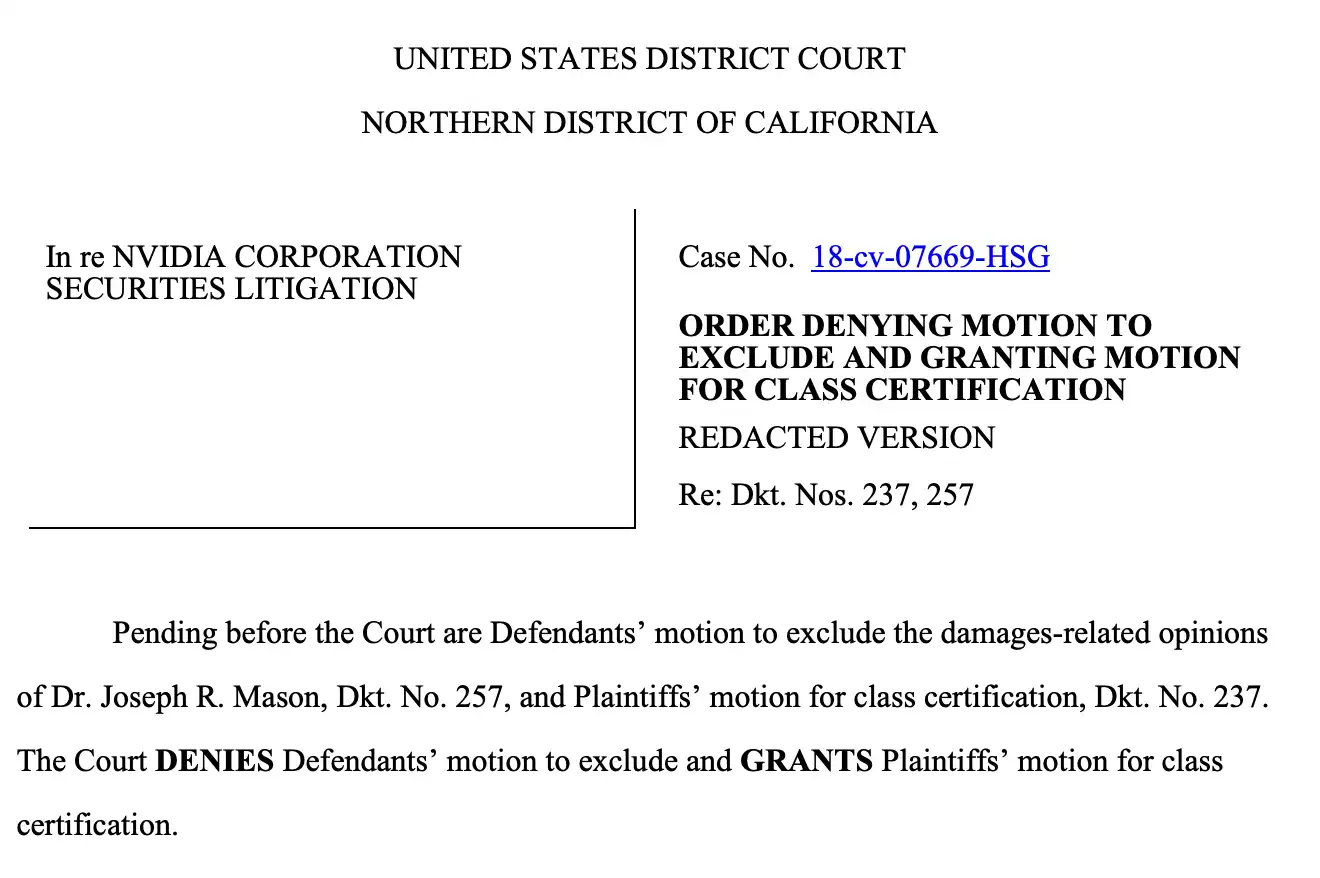
The lawsuit was initially filed by investors in 2018 and was dismissed in 2021. It was subsequently appealed and retried. NVIDIA's appeal to the U.S. Supreme Court was not accepted, and the case has now officially received approval for collective action status.

The plaintiffs argue that NVIDIA generated over $1 billion in cryptocurrency-related revenue through its GeForce gaming graphics cards but recorded most of it under the "Gaming" segment, thereby downplaying the risk disclosure to investors. Investors allege that CEO Jensen Huang downplayed the true scale of cryptocurrency demand at the time. NVIDIA had consistently claimed that cryptocurrency mining constituted only a small part of its business, with Gaming revenue primarily coming from gamers.

The plaintiffs point out that this practice directly exposed the company to the risks associated with the volatility of the cryptocurrency market cycle. Particularly after the company made a corrective disclosure in November 2018, its stock price fell approximately 28.5% over two days.

More crucially, the court's ruling cited an internal email from an NVIDIA vice president, considering it particularly compelling evidence. The judge noted that an internal executive had stated that "the company's stock price remained high precisely because of previous related statements," indicating that these remarks had impacted the stock price.

In fact, as early as 2022, the U.S. SEC had accused NVIDIA of failing to adequately disclose the impact of cryptocurrency mining on its gaming business, believing that its financial reports for two quarters may have misled investors. NVIDIA neither admitted nor denied the SEC's allegations but agreed to pay a $5.5 million fine and reach a resolution.

This approved collective lawsuit covers investors who purchased NVIDIA stock between August 10, 2017, and November 15, 2018. The court plans to hold a case management conference on April 21, where the judge will clarify the subsequent trial process.

NVIDIA's Mining History: Once in the Crypto Gold Rush

Rewind to the 2017 bull market. Mining rigs were snapped up, chips were in short supply, and countless prospectors rushed into Bitcoin mining.

At that time, NVIDIA was best known for its gaming graphics card business. But as the prices of cryptocurrencies, led by Bitcoin and Ethereum, soared, the graphics card market faced a supply shortage, remaining in a state of severe scarcity for a long time. NVIDIA's GPU products were naturally in extremely high demand, even leading to a situation where ordinary gamers found it hard to get a card.
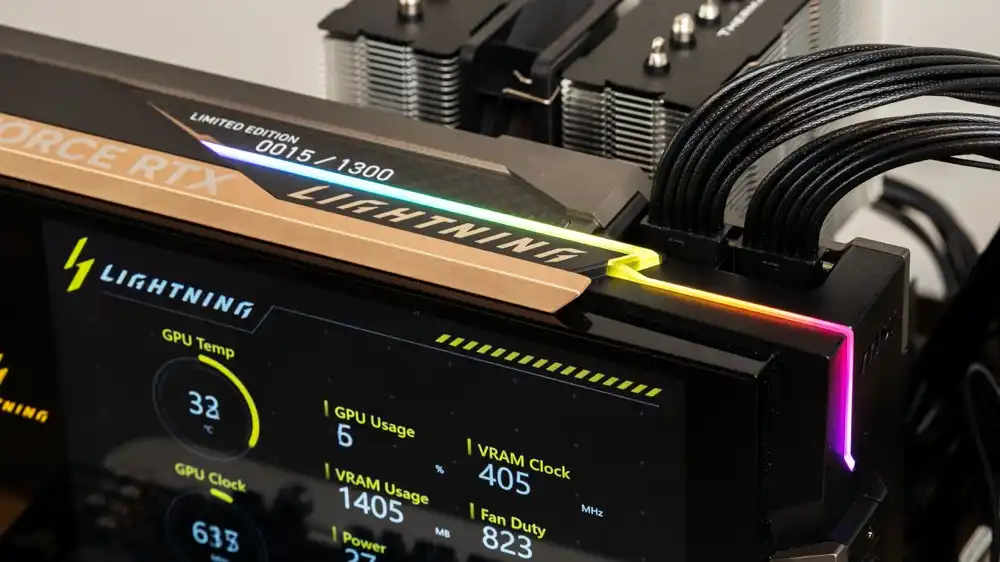
By 2020, a new bull market once again ignited mining enthusiasm. This time, NVIDIA took the initiative, launching CMP (Cryptocurrency Mining Processor) cards specifically designed for mining to meet the special demands of Ethereum mining, and imposed mining performance limits on the RTX 3080 aimed at gamers. Even so, it was difficult to curb the狂热需求 (fanatical demand) of miners. According to NVIDIA's disclosure, sales of CMP mining-specific chips alone reached $155 million in Q1 2021, while the global market size for discrete graphics cards flowing into crypto mining was about $500 million in the same period.

Clearly, this mining boom allowed NVIDIA to reap substantial profits. But how much of this revenue actually came from miners has always been a mystery. In NVIDIA's financial reports, mining earnings were categorized under the gaming segment, making it difficult for outsiders to accurately discern its true composition.

But looking at revenue, mining确实“带飞”了 (indeed "carried") NVIDIA at the time. In 2018 alone, NVIDIA's operating revenue reached $9.714 billion, a year-on-year increase of 41%, with the gaming business contributing more than half (about $5.5 billion). Interestingly, Bitmain, a mining company founded just a few years prior, was expanding rapidly during the same period, with profits once approaching NVIDIA's, and NVIDIA was one of its suppliers.

However, this portion of earnings was greatly affected by crypto cycle fluctuations. After the mining demand plummeted in 2022, it also led to a decline in NVIDIA's sales and inventory surplus, with the gaming business becoming the main segment dragging down its overall performance, and the decline in GPU sales was a key reason. Interestingly, NVIDIA CTO Michael Kagan直言 (stated bluntly) in 2023 that cryptocurrency "doesn't bring anything useful for society," suggesting that the emergence of ChatGPT was the "iPhone moment" for AI.

Since then, NVIDIA's AI success story has become widely known, making it the strongest卖铲人 (shovel seller) in the AI era, selling new Tokens (metaphor for AI chips/tools). Meanwhile, the mining companies that once profited effortlessly are也开始将目光转向 (also beginning to turn their attention to) the AI business.


Связанные с этим вопросы

QWhat is NVIDIA accused of in the recent investor class-action lawsuit?

ANVIDIA is accused of concealing over $1 billion in cryptocurrency mining-related revenue from its GeForce gaming GPUs, misrepresenting the extent of its dependence on crypto mining demand during 2017-2018.

QWhat was the consequence for NVIDIA's stock price after it made a corrective disclosure in November 2018?

ANVIDIA's stock price fell approximately 28.5% over two days following its corrective disclosure in November 2018.

QWhat action did the U.S. SEC take against NVIDIA in 2022 regarding its crypto mining disclosures?

AIn 2022, the U.S. SEC charged NVIDIA for insufficient disclosure of crypto mining's impact on its gaming business. NVIDIA agreed to pay a $5.5 million penalty to settle the charges, without admitting or denying the allegations.

QWhat specific product did NVIDIA launch to cater to the cryptocurrency mining market demand?

ANVIDIA launched CMP (Cryptocurrency Mining Processor) mining cards, specifically designed to meet the demands of Ethereum mining.

QAccording to the article, how did NVIDIA's CTO, Michael Kagan, view cryptocurrency compared to AI in 2023?

AIn 2023, NVIDIA's CTO Michael Kagan stated that cryptocurrency 'does not bring anything useful for society' and that the emergence of ChatGPT represented the 'iPhone moment' for AI.

Похожее

Three Frameworks for Ordinary People to Achieve AI Capability Leap: Say Goodbye to the Dilemma of 'Repeating Inputs Every Day'

Summary: This article outlines three frameworks for maximizing AI efficiency, moving beyond basic prompt usage. 1. **Three-Layer Evolution**: Users progress from (1) **Prompt** (one-off instructions, reset each session), to (2) **Project** (context-aware within a specific project), to (3) **Skill** (permanent, auto-applied knowledge). Most users stagnate at the first layer, repeating the same instructions daily with no cumulative improvement. Skills transform the AI from a chat tool into a personalized work system. 2. **Transaction vs. Compound Interest Mindset**: Using prompts is a linear transaction—effort and output are 1:1, and stopping resets progress. Investing time in building Skills is compound interest; a small initial time investment pays continuous dividends, as each Skill permanently elevates the AI's baseline performance. 3. **Thin Harness, Fat Skills**: The system architecture should prioritize thick, well-defined Skills (90% of the value—containing processes, standards, and domain knowledge) and a thin "harness" (the minimal technical environment). Avoid over-engineering the toolchain while neglecting the AI's actual knowledge. Skills are permanent assets that automatically improve with model updates. The key takeaway: Identify tasks you repeat, encode them into Skills (using tools like Claude's Skill Creator), and shift focus from daily prompting to building a compounding, self-improving AI system.

marsbit36 мин. назад

Three Frameworks for Ordinary People to Achieve AI Capability Leap: Say Goodbye to the Dilemma of 'Repeating Inputs Every Day'

marsbit36 мин. назад

Торговля

Спот
Фьючерсы

Популярные статьи

Как купить S

Добро пожаловать на HTX.com! Мы сделали приобретение Sonic (S) простым и удобным. Следуйте нашему пошаговому руководству и отправляйтесь в свое крипто-путешествие.Шаг 1: Создайте аккаунт на HTXИспользуйте свой адрес электронной почты или номер телефона, чтобы зарегистрироваться и бесплатно создать аккаунт на HTX. Пройдите удобную регистрацию и откройте для себя весь функционал.Создать аккаунтШаг 2: Перейдите в Купить криптовалюту и выберите свой способ оплатыКредитная/Дебетовая Карта: Используйте свою карту Visa или Mastercard для мгновенной покупки Sonic (S).Баланс: Используйте средства с баланса вашего аккаунта HTX для простой торговли.Третьи Лица: Мы добавили популярные способы оплаты, такие как Google Pay и Apple Pay, для повышения удобства.P2P: Торгуйте напрямую с другими пользователями на HTX.Внебиржевая Торговля (OTC): Мы предлагаем индивидуальные услуги и конкурентоспособные обменные курсы для трейдеров.Шаг 3: Хранение Sonic (S)После приобретения вами Sonic (S) храните их в своем аккаунте на HTX. В качестве альтернативы вы можете отправить их куда-либо с помощью перевода в блокчейне или использовать для торговли с другими криптовалютами.Шаг 4: Торговля Sonic (S)С легкостью торгуйте Sonic (S) на спотовом рынке HTX. Просто зайдите в свой аккаунт, выберите торговую пару, совершайте сделки и следите за ними в режиме реального времени. Мы предлагаем удобный интерфейс как для начинающих, так и для опытных трейдеров.

1.2k просмотров всегоОпубликовано 2025.01.15Обновлено 2025.03.21

Как купить S

Sonic: Обновления под руководством Андре Кронье – новая звезда Layer-1 на фоне спада рынка

Он решает проблемы масштабируемости, совместимости между блокчейнами и стимулов для разработчиков с помощью технологических инноваций.

2.2k просмотров всегоОпубликовано 2025.04.09Обновлено 2025.04.09

Sonic: Обновления под руководством Андре Кронье – новая звезда Layer-1 на фоне спада рынка

HTX Learn: Пройдите обучение по "Sonic" и разделите 1000 USDT

HTX Learn — ваш проводник в мир перспективных проектов, и мы запускаем специальное мероприятие "Учитесь и Зарабатывайте", посвящённое этим проектам. Наше новое направление .

1.8k просмотров всегоОпубликовано 2025.04.10Обновлено 2025.04.10

HTX Learn: Пройдите обучение по "Sonic" и разделите 1000 USDT

Обсуждения

Добро пожаловать в Сообщество HTX. Здесь вы сможете быть в курсе последних новостей о развитии платформы и получить доступ к профессиональной аналитической информации о рынке. Мнения пользователей о цене на S (S) представлены ниже.

活动图片