National-Level Players Enter the Game: The 2025 Revelation of Cryptocurrency Crime Spiraling Out of Control

marsbitОпубликовано 2026-01-10Обновлено 2026-01-10

Введение

Summary: In 2025, state-level cryptocurrency activity surged, marking a new phase in the maturation of illicit on-chain ecosystems. Illicit addresses received at least $154 billion, a 162% year-over-year increase, largely driven by a 694% spike in transactions involving sanctioned entities. Stablecoins dominated these flows, accounting for 84% of all illicit transaction volume. Key trends include North Korean hackers stealing a record $2 billion, including the largest crypto theft in history from Bybit. Russia launched the ruble-backed A7A5 token, which saw $93.3 billion in transaction volume within a year, facilitating large-scale evasion. Chinese money laundering networks emerged as dominant, sophisticated operators offering full-service criminal enterprises. Iran-linked proxy networks moved over $2 billion for activities including oil sales and weapons procurement. Illicit actors and nations increasingly rely on full-stack infrastructure providers resistant to takedowns and sanctions. Furthermore, the connection between crypto and real-world violent crime is growing, with increased use in human trafficking and a rise in violent coercion attacks to seize crypto assets during price peaks. Collaboration between law enforcement, regulators, and crypto firms is crucial to counter these evolving, interconnected threats.

Original Author: Chainalysis

Original Compilation: Chopper, Foresight News

In 2025, we observed a significant increase in cryptocurrency-related activities at the national level, marking a new mature stage in the development of the illegal on-chain ecosystem. Over the past few years, the professionalization of the cryptocurrency crime sector has deepened; illegal organizations have now established large-scale on-chain infrastructure to support transnational criminal networks in procuring goods and services and laundering proceeds from crypto crimes. Against this backdrop, governments have also begun to enter this field, leveraging these mature professional service providers on one hand, while building their own customized infrastructure on the other to evade sanctions on a large scale. As governments connect to this cryptocurrency supply chain originally built for cybercriminals and organized crime groups, government agencies, compliance, and security teams now face severe challenges in terms of consumer rights protection and national security.
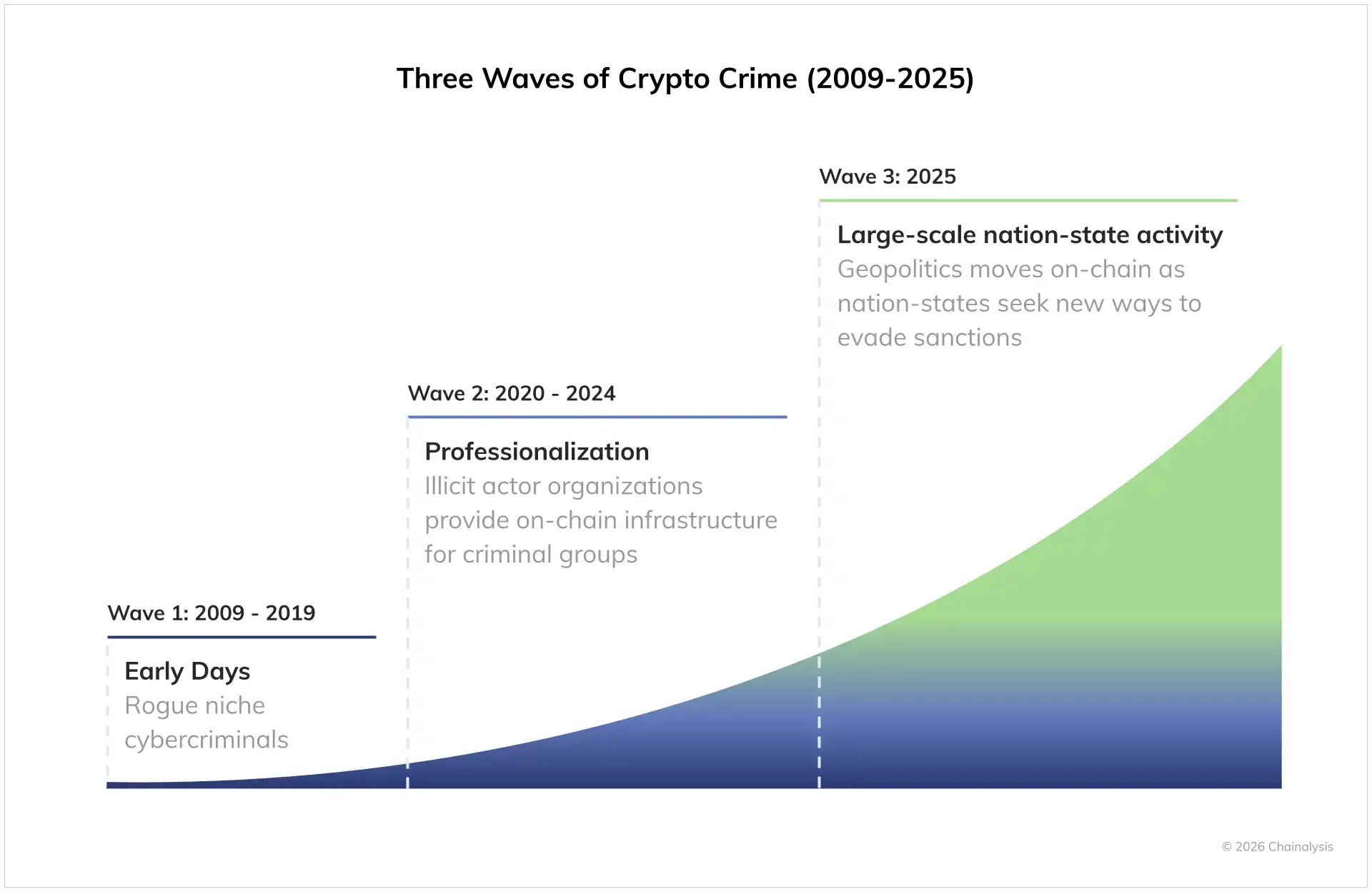
What are the specific on-chain manifestations of these trends and other industry changes? Next, we will analyze them by combining data and macro trends.
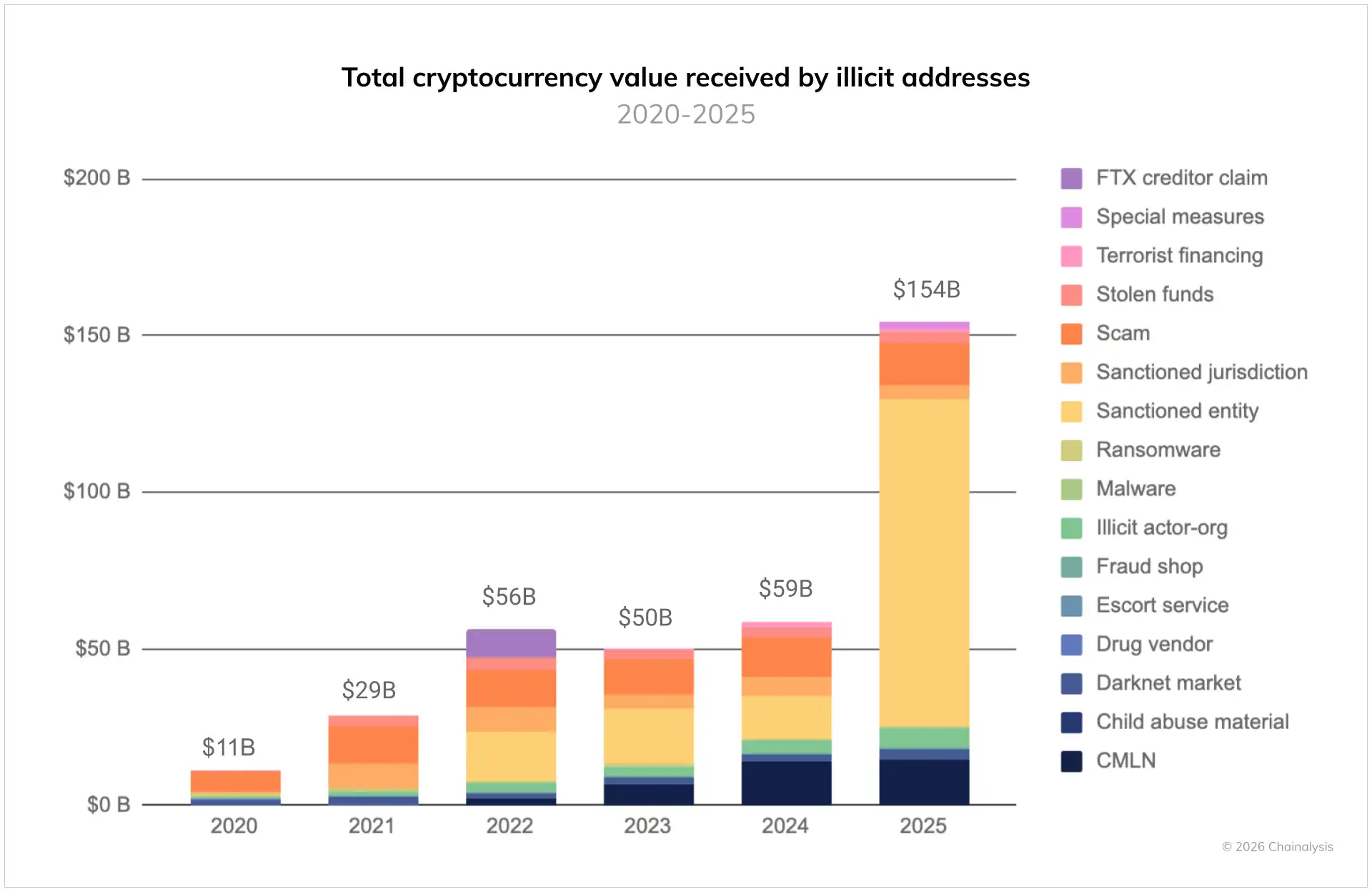
According to our monitoring data, the scale of funds flowing into illegal cryptocurrency addresses in 2025 reached at least $154 billion, a sharp increase of 162% year-on-year. This growth was primarily driven by a surge in fund inflows to sanctioned entities, which soared by 694% year-on-year. However, even excluding the growth from sanctioned entities, 2025 was still a record year for cryptocurrency crime, as the scale of the vast majority of illegal activities increased.

Nevertheless, the scale of these illegal transactions still pales in comparison to the overall cryptocurrency economy, as the main participants in the cryptocurrency market remain legitimate transactions. According to our estimates, although the proportion of illegal transactions in the total traceable cryptocurrency transaction volume in 2025 increased slightly compared to 2024, it remained below 1%.

As shown in the figure below, we also observed a continuous shift in the types of assets involved in cryptocurrency crimes.
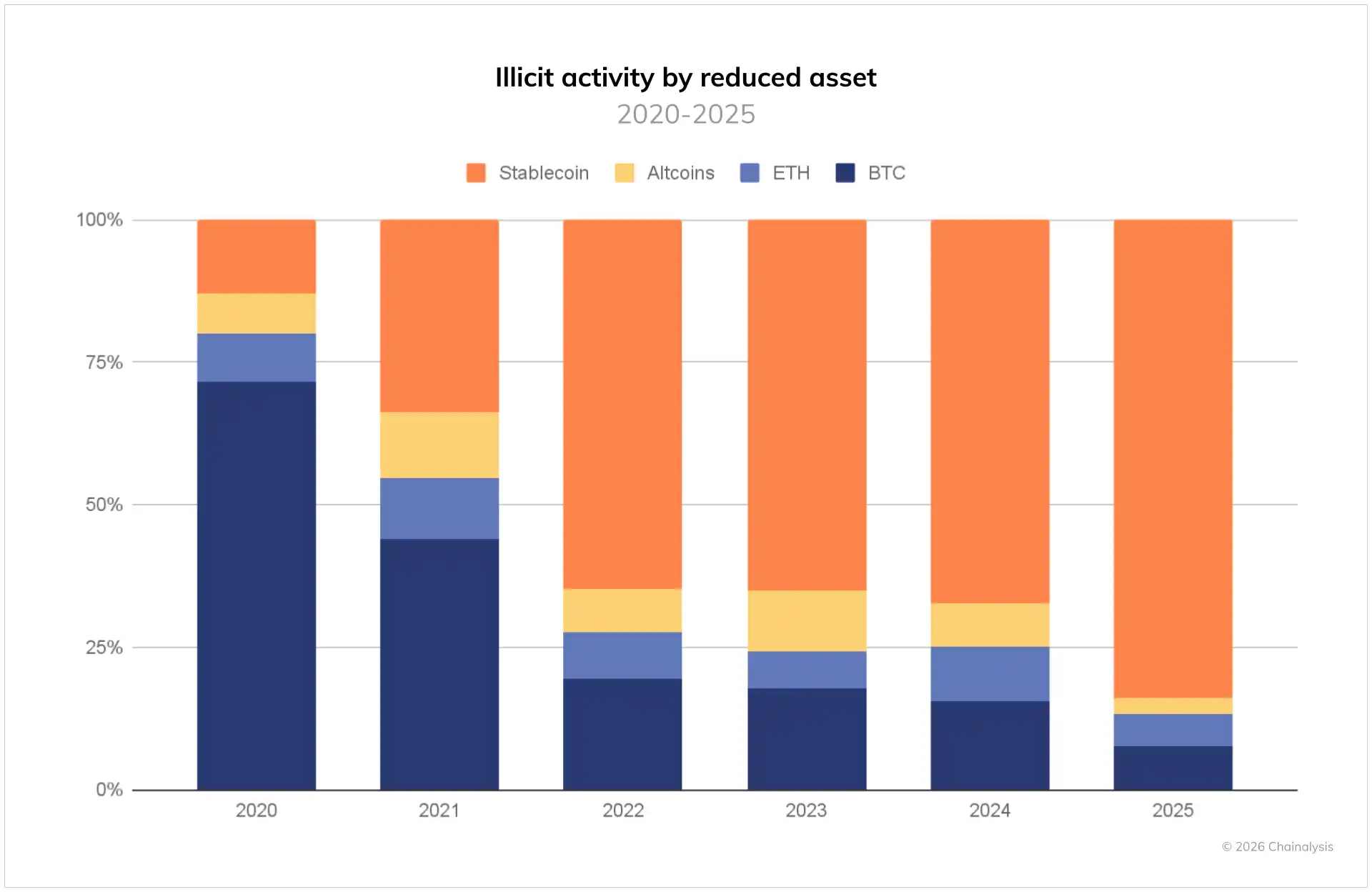
Over the past few years, stablecoins have gradually become the dominant asset in illegal transactions, currently accounting for 84% of the total illegal transaction volume. This trend aligns with the overall development characteristics of the cryptocurrency ecosystem: with advantages such as convenient cross-border transfers, low volatility, and wide application scenarios, stablecoins continue to expand their share in the overall cryptocurrency transactions.

The following sections will delve into the core trends that defined the cryptocurrency crime landscape in 2025, which remain worthy of attention in the future.

National-Level Threats Drive Transaction Scale: North Korea Sets New Record in Theft, Russia's A7A5 Token Facilitates Large-Scale Sanction Evasion

In 2025, stolen funds remained a major threat to the cryptocurrency ecosystem, with hacking groups linked to North Korea alone stealing $2 billion. This figure was primarily driven by several highly destructive large-scale hacking incidents, the most notable of which was the attack on the Bybit exchange in February. The incident involved nearly $1.5 billion, making it the largest digital asset theft in the history of cryptocurrency. Although North Korean hackers have long been a major force threatening the cryptocurrency ecosystem, the past year set new records both in terms of the amount stolen and the sophistication of intrusion and money laundering methods.

Particularly noteworthy is that the scale of on-chain activities by governments reached unprecedented levels in 2025. Russia introduced relevant legislation in 2024 to promote the use of cryptocurrencies to evade sanctions, and this measure was officially implemented in February 2025. The country launched the ruble-backed token A7A5, which achieved a transaction volume of over $93.3 billion in less than a year since its launch.

Meanwhile, over the past few years, Iran's proxy networks have conducted money laundering, illegal oil transactions, and bulk commodity procurement for weapons through confirmed wallet addresses that have been placed on the sanctions list, with a cumulative transaction volume exceeding $2 billion. Despite multiple military strikes, Iran-supported terrorist groups such as Hezbollah, Hamas, and the Houthis continue to use cryptocurrencies on an unprecedented scale.

In 2025, Chinese money laundering networks emerged as a dominant force in the illegal on-chain ecosystem. These organizations operate with high precision, greatly driving the diversification and professionalization of cryptocurrency crimes, offering specialized criminal services including "money laundering services." Building on early illegal operation models such as "Huiyin Guarantee," these networks have established full-service criminal enterprises, covering areas such as fraud, scams, laundering proceeds from North Korean hacking thefts, sanction evasion, and terrorism financing.

Full-Stack Illegal Infrastructure Providers Fuel Malicious Network Activities

While governments are increasing their use of cryptocurrencies, traditional cybercrime activities remain rampant: ransomware operators, child sexual abuse and cybercrime platforms, malware distributors, scammers, and illegal trading markets still rely on extensive support networks to maintain operations. Illegal actors and governments are increasingly dependent on full-stack on-chain infrastructure providers, including domain registrars, secure and reliable hosting services, and other technical infrastructure that can be used to carry out malicious network activities.

These infrastructure providers have evolved into comprehensive infrastructure platforms capable of resisting platform takedowns, abuse complaints, and sanction enforcement. As the scale of these services continues to expand, they may become key drivers in expanding the scope of malicious network activities for economic crime and state-supported forces.

The Increasing Correlation Between Cryptocurrency and Violent Crime

In the perception of many, cryptocurrency crime is still confined to the virtual world. The masterminds are merely anonymous figures hiding behind keyboards, posing no real-world threat. However, in reality, the connection between on-chain activities and violent crime is deepening. Human trafficking groups are increasingly using cryptocurrencies for transactions; at the same time, disturbingly, the number of violent coercion attacks has risen significantly, with criminals using violent means to force victims to transfer crypto assets, and such assaults often occur during peak cryptocurrency price periods.

Looking ahead, collaboration between law enforcement agencies, regulatory bodies, and cryptocurrency companies will be key to addressing these complex, ever-changing, and interconnected threats. Although the proportion of illegal transactions in legitimate cryptocurrency transaction volume remains limited, maintaining the integrity and security of the cryptocurrency ecosystem has never been more important.


Связанные с этим вопросы

QWhat was the total value of illicit cryptocurrency transactions in 2025, and what was the primary driver of this growth?

AThe total value of illicit cryptocurrency transactions in 2025 reached at least $154 billion, representing a 162% year-over-year increase. This growth was primarily driven by a massive 694% surge in transaction volume from sanctioned entities.

QWhich asset has become the dominant currency for illicit transactions and what percentage of the total illicit volume does it represent?

AStablecoins have become the dominant asset for illicit transactions, currently accounting for 84% of the total illicit transaction volume.

QWhat significant role did nation-states play in the 2025 crypto crime landscape according to the article?

ANation-states significantly escalated their involvement in 2025. Russia launched the ruble-backed A7A5 token, which processed over $93.3 billion in volume to circumvent sanctions. North Korean hacking groups stole a record $2 billion, and Chinese money laundering networks emerged as dominant, sophisticated players in the illicit ecosystem.

QWhat new concerning trend connects cryptocurrency to real-world physical violence?

AA concerning trend is the rise in violent coercion attacks, where criminals use physical violence to force victims to transfer their cryptocurrency assets. These attacks often occur during periods of peak cryptocurrency prices.

QDespite the growth in illicit activity, how does its scale compare to the overall cryptocurrency economy?

ADespite the significant growth, illicit transactions still represent less than 1% of the total traceable cryptocurrency transaction volume, meaning the vast majority of cryptocurrency market activity remains legitimate.

Похожее

Майкл Сэйлор: «Мы никогда не говорили, что никогда не будем продавать биткоины»

Председатель стратегической комиссии Майкл Сэйлор прокомментировал сообщения о новом разрешении компании Strategy на продажу биткоинов. Он заявил, что данное разрешение не является новым — оно было объявлено ещё 29 июня в рамках системы управления капиталом компании. Соглашение позволяет продавать BTC на сумму до 5 миллиардов долларов для определённых целей, но не обязывает компанию к продаже. Сэйлор подчеркнул, что Strategy никогда официально не брала на себя обязательство никогда не продавать свои биткоины, хотя и рассчитывает оставаться чистым покупателем BTC в долгосрочной перспективе. Он назвал текущие новости «старыми», переподанными как новые, и подтвердил, что программа монетизации биткоинов компании не предполагает обязательной продажи её активов.

cryptonews.ru53 мин. назад

Майкл Сэйлор: «Мы никогда не говорили, что никогда не будем продавать биткоины»

cryptonews.ru53 мин. назад

«Летняя пила» продолжается: пробой $67 000 станет началом роста биткоина

Цена биткоина продолжает консолидироваться в диапазоне $58 000–$67 000 с начала июня. 1 августа актив снизился до $62 217. Аналитики расходятся в краткосрочных прогнозах: некоторые, как Crypto Candy, ожидают тестирования уровня $60 000 или ниже, пока цена находится под $66 000. Другие, как Jelle, видят в боковом движении «летнюю пилу» и придерживаются стратегии усреднения. Ключевым для определения дальнейшего направления считается уровень $67 000. По мнению Daan Crypto Trades, его пробой необходим для выхода из затянувшейся паузы. Roman полагает, что уверенный пробой с объемом может быстро запустить рост к $70 000–$80 000 и выше. С долгосрочной точки зрения, макроаналитик Герт ван Лаген рассматривает текущую фазу как накопление в рамках масштабной формации «чаша с ручкой». Он отмечает, что долгосрочные держатели не спешат продавать актив, о чем говорит показатель NUPL. Таким образом, рынок находится в решающей фазе, где пробой либо поддержки $60 000, либо сопротивления $67 000 задаст тренд на ближайшее будущее.

cryptonews.ru1 ч. назад

«Летняя пила» продолжается: пробой $67 000 станет началом роста биткоина

cryptonews.ru1 ч. назад

На неделе с 3 по 9 августа стоит обратить внимание: Закон CLARITY, возможно, будет поставлен на голосование в Сенате; SpaceX и Circle опубликуют финансовые отчеты

**Важные события на следующей неделе (3–9 августа 2026 г.)** **Ключевые даты:** * **3 августа:** Публикация отчетов American Bitcoin за Q2. Полное закрытие сервисов DeFi-трекера Zapper и кошелька Ctrl Wallet. LayerZero прекратит поддержку ретрансляторов v1. Upbit прекратит торговлю токенами AQT и AERGO. * **4 августа:** Публикация финансовых отчетов SpaceX и Hut 8 за второй квартал 2026 года. * **5 августа:** Circle опубликует отчет за Q2. Начинается предварительное ценовое консультирование для IPO компании Unitree Tech (Ушу Цзишу) в Китае. * **6 августа:** Первая крупная разблокировка акций SpaceX — до 12% от общего капитала. * **7 августа:** Выход важных данных по рынку труда США (отчет о занятости за июль). Предельный срок для Сената США — получить 60 голосов в поддержку **Закона CLARITY** (билль о регулировании криптовалют и этике). Ожидается выпуск Grok 4.6 от xAI. * **8 августа:** Начало принудительной подачи сигналов в сети Bitcoin согласно предложению BIP-110. * **На неделе (дата уточняется):** Ожидается голосование полного состава Сената США по **Закону CLARITY**. Выход нового релиза XRP Ledger (v3.3.0) с новыми функциями, такими как конфиденциальные данные и пакетные транзакции. **Основные темы недели:** корпоративная отчетность (SpaceX, Circle), регулирование (CLARITY Act), рыночные события (разблокировка акций SpaceX, отчет по занятости в США) и обновления в технологиях блокчейна.

marsbit1 ч. назад

На неделе с 3 по 9 августа стоит обратить внимание: Закон CLARITY, возможно, будет поставлен на голосование в Сенате; SpaceX и Circle опубликуют финансовые отчеты

marsbit1 ч. назад

Акции упали сильнее, чем криптовалюты. Куда делись деньги?

Автор: Кэти,白话区块链 28-29 июля, Сеул. Индекс Kospi впервые в истории Южной Кореи два дня подряд срабатывал на приостановку торгов. Первый день: падение на 10.84%, второй день: -5.98%. SK Hynix, крупнейшая по весу акция, потеряла за два дня около 23%. Падение Nasdaq, глобальный обвал акций полупроводниковых компаний, массовые потери на кредитных ETF. За два дня откат Kospi от пика июня достиг 40%. Июль угрожает стать худшим месяцем в истории индекса. Все ранее перегретые сделки были перевернуты, как стол. Это не локальный негатив по одной акции, а глобальное принудительное снижение кредитного плеча. Самое парадоксальное: на этот раз больше всего на «криптовалютное» падение похожи именно акции. Спот: прибыль SK Hynix за второй квартал достигла рекордных 60.54 трлн вон, но из-за несоответствия прогнозу в 64.22 трлн акция подверглась жесткой распродаже. Хорошие новости не растут — это уже плохая новость. Производные инструменты пострадали еще сильнее. Кредитный ETF с плечом 2x на SK Hynix упал на 83% с пика, потеряв в стоимости более 1 трлн гонконгских долларов. Эмитент был вынужден изменить правила продукта. Неожиданно: Биткоин, известный высокой волатильностью, с 1 июля вырос почти на 15%, в то время как акции демонстрировали «криптовалютную» динамику. Это не паника всего рынка, а точечный сброс перегретых позиций. Триггеры: отчет SK Hynix и фактор Китая — крупнейшее IPO ChangXin Memory, направленное на расширение производства DRAM, создало конкуренцию для нарратива о дефиците памяти для ИИ. Дополнительное давление — нормализация политики Банка Японии и потенциальное сокращение кэрри-трейда в иенах. Эксперт Дэн Найлз считает, что это не крах логики ИИ, а «краткосрочное дно», вызванное принудительными ликвидациями мелких инвесторов и хедж-фондов. Промышленная логика не мертва — умерло кредитное плечо. Перетекли ли деньги из акций в Биткоин? Нет. «Устойчивость» Биткоина объясняется тем, что он уже прошел фазу распродаж раньше. В мае-июне американские спотовые BTC-ETF зафиксировали рекордный отток средств. К июлю продавать было уже нечего. Небольшой приток в июле — лишь частичное восстановление. Настоящие «защитные» деньги пошли в золото. Коэффициент корреляции между Биткоином и золотом упал до -0.88. Нарратив о «цифровом золоте» разбит: золото — для сохранения капитала, Биткоин — для роста. Деньги придут в криптоактивы при выполнении трех условий: смягчение глобального давления на ликвидность; снижение ставок ФРС без рецессии; принятие закона CLARITY, устраняющего регуляторные неопределенности. Пока Биткоин — не убежище, а актив, который раньше других прошел очистку. Но когда шторм утихнет и глобальный капитал снова начнет распределяться, Биткоин займет место в первых рядах очереди. Место уже зарезервировано.

marsbit1 ч. назад

Акции упали сильнее, чем криптовалюты. Куда делись деньги?

marsbit1 ч. назад

Диалог с Далио: Сейчас мы находимся в пузыре ИИ, 1% моего инвестиционного портфеля — это биткоин

Источник: интервью Рэя Далио, основателя Bridgewater Associates, для подкаста "The Diary Of A CEO". Далио, предсказавший кризис 2008 года, обсуждает "большой цикл" — концепцию, охватывающую долговые проблемы, растущее неравенство и геополитические сдвиги. Он указывает, что текущий ажиотаж вокруг ИИ демонстрирует классические признаки пузыря, который может лопнуть из-за высокой долговой нагрузки, роста процентных ставок и чрезмерной эмиссии акций, что способно привести к рецессии. Для защиты личного капитала в неопределенные времена Далио советует диверсификацию: вместо хранения наличных инвестировать в акции, золото, облигации. Сам он держит около 1% портфеля в биткоине, считая его "твердыми деньгами", но предпочитает физическое золото из-за его статуса резервного актива и независимости от технологических рисков. Говоря о влиянии ИИ, Далио отмечает, что технология заменяет не только физический труд, но и элементы мышления, что увеличит разрыв между капиталом и трудом. Ключевыми останутся человеческие качества — эмоции и интуиция, а успеха добьются те, кто научится работать в партнерстве с ИИ. На геополитической арене, по его мнению, мир движется к регионализации с центрами в виде США и Китая. Вовлечение США в конфликты, подобные иранскому, обнажает снижение их абсолютного влияния. Внутренние вызовы, такие как дебаты о налогах на богатство, риск капитального бегства и низкая производительность, также ставят под вопрос стабильность традиционных держав в текущей фазе цикла.

marsbit5 ч. назад

Диалог с Далио: Сейчас мы находимся в пузыре ИИ, 1% моего инвестиционного портфеля — это биткоин

marsbit5 ч. назад

Торговля

Спот
活动图片




