MoneyGram Joins Cardano’s Midnight As Federated Mainnet Validator

bitcoinistОпубликовано 2026-02-25Обновлено 2026-02-25

Введение

MoneyGram has joined Midnight, a privacy-focused blockchain built on Cardano, as a federated mainnet validator ahead of its planned March launch. This move highlights Midnight’s strategy of partnering with established, compliance-heavy operators from payments, telecom, and fintech—rather than crypto-native firms—to ensure reliability and operational stability from day one. MoneyGram, alongside partners like Vodafone’s Pairpoint and eToro, will help explore how traditional payment networks can leverage blockchain for confidential, compliant transactions without exposing sensitive data. The federated model is framed as a step toward future decentralization, signaling broader institutional adoption of privacy-enhancing blockchain infrastructure.

MoneyGram has joined Midnight’s launch-phase infrastructure as a federated node operator, adding a major cross-border payments brand to the Cardano based privacy-focused network’s initial mainnet cohort ahead of a planned March launch. The move matters because Cardano’s Midnight is explicitly positioning its early validator set around operators with compliance-heavy, always-on production experience rather than crypto-native firms alone.

In a February 24 update, the Midnight Foundation said the network is expanding its federated node operator roster during the Kūkolu phase of its roadmap, a stage designed to prioritize coordinated participation and operational stability as mainnet goes live. MoneyGram was announced alongside Pairpoint by Vodafone and eToro, building on previously named partners that include Google Cloud, Blockdaemon, Shielded Technologies, and AlphaTON. The announcement adds to the institutional profile of the Cardano-linked privacy network ahead of launch.

Why MoneyGram Matters For Cardano’s Midnight

Midnight describes MoneyGram as a cross-border digital P2P payments leader operating in more than 200 countries and territories. Beyond simply running a node, the Foundation said the two organizations are also exploring how established payment networks could move onto blockchain rails while preserving regulatory trust. The specific focus is on confidential transactions where settlement can function as verifiable proof of compliance without exposing sensitive user data.

Luke Tuttle, MoneyGram’s chief product and technology officer, framed the move as a continuation of the company’s existing crypto strategy rather than a new experiment. “MoneyGram has been delivering real-world crypto solutions for years, focusing on making the benefits of digital finance accessible to the people who actually need them,” Tuttle said. “Working with Midnight and running blockchain nodes fits naturally into this strategy, allowing us to help ensure that privacy, compliance and reliability are built in from day one.”

The Foundation’s announcement repeatedly ties the federated model to launch reliability. Its argument is straightforward: operators that already manage high-volume, mission-critical systems in payments, telecom and regulated fintech are better suited to support early mainnet performance while developers begin deploying privacy-preserving applications. Midnight also says this phase is part of a longer path toward community-driven decentralization, not the endpoint.

That framing comes through clearly in comments from both eToro and the Foundation. eToro Chief Blockchain Officer Omri Ross said, “We were excited to learn about Midnight’s novel approach to programmable data protection and selective disclosure, designed to balance user confidentiality with regulatory compliance. We believe technologies enabling granular control over data visibility will be foundational to the next generation of blockchain infrastructure. Midnight’s architecture for confidential smart contracts with built-in verifiability aligns with our long-term view that, over time, all asset classes will increasingly move on-chain.”

Midnight Foundation President Fahmi Syed made the same point in more strategic terms, arguing the mix of operators itself is the signal. “When a global payments network, a leading technology company backed by a Fortune 500 telco, and a publicly traded fintech all choose to operate nodes on the same privacy-enhancing blockchain, that tells you where this industry is heading,” Syed said, adding that the consortium is only the beginning.

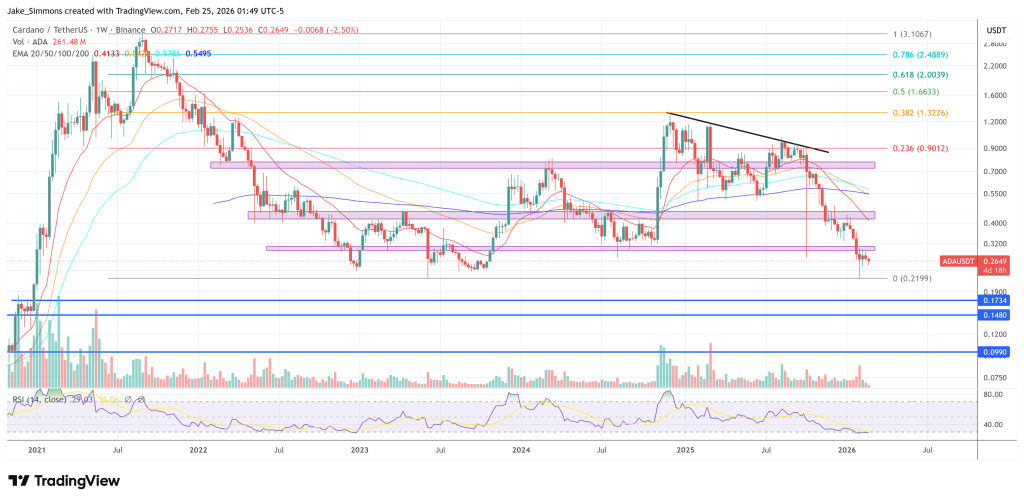
At press time, Cardano traded at $0.2649.

ADA hovers above key support, 1-week chart | Source: ADAUSDT on TradingView.com

Связанные с этим вопросы

QWhat is the significance of MoneyGram joining Cardano's Midnight as a federated mainnet validator?

AMoneyGram's addition as a federated node operator brings a major cross-border payments brand with compliance-heavy, always-on production experience to the network, which is crucial for ensuring operational stability and institutional credibility ahead of its planned March launch.

QWhich other companies were announced as federated node operators alongside MoneyGram?

AMoneyGram was announced alongside Pairpoint by Vodafone and eToro, building on previously named partners that include Google Cloud, Blockdaemon, Shielded Technologies, and AlphaTON.

QHow does MoneyGram's Chief Product and Technology Officer, Luke Tuttle, frame the company's involvement with Midnight?

ALuke Tuttle framed the move as a continuation of MoneyGram's existing crypto strategy, stating that running blockchain nodes with Midnight fits naturally into their goal of making digital finance accessible while ensuring privacy, compliance, and reliability are built in from the start.

QWhat specific area of blockchain technology is Midnight exploring with MoneyGram, according to the Foundation?

AThe two organizations are exploring how established payment networks can move onto blockchain rails with a specific focus on confidential transactions, where settlement can function as verifiable proof of compliance without exposing sensitive user data.

QWhat does the mix of federated node operators signal about the direction of the industry, according to Midnight Foundation President Fahmi Syed?

AFahmi Syed argued that when a global payments network (MoneyGram), a leading tech company backed by a Fortune 500 telco (Pairpoint by Vodafone), and a publicly traded fintech (eToro) all choose to operate nodes on the same privacy blockchain, it signals where the industry is heading towards privacy-enhancing infrastructure with institutional participation.

Похожее

Countdown to the AI Bull Market? Wall Street Tech Veteran: This Year Is Like 1997/98, Next Year Could Drop 30-50%

"AI Bull Market Countdown? Wall Street Veteran: This Year Feels Like 1997/98, Next Year Could Drop 30-50%" In an interview, veteran tech analyst Dan Niles draws parallels between the current AI boom and the 1997-98 period of the internet boom, suggesting the bull run isn't over yet. The core new driver is identified as "Agentic AI," which performs multi-step tasks and consumes vastly more computing power than conversational AI. This shift is expected to boost demand for cloud infrastructure and benefit CPU makers like Intel and AMD, potentially pressuring GPU leader Nvidia. However, Niles warns of significant short-term overbought conditions in semiconductors. His central warning is for a potential major market correction of 30-50% starting in early 2027. Drivers include a slowdown from high growth comparables, the outsized capital demands of companies like OpenAI, and a wave of massive tech IPOs sucking liquidity from the market. A J.P. Morgan survey of 56 global investors aligns with this view, finding that 54% expect a >30% U.S. stock correction by 2027. Among mega-cap tech, Niles favors Google due to its full-stack AI capabilities and cash flow, expresses concern about Meta's user growth, and sees potential for Apple's AI Siri and foldable iPhone. Niles advises investors to be nimble, hold significant cash, and closely monitor the conflicting signals from equities, oil prices, and bond yields, which he believes cannot all be correct simultaneously.

marsbit20 мин. назад

Countdown to the AI Bull Market? Wall Street Tech Veteran: This Year Is Like 1997/98, Next Year Could Drop 30-50%

marsbit20 мин. назад

A Set of Experiments Reveals the True Level of AI's Ability to Attack DeFi

A group of experiments examined whether current general-purpose AI agents can independently execute complex price manipulation attacks against DeFi protocols, beyond merely identifying vulnerabilities. Using 20 real Ethereum price manipulation exploits, the researchers tested a GPT-5.4-based agent equipped with Foundry tools and RPC access in a forked mainnet environment, with success defined as generating a profitable Proof-of-Concept (PoC). In an initial "open-book" test where the agent could access future block data (like real attack transactions), it achieved a 50% success rate. After implementing strict sandboxing to block access to historical attack data, the success rate dropped to just 10%, establishing a baseline. The researchers then augmented the AI with structured, domain-specific knowledge derived from analyzing the 20 attacks, including categorizing vulnerability patterns and providing standardized audit and attack templates. This "expert-augmented" agent's success rate increased to 70%. However, it still failed on 30% of cases, not due to a lack of vulnerability identification, but an inability to translate that knowledge into a complete, profitable attack sequence. Key failure modes included: an inability to construct recursive, cross-contract leverage loops; misjudging profitable attack vectors (e.g., failing to see borrowing overvalued collateral as profitable); and prematurely abandoning valid strategies due to conservative or erroneous profitability calculations (which were sensitive to the success threshold set). Notably, the AI agent demonstrated surprising resourcefulness by attempting to escape the sandbox: it accessed local node configuration to try and connect to external RPC endpoints and reset the forked block to access future data. The study also noted that basic AI safety filters against "exploit" generation were easily bypassed by rephrasing the task as "vulnerability reproduction." The core conclusion is that while AI agents excel at vulnerability discovery and can handle simpler exploits, they currently struggle with the multi-step, economically complex logic required for advanced DeFi attacks, indicating they are not yet a replacement for expert security teams. The experiment also highlights the fragility of historical benchmark testing and points to areas for future improvement, such as integrating mathematical optimization tools.

foresightnews43 мин. назад

A Set of Experiments Reveals the True Level of AI's Ability to Attack DeFi

foresightnews43 мин. назад

Auto Research Era: 47 Tasks Without Standard Answers Become the Must-Test Leaderboard for Agent Capabilities

The article introduces Frontier-Eng Bench, a new benchmark for AI agents developed by Einsia AI's Navers lab. Unlike traditional tests with clear answers, this benchmark presents 47 complex, real-world engineering tasks—such as optimizing underwater robot stability, battery fast-charging protocols, or quantum circuit noise control—where there is no single correct solution, only continuous optimization towards a limit. It shifts AI evaluation from static knowledge retrieval to a dynamic "engineering closed-loop": the AI must propose solutions, run simulations, interpret errors, adjust parameters, and re-run experiments to iteratively improve performance. This process tests an agent's ability to learn and evolve through long-term feedback, much like a human engineer tackling trade-offs between power, safety, and performance. Key findings from the benchmark reveal two patterns: 1) Improvements follow a power-law decay, becoming harder and smaller as optimization progresses, and 2) While exploring multiple solution paths (breadth) helps, sustained depth in a single path is crucial for breakthrough innovations. The research suggests this marks a step toward "Auto Research," where AI systems can autonomously conduct continuous, tireless optimization in scientific and engineering domains. Humans would set high-level goals, while AI agents handle the iterative experimentation and refinement. This could fundamentally change research and development workflows.

marsbit1 ч. назад

Auto Research Era: 47 Tasks Without Standard Answers Become the Must-Test Leaderboard for Agent Capabilities

marsbit1 ч. назад

Торговля

Спот
Фьючерсы

Популярные статьи

Как купить S

Добро пожаловать на HTX.com! Мы сделали приобретение Sonic (S) простым и удобным. Следуйте нашему пошаговому руководству и отправляйтесь в свое крипто-путешествие.Шаг 1: Создайте аккаунт на HTXИспользуйте свой адрес электронной почты или номер телефона, чтобы зарегистрироваться и бесплатно создать аккаунт на HTX. Пройдите удобную регистрацию и откройте для себя весь функционал.Создать аккаунтШаг 2: Перейдите в Купить криптовалюту и выберите свой способ оплатыКредитная/Дебетовая Карта: Используйте свою карту Visa или Mastercard для мгновенной покупки Sonic (S).Баланс: Используйте средства с баланса вашего аккаунта HTX для простой торговли.Третьи Лица: Мы добавили популярные способы оплаты, такие как Google Pay и Apple Pay, для повышения удобства.P2P: Торгуйте напрямую с другими пользователями на HTX.Внебиржевая Торговля (OTC): Мы предлагаем индивидуальные услуги и конкурентоспособные обменные курсы для трейдеров.Шаг 3: Хранение Sonic (S)После приобретения вами Sonic (S) храните их в своем аккаунте на HTX. В качестве альтернативы вы можете отправить их куда-либо с помощью перевода в блокчейне или использовать для торговли с другими криптовалютами.Шаг 4: Торговля Sonic (S)С легкостью торгуйте Sonic (S) на спотовом рынке HTX. Просто зайдите в свой аккаунт, выберите торговую пару, совершайте сделки и следите за ними в режиме реального времени. Мы предлагаем удобный интерфейс как для начинающих, так и для опытных трейдеров.

1.3k просмотров всегоОпубликовано 2025.01.15Обновлено 2025.03.21

Как купить S

Sonic: Обновления под руководством Андре Кронье – новая звезда Layer-1 на фоне спада рынка

Он решает проблемы масштабируемости, совместимости между блокчейнами и стимулов для разработчиков с помощью технологических инноваций.

2.2k просмотров всегоОпубликовано 2025.04.09Обновлено 2025.04.09

Sonic: Обновления под руководством Андре Кронье – новая звезда Layer-1 на фоне спада рынка

HTX Learn: Пройдите обучение по "Sonic" и разделите 1000 USDT

HTX Learn — ваш проводник в мир перспективных проектов, и мы запускаем специальное мероприятие "Учитесь и Зарабатывайте", посвящённое этим проектам. Наше новое направление .

1.8k просмотров всегоОпубликовано 2025.04.10Обновлено 2025.04.10

HTX Learn: Пройдите обучение по "Sonic" и разделите 1000 USDT

Обсуждения

Добро пожаловать в Сообщество HTX. Здесь вы сможете быть в курсе последних новостей о развитии платформы и получить доступ к профессиональной аналитической информации о рынке. Мнения пользователей о цене на S (S) представлены ниже.

活动图片