Market Pullback Accelerates After Senate Postpones Long-Awaited Crypto Framework Bill

bitcoinistОпубликовано 2025-12-17Обновлено 2025-12-17

Введение

The Senate Banking Committee's postponement of a key crypto market structure bill to early 2026 has triggered a sharp market pullback, erasing around $140 billion in market capitalization. Bitcoin fell below $86,000 and Ethereum dropped under $3,000 as regulatory uncertainty led to risk-off behavior. The delay, occurring at a fragile time, amplified downside moves due to elevated derivatives positioning and ETF outflows. Despite ongoing regulatory actions, the lack of comprehensive legislation continues to fuel volatility, leaving investors facing extended uncertainty until at least 2026.

The market entered a sharper pullback this week after the Senate confirmed that a long-anticipated crypto structure legislation will not advance before the end of the year.

Related Reading: Crypto Market Structure Bill Stalled: Senate Banking Committee Pushes Markup To Early 2026

What many investors had hoped would be a closing act for regulatory clarity in 2025 instead became another extension of uncertainty, triggering risk-off behavior across digital assets and related investment products. The delay arrived at a fragile moment for markets grappling with growing sensitivity to policy signals from Washington.

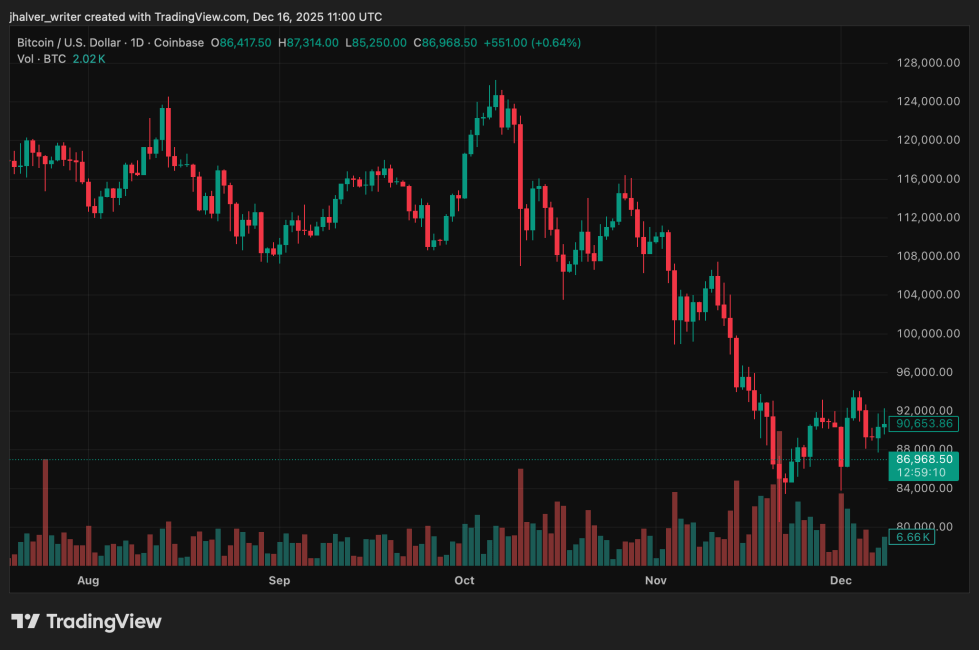
Bitcoin slid below the $86,000 level, while the broader digital asset market shed roughly $140 billion in capitalization within hours. The total market value has fallen to around $2.93 trillion, its lowest level in several weeks, as traders reassessed regulatory timelines that now extend into early 2026.

BTC's price trends to the downside on the daily chart. Source: BTCUSD on Tradingview

Senate Pushes Crypto Market Structure Talks Into 2026

The Senate Banking Committee confirmed it will not hold a markup hearing on the crypto market structure billbefore Congress adjourns for the holidays.

While committee leadership says bipartisan negotiations are progressing, lawmakers acknowledged that time has run out to move the bill forward in 2025. Chairman Tim Scott’s office reiterated that discussions with Democratic counterparts are ongoing, with a markup now expected in early 2026.

The proposed legislation is designed to clarify how digital assets are regulated in the U.S., including defining the respective roles of the Securities and Exchange Commission and the Commodity Futures Trading Commission.

Under current drafts, the CFTC would oversee spot crypto markets, while securities laws would be more clearly applied to token issuers and intermediaries. Parallel efforts in the Senate Agriculture Committee, which also oversees the CFTC, have yet to reach a markup stage, further slowing the process.

Market Reaction Highlights Fragile Sentiment

The legislative setback quickly translated into market pressure. Bitcoin fell from near $90,000 to the mid-$85,000 range, while Ethereum dropped below $3,000. Additionally, the average crypto RSI fell to around 32, indicating that the market is within oversold territory.

Analysts pointed to elevated derivatives positioning and heavy open interest around key price levels as factors amplifying downside moves. Exchange-traded products reflected the shift, with Bitcoin and Ethereum spot ETFs recording significant outflows as institutional investors reduced exposure.

Some market observers noted that unrealized losses have risen sharply, while funding conditions and leverage remain stretched, making prices more vulnerable to negative catalysts such as policy delays.

Regulatory Uncertainty Persists Despite Agency Actions

Despite the legislative pause, regulators have continued to act within existing frameworks. The SEC has issued staff guidance and hosted public discussions on how current securities laws apply to crypto activities, while the CFTC has taken steps to expand supervised spot market participation.

However, industry participants say these measures fall short of the comprehensive clarity the market structure bill is meant to deliver.

Related Reading: Terra Founder Do Kwon Could Face 30-Year Sentence In Potential South Korean Trial

The Senate’s decision reinforces a familiar pattern for crypto markets: policy delays translating into heightened volatility. With negotiations set to resume in early 2026, investors will be left to navigate another extended period where regulatory questions remain unresolved.

Cover image from ChatGPT, BTCUSD chart on Tradingview

Похожее

Bitcoin's 'Rally Ends,' Officially Entering the Later Stage of a Bear Market?

Bitcoin prices declined 13% this week, reversing the recent rebound and signaling a likely transition into the later stages of a bear market. Key on-chain metrics deteriorated, with the short-term holder cost basis falling below the Realized Price—a pattern last seen in early 2022, characteristic of bear market maturity. The rally to ~$82k proved to be a bear market bounce, as evidenced by the 90-day realized profit/loss ratio failing to sustain above the bullish threshold of 2. Daily realized losses surged to $1.35B, including significant selling from long-term holders who accumulated near cycle tops, indicating ongoing supply redistribution. Price was rejected almost precisely at the aggregate US spot ETF cost basis of ~$83k, turning that level into resistance and leaving the average ETF investor underwater again. Spot market selling pressure intensified, with the 7-day volume delta turning significantly negative to its weakest level since February. While a major long liquidation event cleared over $400M in leverage, spot demand has not yet stepped in to absorb the resulting supply. Options markets continue pricing in higher future volatility (elevated volatility risk premium) and maintain a skew toward put options, reflecting persistent demand for downside protection, though not yet panic. Overall, market structure remains fragile. Sustained recovery likely requires a reclaim of the ETF cost basis, a shift back to positive spot demand, and a slowdown in realized loss-taking. Until then, the market risks further downside or extended consolidation within the broader bear trend.

Foresight News48 мин. назад

Bitcoin's 'Rally Ends,' Officially Entering the Later Stage of a Bear Market?

Foresight News48 мин. назад

How Risky is the "Death Spiral" of MSTR and STRC?

Summary: This article explores the perceived "death spiral" risk between MicroStrategy (MSTR), its Bitcoin holdings, and its perpetual preferred stock (STRC), drawing comparisons to the LUNA-UST collapse. While both systems feature price anchors, high yields for holders, and potential feedback loops, their core mechanisms differ fundamentally. The MSTR-STRC structure relies on continuous financing to sustain its high dividend payouts, primarily through stock ATM offerings. A negative feedback cycle could occur: falling MSTR stock price makes raising equity capital harder, increasing pressure to sell Bitcoin, which undermines STRC confidence and further depresses MSTR. However, unlike LUNA-UST's automated, direct linkage, the MSTR-STRC loop is weaker and has brakes: STRC dividends can be deferred or rates lowered, and STRC holders have a $100/share liquidation preference in bankruptcy, providing a price floor. The company's sustainability hinges on its ability to continue financing. Its current ~$900 million USD reserves cover only about 6.3 months of its ~$1.71 billion annual interest/dividend burden. The next six months are critical, aligning with both the potential bottom in Bitcoin's four-year cycle and the depletion timeline of its reserves. While a LUNA-style catastrophic collapse is deemed highly unlikely due to structural differences, the key question is whether MicroStrategy can navigate this period through healthy deleveraging to restart its capital engine.

Foresight News1 ч. назад

How Risky is the "Death Spiral" of MSTR and STRC?

Foresight News1 ч. назад

Торговля

Спот
Фьючерсы

Популярные статьи

Как купить ZEST

Добро пожаловать на HTX.com! Мы сделали приобретение Zest Protocol (ZEST) простым и удобным. Следуйте нашему пошаговому руководству и отправляйтесь в свое крипто-путешествие.Шаг 1: Создайте аккаунт на HTXИспользуйте свой адрес электронной почты или номер телефона, чтобы зарегистрироваться и бесплатно создать аккаунт на HTX. Пройдите удобную регистрацию и откройте для себя весь функционал.Создать аккаунтШаг 2: Перейдите в Купить криптовалюту и выберите свой способ оплатыКредитная/Дебетовая Карта: Используйте свою карту Visa или Mastercard для мгновенной покупки Zest Protocol (ZEST).Баланс: Используйте средства с баланса вашего аккаунта HTX для простой торговли.Третьи Лица: Мы добавили популярные способы оплаты, такие как Google Pay и Apple Pay, для повышения удобства.P2P: Торгуйте напрямую с другими пользователями на HTX.Внебиржевая Торговля (OTC): Мы предлагаем индивидуальные услуги и конкурентоспособные обменные курсы для трейдеров.Шаг 3: Хранение Zest Protocol (ZEST)После приобретения вами Zest Protocol (ZEST) храните их в своем аккаунте на HTX. В качестве альтернативы вы можете отправить их куда-либо с помощью перевода в блокчейне или использовать для торговли с другими криптовалютами.Шаг 4: Торговля Zest Protocol (ZEST)С легкостью торгуйте Zest Protocol (ZEST) на спотовом рынке HTX. Просто зайдите в свой аккаунт, выберите торговую пару, совершайте сделки и следите за ними в режиме реального времени. Мы предлагаем удобный интерфейс как для начинающих, так и для опытных трейдеров.

259 просмотров всегоОпубликовано 2026.05.19Обновлено 2026.06.02

Как купить ZEST

Обсуждения

Добро пожаловать в Сообщество HTX. Здесь вы сможете быть в курсе последних новостей о развитии платформы и получить доступ к профессиональной аналитической информации о рынке. Мнения пользователей о цене на A (A) представлены ниже.

活动图片