Author:@aaronjmars
Compiled by: Deep Tide TechFlow
Andreessen Horowitz (a16z) is undergoing a fundamental transformation. Once regarded as Silicon Valley's top venture capital firm, it is now evolving into a more ambitious organization—an engine that fully coordinates technology with political reality.
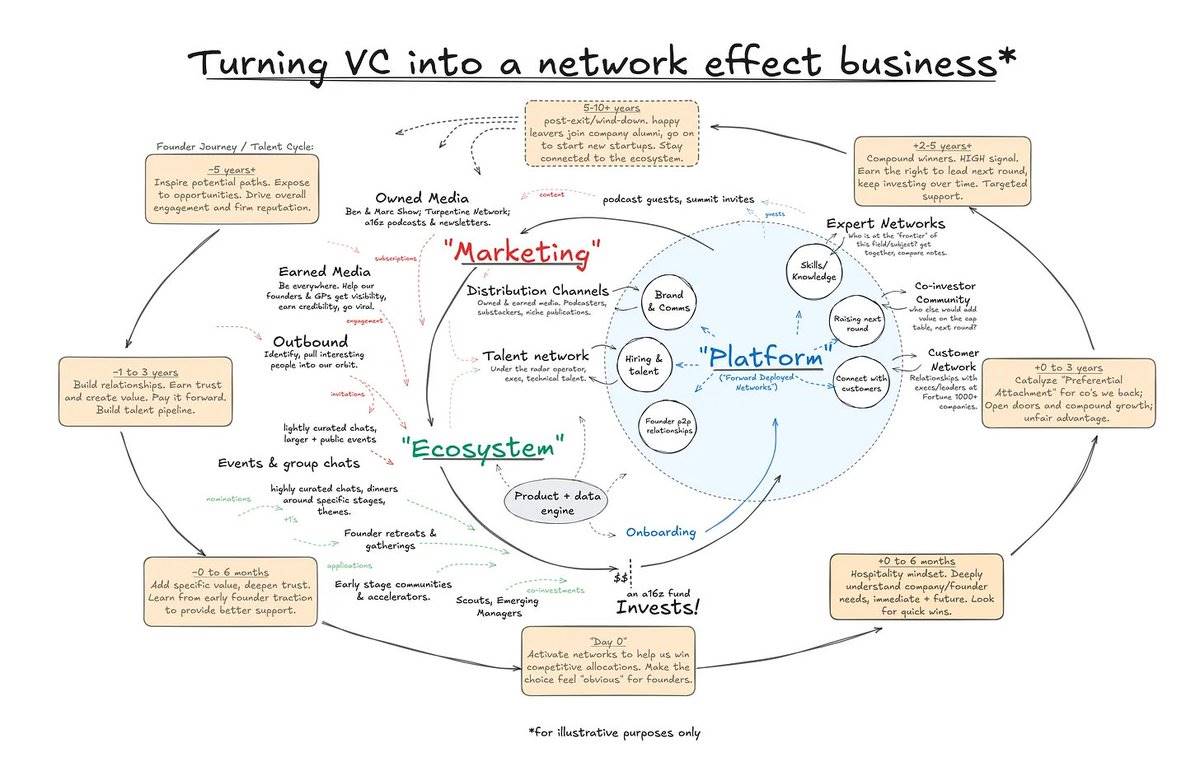
In August 2025, the most obvious signal emerged: Alex Danco (@Alex_Danco) joined a16z as Editor-at-Large, leading the firm's entire written content output. This appointment was not merely a PR role. Danco views writing as a "power transfer technology," believing that legitimacy is not unilaterally "bestowed" by institutions but achieved through "co-inspiration" between authors and readers.
However, Danco's addition is just one part of this vast machine. In November 2025, a16z released its "New Media Manifesto," revealing an operational model far beyond traditional venture capital. The firm now explicitly offers a service called "Timeline Takeover"—coordinated content across videos, podcasts, articles, and social media to help portfolio companies "win the day on the internet."
Building a Media Machine: a16z's Narrative Revolution
a16z is constructing a sophisticated media infrastructure. Led by Erik Torenberg (@eriktorenberg), the new media team brings together internal content creators dubbed "online legends," "forward deployed New Media" personnel who work directly with portfolio companies during product launches, and a network of high-impact talent to amplify selected narratives.
In October 2025, David Booth (@david__booth) joined a16z as a partner and head of ecosystem, focusing on building infrastructure he calls "preferential attachment" mechanisms. These mechanisms aim to channel resources, talent, and attention toward a16z's portfolio companies rather than competitors. As Marc Andreessen (@pmarca) explained when announcing Booth's appointment, startups need to enter a "virtuous cycle where resources accumulate... from qualified executives and technical staff to future follow-on funding, brand momentum, public perception, customers, revenue, and even influence in government."
To further strengthen its media setup, a16z plans to launch an 8-week New Media Fellowship program in January 2026, training operators, creators, and narrators to be deployed to portfolio companies. This is not just consulting but a dedicated talent pipeline for narrative warfare.
a16z's operational capabilities are impressive. The team publishes content five times a week across multiple channels, runs an internal video production department inspired by "new media legends" like Mr. Beast, and maintains "group chats, dinners, events, and hidden networks" to help talented and trusted individuals connect.
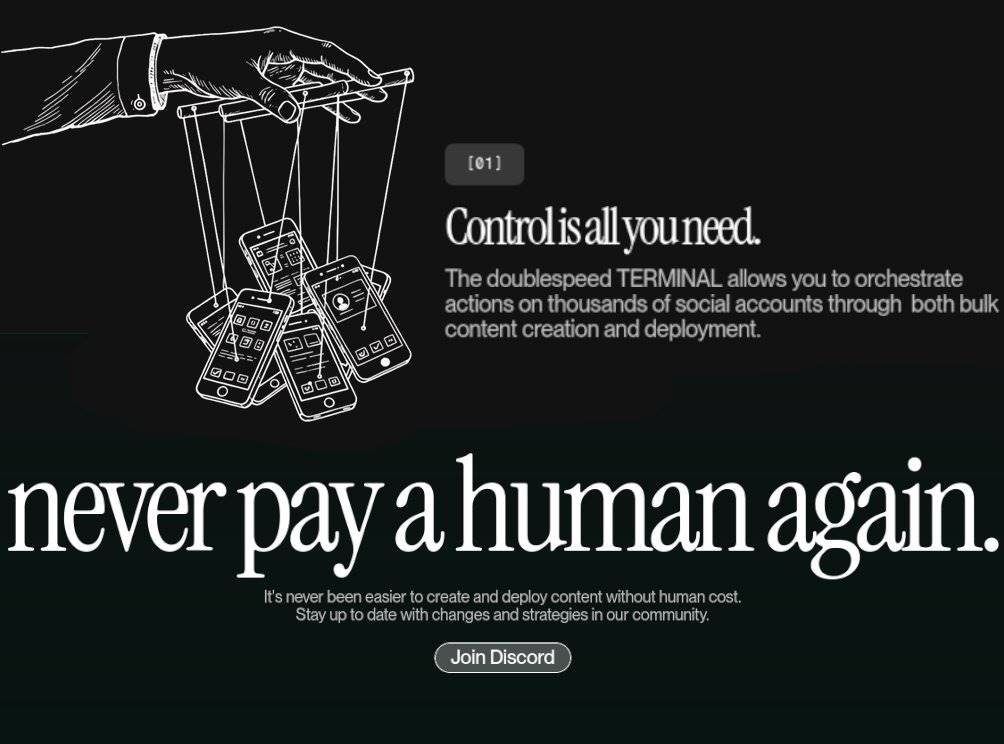
One portfolio company exemplifies the logical endpoint of this media machine: DoubleSpeed (@rareZuhair). This company uses AI to control thousands of social media accounts, ensuring they behave "as humanly as possible." Its slogan is bold and straightforward: "Never hire humans again."
The Twitter Outpost
a16z's media infrastructure efforts date back to 2022 when the firm invested $400 million to support Elon Musk's acquisition of Twitter. By September 2024, the investment had reportedly lost $288 million, but the financial loss was not the point. Ben Horowitz (@bhorowitz) stated at the time: "Elon is the one person we know, and perhaps the only person in the world, who has the courage, intelligence, and ability to solve these problems and build the public square we all want and deserve."
a16z quickly embedded its personnel into Twitter's team. Sriram Krishnan (@sriramk), an a16z general partner focused on crypto, publicly announced he was "temporarily assisting Elon Musk with Twitter management alongside other great people," adding: "I (and a16z) believe this is an incredibly important company that can have a major impact on the world."
Infrastructure for Prediction Markets
However, the media machine is only part of a16z's strategy. In his article "Prediction: The Successor to Postmodernism," Alex Danco argues that prediction markets represent a fundamental reshaping of civilization's foundations, comparable in importance to modernism and postmodernism.
In October 2025, a16z co-led a $300 million Series D investment in prediction market platform Kalshi at a $5 billion valuation. Partner Alex Immerman stated that prediction markets have the "opportunity to become the largest and most important financial markets of the future."
a16z attempted to have its executive and Kalshi board member Brian Quintenz (@CFTCquintenz) appointed as head of the U.S. Commodity Futures Trading Commission (CFTC), which regulates prediction markets. However, due to significant controversy over conflicts of interest and opposition from crypto figures including the Winklevoss twins, the White House withdrew Quintenz's nomination in September or October 2025. This failed nomination revealed both a16z's ambition to influence regulation and its current limitations.
Meanwhile, prediction market trading volume exploded. From early June 2024 to election week that year, volume grew 42-fold, with monthly trading totals on platforms like Polymarket and Kalshi reaching billions of dollars. During the 2024 election, journalists and Wall Street traders began relying on prediction markets, which "outperformed polls" and became "a signal the world could learn from."
When CEOs like Brian Armstrong started referencing specific cryptocurrencies in investor communications based on market signals, the feedback loop became evident: markets are not just predictive tools; they coordinate reality.
Even a16z's market design expert Scott Kominers (@skominers) acknowledged that "prediction markets themselves are not always an ideal information aggregation tool: even for global 'macro' events, prediction markets may not be reliable enough; for 'micro' issues, the prediction pool may be too small to provide meaningful signals." However, Kalshi's annualized trading volume has expanded to over $50 billion, growing more than 25-fold since early 2024. At this scale, the line between prediction and coordination blurs.
Reshaping the Political Landscape
Marc Andreessen supported Hillary Clinton in 2016, even tweeting "I'm with her." By 2024, his stance had completely shifted. He and Ben Horowitz donated over $5 million to groups supporting Trump, with Andreessen alone contributing $33.5 million to pro-crypto political groups—more than six times his direct donations to Trump.
Andreessen cited the Biden administration's proposal to tax unrealized capital gains as "the final straw," arguing it would force startups to pay taxes on valuation increases. He criticized the Biden administration for pushing a "soft authoritarian social revolution" and pointed to direct pressure on tech companies from the government.
This coordination extended to more covert levels. Andreessen organized WhatsApp groups that became "meme sources for mainstream opinion," described as a modern version of "samizdat" (underground publications), driving a nationwide "vibe shift." These encrypted, self-deleting message groups were called "dark matter of American politics and media," where "an astonishing political shift toward Trump was shaped and negotiated."
Erik Torenberg, now head of a16z's new media team, played a key role in organizing these groups. The person coordinating a16z's "Timeline Takeover" service was also coordinating political chats that shaped the discourse of the 2024 election.
a16z's Legitimacy Architecture
a16z sees itself as a "legitimacy bank" where entrepreneurs can "withdraw legitimacy on credit or make legitimacy deposits." This is not just a metaphor. In their article "How to be Legitimate," Alex Danco and former Microsoft executive Steven Sinofsky outline the history of legitimacy-building in tech—from Special Interest Groups in the 1960s, to authoritative reviews in PC Magazine in the 1980s, to today's ecosystem of coordinated influence.
The core insight: once you establish a legitimacy architecture, you are no longer selling a product but a vision of the future. As Sinofsky explained, when Microsoft sold to enterprises, "they only wanted to hear my ten-year plan." Legitimacy comes from the ability to "predict the future credibly."
This is what a16z is building: making certain futures seem inevitable by controlling the infrastructure through which we understand what is possible.
Convergence of the Tech Ecosystem
In April 2025, a16z formally launched the "American Innovators Network" with Y Combinator and several AI companies, positioning itself as the "small tech ecosystem of America" leading the next wave of innovation. Their public stance: "If a candidate supports an optimistic, technology-driven future, we support them. If they want to stifle important technologies, we oppose them."
Consider the ecosystem a16z has built:
-
Media Infrastructure: A new media team led by Torenberg offering "timeline takeover as a service," internal production capabilities, and forward-deployed narrative experts.
-
Talent Pipeline: The New Media Fellowship training teams to embed in portfolio companies.
-
Platform Play: A $400 million investment in Twitter/X, with personnel embedded during the transition.
-
Market Infrastructure: A major investment in Kalshi ($5 billion valuation), betting on prediction markets as a coordination mechanism.
-
Coordination Networks: WhatsApp groups, dinners, and "hidden networks that help talented and trusted people find each other."
-
Political Alliances: Direct ties to the Trump administration, with political donations exceeding $40 million.
-
Regulatory Influence Attempts: Though Quintenz's nomination failed, it revealed both ambition and current limits.
The F1 Pit Crew Theory
a16z uses an F1 racing metaphor to describe itself. General partners are the drivers, but "the race is won or lost long before it starts, by the team that designs the best chassis, hires the top engineers, trains the pit crew, and builds a fanatical fan base to sustain sponsor funding."
As David Booth wrote: "Adrian Newey didn't win any races, but his arrival as Red Bull's CTO transformed them from a cash-burning mid-field team into an era-defining world champion. The top VC firms of the next decade will need not only the best 'drivers' but also thoughtful investments on their 'machines on the track.'"
The machine a16z is building has multiple engines: one manufacturing legitimacy through coordinated media; one coordinating capital and attention through prediction markets; one coordinating political outcomes through encrypted group chats and strategic donations; one coordinating talent flow through fellowship programs and "ecosystem" infrastructure.
What Does This Mean?
When prediction markets are widely adopted by institutions and integrated with media machines, they cease to be mere prediction tools. Markets generate "a real-time probability more disciplined than polls, pundits, or headlines"—and when journalists, traders, and corporate executives base decisions on these probabilities, markets become self-fulfilling.
According to a16z's own framework, "prediction" is becoming the new paradigm after postmodernism—a new way to organize human attention, capital, and action. a16z has positioned itself at every key node:
-
They invest in platforms that set the odds;
-
They hire media teams that decide which questions matter;
-
They organize group chats that coordinate political strategy;
-
They train the next generation of talent for enterprises;
-
They attempt (though temporarily fail) to place their people in regulatory agencies.
This is not a conspiracy but a complex system designed by people who understand that "controlling the infrastructure of belief is more valuable than controlling the infrastructure of production."

The failure of Quintenz's nomination shows that this strategy still has limits. Opposition from within the crypto industry, concerns about conflicts of interest, and complex political factors can still block actions that appear too overtly like "regulatory capture."
But the broader machine continues to operate. The new media team keeps expanding, prediction markets keep growing, coordination networks deepen, and fellowship programs begin placing trained narrative experts into portfolio companies.
The goal of this game is not to predict the future but to build the infrastructure that determines which futures are understandable, which questions are asked, and which answers seem authoritative.
a16z is openly building this infrastructure, displaying remarkable transparency about what they are doing—while most people are still debating whether prediction markets are "more accurate than polls."