In early February 2026, Trump nominated former Federal Reserve Governor and monetary policy hawk Kevin Warsh as the next Fed Chair. This personnel appointment triggered significant turbulence in global financial markets, a phenomenon in the crypto market as the "Warsh Effect." Major cryptocurrencies experienced substantial declines, and spot Bitcoin ETFs saw a net outflow of nearly $1 billion in a single day. Our in-depth analysis suggests that the essence of the Warsh Effect is a "anchor shift" in the market's underlying logic regarding monetary policy—transitioning from the old narrative of "persistent inflation driving fiat devaluation, with crypto assets benefiting as a store of value" to a new paradigm of "interest rate discipline strengthening the dollar's credibility, with liquidity contraction penalizing risk assets." In this paradigm shift, the pricing mechanism of crypto assets is undergoing structural reconstruction: Bitcoin's correlation with tech stocks continues to strengthen, forcing it to accept the identity of a "high-beta risk factor"; the valuation driver of the entire market is shifting from liquidity expansion to real interest rate pricing; and the market will experience intense internal differentiation, with assets possessing genuine cash flows and real-world use cases gaining valuation premiums.
Looking ahead, crypto assets may evolve into "non-sovereign digital collateral" rather than traditional safe-haven assets. Investors need to systematically adjust their allocation frameworks, viewing cryptocurrencies as a "high-beta risk factor" highly sensitive to macro liquidity, and place greater emphasis on fundamental analysis, risk management, and liquidity reserves during the tightening cycle.
Chapter 1: Analysis of the Warsh Effect—Why Did a Personnel Appointment Cause a Market Earthquake?
On January 30, 2026, a personnel appointment triggered a tsunami-level shock in global financial markets, with an impact even exceeding that of economic data releases and monetary policy adjustments. After the news broke that former Federal Reserve Governor Kevin Warsh was nominated as the next Fed Chair, the U.S. Dollar Index surged violently, gold and silver flash-crashed, and the cryptocurrency market experienced a bloodbath—Bitcoin fell approximately 7% in a single day, Ethereum plummeted over 10%, and the total market capitalization evaporated by more than $800 billion. On the surface, this appeared to be a normal personnel change, but deeper analysis reveals that the market reacted so violently because the nomination of Warsh, a specific individual, touched the most sensitive nerve of the current financial system. Kevin Warsh is no ordinary Fed official; his career trajectory and policy stance paint a complete portrait of a hawk. In 2006, at the age of 35, Warsh became the youngest governor in Fed history, an appointment that itself signaled his extraordinary potential. During the stormy seas of the 2008 global financial crisis, when most colleagues advocated aggressive quantitative easing to save the collapsing financial system, Warsh became the most steadfast dissenter. He not only publicly opposed the second round of quantitative easing (QE2) but also repeatedly warned in post-crisis reflections that large-scale asset purchases and prolonged zero-interest-rate policies were distorting market signals, creating moral hazard, and damaging long-term price stability. These views seemed out of place amidst the crisis atmosphere at the time, but as time passed, more people began to re-examine his warnings. After leaving the Fed, Warsh further refined his theoretical framework through academic work at the Hoover Institution and Stanford Graduate School of Business. He particularly emphasized the importance of "real interest rates" as an anchor for monetary policy, arguing that negative real interest rates penalize savers and encourage capital misallocation. In a public speech in 2025, he explicitly stated: "A healthy economy needs positive real interest rates as a signaling mechanism for resource allocation; artificially suppressed rates only create false prosperity and inevitable bubble bursts." These statements stand in direct and sharp opposition to the liquidity environment on which the current crypto market thrives.
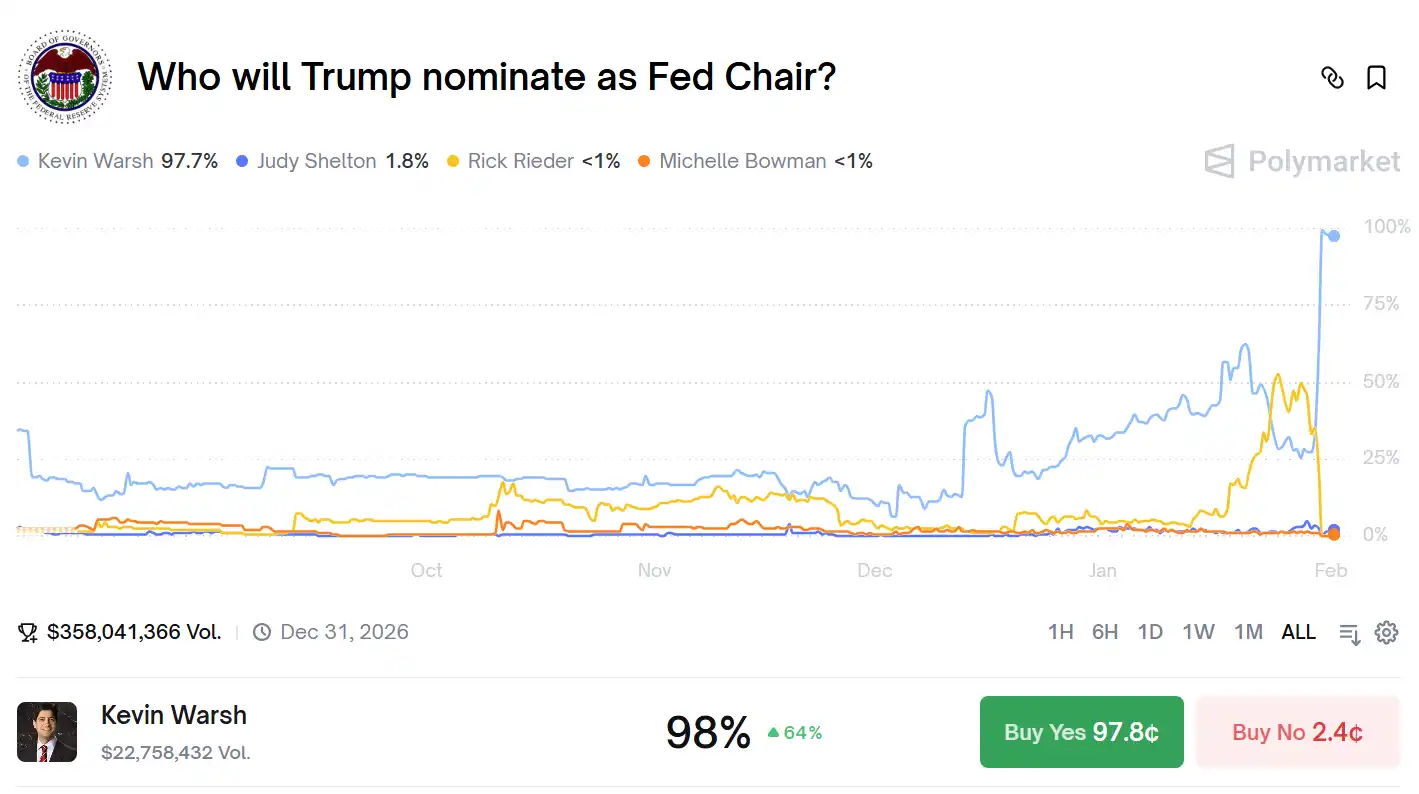
The most profound revelation of the Warsh Effect is that it exposed a long-overlooked contradictory relationship between the crypto market and monetary policy. The original narrative of cryptocurrency was built on opposing central bank money printing, as clearly indicated by Satoshi Nakamoto's message in the Bitcoin genesis block: "The Chancellor is on the verge of a second bailout for banks." However, as the crypto market developed and matured, it did not become a parallel financial system completely independent of the traditional system as early idealists had hoped. Instead, it became increasingly integrated into the existing system, developing a structural dependence on it. The approval of Bitcoin spot ETFs was a milestone in this process: it opened the door for institutional capital to enter the crypto market, but it also meant that the pricing power of crypto assets shifted from the decentralized community to Wall Street trading desks. Today, Bitcoin's price is not determined by miners, holders, or developers, but by the asset allocation models and risk management systems of BlackRock and Fidelity. These models naturally categorize crypto assets as "high-growth tech stocks" or "alternative risk assets," and their buying and selling decisions are based on the same macro variables as traditional assets—interest rate expectations, liquidity conditions, and risk appetite. This structural dependence makes the crypto market exceptionally vulnerable when facing a hawkish figure like Warsh, because institutional investors mechanically adjust their positions based on interest rate expectations, without considering Bitcoin's "non-sovereign store of value" narrative. This is a cruel irony: an asset born to oppose central banks ultimately has its price determined by traditional institutions most sensitive to central bank policy.
Chapter 2: Historical Backtesting of Tightening Cycles—How Are Crypto Assets Priced?
To truly understand the potential profound impact of the Warsh Effect, we need to look back at history and examine the performance patterns of crypto assets during past tightening cycles. This historical backtesting is not mere data accumulation but an attempt to extract structural patterns from past price fluctuations, providing a reference framework for judging the possible direction of the current market. The first period worth in-depth analysis is the 2017-2018 quantitative tightening (QT) and rate hike cycle. The Fed officially began balance sheet reduction in October 2017 and raised rates seven times cumulatively over the next two years. Bitcoin's performance in this cycle showed a clear lagging characteristic: in December 2017, when the Fed had already started its rate hike process, Bitcoin instead hit a then all-time high of $19,891. The market completely ignored the signals of monetary tightening, continuing to revel in the frenzy of a bull market. However, this ignorance ultimately came at a painful cost. As the pace of rate hikes accelerated and the scale of balance sheet reduction expanded in 2018, the continuous contraction of liquidity eventually overwhelmed the market. Bitcoin entered a bear market that lasted 13 months, falling to a low of $3,127, a drop of over 84.3%. The lesson from this period is profound: the impact of monetary policy takes time to accumulate. The market may ignore tightening signals in the short term, but once a tipping point is reached, the adjustment is often violent and painful. More importantly, the 2017-2018 cycle also revealed an early characteristic of the crypto market—its linkage with traditional financial markets was relatively weak, driven more by its own cycles (like Bitcoin halving) and retail sentiment.
The second key period is the 2021-2022 inflation response cycle, which has higher comparability to the current environment. The Fed began tapering asset purchases (Taper) in November 2021, initiated the first rate hike in March 2022, and raised rates seven times throughout the year for a total of 425 basis points. Bitcoin, after reaching its peak of $69,000 in November 2021, fell to a low of $15,480 in November 2022, a decline of approximately 77%. Compared to the 2017-2018 cycle, the most important change in this period was the significant strengthening of the correlation between the crypto market and tech stocks. Data shows that the 120-day rolling correlation between Bitcoin and the Nasdaq index soared from around 0.3 in early 2021 to 0.86 by mid-2022. This sharp increase in correlation was not accidental but reflected a structural change in the crypto market: the massive entry of institutional investors, who incorporated crypto assets into a unified risk asset framework for management. When the Fed initiated aggressive rate hikes to combat inflation, institutional investors reduced their positions in tech stocks and crypto assets simultaneously according to their risk models, creating a vicious cycle of "multi-asset liquidation." Another important phenomenon emerged during this period: intense internal differentiation within the crypto market. Amid the overall decline, Bitcoin's performance was relatively resilient, while most altcoins fell more deeply, with many tokens dropping over 90%. This differentiation signaled the market beginning to distinguish between "core assets" and "peripheral assets," with funds concentrating towards more liquid and consensus-stronger assets.
The third period is the high-interest-rate maintenance phase of 2024-2025, the most recent and relevant for reference. The Fed maintained the federal funds rate in the 5.25%-5.50% range for 16 months while continuing to reduce its balance sheet at a pace of $95 billion per month. During this period, the crypto market exhibited complex structural characteristics. On one hand, Bitcoin benefited from the approval of spot ETFs and achieved a significant rally, rising from $45,000 to over $100,000; on the other hand, most altcoins fell 40-70%, with over 80% of the top 100 tokens by market cap underperforming Bitcoin. This differentiation reveals an important trend: in an environment of overall tightening liquidity, funds concentrate towards the "safest risk assets," i.e., those with the best liquidity, highest institutional acceptance, and lowest regulatory risk. For other crypto assets, they not only face the contraction of macro liquidity but also a "siphoning effect" from Bitcoin. Another noteworthy phenomenon during this period was that changes in real interest rates began to directly affect crypto asset pricing. When the yield on the 10-year Treasury Inflation-Protected Securities (TIPS) rose from 1.5% to 2.5%, the Bitcoin price fell by approximately 15%, a sensitivity not明显 apparent in previous cycles.
Based on the experience of these three historical periods, we can summarize several key patterns of the crypto market during tightening cycles. First, the impact of monetary policy has cumulative and lagging effects; the market may ignore tightening signals initially but eventually reacts through violent adjustments. Second, as institutional participation increases, the correlation between the crypto market and traditional risk assets continues to strengthen, reaching extremes in tightening environments. Third, intense internal differentiation occurs within the market, with funds concentrating towards top-tier assets, highlighting the Matthew effect. Fourth, the accumulation of leverage amplifies the magnitude and speed of declines, forming a vicious cycle of "price drop - triggers liquidation - further price drop." Fifth, changes in real interest rates are increasingly becoming a core variable affecting crypto pricing, as rising risk-free rates directly increase the opportunity cost of holding crypto assets. The particularity of the Warsh Effect lies in its occurrence at the moment of highest institutionalization of the crypto market and at a relatively high valuation level. The superposition of these two factors may make this adjustment more complex and prolonged than any previous one. Meanwhile, Warsh, as a hawk with a complete theoretical system and consistent stance, his nomination might imply that tight policy is not a temporary response measure but a long-term policy paradigm. The impact of this paradigm shift will far exceed that of cyclical policy adjustments.
Chapter 3: Pricing Model for the Crypto Market in a Tightening Cycle
In the new environment initiated by the Warsh Effect, traditional crypto asset pricing models have become ineffective, necessitating the establishment of a new analytical framework to understand market dynamics. Based on historical data and the current market structure, we have constructed a three-factor pricing model to explain the price formation mechanism of crypto assets during a tightening cycle. The first factor is liquidity conditions, with a weight set at 40%. This factor measures the changing trends of global money supply, including the Fed's balance sheet size, global M2 growth rate, overnight reverse repo scale, and other indicators. Data shows a strong correlation (R² = 0.62) between changes in global liquidity and the crypto market capitalization; for every 1% contraction in liquidity, the total crypto market cap decreases by an average of 2.1%. Under the policy framework likely to be promoted by Warsh, we anticipate the Fed's balance sheet will shrink by 15-20% over the next two years, equivalent to approximately $1.2-$1.6 trillion. According to the model, this alone could cause the total crypto market capitalization to contract by 25-30%. More importantly, liquidity contraction often exhibits non-linear characteristics: the initial impact is limited, but once contraction accumulates to a certain extent, it may trigger a positive feedback loop of a liquidity crisis. The current leverage structure of the crypto market amplifies this vulnerability, as a large amount of collateralized lending and derivative positions face liquidation pressure when liquidity tightens, further exacerbating market declines.
The second factor is the real interest rate, with a weight set at 35%. This factor measures the opportunity cost of holding crypto assets, with core indicators being the 10-year Treasury Inflation-Protected Securities (TIPS) yield and the real federal funds rate. For every 1 percentage point increase in the real interest rate, the risk premium required by Bitcoin must increase by 280 basis points to maintain its current valuation. This means if the real rate rises from the current 1.5% to the 3% that Warsh might advocate, Bitcoin's expected annualized return would need to increase from the historical average of about 60% to nearly 70%, a considerably high threshold.
The third factor is risk appetite, with a weight set at 25%. This factor measures market participants' willingness to bear risk, with core indicators including the VIX fear index, high-yield bond spreads, and tech stock valuation premiums. The crypto market is extremely sensitive to changes in risk appetite, with an elasticity coefficient of 1.8, meaning that when overall market risk appetite decreases by 10%, the crypto market's valuation may drop by 18%. This disproportionate amplification effect stems from the high volatility and peripheral status of crypto assets: in optimistic markets, investors are willing to take higher risks chasing potential returns; in pessimistic markets, crypto assets are often the first to be sold. During tightening cycles, risk appetite typically declines systematically because the high-interest-rate environment itself discourages risk-taking behavior. The rise in real interest rates not only changes the absolute valuation of assets but also alters investors' risk tolerance: when risk-free assets provide substantial returns, investors no longer need to bear excessive risk in pursuit of returns. This psychological shift is reflected in multiple dimensions: slowdown in venture capital, compression of growth stock valuations, and widening high-yield bond spreads. The crypto market, as one of the most risk-appetite-sensitive areas, naturally suffers the greatest impact.
Under this three-factor model framework, different categories of crypto assets exhibit differentiated pricing characteristics. Bitcoin, as the market benchmark, has 60% of its price movement explained by macro liquidity factors, 25% determined by ETF flows, and the influence of on-chain fundamentals has dropped below 15%. This structural change means Bitcoin's correlation with traditional risk assets will remain at a high level of 0.65-0.75, with annualized volatility staying in the 55-70% range, and sensitivity to real interest rates reaching a 12-15% inverse price change for every 1% change. Smart contract platform tokens like Ethereum present a more complex pricing logic: network revenue accounts for 40%, developer activity 25%, DeFi Total Value Locked (TVL) 20%, and macro factors 15%. This combination means Ethereum has some fundamental support but cannot completely escape macro influences. More importantly, there are complex interconnections within smart contract platforms; the failure of one protocol may spread systemic risk throughout the ecosystem through asset linkages and sentiment transmission. Application-layer tokens and governance tokens will experience the most severe differentiation: tokens with genuine cash flow (annual protocol fees exceeding $50 million) may gain valuation support, while pure governance tokens may face liquidity drying up. Data shows that among the top 200 tokens by market cap, less than 30% have annual protocol revenue exceeding $10 million, and only about 15% have sustainable dividend or buyback mechanisms. During the tightening cycle, funds will increasingly concentrate on a few high-quality assets, and most tokens may fall into a "zombie state."
Chapter 4: Investment Strategy Adjustment and Risk Management
Facing the tightening environment initiated by the Warsh Effect, all market participants need to fundamentally adjust their strategic frameworks and risk management methods. For traditional institutional investors, the first step is to redefine the role and positioning of crypto assets in the investment portfolio. Bitcoin should no longer be regarded as "digital gold" or an inflation hedge but should be clearly defined as a "high-beta growth asset," categorized under the same risk factor as tech stocks. This reclassification has practical operational significance: in asset allocation models, the risk budget for crypto assets needs to be adjusted accordingly, reduced from 5-8% of total portfolio risk to 3-5%; in performance evaluation, the benchmark should be changed from gold or commodity indices to tech stock indices; in risk management, stress test scenarios need to include extreme situations like "liquidity shock" and "correlation spike." Institutional investors also need to establish more systematic decision-making processes, making dynamic adjustments based on macro signals (real interest rates, liquidity indicators, risk appetite) rather than relying on long-term holding belief investing. Specifically, clear trigger conditions can be set: automatically reducing positions when real interest rates break through a certain threshold, initiating hedging when liquidity indicators deteriorate to a specific level, and gradually adding positions when risk appetite falls to historical lows. Hedging strategies become crucial, considering the use of Bitcoin futures, options, or correlation trades to manage downside risk. Special attention is needed: during the tightening cycle, the correlation between crypto assets and traditional assets may further strengthen, which would reduce their diversification value in the portfolio. This change needs to be accurately reflected in risk models and allocation ratios adjusted promptly.
Looking to the future, regardless of the final outcome of Warsh's nomination, the crypto market has entered an irreversible new stage. The core feature of this stage is the deep integration of crypto assets with the traditional financial system, and the resulting fundamental changes in pricing mechanisms, volatility patterns, and correlations. Regulatory frameworks will gradually clarify, valuation methods will become professionalized, market structure will complexify, and cyclical characteristics will weaken. From a broader perspective, the Warsh Effect may ultimately prompt the necessary self-innovation within the crypto industry. When the liquidity红利 (dividend) disappears, the market will be forced to return to its essence: creating actual value, solving real problems, and building sustainable economic models. Projects reliant on speculation and narrative without substantive progress will be淘汰 (eliminated), while truly innovative protocols will gain development space.







