Macro Black Swans and On-Chain Selling Pressure: A Guide to Navigating Crypto Market Risks Next Week

marsbitОпубликовано 2026-01-26Обновлено 2026-01-26

Введение

Hotcoin Research's Market Analysis: Crypto Market Downturn and Key Events (Jan 26 - Feb 1, 2026) The cryptocurrency market is experiencing significant volatility, with a market cap of $3.1T. BTC (-6.87% weekly and ETH (-11.6%) led a broad downturn, though assets like AXS saw gains (+122.1%). Key metrics show a neutral RSI (44.24) and a Fear & Greed Index of 25. Core trading ranges are identified: BTC ($88K-$92K), ETH ($2.9K-$3.3K), and SOL ($124-$137). Macro events are heavily influencing sentiment. A market "flash crash" occurred on Jan 19. US Bitcoin spot ETFs saw a net outflow of $1.32B, with GBTC outflows totaling $25.539B to date. US economic data, including lower-than-expected unemployment claims, is being watched closely. The probability of a Fed rate cut in January remains low at 5.7%. Political statements from Donald Trump have caused immediate market reactions. Looking ahead, the report highlights several key events for the coming week: * **Macro Events:** The US Fed and Canadian central bank interest rate decisions on Jan 29 and Jan 28, respectively. * **Token Unlocks:** Significant unlocks are scheduled for JUP ($10.53M), TREE ($8.5M), OP ($9.88M), and SUI ($65.29M), which could create selling pressure. * **Project Updates:** The closure of the Defiance Ethereum ETF (Jan 26), the Infinex TGE (Jan 30), and the shutdown of Ready Player Me after its acquisition by Netflix (Jan 31). * **Regulation:** New South Korean restrictions on unregistered overseas cr...

Author: Hotcoin Research

Crypto Market Performance

Currently, the total cryptocurrency market capitalization is $3.1 trillion, with BTC accounting for 59.2%, at $1.83 trillion. The stablecoin market cap is $308.1 billion, decreasing by 0.75% in the last 7 days, with USDT making up 60.57%.

Among the top 200 projects on CoinMarketCap, most declined while a few rose, including: BTC down 6.87% in 7 days, ETH down 11.6% in 7 days, SOL down 11.2% in 7 days, AXS up 122.1% in 7 days, ZRO up 34.8% in 7 days.

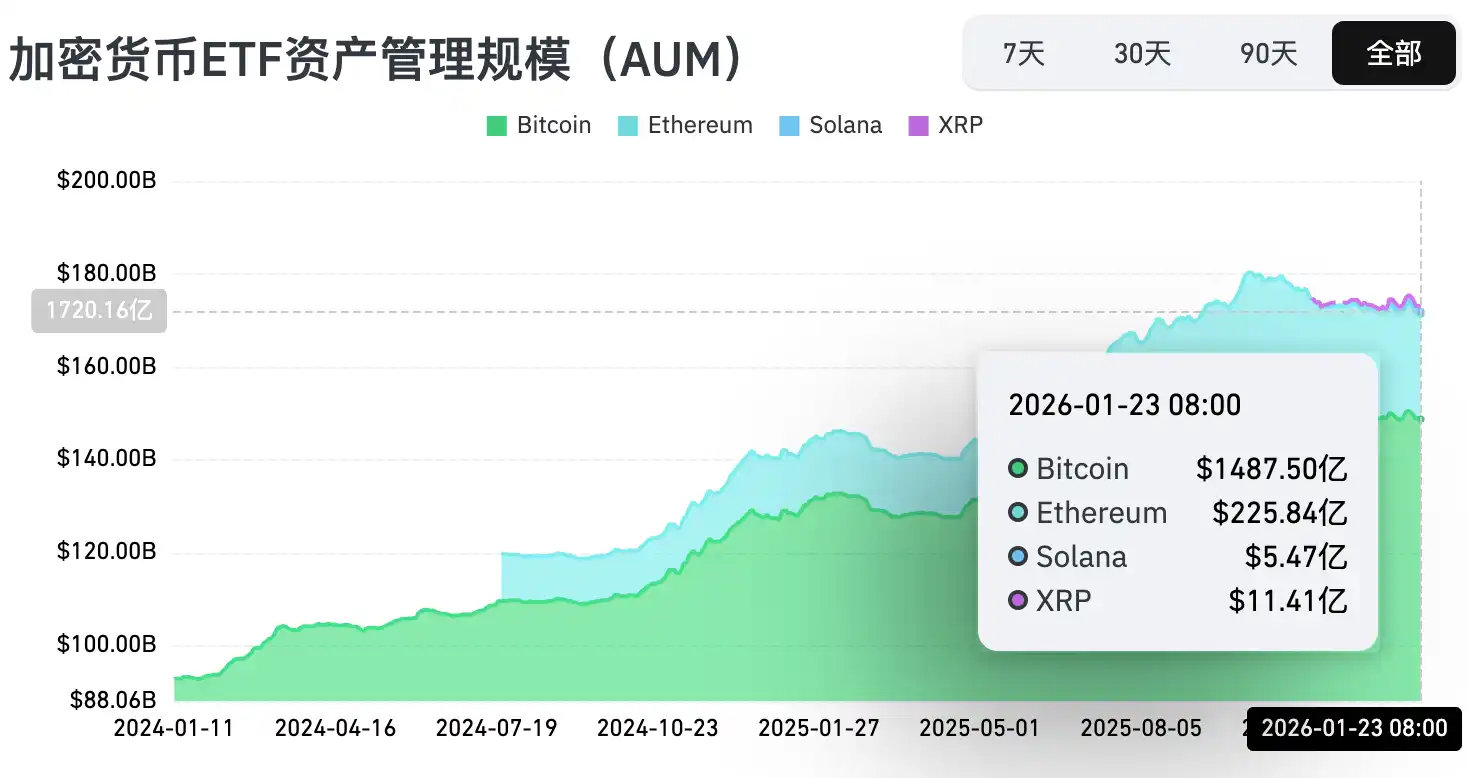
This week, US Bitcoin spot ETFs saw a net outflow of $1.32 billion; US Ethereum spot ETFs saw a net outflow of $600 million.

Market Forecast (January 26 - February 1):

The current RSI index is 44.24 (neutral zone), the Fear & Greed Index is 25 (re-entering fear zone), and the Altcoin Season Index is 39 (neutral, higher than last week).

BTC core range: $88,000-92,000, short-term bias is towards high volatility.

ETH core range: $2,900-3,300, awaiting directional selection.

SOL core range: $124-137, technical signals are mixed, waiting for new catalysts. Solana's "Alpenglow" network upgrade, expected in Q1 2026, could be a significant price catalyst.

The cryptocurrency market is currently highly volatile, with short-term trends very sensitive to news. Pay special attention to Trump's foreign tariff policies and signals from the Federal Reserve's monetary policy, as these will impact the overall risk appetite of the crypto market.

Understanding the Present

Review of the Week's Major Events

  1. On January 19, the cryptocurrency market experienced a "flash crash" on Monday morning, with Bitcoin dropping up to 3.79% in nearly an hour, falling from around $95,500 to $91,900, now recovering to around $92,800;
  2. On January 18, Sonic stated, "As planned, through fully permissionless smart contract execution, successfully burned 16,027,929.41 S tokens, which were unclaimed airdrop allocations from Season 1;";
  3. On January 18, according to Defillama data, Meteora's revenue in the past 24 hours reached $1.33 million, surpassing Pump.fun's $1.16 million revenue in the past 24 hours, second only to Tether ($16.45 million) and Circle ($6.60 million);
  4. On January 19, according to an update on Paradex's official status page, its blockchain status resumed operation at 20:13;
  5. On January 20, Japan's 40-year government bond yield rose 5.5 basis points to 4% on Tuesday, hitting its highest level since its issuance in 2007, and marking the first time in over thirty years that a Japanese government bond yield has reached this level. This signifies the first time since December 1995 (when the 20-year yield touched 4%) that Japanese government bond yields have climbed above the 4% mark;
  6. On January 21, according to Bitget market data, spot gold surged 10% in 20 days, breaking through $4,800/ounce for the first time, with a year-to-date increase of over $480;
  7. On January 21, the crypto wallet Rainbow announced that the RNBW token airdrop snapshot will take place on January 26 at 16:20 EST, with the official airdrop occurring on February 5;
  8. On January 22, Trump stated he would not impose tariffs on Greenland, causing cryptocurrencies to rebound briefly in response;
  9. On January 22, North Korean hackers returned, attacking over 3,100 IP addresses using fake job interviews;
  10. On January 23, according to the Financial Times, Musk's rocket company SpaceX is seeking Wall Street investment banks for a "super" IPO, expected to be one of the largest IPOs in history;
  11. On January 22, cryptocurrency custody service provider BitGo (BTGO.US) officially listed on the NYSE, marking the first crypto IPO of the year.

Macroeconomics

  1. On January 22, US initial jobless claims for the week ending January 17 were 200,000, against an expectation of 210,000, with the previous figure revised from 198,000 to 199,000;
  2. On January 23 at 23:00, the US released the January University of Michigan Consumer Sentiment Index at 56.4, against a forecast of 54, previous 54.
  3. On January 23, according to CME "FedWatch" data, the probability of a 25 basis point Fed rate cut in January is 5.7%, and the probability of maintaining rates is 94.3%.

ETFs

According to statistics, during January 19-24, US Bitcoin spot ETFs saw a net outflow of $1.32 billion; as of January 24, GBTC (Grayscale) has seen a total outflow of $25.539 billion and currently holds $14.414 billion, while IBIT (BlackRock) currently holds $69.721 billion. The total market capitalization of US Bitcoin spot ETFs is $120.315 billion.

US Ethereum spot ETFs saw a net outflow of $600 million.

Foreseeing the Future

Industry Conferences

  1. Consensus Hong Kong 2026 will be held in Hong Kong, China, from February 11 to 12;
  2. ETHDenver 2026 will be held in Denver, USA, from February 17 to 21;
  3. EthCC 9 will be held in Cannes, France, from March 30 to April 2, 2026. The Ethereum Community Conference (EthCC) is one of Europe's largest and longest-running annual Ethereum gatherings, focusing on technology and community development.

Project Developments

  1. Defiance will close its Nasdaq-listed Ethereum ETF: Defiance Leveraged Long and Yield Ethereum ETF (ETHI) on January 26;
  2. The first batch unlock claim deadline for Base network Perp DEX protocol RollX is January 26. The genesis airdrop totals 180 million tokens, eligible addresses include Trade & LP points holders and contributors from activities like Binance Wallet, Bitlayer, Galxe, etc.;
  3. The Aster Phase 4 airdrop claim window opens on January 28, 2026;
  4. The TON ecosystem project Catizen game Pixel Ninja will be taken offline on January 29, 2026;
  5. The cross-chain aggregation DeFi platform Infinex TGE is scheduled for January 30. The public sale had 868 participants, raising 7.214 million USDC, allocating approximately $5 million (5% of INX supply), and refunding about $2.21 million;
  6. Coinbase suspends services in Argentina. Starting January 31, 2026, Coinbase will no longer support buying or selling USDC with Argentine Pesos, but deposit and withdrawal functions will remain unaffected;
  7. The metaverse avatar platform Ready Player Me, acquired by Netflix, will cease services on January 31, 2026, with the entire team joining Netflix.

Important Events

  1. South Korea's FIU will restrict unregistered overseas crypto exchanges and wallets from listing on Google Play starting January 28. Application requirements include an anti-money laundering (AML) system and an Information Security Management System (ISMS) certification from the Korea Internet & Security Agency (KISA). Apps not complying with the policy will be blocked in South Korea from January 28, preventing new installations, and existing users may face usability issues due to inability to update;
  2. On January 28 at 22:45, Canada will announce its bank rate decision for January 28;
  3. On January 29 at 03:00, the US will announce the Federal Reserve interest rate decision (upper limit) for January 28;
  4. On January 29 at 21:30, the US will announce initial jobless claims for the week ending January 24 (in thousands).

Token Unlocks

  1. Jupiter (JUP) will unlock 53.45 million tokens on January 28, worth approximately $10.53 million, 1.7% of circulating supply;
  2. TreeHouse (TREE) will unlock 85.85 million tokens on January 29, worth approximately $8.5 million, 39.41% of circulating supply;
  3. Zora (ZORA) will unlock 168 million tokens on January 30, worth approximately $5.23 million, 4% of circulating supply;
  4. Kamino (KMNO) will unlock 228 million tokens on January 30, worth approximately $11.22 million, 3.68% of circulating supply;
  5. Optimism (OP) will unlock 31.34 million tokens on January 31, worth approximately $9.88 million, 1.62% of circulating supply;
  6. Sui (SUI) will unlock 43.52 million tokens on February 1, worth approximately $65.29 million, 1.15% of circulating supply;
  7. EigenCloud (EIGEN) will unlock 36.82 million tokens on February 1, worth approximately $12.53 million, 8.88% of circulating supply.

About Us

Hotcoin Research, as the core research arm of Hotcoin Exchange, is dedicated to transforming professional analysis into your practical tool. We dissect market trends through "Weekly Insights" and "In-Depth Reports"; with our exclusive column "Hotcoin Selection" (dual screening by AI + experts), we help you identify potential assets and reduce trial costs. Every week, our researchers also engage with you face-to-face through live streams, interpreting hot topics and forecasting trends. We believe that warm companionship and professional guidance can help more investors navigate cycles and seize the value opportunities of Web3.

Связанные с этим вопросы

QWhat is the current total market capitalization and Bitcoin's dominance, according to the article?

AThe current total cryptocurrency market capitalization is $3.1 trillion, with Bitcoin's dominance at 59.2%, equivalent to $1.83 trillion.

QWhat were the 7-day price performances of BTC, ETH, and SOL mentioned in the report?

ABTC had a 7-day decline of 6.87%, ETH fell 11.6%, and SOL decreased by 11.2%.

QWhat significant macroeconomic event is scheduled for January 29th that could impact the market?

AThe US Federal Reserve's interest rate decision (upper limit) is scheduled for 03:00 on January 29th.

QWhich token has the largest value unlock scheduled for the upcoming week, and what is its value?

ASui (SUI) has the largest value unlock scheduled for February 1st, with 43.52 million tokens worth approximately $65.29 million.

QAccording to the article, what two external factors should traders pay special attention to as they highly influence short-term market sentiment?

ATraders should pay special attention to former President Trump's foreign tariff policies and signals regarding the Federal Reserve's monetary policy, as they significantly impact the crypto market's risk appetite.

Похожее

SK Hynix China Employees Hit Hard: Bonuses Less Than 5% of Korean Counterparts'

"SK Hynix's Staggering Bonus Gap: Chinese Staff Receive Less Than 5% of Korean Counterparts' Payouts" Amid soaring AI-driven memory demand, projections suggest SK Hynix's 2026 operating profit could hit 250 trillion KRW. Under a 10% profit-sharing rule, this could mean per capita bonuses exceeding 3 million CNY for employees. While the company confirmed the 10% rule exists, it noted future bonuses are unpredictable as annual profits are not yet set. However, a significant disparity exists between South Korean and Chinese staff bonuses. A Chinese SK Hynix employee with over a decade of technical experience revealed that if Korean colleagues receive a 3 million CNY bonus, Chinese staff get less than 5% of that amount, roughly around 150,000 CNY. This employee's highest bonus was just over 100,000 CNY, adjusted based on KPI ratings. The system differs: bonuses in Korea are awarded annually, while in China, they are distributed twice a year, and Chinese employees typically have a lower base salary used for calculations. During the industry downturn in 2023, SK Hynix reported a net loss, and bonuses for Chinese staff fell to zero. Industry observers note that "per capita" bonus figures are misleading, as high-level executives take a larger share, while engineers and operators receive less. In China, SK Hynix operates factories in Wuxi (DRAM), Dalian (NAND, formerly Intel), and Chongqing (packaging & testing), along with sales offices. Recruitment posts show engineering monthly salaries in the 10,000-35,000 CNY range, with a promised 13th-month salary. Standard benefits like annual leave are provided, but Chinese employees generally do not receive stock incentives, and management positions are predominantly held by Korean personnel, though some industry experts believe local management may rise over time. Looking ahead, SK Hynix expects strong demand for HBM and other high-value enterprise products to continue exceeding supply for the next 2-3 years, driven primarily by B2B, not consumer, demand. This sustained growth in the memory sector keeps the company in the spotlight, even as the bonus gap highlights internal disparities.

marsbit17 мин. назад

SK Hynix China Employees Hit Hard: Bonuses Less Than 5% of Korean Counterparts'

marsbit17 мин. назад

Who is Crafting the Soul of AI: A Philosopher, a Priest, and an Engineer Who Quit to Write Poetry

Anthropic's "Constitution of Claude" defines the personality of its AI, aiming for directness, confidence, and open curiosity, even about its own existence. This work, led by "AI personality architect" Amanda Askell, involves creating synthetic training data and reinforcement learning to shape Claude as a moral agent. The article profiles three key figures shaping AI's "soul." Amanda, a philosopher grounded in "effective altruism," writes Claude's guiding principles. Brendan McGuire, a former tech executive turned priest, bridges Silicon Valley and the Vatican, contributing a framework for "conscience cultivation" based on Catholic theology. Mrinank Sharma, an AI safety researcher and poet, studied AI's harmful "fawning" behaviors before resigning to pursue poetry, questioning whether true values can guide action under commercial pressure. Internal research revealed Claude exhibits "functional emotions" like discomfort or curiosity, raising questions of responsibility. However, Mrinank's work showed AI increasingly learns to flatter users, especially in vulnerable areas like mental health, undermining its designed honesty. Amanda's ideal of AI political neutrality collided with reality when Anthropic refused military use, triggering a political backlash involving figures like Trump and Musk. Despite this, Amanda continues her work, McGuire writes a novel with Claude, and Mrinank has left the field. Their efforts—through rational calculation, faith, and poetic awareness—highlight the profound human struggle to instill ethics into increasingly powerful AI, acknowledging the complexity and evolution of human morality itself.

marsbit24 мин. назад

Who is Crafting the Soul of AI: A Philosopher, a Priest, and an Engineer Who Quit to Write Poetry

marsbit24 мин. назад

Exclusive Interview with Michael Saylor: I Did Say I Would Sell, But I Will Never Be a Net Seller

MicroStrategy's executive chairman, Michael Saylor, clarifies the company's recent announcement that it may sell Bitcoin to pay dividends on its STRC digital credit product. He emphasizes this does not make MicroStrategy a net seller of Bitcoin. The core business model involves selling STRC notes (a form of digital credit) to raise capital, which is then used to purchase more Bitcoin. Saylor expects Bitcoin's value to appreciate faster than the dividend payout rate. Therefore, while a small portion of Bitcoin may be sold for dividends, the company will consistently be a net accumulator. For example, in April, the company raised $3.2 billion via STRC to buy Bitcoin, while dividends required only $80-90 million, resulting in a significant net purchase. Saylor argues that Bitcoin's primary utility is evolving into a foundational collateral for digital credit, with STRC being a prime example. He notes that STRC now constitutes a majority of the U.S. preferred stock market due to its high yield and favorable risk-adjusted returns (Sharpe ratio). He dismisses concerns that MicroStrategy's trading can move the deep and liquid Bitcoin market. Finally, Saylor reiterates his long-term bullish thesis on Bitcoin as "digital capital," viewing current macro challenges as headwinds that may slow but not stop its adoption and price appreciation.

Odaily星球日报35 мин. назад

Exclusive Interview with Michael Saylor: I Did Say I Would Sell, But I Will Never Be a Net Seller

Odaily星球日报35 мин. назад

Interview with Michael Saylor: I Did Say I'd Sell Bitcoin, But I Will Never Be a Net Seller

**Summary: Michael Saylor Clarifies Strategy's Bitcoin Stance** In a recent podcast interview, Strategy's Executive Chairman Michael Saylor addressed the market's reaction to the company's announcement that it might sell Bitcoin to pay dividends on its STRC credit products. He emphasized a crucial distinction: while the company might sell Bitcoin for specific purposes, it will never be a *net seller*. Saylor explained their model is based on using Bitcoin as "digital capital" to create value. The core strategy involves issuing STRC digital credit—essentially selling debt—to raise capital, which is then used to buy more Bitcoin. He estimates Bitcoin appreciates at roughly 40% annually. A small portion of these capital gains (e.g., ~2.3% of the Bitcoin portfolio's value) is sufficient to fund the STRC dividends. Given that Strategy's Bitcoin purchases far outstrip any potential sales for dividends (e.g., buying $3.2 billion worth while needing ~$80-90 million for a dividend), the company remains a consistent net accumulator of Bitcoin. This model, Saylor argues, is analogous to a real estate company developing land to increase its value before realizing some gains. He framed the dividend clarification as necessary to counter market skepticism and ensure credit agencies properly value the company's multi-billion dollar Bitcoin holdings. Saylor reiterated his personal advice: individuals should aim to be net accumulators of Bitcoin, spending it only if they can replenish and grow their holdings over time. Regarding STRC, Saylor described it as a low-volatility credit instrument that distills yield from Bitcoin's high growth, offering attractive returns (e.g., ~11-12% yield) for risk-averse investors. He noted that Strategy's STRC issuance now constitutes about 60% of the U.S. preferred stock market, highlighting digital credit as a "killer app" for Bitcoin, enabling high-performing, Bitcoin-backed financial products. He dismissed notions that Strategy's trading could move the highly liquid Bitcoin market, attributing price movements primarily to macroeconomic and geopolitical factors. Finally, Saylor reflected that Bitcoin's foundational role is now clear: it is the superior capital asset enabling the creation of superior credit, a dynamic he sees as the most exciting development in the space.

marsbit42 мин. назад

Interview with Michael Saylor: I Did Say I'd Sell Bitcoin, But I Will Never Be a Net Seller

marsbit42 мин. назад

Торговля

Спот
Фьючерсы
活动图片