Machines Pay, Humans Reap: Coinbase, Stripe, Google, Visa's AI Payments Land Grab

marsbitОпубликовано 2026-05-22Обновлено 2026-05-22

Введение

One year after being a concept, machine-to-machine payments are now a battleground. Four competing architectures are already deployed by Coinbase (x402 protocol), Stripe/Tempo (MPP standard), Google (AP2 authorization layer), and Visa (tokenized credentials). AI Agents have already settled over $73 million across 176 million transactions, with a median value between $0.01 and $0.10. A key barrier is the ~$0.30 minimum fee of traditional card rails, making them unviable for micro-payments. In contrast, Layer 2 stablecoin settlement costs $0.0001, with USDC dominating 98.6% of all transactions. The dynamic is less about a single winning protocol and more about vertical integration within a new payment stack. Companies like Coinbase and Stripe control multiple layers (settlement, wallet, routing, protocol, governance), driving over $8 billion in recent acquisitions to solidify their positions. The shift from extractive bot activity to productive Agent commerce is underway, with AI Agents accounting for 37% of all Gnosis Chain Safe transactions. The pace of adoption will be set not by available technology but by the development of trust and safety infrastructure for autonomous transactions. While a fully permissionless vision is appealing, supervised access remains crucial until AI reliability improves. Regulatory frameworks like MiCA and the EU AI Act, due in mid-2026, currently lag behind this rapidly evolving reality. The foundational argument is clear: crypto rails have alr...

Author:Ben Harvey

Compilation: TechFlow

TechFlow Introduction: A year ago, machine-to-machine payments were just a concept. Now, Coinbase, Stripe, Google, and Visa have deployed four competing architectures. AI Agents have already completed 176 million transactions and settled $73 million. Traditional giants have spent over $8 billion on acquisitions to secure their position. This is not a future narrative but an ongoing restructuring of payment infrastructure—whoever controls the most layers will capture the most value.

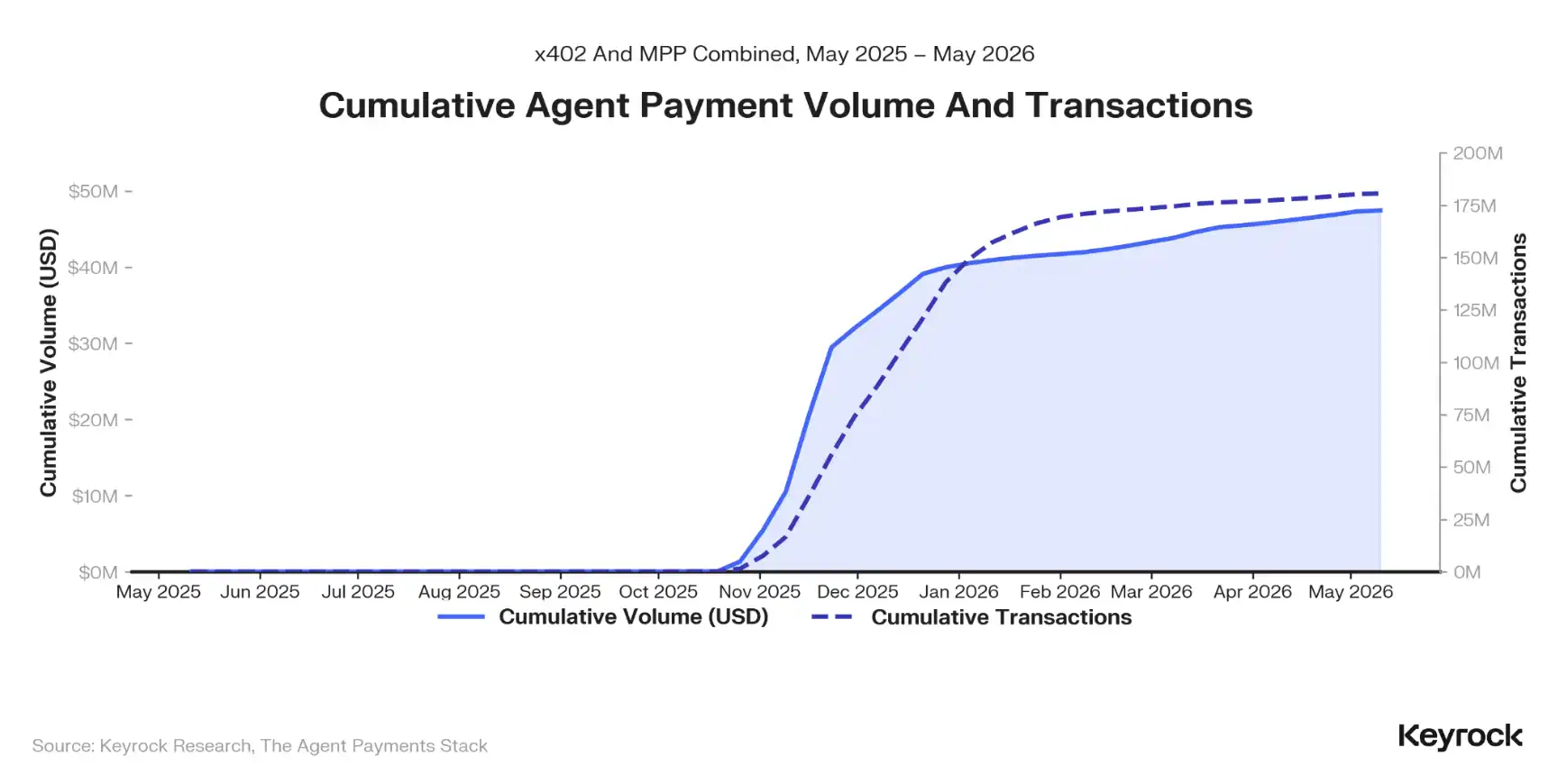
A year ago, machine-to-machine payments were just a concept. Now four competing payment architectures are live, backed by Coinbase, Stripe, Google, Visa, and American Express. AI Agents have settled over $73 million across 176 million transactions. Traditional giants have invested over $8 billion in acquisitions to stake their claim in this new payment stack.

This report, produced in collaboration with Keyrock, Coinbase, and Tempo, examines how this payment stack is being assembled, whether the economic model works, and the obstacles it faces.

Protocols Aren't Competing, They're Stacking

In September 2024, if you wanted an AI Agent to pay for something, there was essentially one insecure option. Twelve months later, four architectures exist, backed by some of tech's biggest companies.

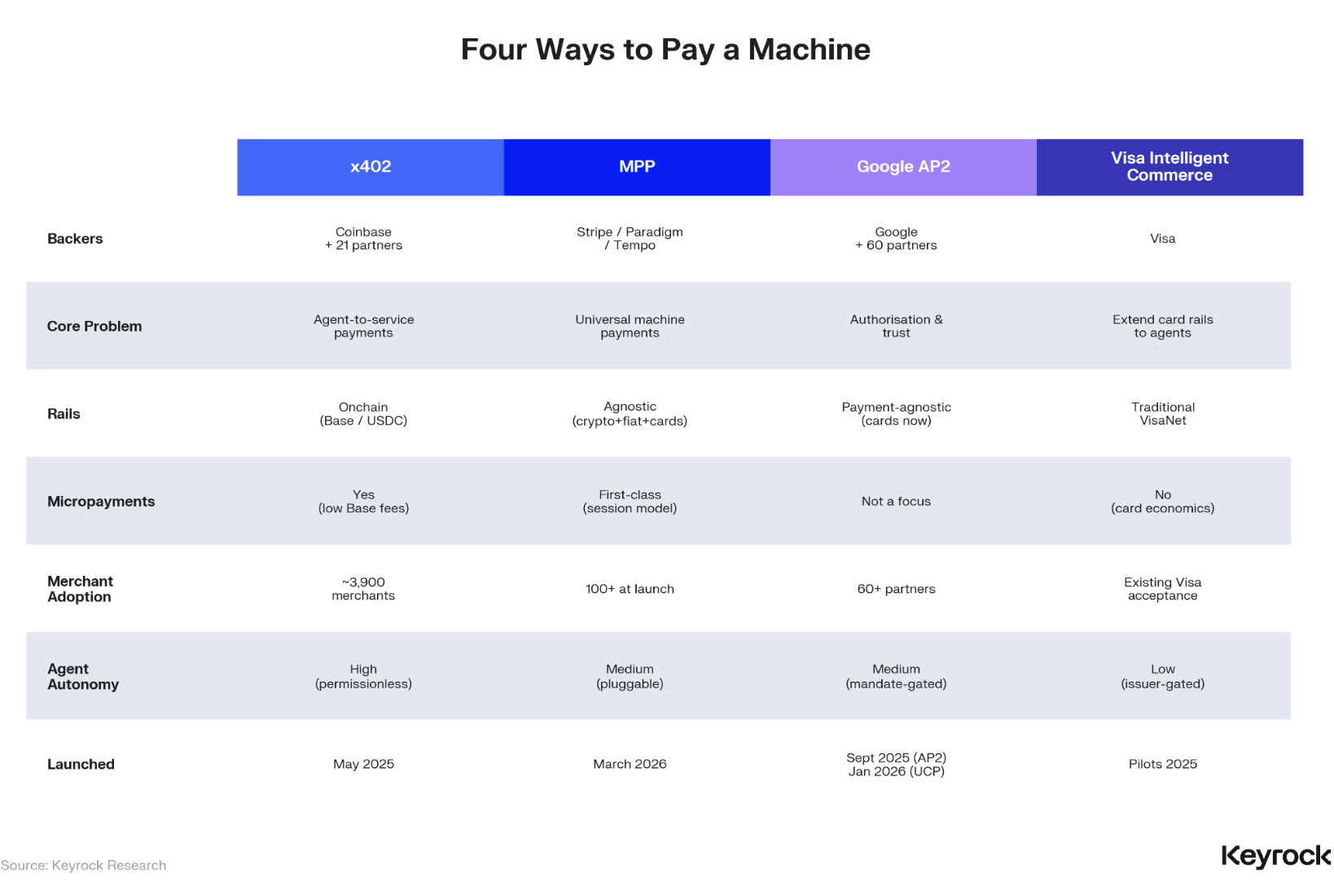
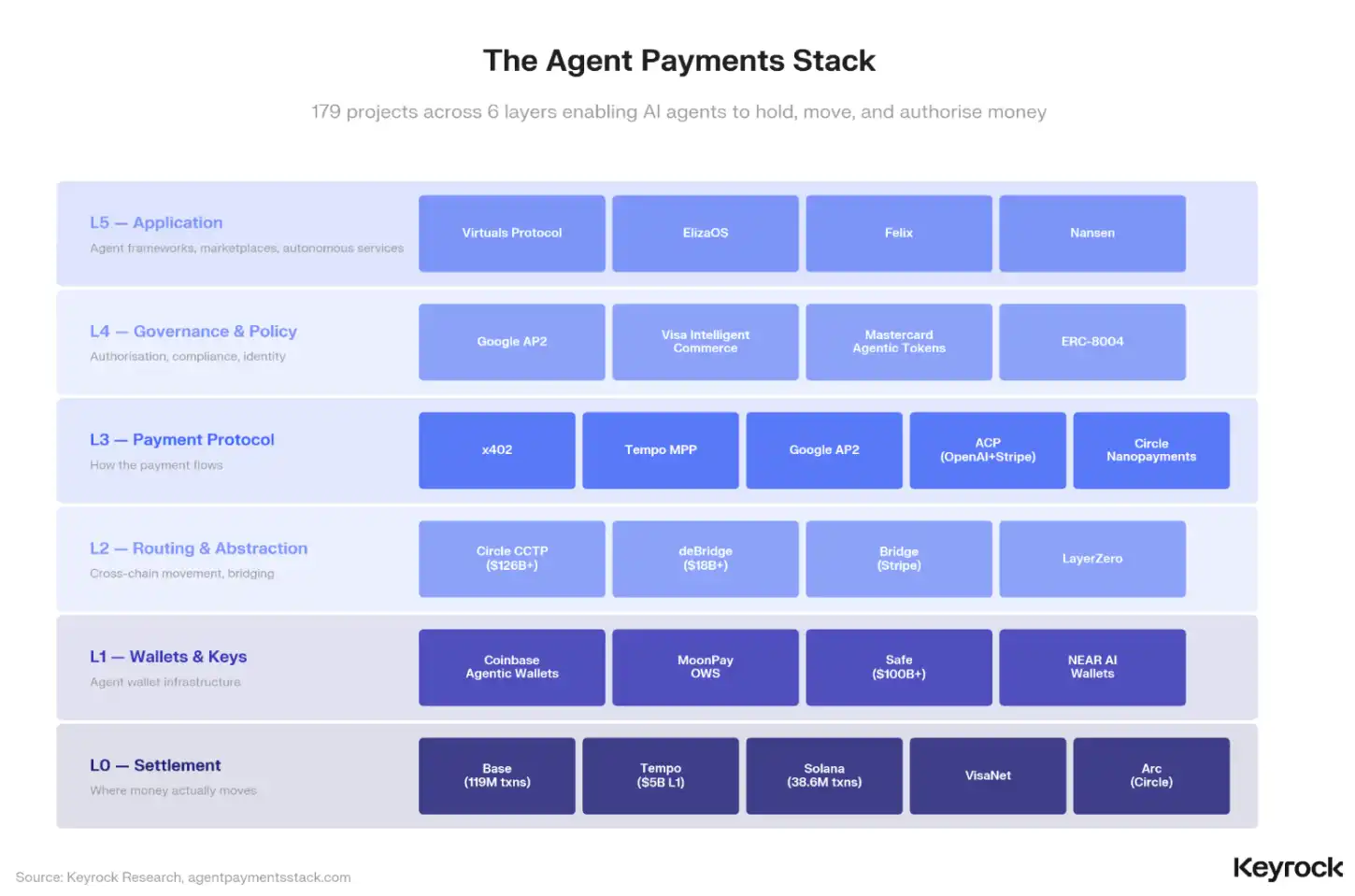
Coinbase built x402, a crypto-native protocol that turns stablecoin wallets into a universal API key. Stripe and Tempo launched MPP, a payment-method-agnostic standard handling bank cards, cryptocurrency, and Lightning through a single HTTP flow. Google assembled AP2, an authorization layer allowing users to delegate payment permissions to Agents via cryptographic signatures. Visa expanded its existing card rails to provide AI-ready tokenized credentials.

What most coverage misses is that these four proposals are not purely competitive. Protocol layers do overlap, but the more important dynamic is that they are assembling into a payment stack. The right question isn't "which protocol will win?" but "which companies control the most layers and thus capture the most value?"

The $0.30 Wall

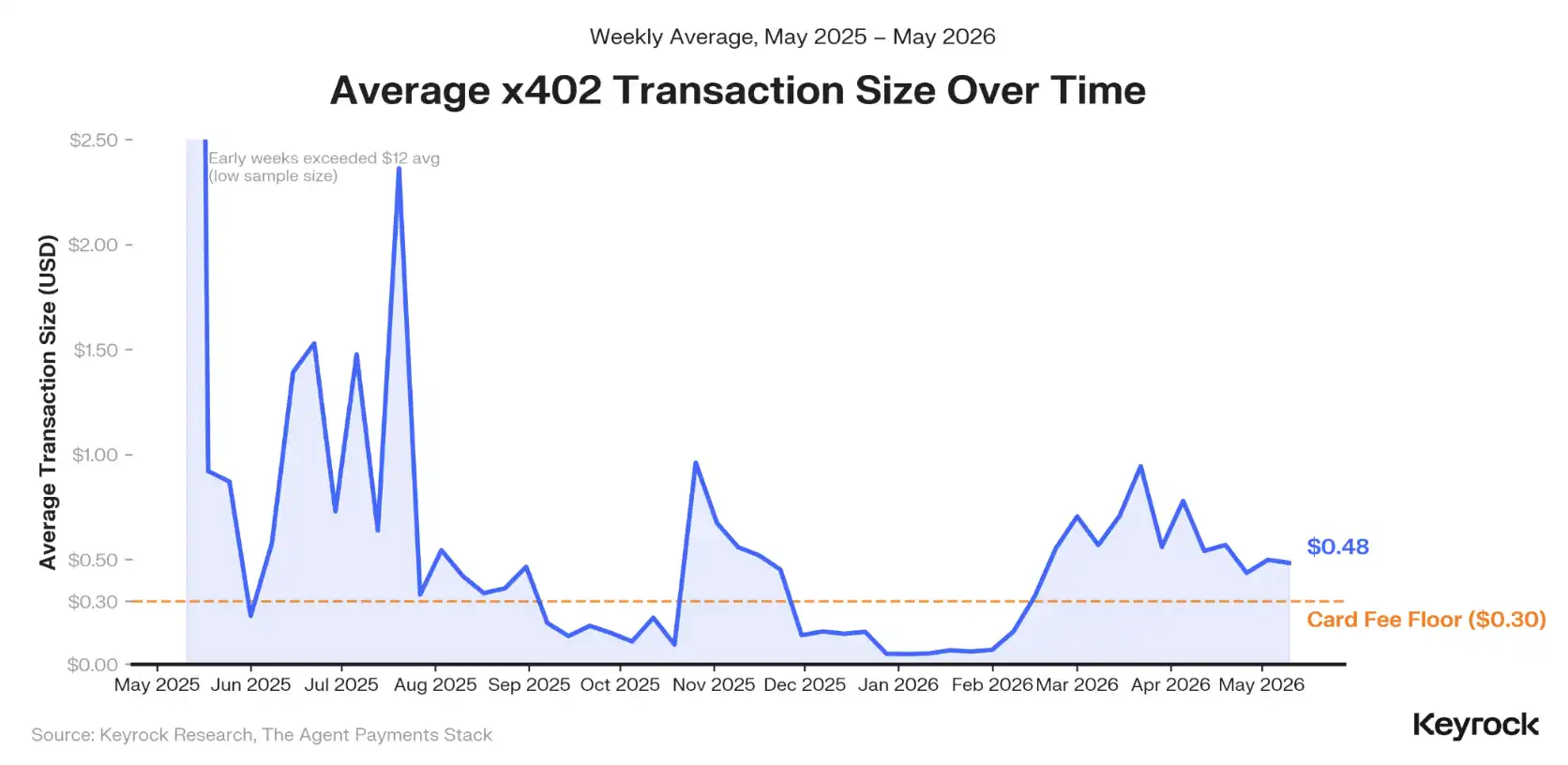
Among the 176 million x402 payments processed so far, the median transaction amount falls between $0.01 and $0.10. 76% of the activity is below the $0.30 baseline card processing fee. This figure almost single-handedly explains why traditional payment rails cannot serve this market. A fixed processing fee of approximately $0.30 per transaction renders micropayments unprofitable. An Agent cannot route a 3-cent payment for a weather API call through Visa.

Layer 2 stablecoin settlement costs $0.0001. For Agents, this means blockchain rails are a necessity.

Single Stablecoin Dominance

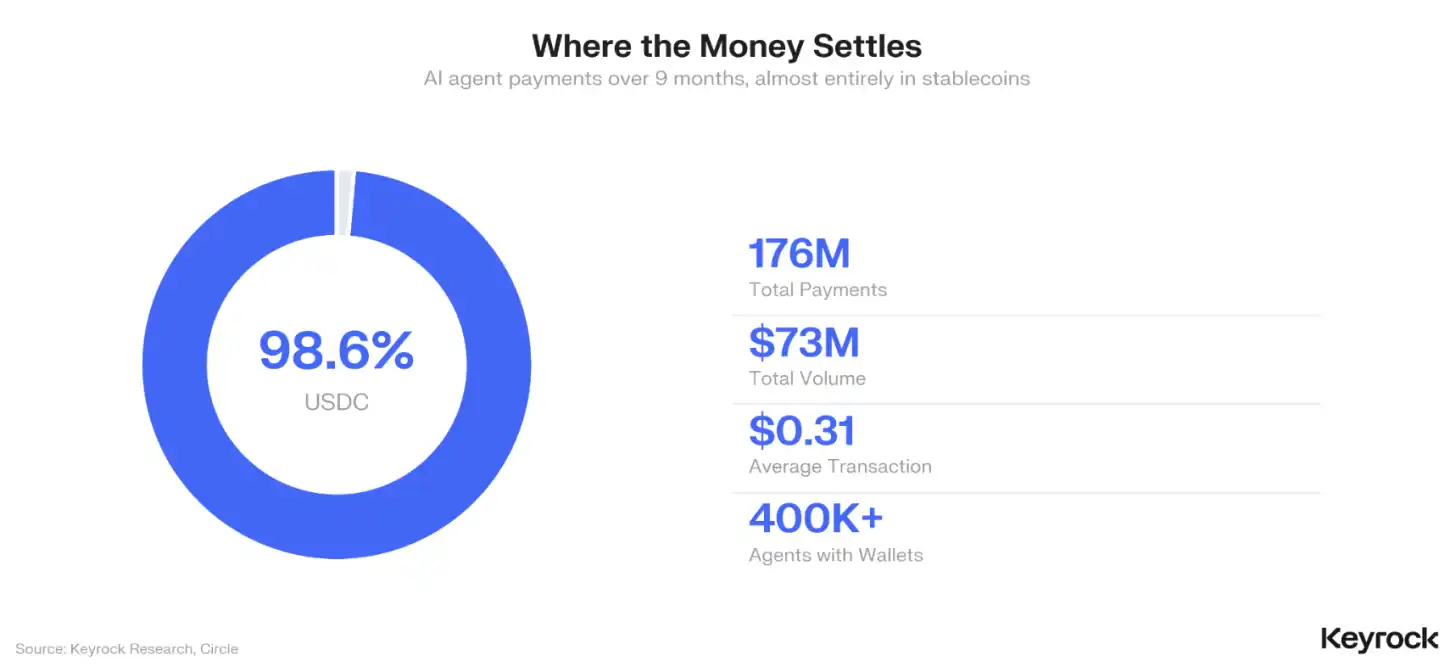
Of those 176 million payments, 98.6% were settled in USDC. Stablecoins have all but defaulted to winning the settlement layer for machine commerce; they are the only instruments that can process small-value transactions without the economic model collapsing.

This concentration is both validation and a vulnerability. It validates Circle's position as the default settlement asset, but it also means the entire Agent payments ecosystem depends on a single stablecoin issuer's reserve management, regulatory standing, and technical infrastructure. No one in the industry is discussing this publicly. We think they should.

The Race for Vertical Integration

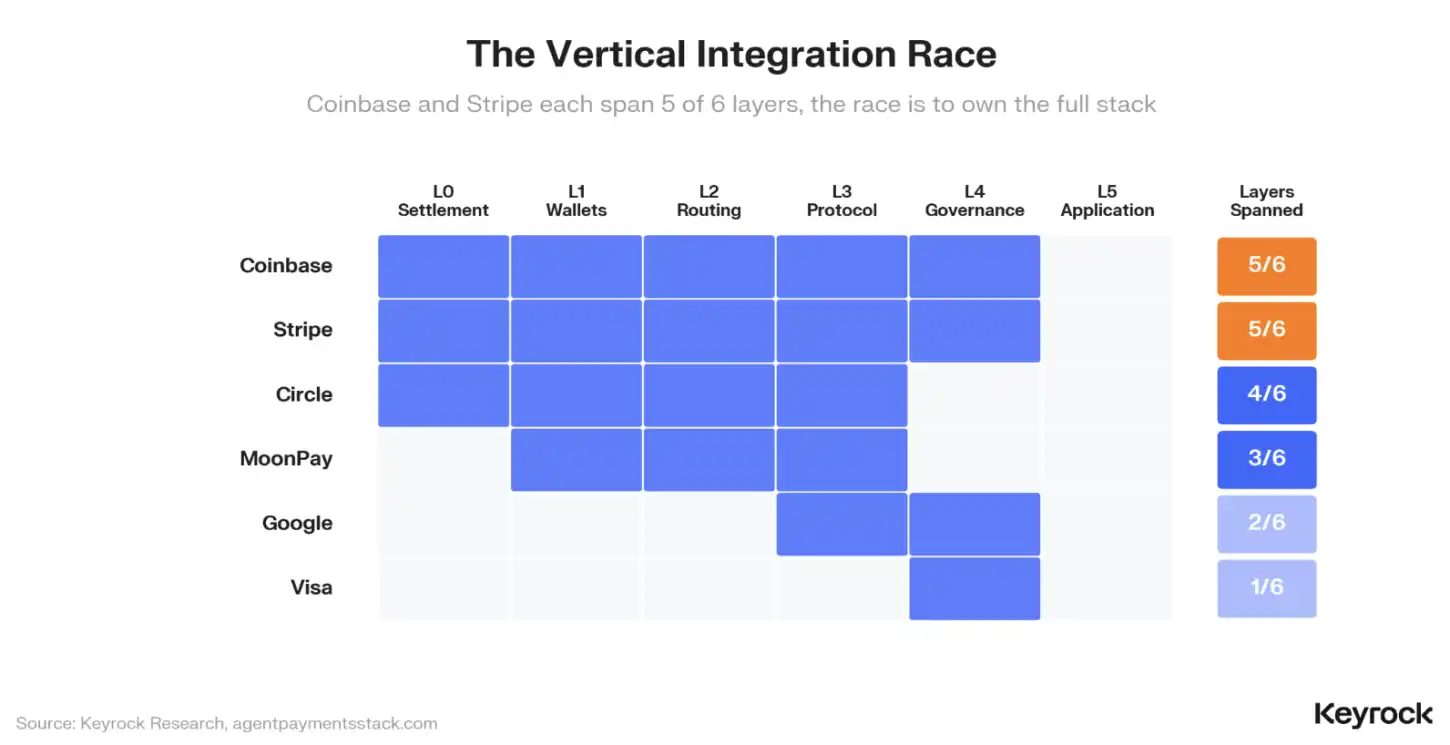
Coinbase and Stripe each cover five of the six layers in the emerging payment stack. Coinbase controls the settlement layer (Base), wallets (Agentic Wallets), routing (internal infrastructure), the payment protocol (x402), and governance (as an AP2 collaborator). Stripe forms a mirror image through Tempo (settlement), Privy (wallets), Bridge (routing, acquired for $1.1 billion), MPP (protocol), and its compliance infrastructure.

Over the past 12 months, traditional giants have spent over $8 billion on acquisitions to fill gaps in their stack coverage. Capital One acquired Brex for $5.15 billion, Mastercard spent $1.8 billion on BVNK, and Stripe bought Bridge. These are infrastructure consolidation moves by companies that see machine payments as a natural expansion of their core business.

From Bot Activity to Agent Commerce

The machine economy has arrived. It just hasn't started doing commerce yet. But the signals are clear: AI Agents account for 37% of all Safe transactions on Gnosis Chain, peaking over 75%. Coinbase has deployed tens of thousands of fenced Agents. Over 104,000 Agents are registered across 15 or more directories and registries.

The shift from extractive bot activity to productive Agent commerce is underway. The payment infrastructure studied in this report is what makes this possible.

Regulation as a Constraint

MiCA, the GENIUS Act, and the EU AI Act will all reach enforcement stages within weeks of each other in mid-2026. None of them address autonomous machine-to-machine transactions. This is not a future problem; it's a current one, playing out on a real-time timeline with real capital at stake.

What Happens Next

The market is moving towards greater Agent autonomy, but we believe the pace will not be set by technology—that's largely ready. The pace will be set by the trust infrastructure that makes it safe. The fully permissionless vision is attractive in theory, but it assumes a level of AI reliability that doesn't exist yet. Until Agents stop hallucinating, they probably shouldn't have unsupervised access to user funds.

We find the bottom-up argument the most compelling framework for what happens next. Crypto rails have already default-won for micropayments. As transaction volumes grow and trust infrastructure matures, increasingly larger transaction amounts will migrate on-chain. The question isn't whether machine-native payments can scale, but how quickly the trust layer can catch up with the settlement layer.

This article is a summary of the report's core findings. The full report delves deeper into the data, including analysis of protocol architectures, insights from interviews with Coinbase and Tempo, economic modeling of transactions, and the regulatory landscape.

Связанные с этим вопросы

QWhat are the key competing payment architectures for AI Agents mentioned in the article, and which companies back them?

AThe article mentions four key competing payment architectures for AI Agents: Coinbase's x402 (a crypto-native protocol), Stripe and Tempo's MPP (a payment-method-agnostic standard), Google's AP2 (an authorization layer), and Visa's extension of its existing card rails to provide AI-ready tokenized credentials.

QWhy are traditional payment rails like Visa considered unsuitable for AI Agent micro-payments according to the report?

ATraditional payment rails like Visa have a fixed processing fee of around $0.30 per transaction. Since the median transaction value for AI Agent payments is between $0.01 and $0.10, with 76% of activity below $0.30, these fees make micro-payments economically unviable. In contrast, Layer 2 stablecoin settlement costs are as low as $0.0001.

QWhich stablecoin dominates the settlement layer for machine-to-machine payments, and what concern does this raise?

AUSDC dominates the settlement layer, accounting for 98.6% of the 176 million payments analyzed. While this validates Circle's position, it also introduces fragility, as the entire AI Agent payment ecosystem depends on the reserve management, regulatory status, and technical infrastructure of a single stablecoin issuer, creating a central point of risk.

QHow are companies like Coinbase and Stripe positioning themselves in the new AI payment stack through vertical integration?

ABoth Coinbase and Stripe are pursuing vertical integration to control multiple layers of the payment stack. Coinbase controls the settlement layer (Base), wallets, routing, payment protocol (x402), and governance. Stripe has a mirroring strategy through Tempo (settlement), Privy (wallets), Bridge (routing, acquired for $1.1B), MPP (protocol), and its compliance infrastructure. This allows them to capture more value from the ecosystem.

QWhat does the article identify as the primary constraint on the pace of adoption for fully autonomous AI Agent payments?

AThe article identifies trust infrastructure, not technology, as the primary constraint. While the technical capability for autonomous payments exists, the pace of adoption will be set by the development of security and reliability measures. Until AI Agents can operate without 'hallucinations' or errors, they should not have unsupervised access to user funds, limiting full autonomy.

Похожее

Three Years Later: Looking Back at My Predictions About ChatGPT in 2023

Three Years Later: Revisiting My 2023 Predictions on ChatGPT In March 2023, shortly after ChatGPT's launch, I made 20 predictions about its future. Now, in mid-2026, I've used AI agents to fact-check each one against the latest data. Overall, most major directional forecasts were correct, with only one outright error (incorrectly stating GPT-4 had 100 trillion parameters). Key successes included predicting that RAG and retrieval architectures would become the standard for handling knowledge and hallucinations, that natural language interfaces (LUI) would create a massive new industry layer beyond the models themselves, and that China would develop viable large language models, significantly closing the performance gap with Western counterparts within about three years. Predictions about the absence of mass unemployment, the rise of a new "robot network" for agent communication, and ChatGPT not possessing consciousness also held true in their core arguments. However, the "devil was in the details." Errors frequently involved specific numbers, timelines, or overlooking distributional effects. I tended to overestimate the speed of adoption (e.g., for agent networks) while underestimating the ultimate scale of capabilities or costs (e.g., AI winning IMO gold without tools, or the extreme capital required for frontier models). Other misjudgments included: underestimating how AI would reinforce, not dissolve, information filter bubbles; incorrectly assuming AI-generated content would easily circumvent copyright (it has instead triggered record-breaking settlements); and misidentifying where value would be captured (it accrued overwhelmingly to the compute layer, like Nvidia, not just the application or model layers). Key lessons from reviewing these predictions are: 1) Directional and mechanistic insights are far more reliable than precise numbers or absolute statements. 2) There's a consistent bias to overestimate short-term speed but underestimate long-term magnitude. 3) Errors often lie in missing distributional impacts within a generally correct aggregate trend. 4) Predictions phrased with nuance and caveats aged the best. 5) Some fundamental debates (e.g., on machine consciousness or the ultimate value chain) remain unresolved even after three years. This exercise is less about scoring the past and more about establishing rules for clearer thinking about the next three years of AI.

marsbit4 ч. назад

Three Years Later: Looking Back at My Predictions About ChatGPT in 2023

marsbit4 ч. назад

Three Years Later: Looking Back on My 2023 Predictions for ChatGPT

Looking Back After Three Years: Revisiting My 2023 Predictions on ChatGPT In March 2023, shortly after ChatGPT's debut and before GPT-4's release, I made over twenty predictions about AI's future based on limited information and intuition. Now, in May 2026, I revisited those forecasts using an AI-driven analysis with 41 Opus 4.8 agents to cross-reference them with the latest data. The assessment used symbols: ✅ Correct, 🟢 Mostly Correct, 🟡 Partially Correct, ❌ Incorrect. Overall, the directional judgments held up well, with only one major factual error regarding GPT-4's rumored parameter size (incorrectly cited as 100T). However, nuances and degrees of accuracy revealed more. **What Was Largely Correct:** Predictions about mechanisms and directions proved accurate. The rise of RAG (Retrieval-Augmented Generation) as the standard architecture for combating AI hallucination was confirmed, as was the transformative potential of LUI (Language User Interface) in creating a new industry layer atop GUIs. The emergence of "robot networks" (agent-to-agent communication protocols) and China's rapid catch-up in developing capable large models (closing the performance gap with top models to ~2.7%) were also on point. The analysis affirmed that LLMs lack consciousness and that the Turing Test merely measures perceived intelligence. **What Was Off Target:** Errors often involved specific numbers, over-optimistic timelines, or misjudged distributions. The prediction that value would primarily accrue to the application layer was half-right but missed NVIDIA's dominance as the profitable infrastructure layer. Forecasts about AI circumventing copyright issues and fostering a "global common ground" by averaging human viewpoints were incorrect; instead, major copyright settlements occurred and AI personalization is increasing. Estimates for model training costs ("$5-10 billion cap") were significantly off, underestimating frontier costs and overestimating replication costs. The notion that LLMs could never do complex math without tools was disproven by later models winning IMO gold. **Key Patterns from the Review:** 1. **Direction over precision:** Judgments about mechanisms and trends were more reliable than specific numbers or definitive statements. 2. **Timing bias:** There was a tendency to overestimate short-term speed but underestimate long-term magnitude and transformation. 3. **The distribution blind spot:** Aggregate-level correctness often masked uneven impacts (e.g., on young professionals' employment). 4. **The value of qualifiers:** Predictions framed with caution (e.g., "reportedly," "for now," "prototype in 2-3 years") aged better. 5. **Some debates continue:** Issues like the nature of "emergent abilities" or machine consciousness remain unresolved. This three-year review highlights that while seeing the big picture is crucial, humility regarding specifics, timelines, and disparate impacts is essential for future forecasting.

链捕手6 ч. назад

Three Years Later: Looking Back on My 2023 Predictions for ChatGPT

链捕手6 ч. назад

AI Bubble Warning: AI Investments Are Negative Returns for Most Tech Giants

The article issues a stark warning about a potential AI investment bubble. It notes that while the AI boom shares similarities with the TMT bubble of the late 1990s, its scale is vastly larger, currently driving 93% of U.S. GDP growth. Major hyperscale cloud providers like Microsoft, Alphabet, Amazon, Meta, and Oracle are planning to invest trillions in AI data centers over the coming years. However, calculations based on analyst projections for 2025-2030 reveal a concerning math problem: expected capital expenditure growth far outpaces projected revenue growth. Even under an extremely optimistic scenario of zero costs, the implied return on investment for most of these tech giants (except Amazon) is deeply negative. This suggests that the current trajectory could lead to one of history's largest shareholder value destruction events. The piece outlines two potential escapes: AI generating vastly more revenue than currently anticipated—a near-impossible task—or a significant cutback in the planned investment splurge. The latter scenario could trigger a domino effect, severely impacting the entire tech supply chain (from Nvidia to TSMC), potentially pushing the U.S. economy into recession, and causing a major stock market downturn. The author suggests upcoming high-profile IPOs by companies like OpenAI and Anthropic might represent a transfer of risk from early investors to public market participants. While the peak of the hype cycle might sustain investment through 2026, the fundamental financial dilemma remains unresolved, setting the stage for a potential market correction in 2027 or 2028, similar to the years following Alan Greenspan's "irrational exuberance" warning.

marsbit7 ч. назад

AI Bubble Warning: AI Investments Are Negative Returns for Most Tech Giants

marsbit7 ч. назад

From Tokens to Machine Labor: AI is Shifting from Tool to "Worker"

The article "From Token to Machine Labor: AI is Evolving from Tool to 'Worker'" argues that the business model for AI is shifting beyond simply selling computational resources (tokens, GPU hours) or model access. Instead, a new "machine labor market" is emerging, where the core economic transaction is the purchase of economically useful work directly performed by software. The central thesis is that AI pricing will evolve through four stages: 1) raw tokens, 2) standardized LLM capabilities (e.g., text generation), 3) industry-specific labor markets (e.g., legal review, radiology), and finally 4) a programmable results market where tasks like resolving a support ticket are bid on and priced based on outcome. In this future, buyers will care less about *which* model or GPU completes a task and more about whether the work meets specified standards for accuracy, latency, and cost. This transition reframes the impact of AI on human labor. Rather than simple replacement, it suggests a re-coordination where machines handle standardized, verifiable work, freeing humans for roles involving oversight, context management, responsibility, and final judgment. In some cases, this "last 1%" of human input becomes more valuable as it enables the other 99% to be automated. Furthermore, as AI reduces the cost of work, demand may expand, creating larger markets (e.g., 24/7 customer service) rather than just cheaper versions of existing ones. The article concludes that while infrastructure (GPUs, models, tokens) remains crucial upstream, the market is converging on a simpler, tradeable unit: machine labor that can be defined, measured, priced, and procured based on contractible specifications.

marsbit7 ч. назад

From Tokens to Machine Labor: AI is Shifting from Tool to "Worker"

marsbit7 ч. назад

Xiaomi MiMo's 99% Price Cut is Not Marketing! Luo Fuli Posts on X to Refute Critics

The price of Xiaomi's MiMo-V2.5 series API has been permanently reduced by up to 99%, specifically for the "Input (Cache Hit)" cost, which covers users re-reading historical context in long conversations. MiMo's head, Luo Fuli, published a detailed technical blog to clarify that this drastic price cut stems from genuine engineering breakthroughs, not a marketing stunt or a simple price war. The core of the achievement lies in six key engineering optimizations. First, the model architecture adopts a Hybrid Sliding Window Attention (SWA), reducing the memory footprint (KVCache) to 1/7th of a traditional model. Second, a dual-pool memory management system actually utilizes these savings, allowing a single GPU to handle over 5 times more concurrent users. Third, an upgraded prefix caching mechanism achieves a cache hit rate of 93-95% for repeated reads, meaning most such requests bypass GPU computation entirely. Fourth, a self-developed distributed cache (GCache) utilizes idle SSD space on existing GPU servers, eliminating additional storage costs. Fifth, an intelligent scheduling system (LLM-Router) efficiently routes requests to maximize cache reuse and performance. Sixth, Multi-Token Prediction (MTP) accelerates the model's text generation ("output") side. Together, these systemic optimizations dramatically lower the real computational cost per request, enabling the 99% price reduction for cached inputs while reportedly maintaining positive gross margins. Luo Fuli's disclosure aims to shift the narrative from "price war" to a demonstration of substantive AI engineering progress.

marsbit9 ч. назад

Xiaomi MiMo's 99% Price Cut is Not Marketing! Luo Fuli Posts on X to Refute Critics

marsbit9 ч. назад

Торговля

Спот
Фьючерсы

Популярные статьи

Неделя обучения по популярным токенам (2): 2026 может стать годом приложений реального времени, сектор AI продолжает оставаться в тренде

2025 год — год институциональных инвесторов, в будущем он будет доминировать в приложениях реального времени.

1.8k просмотров всегоОпубликовано 2025.12.16Обновлено 2025.12.16

Неделя обучения по популярным токенам (2): 2026 может стать годом приложений реального времени, сектор AI продолжает оставаться в тренде

Обсуждения

Добро пожаловать в Сообщество HTX. Здесь вы сможете быть в курсе последних новостей о развитии платформы и получить доступ к профессиональной аналитической информации о рынке. Мнения пользователей о цене на AI (AI) представлены ниже.

活动图片