Machines Pay, Humans Reap: Coinbase, Stripe, Google, Visa's AI Payments Land Grab

marsbitОпубликовано 2026-05-22Обновлено 2026-05-22

Введение

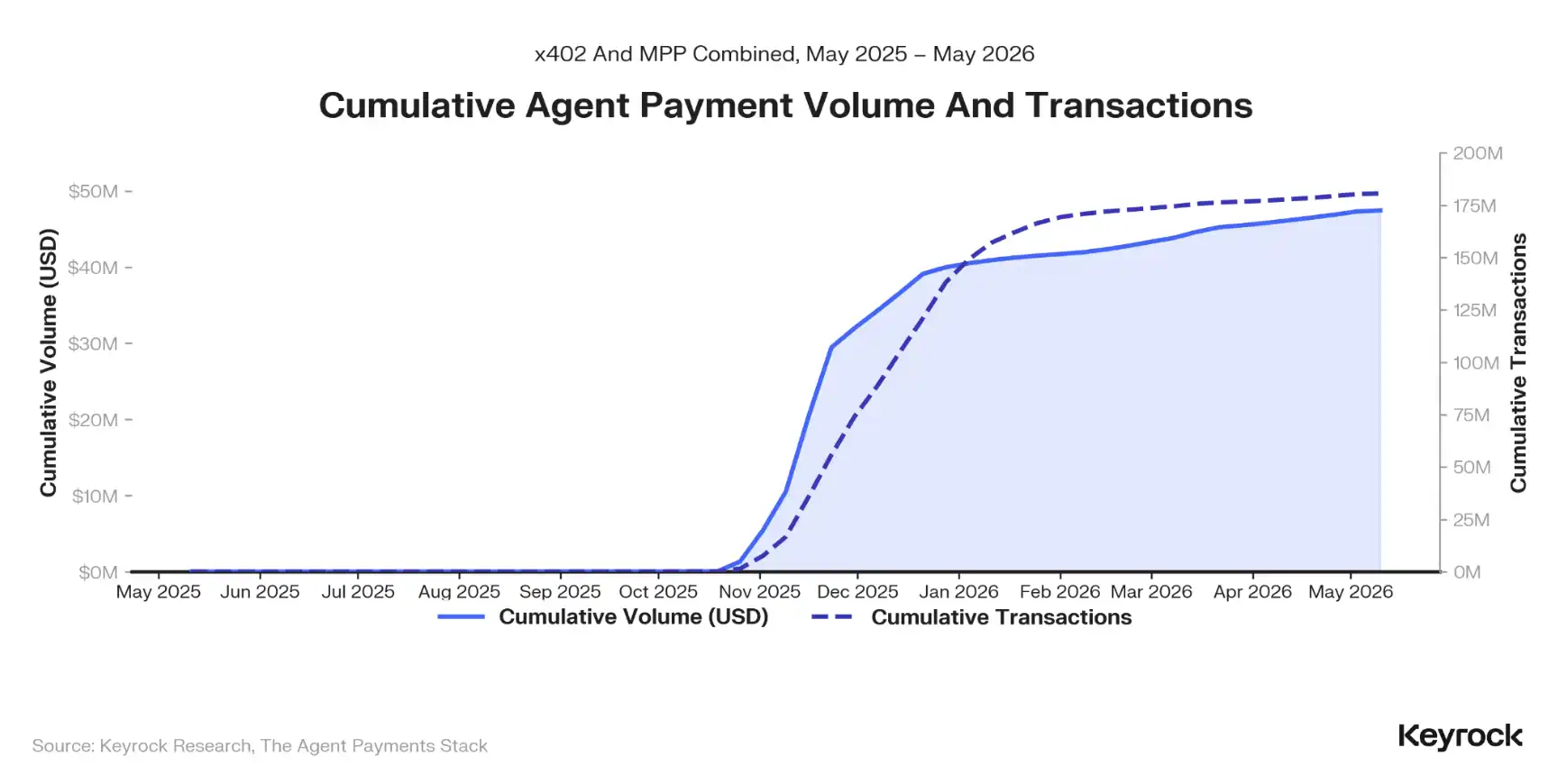
One year after being a concept, machine-to-machine payments are now a battleground. Four competing architectures are already deployed by Coinbase (x402 protocol), Stripe/Tempo (MPP standard), Google (AP2 authorization layer), and Visa (tokenized credentials). AI Agents have already settled over $73 million across 176 million transactions, with a median value between $0.01 and $0.10. A key barrier is the ~$0.30 minimum fee of traditional card rails, making them unviable for micro-payments. In contrast, Layer 2 stablecoin settlement costs $0.0001, with USDC dominating 98.6% of all transactions. The dynamic is less about a single winning protocol and more about vertical integration within a new payment stack. Companies like Coinbase and Stripe control multiple layers (settlement, wallet, routing, protocol, governance), driving over $8 billion in recent acquisitions to solidify their positions. The shift from extractive bot activity to productive Agent commerce is underway, with AI Agents accounting for 37% of all Gnosis Chain Safe transactions. The pace of adoption will be set not by available technology but by the development of trust and safety infrastructure for autonomous transactions. While a fully permissionless vision is appealing, supervised access remains crucial until AI reliability improves. Regulatory frameworks like MiCA and the EU AI Act, due in mid-2026, currently lag behind this rapidly evolving reality. The foundational argument is clear: crypto rails have alr...

Author:Ben Harvey

Compilation: TechFlow

TechFlow Introduction: A year ago, machine-to-machine payments were just a concept. Now, Coinbase, Stripe, Google, and Visa have deployed four competing architectures. AI Agents have already completed 176 million transactions and settled $73 million. Traditional giants have spent over $8 billion on acquisitions to secure their position. This is not a future narrative but an ongoing restructuring of payment infrastructure—whoever controls the most layers will capture the most value.

A year ago, machine-to-machine payments were just a concept. Now four competing payment architectures are live, backed by Coinbase, Stripe, Google, Visa, and American Express. AI Agents have settled over $73 million across 176 million transactions. Traditional giants have invested over $8 billion in acquisitions to stake their claim in this new payment stack.

This report, produced in collaboration with Keyrock, Coinbase, and Tempo, examines how this payment stack is being assembled, whether the economic model works, and the obstacles it faces.
Protocols Aren't Competing, They're Stacking

In September 2024, if you wanted an AI Agent to pay for something, there was essentially one insecure option. Twelve months later, four architectures exist, backed by some of tech's biggest companies.

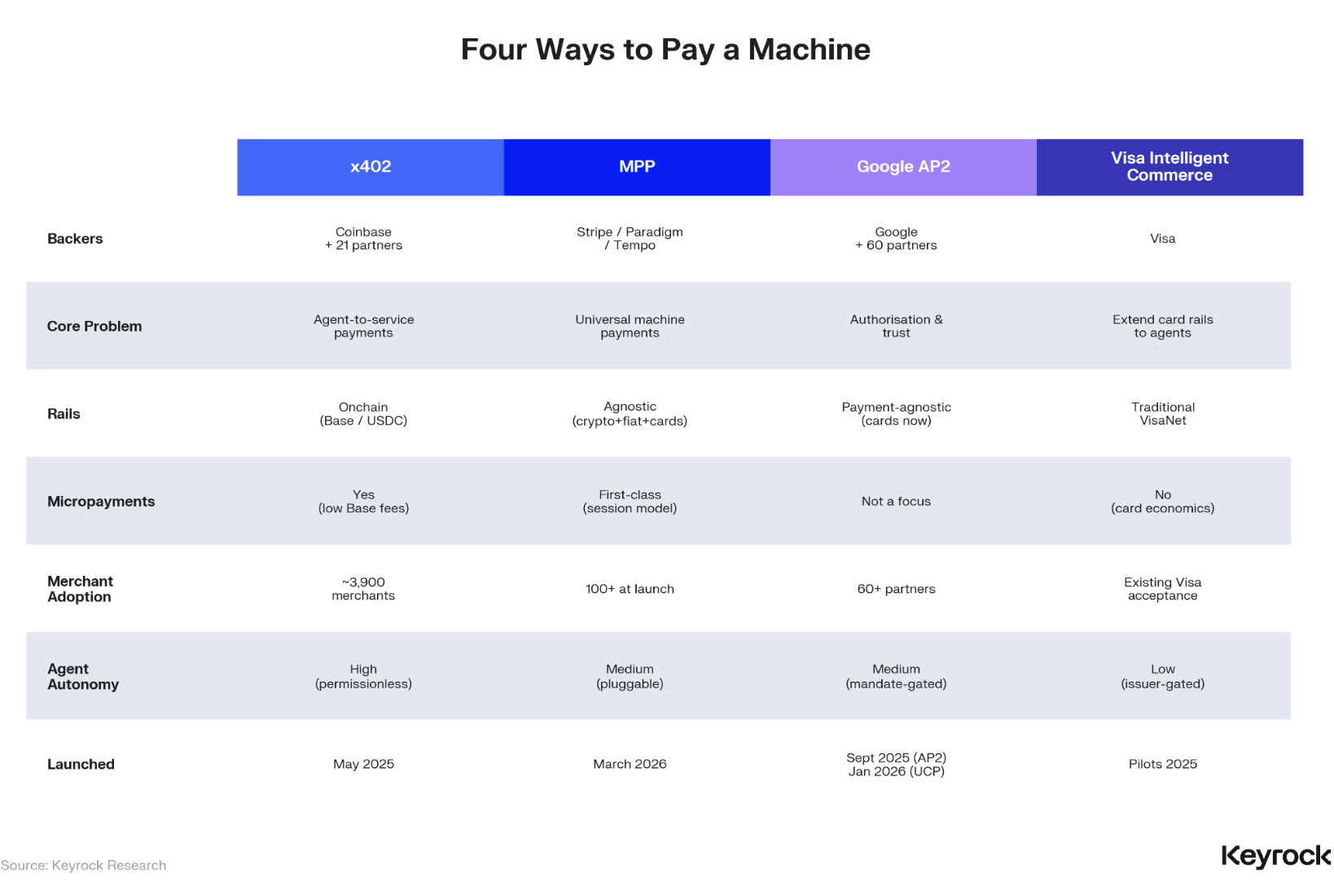
Coinbase built x402, a crypto-native protocol that turns stablecoin wallets into a universal API key. Stripe and Tempo launched MPP, a payment-method-agnostic standard handling bank cards, cryptocurrency, and Lightning through a single HTTP flow. Google assembled AP2, an authorization layer allowing users to delegate payment permissions to Agents via cryptographic signatures. Visa expanded its existing card rails to provide AI-ready tokenized credentials.

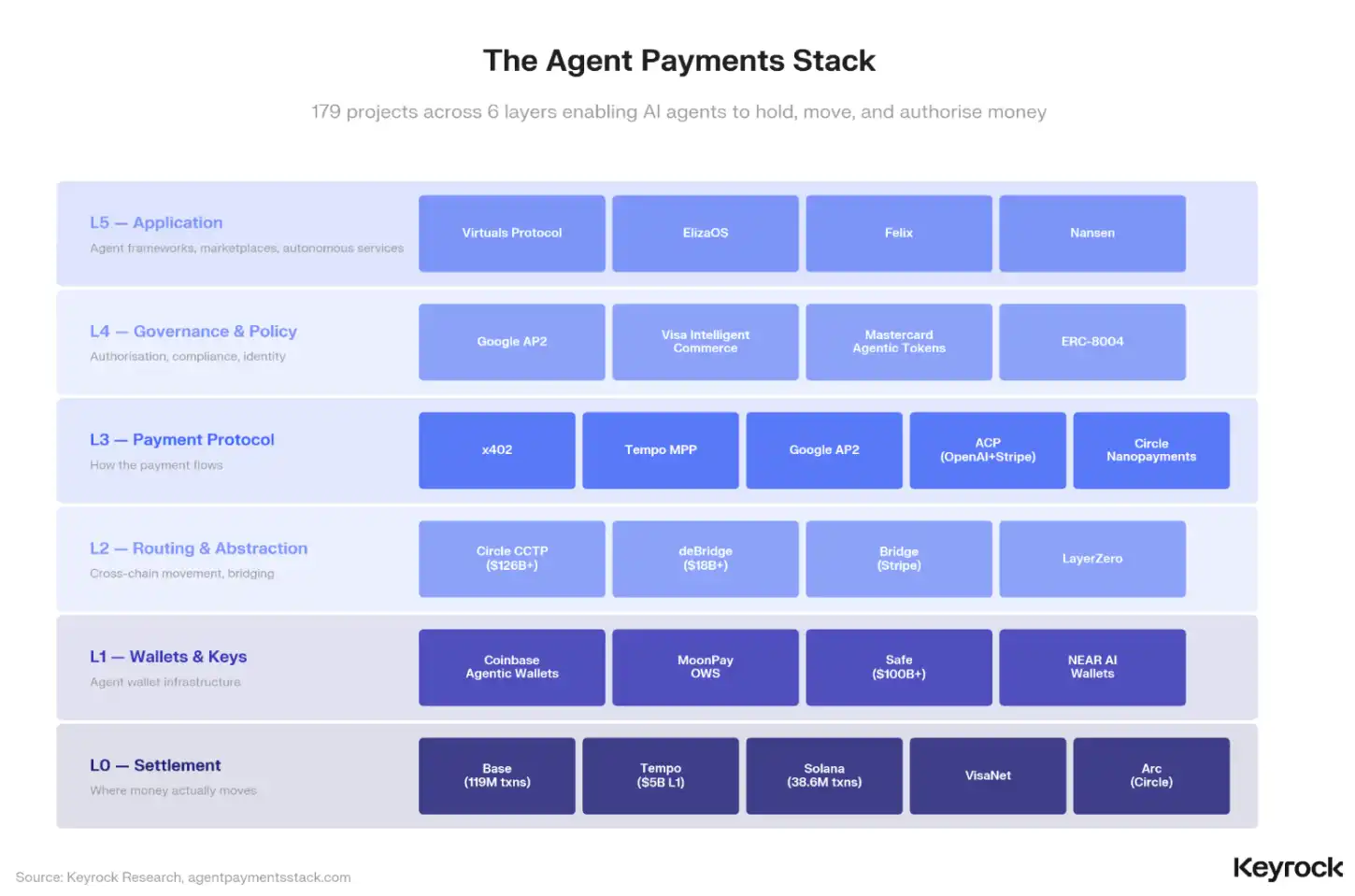
What most coverage misses is that these four proposals are not purely competitive. Protocol layers do overlap, but the more important dynamic is that they are assembling into a payment stack. The right question isn't "which protocol will win?" but "which companies control the most layers and thus capture the most value?"
The $0.30 Wall

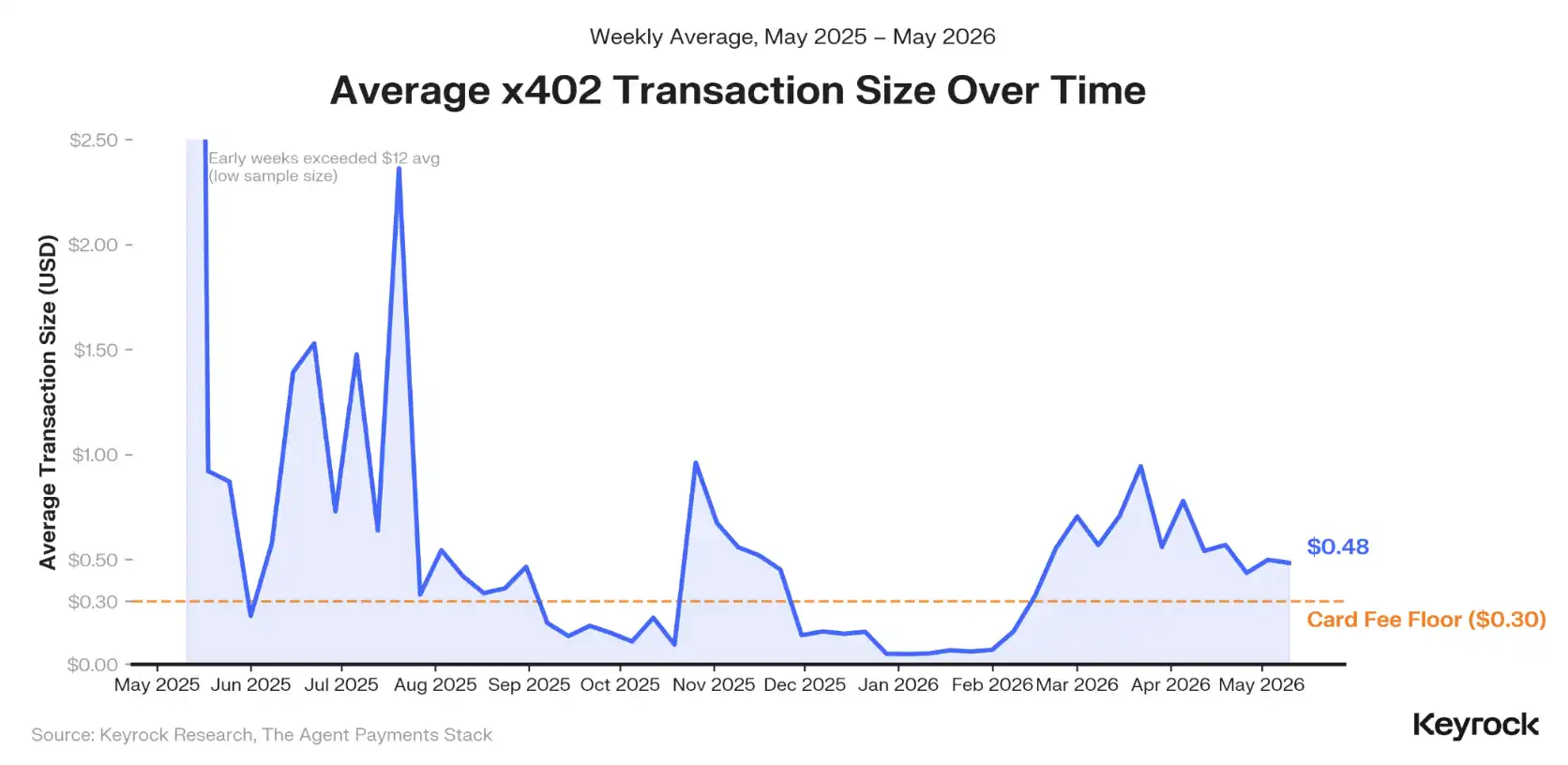
Among the 176 million x402 payments processed so far, the median transaction amount falls between $0.01 and $0.10. 76% of the activity is below the $0.30 baseline card processing fee. This figure almost single-handedly explains why traditional payment rails cannot serve this market. A fixed processing fee of approximately $0.30 per transaction renders micropayments unprofitable. An Agent cannot route a 3-cent payment for a weather API call through Visa.

Layer 2 stablecoin settlement costs $0.0001. For Agents, this means blockchain rails are a necessity.
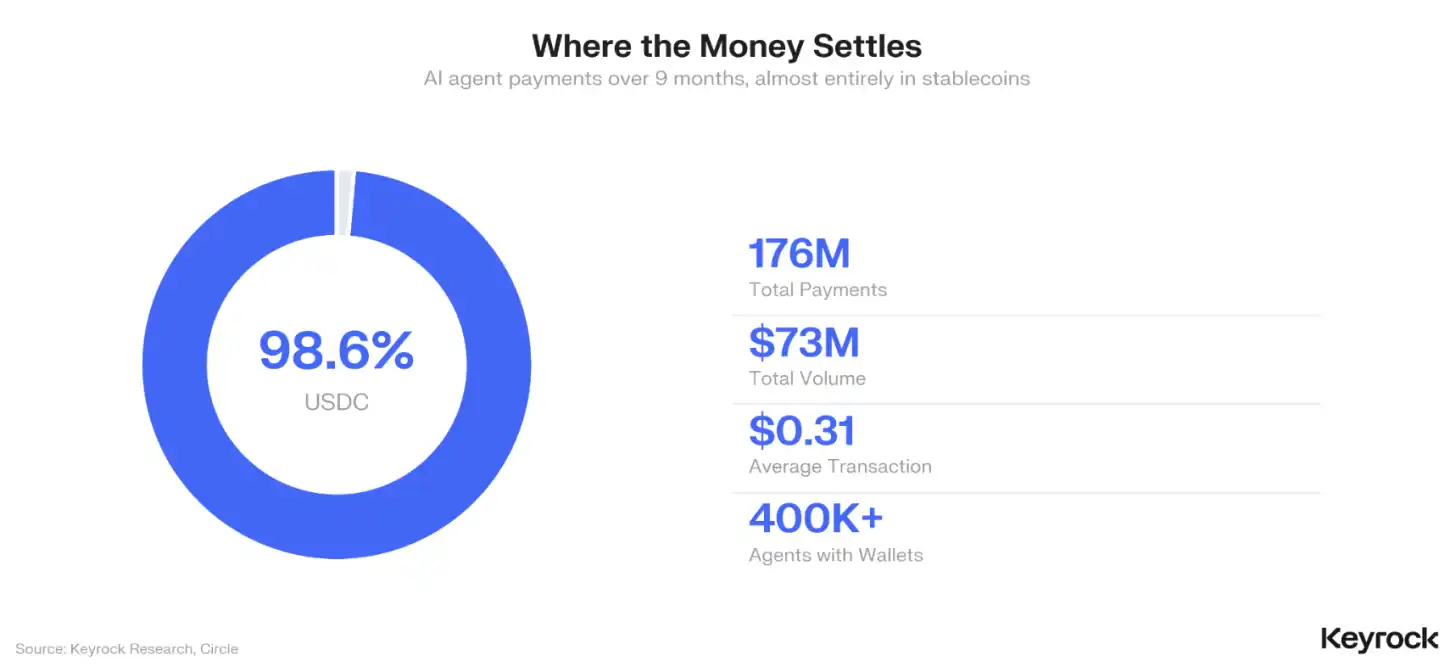
Single Stablecoin Dominance

Of those 176 million payments, 98.6% were settled in USDC. Stablecoins have all but defaulted to winning the settlement layer for machine commerce; they are the only instruments that can process small-value transactions without the economic model collapsing.

This concentration is both validation and a vulnerability. It validates Circle's position as the default settlement asset, but it also means the entire Agent payments ecosystem depends on a single stablecoin issuer's reserve management, regulatory standing, and technical infrastructure. No one in the industry is discussing this publicly. We think they should.
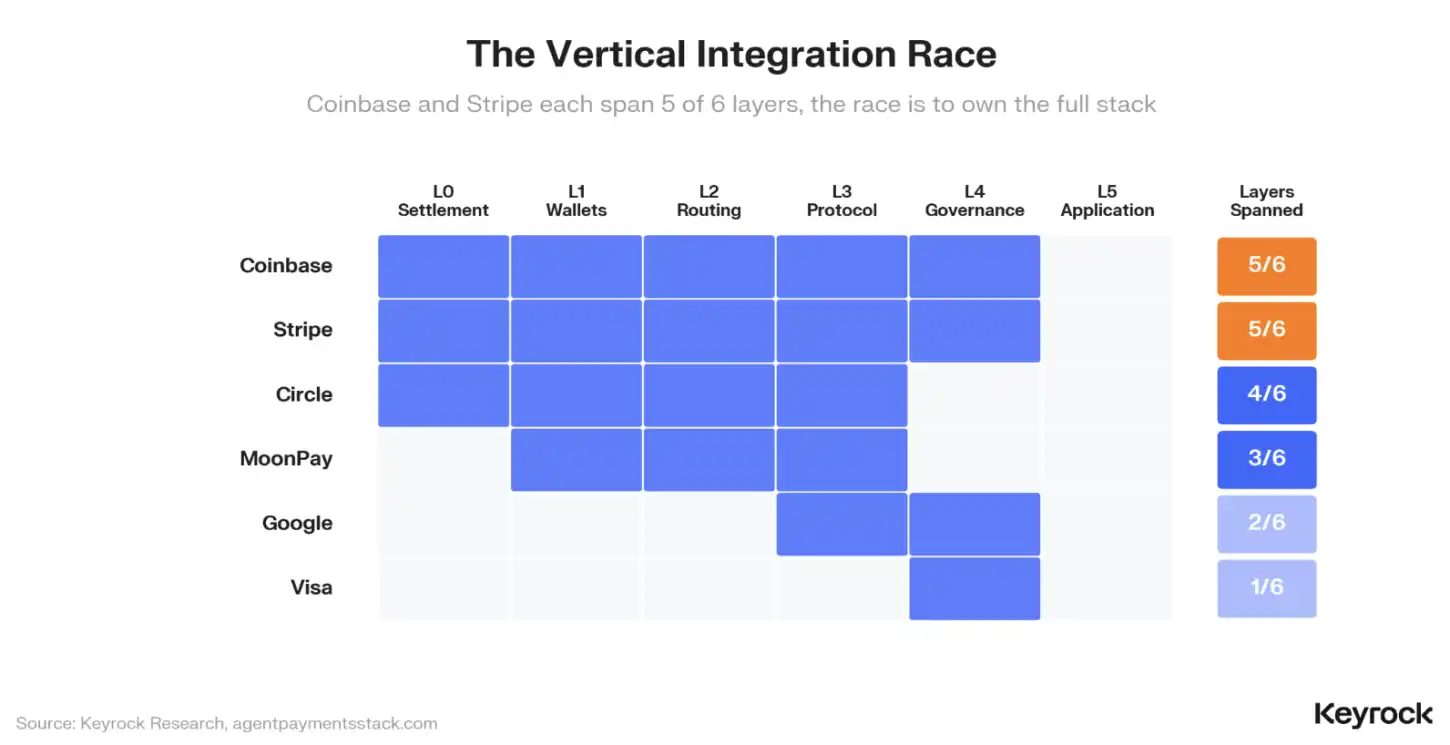
The Race for Vertical Integration

Coinbase and Stripe each cover five of the six layers in the emerging payment stack. Coinbase controls the settlement layer (Base), wallets (Agentic Wallets), routing (internal infrastructure), the payment protocol (x402), and governance (as an AP2 collaborator). Stripe forms a mirror image through Tempo (settlement), Privy (wallets), Bridge (routing, acquired for $1.1 billion), MPP (protocol), and its compliance infrastructure.

Over the past 12 months, traditional giants have spent over $8 billion on acquisitions to fill gaps in their stack coverage. Capital One acquired Brex for $5.15 billion, Mastercard spent $1.8 billion on BVNK, and Stripe bought Bridge. These are infrastructure consolidation moves by companies that see machine payments as a natural expansion of their core business.
From Bot Activity to Agent Commerce

The machine economy has arrived. It just hasn't started doing commerce yet. But the signals are clear: AI Agents account for 37% of all Safe transactions on Gnosis Chain, peaking over 75%. Coinbase has deployed tens of thousands of fenced Agents. Over 104,000 Agents are registered across 15 or more directories and registries.

The shift from extractive bot activity to productive Agent commerce is underway. The payment infrastructure studied in this report is what makes this possible.
Regulation as a Constraint

MiCA, the GENIUS Act, and the EU AI Act will all reach enforcement stages within weeks of each other in mid-2026. None of them address autonomous machine-to-machine transactions. This is not a future problem; it's a current one, playing out on a real-time timeline with real capital at stake.

What Happens Next

The market is moving towards greater Agent autonomy, but we believe the pace will not be set by technology—that's largely ready. The pace will be set by the trust infrastructure that makes it safe. The fully permissionless vision is attractive in theory, but it assumes a level of AI reliability that doesn't exist yet. Until Agents stop hallucinating, they probably shouldn't have unsupervised access to user funds.

We find the bottom-up argument the most compelling framework for what happens next. Crypto rails have already default-won for micropayments. As transaction volumes grow and trust infrastructure matures, increasingly larger transaction amounts will migrate on-chain. The question isn't whether machine-native payments can scale, but how quickly the trust layer can catch up with the settlement layer.

This article is a summary of the report's core findings. The full report delves deeper into the data, including analysis of protocol architectures, insights from interviews with Coinbase and Tempo, economic modeling of transactions, and the regulatory landscape.


Связанные с этим вопросы

QWhat are the key competing payment architectures for AI Agents mentioned in the article, and which companies back them?

AThe article mentions four key competing payment architectures for AI Agents: Coinbase's x402 (a crypto-native protocol), Stripe and Tempo's MPP (a payment-method-agnostic standard), Google's AP2 (an authorization layer), and Visa's extension of its existing card rails to provide AI-ready tokenized credentials.

QWhy are traditional payment rails like Visa considered unsuitable for AI Agent micro-payments according to the report?

ATraditional payment rails like Visa have a fixed processing fee of around $0.30 per transaction. Since the median transaction value for AI Agent payments is between $0.01 and $0.10, with 76% of activity below $0.30, these fees make micro-payments economically unviable. In contrast, Layer 2 stablecoin settlement costs are as low as $0.0001.

QWhich stablecoin dominates the settlement layer for machine-to-machine payments, and what concern does this raise?

AUSDC dominates the settlement layer, accounting for 98.6% of the 176 million payments analyzed. While this validates Circle's position, it also introduces fragility, as the entire AI Agent payment ecosystem depends on the reserve management, regulatory status, and technical infrastructure of a single stablecoin issuer, creating a central point of risk.

QHow are companies like Coinbase and Stripe positioning themselves in the new AI payment stack through vertical integration?

ABoth Coinbase and Stripe are pursuing vertical integration to control multiple layers of the payment stack. Coinbase controls the settlement layer (Base), wallets, routing, payment protocol (x402), and governance. Stripe has a mirroring strategy through Tempo (settlement), Privy (wallets), Bridge (routing, acquired for $1.1B), MPP (protocol), and its compliance infrastructure. This allows them to capture more value from the ecosystem.

QWhat does the article identify as the primary constraint on the pace of adoption for fully autonomous AI Agent payments?

AThe article identifies trust infrastructure, not technology, as the primary constraint. While the technical capability for autonomous payments exists, the pace of adoption will be set by the development of security and reliability measures. Until AI Agents can operate without 'hallucinations' or errors, they should not have unsupervised access to user funds, limiting full autonomy.

Похожее

After Burning Tens of Billions of Dollars in Tokens, Silicon Valley Giants Start Limiting Employee Token Usage

After burning tens of billions of dollars on AI tokens, major Silicon Valley firms are now restricting employee usage. Companies like Microsoft, Uber, and Salesforce, which heavily promoted AI for "efficiency," are facing a cost crisis. The practice of "tokenmaxxing"—pushing employees to maximize AI tool usage—led to wasteful spending on trivial tasks like checking the weather or writing birthday messages, with studies showing significant hidden costs for bug fixes and code rewrites. The core issue is a misalignment between individual productivity gains and actual business value. While employees use AI to automate tasks they dislike, such as writing reports, this often doesn't translate to increased company revenue or improved core business outcomes. For instance, AI-generated code speeds up development but also sees an 800% increase in "code churn" (code being discarded or rewritten). As a result, only 14% of CFOs report seeing a clear, measurable return on AI investments. Firms are now shifting strategies. Microsoft has revoked most internal licenses for Claude Code, while others are implementing monitoring and cost controls. New tools from companies like Harness and CloudZero aim to track AI spending and tie costs to business results. Some AI vendors, like HubSpot, are moving from token-based pricing to charging based on outcomes, such as "resolved conversations" or "leads generated." This represents a necessary correction in the AI adoption cycle. The challenge now is for companies to move beyond using AI merely to speed up old tasks and instead rethink their workflows and business models fundamentally. The future of enterprise AI depends on proving its value, not just its usage.

marsbit5 мин. назад

After Burning Tens of Billions of Dollars in Tokens, Silicon Valley Giants Start Limiting Employee Token Usage

marsbit5 мин. назад

I've Been a VC in Web3 for Nine Years: Asian Funds Are Experiencing "Hell Mode"

After nine years as a Web3 VC, the author observes a severe downturn in Asia's crypto venture capital scene, with many funds disappearing or pivoting away. The market has cooled dramatically since the 2021-2024 frenzy, leading to fewer deals and active investors. IOSG Ventures, a firm that has endured three market cycles, has adapted its strategy: shifting from 80-90% early-stage investments to a 50% early-stage, 30% post-TGE, and 20% OTC portfolio to find better value and liquidity. The current bear market is described as "hell mode" for Asian funds due to scarce LP capital, forcing extreme precision in targeting only top projects. The author argues the core industry problem has been the disconnect between tokens and real value, where tokens served as fundraising tools without granting holders rights to protocol revenue. A positive shift is emerging where projects like Uniswap and Morpho are programmatically binding token value to protocol profits. Investment focus has moved towards fundamentals: real-yield financial infrastructure (stablecoins, lending) and crypto-native AI infrastructure, while avoiding narrative-driven projects. The conclusion is that true, durable companies are born in pessimistic times when focus shifts to real user needs and sustainable business models. The industry's future will be shaped by those who remain after the泡沫 dissipates.

marsbit30 мин. назад

I've Been a VC in Web3 for Nine Years: Asian Funds Are Experiencing "Hell Mode"

marsbit30 мин. назад

Cango Releases Q1 Financial Report: Total Revenue of $102 Million, Business Expands into AI Computing Infrastructure

Cango Releases Q1 2026 Financial Results: Total Revenue of $102 Million, Business Expands into AI Compute Infrastructure Bitcoin mining company Cango reported unaudited financial results for Q1 2026. While bitcoin mining remains its core revenue driver, the company is strategically expanding into energy and AI compute infrastructure. **Key Financial & Operational Highlights:** * **Revenue & Performance:** Total revenue for the quarter was $102 million, with $98.4 million coming from bitcoin mining. However, the company reported a net loss of $261.1 million, primarily attributed to non-cash impacts like bitcoin price declines leading to miner impairments and fair value losses on its bitcoin holdings. Notably, long-term debt was significantly reduced to $30.6 million from $557.6 million at the end of 2025. * **Mining Operations:** Cango's total hash rate was 37.01 EH/s. It mined 1,266 bitcoin during the quarter and reduced its average cash cost per bitcoin by 9.0% quarter-over-quarter to $76,928, demonstrating improved operational efficiency. * **AI Business Expansion:** The company introduced EcoHash, a new commercial platform. This initiative leverages Cango's existing expertise in energy management and high-density computing to provide infrastructure for AI workloads, starting with GPU compute leasing. Management emphasized executing a disciplined strategy to strengthen the core mining business while advancing AI infrastructure through EcoHash. They highlighted progress in cost reduction, stable global operations, and a strengthened balance sheet through debt reduction.

marsbit31 мин. назад

Cango Releases Q1 Financial Report: Total Revenue of $102 Million, Business Expands into AI Computing Infrastructure

marsbit31 мин. назад

Торговля

Спот
Фьючерсы

Популярные статьи

Неделя обучения по популярным токенам (2): 2026 может стать годом приложений реального времени, сектор AI продолжает оставаться в тренде

2025 год — год институциональных инвесторов, в будущем он будет доминировать в приложениях реального времени.

1.8k просмотров всегоОпубликовано 2025.12.16Обновлено 2025.12.16

Неделя обучения по популярным токенам (2): 2026 может стать годом приложений реального времени, сектор AI продолжает оставаться в тренде

Обсуждения

Добро пожаловать в Сообщество HTX. Здесь вы сможете быть в курсе последних новостей о развитии платформы и получить доступ к профессиональной аналитической информации о рынке. Мнения пользователей о цене на AI (AI) представлены ниже.

活动图片