LayerZero rallies 11% as market activity overheats: Can ZRO push past $2.28?

ambcryptoОпубликовано 2026-03-17Обновлено 2026-03-17

Введение

LayerZero (ZRO) surged over 11% in 24 hours, with trading volume jumping more than 140%, pushing its price toward the key $2.286 resistance level. The token recovered from a February low below $1.60, showing a sequence of higher lows and improved trend stability. Technical indicators like the positive MACD crossover and green histogram bars suggest growing buying momentum. However, spot market data signals overheating, with high speculative activity and persistent taker sell dominance creating short-term imbalance. Derivatives data shows higher short liquidations, amplifying volatility. While buyer interest is strong, overcoming the $2.286 barrier remains uncertain due to potential selling pressure. A breakout depends on sustained demand versus speculative activity.

LayerZero rallied more than 11% in the last 24 hours as trading activity intensified and 24-hour volume jumped over 140%, pushing ZRO toward key resistance.

Rising participation has pushed ZRO back into focus across spot and derivatives markets. Buyers have returned aggressively after weeks of choppy consolidation.

At the time of press, LayerZero [ZRO] traded at around $2.20, reflecting renewed speculative interest. Volume expansion usually signals strong participation; however, overheated conditions sometimes follow rapid spikes.

Traders therefore continue monitoring whether this surge reflects sustained demand or short-term speculation.

ZRO climbs toward major resistance barrier

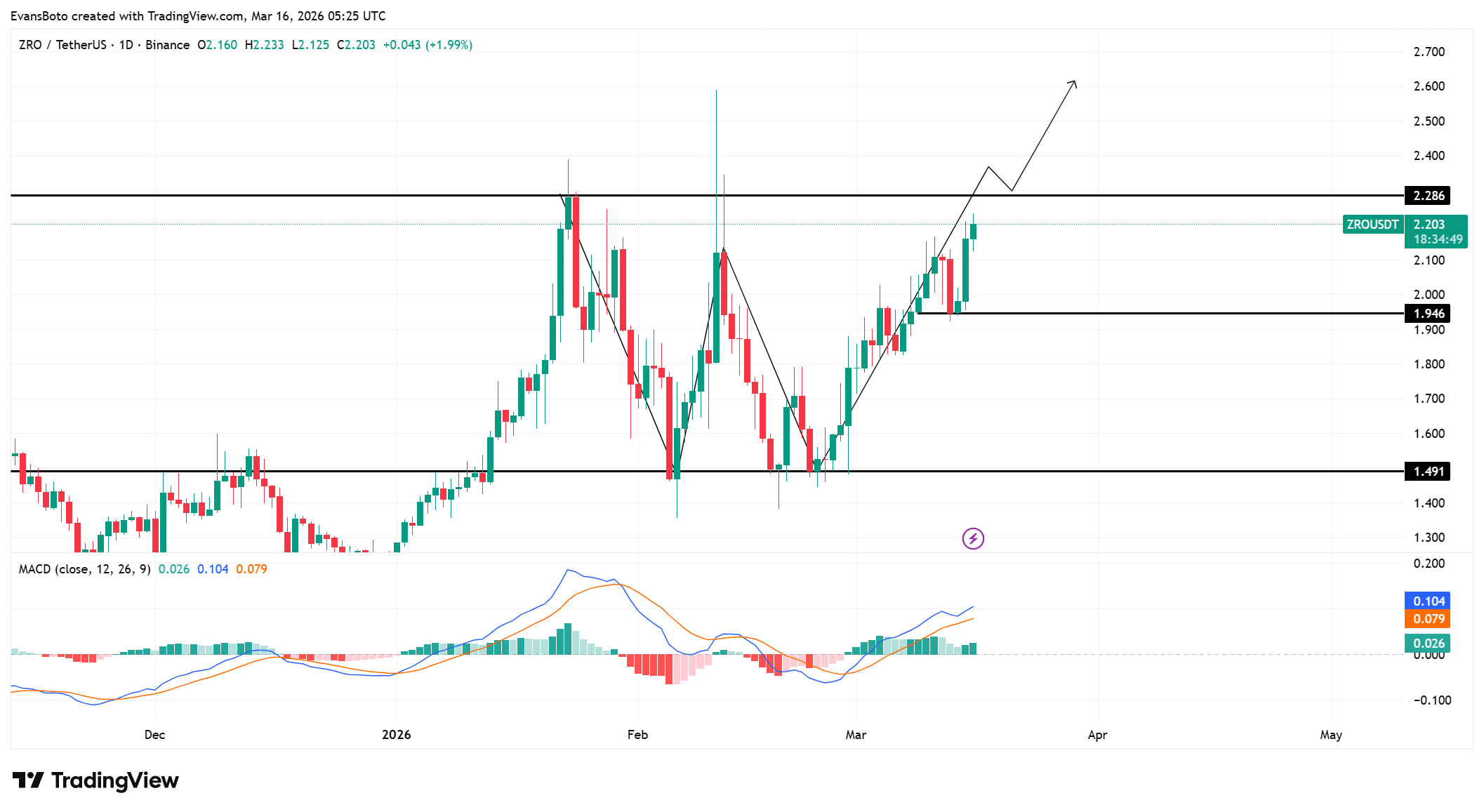
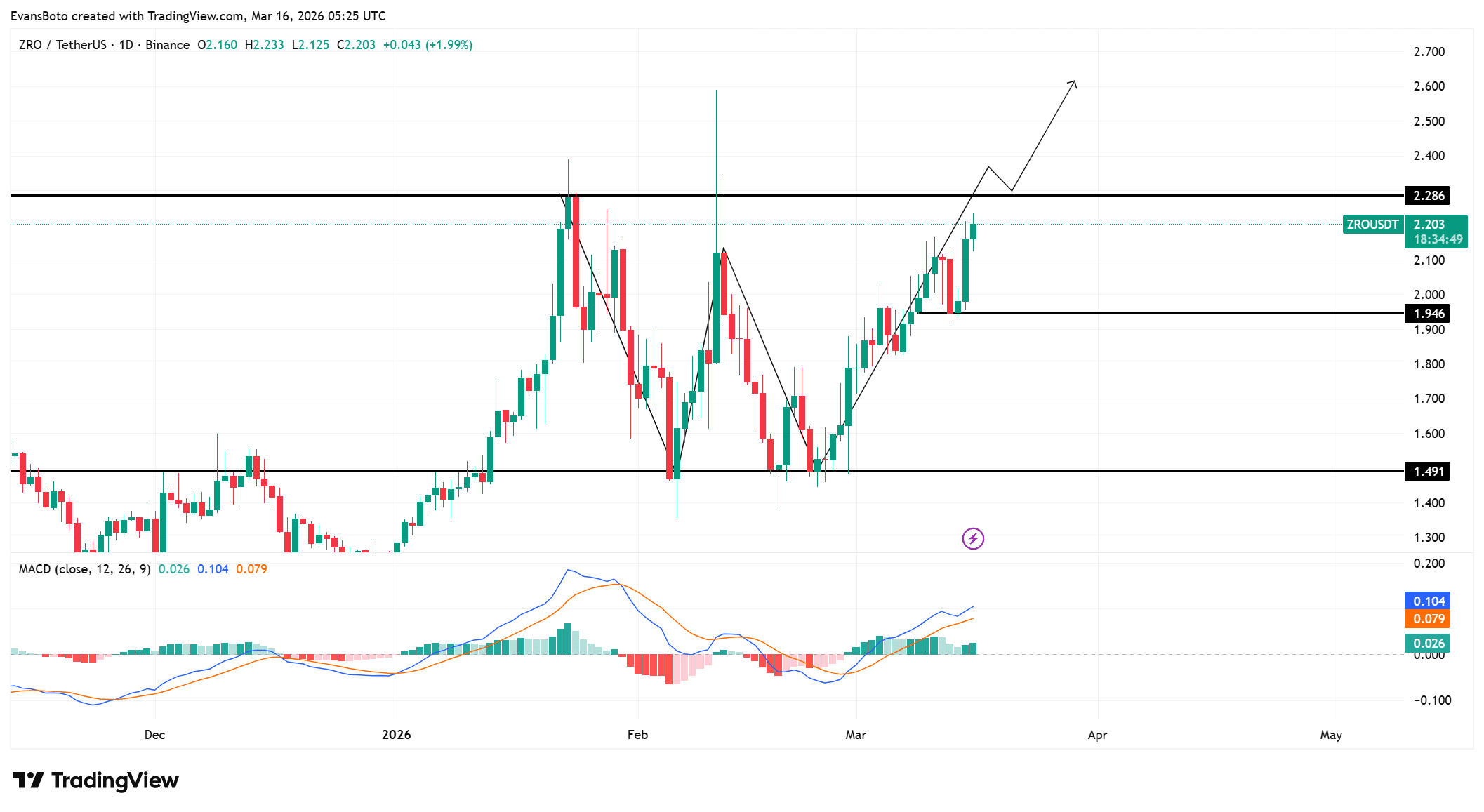
Recent price action shows LayerZero recovering strongly from the $1.491 support level and steadily advancing toward the $2.286 resistance zone.

Buyers regained control after the February decline pushed the price briefly below $1.60. Since then, a sequence of higher lows has developed across the daily chart.

This structure reflects improving trend stability. Price has already reclaimed the intermediate $1.946 level, which now acts as a support pivot.

However, the $2.286 region represents a major barrier where previous rallies stalled earlier this year. Sellers previously defended that zone aggressively.

If buyers maintain pressure near current levels, price could attempt another breakout toward higher targets.

The MACD line currently sits around 0.104, while the signal line remains near 0.079, confirming a positive crossover.

Histogram bars have also turned green near 0.026, showing strengthening buying pressure over recent sessions. This configuration normally appears during early trend recovery phases.

Source: TradingView

Spot market overheating raises caution signals

While price strength has attracted buyers, Spot market data suggests traders have started pushing activity into overheated territory.

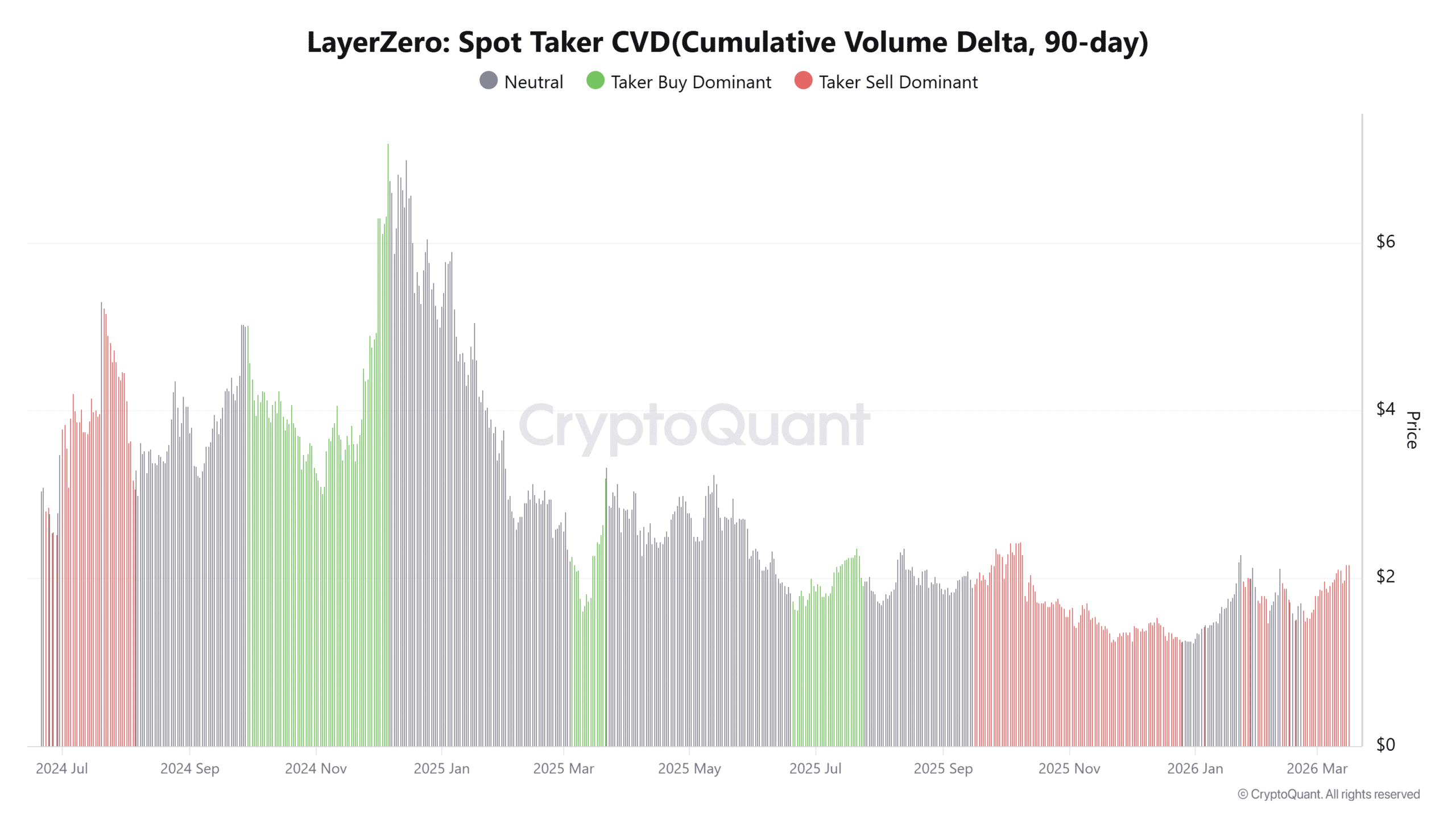
The Spot Volume Bubble Map currently signals overheating conditions following the rapid surge in trading activity. Large bursts of volume often appear when speculative interest intensifies.

However, the 90-day Spot Taker CVD continues reflecting taker sell dominance, indicating that market sell orders still outweigh aggressive buying.

This imbalance creates a conflicting signal for short-term direction. Price rises while sellers remain active, which sometimes leads to brief volatility spikes.

Source: CryptoQuant

Short liquidations hint at growing volatility

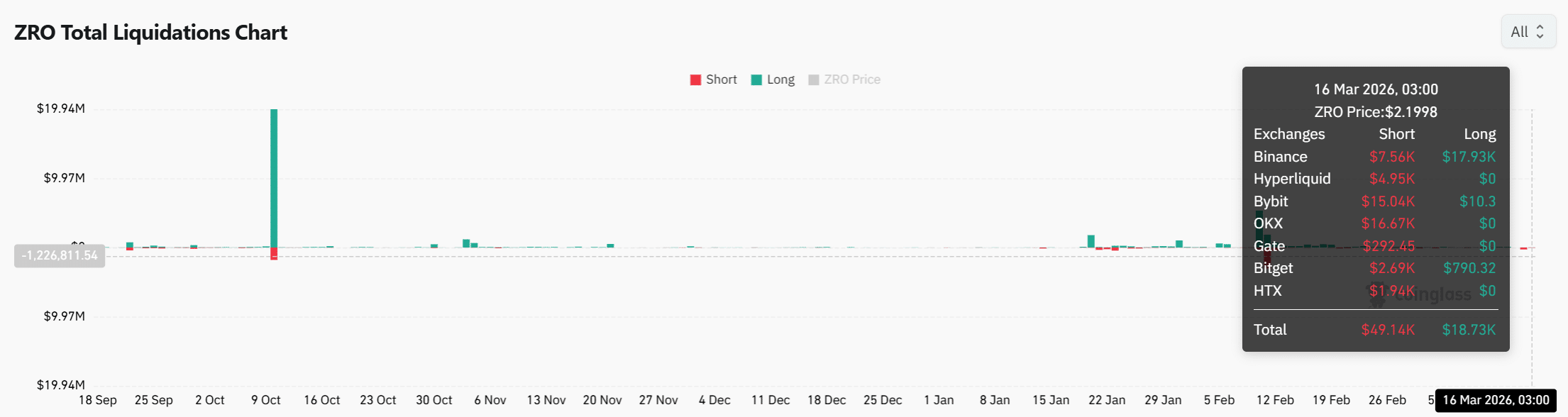
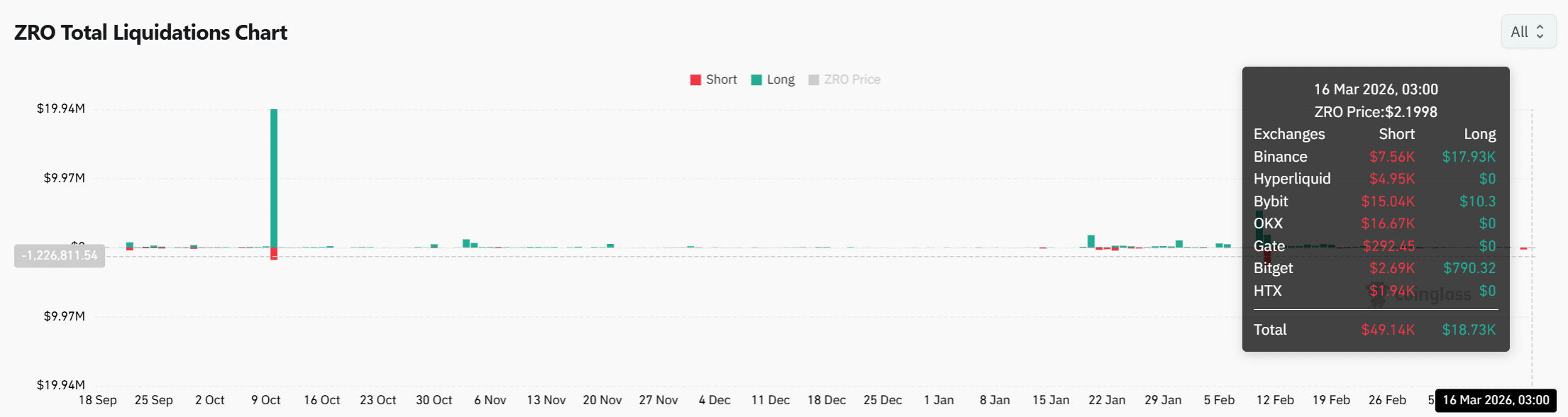
Derivatives data has also started reflecting the renewed price expansion across LayerZero markets. The total liquidation chart shows short positions absorbing slightly higher pressure during the latest move.

At the latest data point, short liquidations reached about $49.14K, while long liquidations remained near $18.73K.

This imbalance shows that rising prices have forced several short traders to close positions. Forced exits usually amplify volatility because liquidations trigger additional buying pressure.

Exchanges such as OKX and Bybit have recorded some of the largest short liquidations. However, the overall scale of liquidations remains moderate compared with earlier spikes.

Source: CoinGlass

LayerZero’s rally has pushed the price close to the $2.286 resistance, while indicators and liquidation data suggest strengthening market activity.

However, overheating spot signals and persistent taker sell dominance introduce short-term uncertainty.

If buyers sustain pressure near current levels, ZRO could challenge resistance again. However, heavy selling activity may still slow the advance before a confirmed breakout.


Final Summary

  • Growing participation has revived LayerZero interest; however, resistance pressure could still challenge sustained upside continuation soon.
  • Rising volatility and strong buyer activity could sustain ZRO’s recovery if resistance pressure weakens across markets.

Связанные с этим вопросы

QWhat was the percentage increase in LayerZero (ZRO) over the last 24 hours and what key resistance level is it approaching?

ALayerZero rallied more than 11% in the last 24 hours and is approaching the key resistance level of $2.286.

QWhat technical indicator is mentioned as confirming a positive crossover and what does this signal?

AThe MACD indicator is mentioned, with the MACD line at 0.104 and the signal line at 0.079, confirming a positive crossover which is a signal that often appears during early trend recovery phases.

QAccording to the Spot Volume Bubble Map, what condition is the market signaling and what does a 90-day metric show?

AThe Spot Volume Bubble Map is signaling overheating conditions, while the 90-day Spot Taker CVD continues to reflect taker sell dominance, indicating that market sell orders still outweigh aggressive buying.

QWhat does the imbalance between short and long liquidations suggest about recent market activity?

AThe imbalance, with short liquidations at $49.14K and long liquidations at $18.73K, suggests that rising prices have forced short traders to close positions, which can amplify volatility by triggering additional buying pressure.

QWhat are the two potential outcomes for ZRO's price mentioned in the final summary regarding resistance?

AThe final summary states that if buyers sustain pressure, ZRO could challenge the $2.286 resistance again, but heavy selling activity may slow the advance before a confirmed breakout occurs.

Похожее

Is the Sharp Decline Over? Let the Data Speak

**Has the Sharp Decline Ended? Let Data Speak** Bitcoin's recent significant drop has placed short sellers in a precarious position. Three concurrent pressures—sustained outflows from ETFs, miners offloading coins to exchanges, and short-term holders capitulating—pushed the price near $63k. The asset fell 13% this week and 21% this month, roughly halving from its all-time high. A critical data point is the extremely crowded short positioning, with a short-to-long ratio reaching 8:1, representing nearly $100 billion in short interest overhead. This creates conditions for a potential short squeeze if selling pressure merely pauses, similar to the event in November 2022 which triggered a 24% rally. The selling pressures are real: spot Bitcoin ETFs have seen a record $5.4 billion outflow over 20 days. Short-term holders moved 53k loss-held BTC to exchanges in a day, and miners sent 24k BTC to Binance, a six-month high. Capital is also rotating towards AI and tech stocks like SpaceX, with $400 billion invested in AI infrastructure recently. However, on-chain data shows accumulation by long-term holders, who added 200k BTC in a month, and institutions/miners have absorbed 1.24 million BTC since 2023. This indicates strong buying beneath the surface. Key levels to watch are the $67k-$70k zone (2021 high & 2024 breakout point). A swift recovery above it suggests a leverage washout; failure could test $60k-$55k. The direction also hinges on ETF flow reversal. Currently, the S&P 500 hits new highs driven by AI, while Bitcoin and DeFi (TVL down from $173b to $73.9b) lag. The most probable path is a grinding basing process between $60k-$58k with continued ETF outflows. A less likely but explosive scenario involves a sudden flow reversal, a surge above $70k triggering a short squeeze, and a rally back above $76k. The immediate trigger depends on when the relentless selling pauses. A final cautionary note questions Bitcoin's correlation: if the high-flying U.S. stock market corrects, will Bitcoin once again miss the rally but not the decline?

foresightnews_api14 мин. назад

Is the Sharp Decline Over? Let the Data Speak

foresightnews_api14 мин. назад

Single-Day Plunge of 30%, Arthur Hayes Suddenly Liquidates: Why Did ZEC Get Exploded by Security Issues?

On June 5th, Zcash founder Zooko Wilcox disclosed a critical soundness vulnerability in the project's latest Orchard privacy pool. This flaw, found in the elliptic curve multiplication constraints, could allow an attacker to create unlimited counterfeit ZEC within the shielded pool, with transactions appearing valid. The vulnerability was discovered in late May by security researcher Taylor Hornby, who utilized Anthropic's new Opus 4.8 AI model for a targeted audit. The Zcash ecosystem had already performed an emergency network upgrade to patch the issue. However, the detailed disclosure triggered severe market panic, causing ZEC's price to plummet over 30% in a single day. Notably, prominent investor Arthur Hayes announced he had sold his entire ZEC position following the news. The incident starkly challenges the "technological trust" narrative central to privacy coins. Despite years of top-tier cryptographic audits, the bug persisted until uncovered with advanced AI-assisted research. This highlights the growing gap between theoretical perfection and practical implementation in privacy technology. The event serves as a industry-wide warning: in an AI-driven security landscape, the assumption that "undiscovered equals safe" is obsolete. It underscores the urgent need for continuous, proactive security practices combining AI audits, formal verification, and rapid response mechanisms.

foresightnews_api1 ч. назад

Single-Day Plunge of 30%, Arthur Hayes Suddenly Liquidates: Why Did ZEC Get Exploded by Security Issues?

foresightnews_api1 ч. назад

Breaking the Curse of DeFi Cascading Liquidations, Vitalik Proposes a New Solution

**Vitalik Buterin Proposes New DeFi Design to Eliminate Forced Liquidations** Ethereum co-founder Vitalik Buterin has published a proposal for a new decentralized finance (DeFi) architecture aimed at removing the automatic liquidation mechanisms prevalent in current lending protocols. The core idea involves creating synthetic assets using options as building blocks, fundamentally avoiding the抵押借贷结构 that triggers forced sell-offs. The proposal responds to a recurring flaw in DeFi: during sharp market downturns, mass自动清算 of under-collateralized positions can exacerbate price declines, creating systemic selling pressure and market instability, as evidenced by recent crypto market volatility. Buterin's model would split an asset like 1 ETH into two option-like derivatives, P and N, pegged to a price index with a set strike price and expiration. At expiry, an oracle determines the settlement price to allocate the underlying ETH between P and N holders. This design eliminates the "cliff" of instant liquidation. Instead, a position's value would gradually drift from its target peg if not actively rebalanced by the user, transferring the rebalancing decision from the protocol to the user or automated tools. A key advantage is the reduced reliance on high-frequency, real-time oracle price feeds, which are vulnerable to manipulation and errors in current systems. The delayed settlement in the options model allows for more robust, fault-tolerant oracle designs. However, significant challenges remain for practical adoption. High transaction costs (slippage) from frequent rebalancing on automated market makers (AMMs) could erode user funds. The model may not be suitable for stablecoins requiring a strict 1:1 dollar peg, as it inherently allows for value drift. Success would depend on developing new liquidity provisioning models and deep markets for these synthetic assets. The proposal represents a fundamental rethinking of DeFi risk management, challenging the industry to explore alternatives to被动集中平仓 rather than merely optimizing existing liquidation processes. It remains a theoretical framework awaiting implementation and testing by development teams.

foresightnews_api1 ч. назад

Breaking the Curse of DeFi Cascading Liquidations, Vitalik Proposes a New Solution

foresightnews_api1 ч. назад

Bitcoin's Decline Marks the Transformation of Crypto

Title: The Decline of Bitcoin Marks the Transformation of Crypto While Bitcoin's price recently fell below $70,000, down approximately 45% from its peak, the broader crypto industry is not following it into decline. Instead, crypto is maturing and evolving beyond its dependence on Bitcoin's price movements. Two of Bitcoin's core functions are being usurped. First, AI has captured its role as the primary speculative asset. AI, with its tangible revenue, explosive demand, and massive capital inflows ($700-830 billion in 2024), is siphoning off the speculative "hot money" that once drove Bitcoin. It also contributes to a sustained high-interest-rate environment, further tightening liquidity for assets like Bitcoin. Second, dollar-pegged stablecoins like USDC and USDT have replaced Bitcoin as the crypto market's foundational currency and primary on/off-ramp. Most trading pairs and on-chain transactions are now settled in stablecoins, severing the historical link where all capital inflows had to pass through Bitcoin first. This decoupling allows projects to thrive based on their own fundamentals rather than Bitcoin's price. Examples include Hyperliquid, an on-chain derivatives exchange with annual revenues of $8-13 billion, and prediction market platform Polymarket, valued at $200 billion with $3.65 billion in annual fees. These projects are evaluated on traditional metrics like revenue and user growth. New opportunities are emerging, particularly around privacy. Privacy coins like Zcash (ZEC) are seeing surging demand, while infrastructure like NEAR enables private, cross-chain asset transfers without requiring users to hold a specific token—privacy becomes a universal service layer. In this new paradigm, stablecoins are the universal cash, various project tokens represent equity, and privacy-enabled cross-chain coordination layers (like NEAR) act as the critical infrastructure connecting a fragmented, multi-chain ecosystem. Bitcoin is now just one asset among many. The era where the entire crypto market moved in lockstep with Bitcoin is over. The industry's health should now be judged by project fundamentals—real revenue, active users, and tokenomics that capture value—and the development of the underlying infrastructure enabling a mature, dollar-denominated crypto economy.

foresightnews_api1 ч. назад

Bitcoin's Decline Marks the Transformation of Crypto

foresightnews_api1 ч. назад

Торговля

Спот
Фьючерсы
活动图片