Kraken Reveals Extortion Demands After Client Data Incident: ‘We Will Not Pay’, Security Chief Says

bitcoinistОпубликовано 2026-04-14Обновлено 2026-04-14

Введение

Kraken, a major US crypto exchange, has publicly refused extortion demands from a criminal group following two incidents of unauthorized access to limited client support data. Chief Security Officer Nick Percoco stated the exchange identified and terminated access for individuals involved, emphasizing that no systems were breached and user funds remained safe. Approximately 2,000 client accounts (0.02% of users) were affected. Kraken is cooperating with law enforcement and industry partners to investigate what it describes as insider recruitment efforts targeting multiple sectors. The incident has sparked community concerns over insider threats and data security, drawing comparisons to a similar past event at Coinbase.

Kraken, the US’s second-largest crypto exchange, has rejected extortion threats from a criminal group after two incidents of unauthorized access to limited client support data in the past year, reigniting investors’ concerns about insider threats.

Kraken Fights Back Extortion Demands

On Monday, Kraken’s Chief Security Officer (CSO), Nick Percoco, revealed that a criminal group is extorting the crypto exchange, threatening to release videos of their systems exposing client data.

In a security update, the CSO affirmed that Kraken had identified and shut down two instances of inappropriate access to limited client support data since 2025. Per the post, the crypto exchange received a tip about a video shared on a criminal forum. The video reportedly showed access to Kraken’s client support system.

The exchange “immediately launched an investigation and quickly identified the individual involved as a member of our support team,” Percoco explained, “Their access was revoked immediately, a full investigation was conducted, additional security controls were put in place and a limited number of affected clients were notified.”

More recently, they received another tip with a new video showing similar activity, prompting a new investigation to identify the parties involved, terminate their access, and notify the affected clients.

“Shortly after access was terminated, we began receiving extortion demands,” the security chief stated. “The criminals threatened to distribute materials from both the February 2025 incident and the recent incident to media outlets and on social media if we did not comply.”

Percoco emphasized that the exchange’s systems were never breached and funds were never at risk. In addition, he noted that “only a very small number” of client accounts, approximately 2,000 or 0.02% of clients, were potentially viewed across both incidents.

Kraken has now publicly rejected the criminal demands, declaring that they “will not pay these criminals” and “will not ever negotiate with bad actors.”

In the announcement, the exchange highlighted that it has been collaborating with industry partners and law enforcement to “investigate and disrupt insider recruitment efforts targeting not only crypto companies, but also gaming and telecommunications organizations.”

Based on intelligence gathered from the two incidents and extensive analysis, Kraken believes there is sufficient evidence to identify and arrest all individuals involved, but did not share additional details as the investigation continues. However, they urged anyone with relevant information to contact the exchange directly.

This incident comes just a month after Kraken scored a major victory for the crypto industry, becoming the first crypto company with direct access to the Federal Reserve’s core payment system after winning the Kansas City Fed’s approval for a Fed master account.

Crypto Community Raises Insider Access Concerns

Crypto investors and Kraken users online reacted to the news, questioning the exchange about the details of the two incidents and criticizing the exchange for offshoring customer support staff.

“So, basically, you outsourced it to shady third-party companies (or even worse, your internal recruiters are sleeping), and you got hacked twice or more. You made your customers vulnerable to wrench attacks,” an X user wrote under Percoco’s post.

However, details of whether the inappropriate data access was from an in-house support team or an overseas third-party support staff have not been revealed yet.

Another crypto community member pushed back on Kraken’s “very small number” of clients clarification, asserting that “this is not the metric you think it is... of those 2000 accounts, they are probably the ones with balances worth wrench attacking.”

Others drew a parallel between this incident and Coinbase’s data breach controversy from last year. For context, Coinbase CEO Brian Armstrong revealed in May 2025 that malicious actors had bribed a handful of support contractors overseas to access the company’s internal tools.

This led to the leak of names, email addresses, limited transaction records, and partial Social Security numbers of around 1% of the exchange’s users. Then, the attackers attempted to blackmail Coinbase using the breached information, demanding a $20 million Bitcoin (BTC) ransom for the sensitive data.

Reuters later alleged that Coinbase had been aware of the customer data leak months before it disclosed it, also raising concerns about transparency and insider threats.

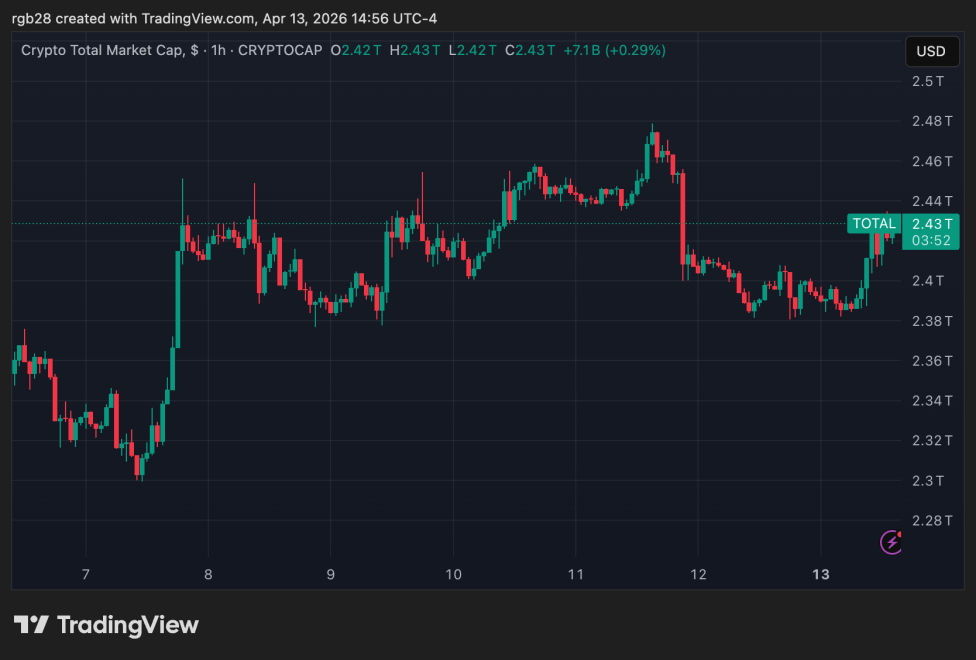
The total crypto market capitalization is at $2.43 trillion in the one-week chart. Source: TOTAL on TradingView

Связанные с этим вопросы

QWhat did Kraken's Chief Security Officer reveal about the extortion demands?

AKraken's CSO Nick Percoco revealed that a criminal group is extorting the crypto exchange by threatening to release videos of their systems exposing client data, and that Kraken will not pay or negotiate with these criminals.

QHow many client accounts were potentially affected by the unauthorized access incidents at Kraken?

AApproximately 2,000 client accounts, or 0.02% of Kraken's clients, were potentially viewed across both incidents.

QWhat was the nature of the security incidents at Kraken, according to the company?

AThe incidents involved two instances of unauthorized access to limited client support data by individuals who were members of the support team, but the company's core systems were never breached and client funds were never at risk.

QHow did the crypto community react to Kraken's announcement of the security incidents?

AThe community questioned the details of the incidents, criticized the exchange for potentially offshoring customer support staff, and expressed concern that the affected accounts might be high-value targets for 'wrench attacks'.

QWhat parallel was drawn between this Kraken incident and another crypto exchange?

AThe incident was compared to Coinbase's data breach from May 2025, where malicious actors bribed overseas support contractors to access internal tools, leading to a data leak and a subsequent extortion attempt.

Похожее

Is the Sharp Decline Over? Let the Data Speak

**Has the Sharp Decline Ended? Let Data Speak** Bitcoin's recent significant drop has placed short sellers in a precarious position. Three concurrent pressures—sustained outflows from ETFs, miners offloading coins to exchanges, and short-term holders capitulating—pushed the price near $63k. The asset fell 13% this week and 21% this month, roughly halving from its all-time high. A critical data point is the extremely crowded short positioning, with a short-to-long ratio reaching 8:1, representing nearly $100 billion in short interest overhead. This creates conditions for a potential short squeeze if selling pressure merely pauses, similar to the event in November 2022 which triggered a 24% rally. The selling pressures are real: spot Bitcoin ETFs have seen a record $5.4 billion outflow over 20 days. Short-term holders moved 53k loss-held BTC to exchanges in a day, and miners sent 24k BTC to Binance, a six-month high. Capital is also rotating towards AI and tech stocks like SpaceX, with $400 billion invested in AI infrastructure recently. However, on-chain data shows accumulation by long-term holders, who added 200k BTC in a month, and institutions/miners have absorbed 1.24 million BTC since 2023. This indicates strong buying beneath the surface. Key levels to watch are the $67k-$70k zone (2021 high & 2024 breakout point). A swift recovery above it suggests a leverage washout; failure could test $60k-$55k. The direction also hinges on ETF flow reversal. Currently, the S&P 500 hits new highs driven by AI, while Bitcoin and DeFi (TVL down from $173b to $73.9b) lag. The most probable path is a grinding basing process between $60k-$58k with continued ETF outflows. A less likely but explosive scenario involves a sudden flow reversal, a surge above $70k triggering a short squeeze, and a rally back above $76k. The immediate trigger depends on when the relentless selling pauses. A final cautionary note questions Bitcoin's correlation: if the high-flying U.S. stock market corrects, will Bitcoin once again miss the rally but not the decline?

foresightnews_api2 мин. назад

Is the Sharp Decline Over? Let the Data Speak

foresightnews_api2 мин. назад

Single-Day Plunge of 30%, Arthur Hayes Suddenly Liquidates: Why Did ZEC Get Exploded by Security Issues?

On June 5th, Zcash founder Zooko Wilcox disclosed a critical soundness vulnerability in the project's latest Orchard privacy pool. This flaw, found in the elliptic curve multiplication constraints, could allow an attacker to create unlimited counterfeit ZEC within the shielded pool, with transactions appearing valid. The vulnerability was discovered in late May by security researcher Taylor Hornby, who utilized Anthropic's new Opus 4.8 AI model for a targeted audit. The Zcash ecosystem had already performed an emergency network upgrade to patch the issue. However, the detailed disclosure triggered severe market panic, causing ZEC's price to plummet over 30% in a single day. Notably, prominent investor Arthur Hayes announced he had sold his entire ZEC position following the news. The incident starkly challenges the "technological trust" narrative central to privacy coins. Despite years of top-tier cryptographic audits, the bug persisted until uncovered with advanced AI-assisted research. This highlights the growing gap between theoretical perfection and practical implementation in privacy technology. The event serves as a industry-wide warning: in an AI-driven security landscape, the assumption that "undiscovered equals safe" is obsolete. It underscores the urgent need for continuous, proactive security practices combining AI audits, formal verification, and rapid response mechanisms.

foresightnews_api1 ч. назад

Single-Day Plunge of 30%, Arthur Hayes Suddenly Liquidates: Why Did ZEC Get Exploded by Security Issues?

foresightnews_api1 ч. назад

Breaking the Curse of DeFi Cascading Liquidations, Vitalik Proposes a New Solution

**Vitalik Buterin Proposes New DeFi Design to Eliminate Forced Liquidations** Ethereum co-founder Vitalik Buterin has published a proposal for a new decentralized finance (DeFi) architecture aimed at removing the automatic liquidation mechanisms prevalent in current lending protocols. The core idea involves creating synthetic assets using options as building blocks, fundamentally avoiding the抵押借贷结构 that triggers forced sell-offs. The proposal responds to a recurring flaw in DeFi: during sharp market downturns, mass自动清算 of under-collateralized positions can exacerbate price declines, creating systemic selling pressure and market instability, as evidenced by recent crypto market volatility. Buterin's model would split an asset like 1 ETH into two option-like derivatives, P and N, pegged to a price index with a set strike price and expiration. At expiry, an oracle determines the settlement price to allocate the underlying ETH between P and N holders. This design eliminates the "cliff" of instant liquidation. Instead, a position's value would gradually drift from its target peg if not actively rebalanced by the user, transferring the rebalancing decision from the protocol to the user or automated tools. A key advantage is the reduced reliance on high-frequency, real-time oracle price feeds, which are vulnerable to manipulation and errors in current systems. The delayed settlement in the options model allows for more robust, fault-tolerant oracle designs. However, significant challenges remain for practical adoption. High transaction costs (slippage) from frequent rebalancing on automated market makers (AMMs) could erode user funds. The model may not be suitable for stablecoins requiring a strict 1:1 dollar peg, as it inherently allows for value drift. Success would depend on developing new liquidity provisioning models and deep markets for these synthetic assets. The proposal represents a fundamental rethinking of DeFi risk management, challenging the industry to explore alternatives to被动集中平仓 rather than merely optimizing existing liquidation processes. It remains a theoretical framework awaiting implementation and testing by development teams.

foresightnews_api1 ч. назад

Breaking the Curse of DeFi Cascading Liquidations, Vitalik Proposes a New Solution

foresightnews_api1 ч. назад

Bitcoin's Decline Marks the Transformation of Crypto

Title: The Decline of Bitcoin Marks the Transformation of Crypto While Bitcoin's price recently fell below $70,000, down approximately 45% from its peak, the broader crypto industry is not following it into decline. Instead, crypto is maturing and evolving beyond its dependence on Bitcoin's price movements. Two of Bitcoin's core functions are being usurped. First, AI has captured its role as the primary speculative asset. AI, with its tangible revenue, explosive demand, and massive capital inflows ($700-830 billion in 2024), is siphoning off the speculative "hot money" that once drove Bitcoin. It also contributes to a sustained high-interest-rate environment, further tightening liquidity for assets like Bitcoin. Second, dollar-pegged stablecoins like USDC and USDT have replaced Bitcoin as the crypto market's foundational currency and primary on/off-ramp. Most trading pairs and on-chain transactions are now settled in stablecoins, severing the historical link where all capital inflows had to pass through Bitcoin first. This decoupling allows projects to thrive based on their own fundamentals rather than Bitcoin's price. Examples include Hyperliquid, an on-chain derivatives exchange with annual revenues of $8-13 billion, and prediction market platform Polymarket, valued at $200 billion with $3.65 billion in annual fees. These projects are evaluated on traditional metrics like revenue and user growth. New opportunities are emerging, particularly around privacy. Privacy coins like Zcash (ZEC) are seeing surging demand, while infrastructure like NEAR enables private, cross-chain asset transfers without requiring users to hold a specific token—privacy becomes a universal service layer. In this new paradigm, stablecoins are the universal cash, various project tokens represent equity, and privacy-enabled cross-chain coordination layers (like NEAR) act as the critical infrastructure connecting a fragmented, multi-chain ecosystem. Bitcoin is now just one asset among many. The era where the entire crypto market moved in lockstep with Bitcoin is over. The industry's health should now be judged by project fundamentals—real revenue, active users, and tokenomics that capture value—and the development of the underlying infrastructure enabling a mature, dollar-denominated crypto economy.

foresightnews_api1 ч. назад

Bitcoin's Decline Marks the Transformation of Crypto

foresightnews_api1 ч. назад

Торговля

Спот
Фьючерсы
活动图片