Is Quantum Computing A Threat To Bitcoin? ARK Invest Breaks It Down

bitcoinistОпубликовано 2026-03-12Обновлено 2026-03-12

Введение

ARK Invest and Unchained's research paper examines the potential threat quantum computing poses to Bitcoin's cryptography. The authors conclude it is a legitimate long-term concern but not an imminent threat. Current quantum systems are in the "NISQ era" with limited qubits and high error rates, far from the estimated requirement of at least 2,330 logical qubits to break Bitcoin's encryption. The report describes quantum development as a gradual progression, not a sudden event, providing ample warning and time for the market and network to adapt. It estimates that roughly 35% of Bitcoin's supply could theoretically be exposed, but many of these coins are either lost or can be migrated to safer address formats. The paper highlights that meaningful quantum breakthroughs would disrupt broader internet security first, triggering a coordinated response. While the technical risk is distant, it raises future governance challenges, as upgrading Bitcoin's cryptography would require community consensus. The authors frame the issue as a manageable long-term engineering problem rather than an abrupt point of failure.

A new research paper from ARK Invest and Unchained examines one of the most persistent questions in Bitcoin: whether advances in quantum computing could eventually break it’s cryptography.

The authors conclude that while the technology represents a legitimate long-term concern, it does not pose an immediate threat to the network. Published March 11 and authored by Dhruv Bansal, Tom Honzik and David Puell, the report argues that current quantum systems remain far from the capabilities required to compromise Bitcoin’s cryptographic foundations.

Bitcoin Quantum Threat Is Distant, Not Immediate

The paper’s central thesis is straightforward: quantum computing represents a real but gradual risk.

“Our two central arguments are as follows,” the authors write. “Quantum is a long-term risk but not an imminent threat. The community must continue to research and make plans for protecting the network as quantum computers improve.”

They add that even if breakthroughs occur, exploiting them against Bitcoin would be costly and slow. “If quantum computing were to affect Bitcoin’s cryptography, the process would be protracted and undertaken at meaningful cost to the attacker.”

In practical terms, the report notes that today’s machines fall well short of the scale needed to attack the elliptic-curve cryptography used by Bitcoin keys. Current devices operate in what researchers call the “NISQ era,” characterized by limited logical qubits and high error rates.

Breaking Bitcoin’s cryptography would require significantly more advanced systems. “To do so would require at least 2,330 logical qubits and tens of millions to billions of quantum gates,” the authors write, far beyond the roughly hundred-qubit systems typical today.

Rather than a sudden technological shock, the paper outlines a staged progression toward any meaningful threat. The authors describe a series of milestones in quantum development. Early stages involve experimental systems with limited commercial usefulness. Later phases would see applications in fields like chemistry or materials science long before cryptographic attacks become viable.

Only in more advanced stages would quantum computers become capable of breaking elliptic-curve cryptography — and even then the process could take longer than Bitcoin’s roughly 10-minute block interval.
The researchers emphasize that this gradual progression would create numerous warning signals. “In our view, quantum development will be a gradual technological progression—not a sudden ‘Q-day’ event—giving markets and the Bitcoin network time to adapt.”

The implication is that the broader internet security ecosystem would likely face disruption before Bitcoin specifically becomes vulnerable. “Meaningful breakthroughs would disrupt internet security first,” the paper states, “triggering coordinated responses well beyond Bitcoin.”

The report also estimates how much bitcoin could theoretically be vulnerable if large-scale quantum attacks became feasible. According to the analysis, roughly 1.7 million BTC stored in older P2PK address types are considered exposed but likely lost. Another 5.2 million BTC sit in address formats that could be migrated if necessary.

Combined, the authors estimate that roughly 35% of the total outstanding supply could theoretically face quantum exposure in its current form. However, because many of those coins are inactive or capable of being moved to safer address types, the researchers frame the issue as manageable rather than catastrophic.

Governance And Upgrades Remain Open Questions

While the technical threat may be distant, the report highlights governance challenges that could emerge if the ecosystem eventually needs to adopt post-quantum cryptography. Upgrading Bitcoin’s cryptographic primitives would require consensus changes, meaning coordination across developers, miners, node operators, and the broader community.

The authors also raise unresolved questions around coins whose public keys are already exposed on-chain. “There is no consensus about protecting coins that remain vulnerable to quantum,” the report notes, pointing to ongoing debates about whether such coins should be migrated, restricted, or treated as recoverable by quantum attackers.

The researchers ultimately frame the issue as a long-range engineering problem rather than a near-term existential risk. “Quantum risk will evolve over an extended period of time, with many intermediate warning signals and decision points,” the authors conclude. “An abrupt single point of failure is unlikely.”

At press time, Bitcoin traded at $69,496.
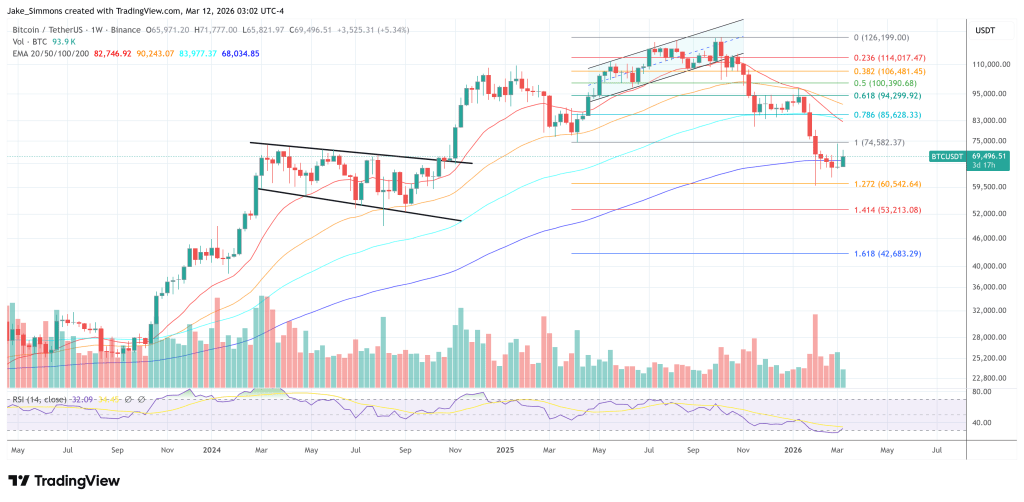
Bitcoin must break above the 1.0 Fib level, 1-week chart | Source: BTCUSDT on TradingView.com

Связанные с этим вопросы

QWhat is the main conclusion of the ARK Invest and Unchained research paper regarding quantum computing and Bitcoin?

AThe paper concludes that while quantum computing represents a legitimate long-term concern, it does not pose an immediate threat to the Bitcoin network, as current systems are far from the capabilities required to break its cryptography.

QHow many logical qubits would be required to break Bitcoin's elliptic-curve cryptography according to the report?

AThe report states that breaking Bitcoin's cryptography would require at least 2,330 logical qubits, which is beyond the roughly hundred-qubit systems typical today.

QWhat percentage of Bitcoin's total outstanding supply is estimated to be theoretically vulnerable to quantum exposure?

AThe authors estimate that roughly 35% of the total outstanding Bitcoin supply could theoretically face quantum exposure in its current form.

QWhat does the report say about the nature of the quantum threat to Bitcoin? Is it a sudden event or a gradual progression?

AThe report describes the quantum threat as a gradual technological progression, not a sudden 'Q-day' event, which would provide markets and the Bitcoin network time to adapt.

QWhat governance challenge does the report highlight in relation to a potential quantum threat?

AThe report highlights that upgrading Bitcoin's cryptographic primitives to post-quantum cryptography would require consensus changes, meaning coordination across developers, miners, node operators, and the broader community.

Похожее

DeepSeek Funding: Liang Wenfeng's 'Realist' Pivot

DeepSeek, a leading Chinese AI company, has initiated its first external funding round, aiming to raise at least $300 million at a valuation of no less than $10 billion. This move marks a significant shift from its founder Liang Wenfeng’s previous idealistic stance of rejecting external capital to maintain independence. Despite strong financial backing from its parent company, quantitative trading firm幻方量化 (Huanfang Quant), which provided an estimated $700 million in revenue in 2025 alone, DeepSeek faces mounting challenges. Key issues include a 15-month gap in major model updates, delays in its flagship V4 release, and the loss of several core researchers to competitors offering significantly higher compensation. The company is also undergoing a strategic pivot by migrating its infrastructure from NVIDIA’s CUDA to Huawei’s Ascend platform, a move aligned with China’s push for technological self-reliance amid U.S. export controls. However, DeepSeek lags behind rivals like智谱AI and MiniMax—both now publicly listed—in areas such as product ecosystem, multimodal capabilities, and commercialization. The funding round, though relatively small in scale, is seen as a way to establish a market-validated valuation anchor, making employee stock options more competitive and facilitating talent retention. It also signals DeepSeek’s transition from a pure research-oriented organization to a commercially-driven player in the global AI ecosystem.

marsbit33 мин. назад

DeepSeek Funding: Liang Wenfeng's 'Realist' Pivot

marsbit33 мин. назад

Solana Q1 Report: Revenue Plunges 68% Year-on-Year, Developers Decrease by 30%

Solana Q1 2026 Report: Key Metrics Show Significant Decline Amid Market Reset Solana experienced a substantial downturn in Q1 2026, with key performance indicators reflecting a broader market cooling. Total network revenue (REV) fell to $89.9 million, down 68% year-over-year (YoY) and 1.4% quarter-over-quarter (QoQ). This decline was driven by reduced speculative activity, which had previously fueled the network during the 2024/2025 bull market. Key revenue components saw mixed results: base fees dropped 8.7% QoQ, Jito tips (MEV) fell 19.7%, priority fees rose 23%, and vote fees declined 44.5%. The annualized real yield for stakers was just 0.17%, down 67% YoY. Network GDP, generated by top applications, fell 7% QoQ to $451 million. Pump Fun emerged as a standout, generating $103 million (up 3% QoQ), surpassing Solana's L1 revenue. However, daily active addresses averaged 2.4 million, down 4.8% YoY. Stablecoin supply on Solana reached $15.9 billion, down 2.7% QoQ but up 18% YoY. USDC and USDT remained dominant. DEX volumes averaged $3.2 billion daily, with private DEXs now accounting for 60% of all volume. The network's net dilution rate was 4.38%, while the cost to produce $1 of REV was $8.10, up 93% YoY. The number of new tokens created on launchpads grew 42% QoQ to 3 million, with Pump Fun dominating 85% of this market. Despite the downturn, Solana's core strengths remain: its position as a hub for retail trading apps, potential in perpetual markets, and growing use in stablecoin-based fintech applications, particularly in Latin America. However, developer activity declined 32% YoY, slightly worse than Ethereum's 29% drop. The network must now focus on attracting traditional finance, competing in perpetual markets, and sustaining developer ecosystem growth to drive the next expansion cycle.

marsbit1 ч. назад

Solana Q1 Report: Revenue Plunges 68% Year-on-Year, Developers Decrease by 30%

marsbit1 ч. назад

Торговля

Спот
Фьючерсы

Популярные статьи

Как купить ONE

Добро пожаловать на HTX.com! Мы сделали приобретение Harmony (ONE) простым и удобным. Следуйте нашему пошаговому руководству и отправляйтесь в свое крипто-путешествие.Шаг 1: Создайте аккаунт на HTXИспользуйте свой адрес электронной почты или номер телефона, чтобы зарегистрироваться и бесплатно создать аккаунт на HTX. Пройдите удобную регистрацию и откройте для себя весь функционал.Создать аккаунтШаг 2: Перейдите в Купить криптовалюту и выберите свой способ оплатыКредитная/Дебетовая Карта: Используйте свою карту Visa или Mastercard для мгновенной покупки Harmony (ONE).Баланс: Используйте средства с баланса вашего аккаунта HTX для простой торговли.Третьи Лица: Мы добавили популярные способы оплаты, такие как Google Pay и Apple Pay, для повышения удобства.P2P: Торгуйте напрямую с другими пользователями на HTX.Внебиржевая Торговля (OTC): Мы предлагаем индивидуальные услуги и конкурентоспособные обменные курсы для трейдеров.Шаг 3: Хранение Harmony (ONE)После приобретения вами Harmony (ONE) храните их в своем аккаунте на HTX. В качестве альтернативы вы можете отправить их куда-либо с помощью перевода в блокчейне или использовать для торговли с другими криптовалютами.Шаг 4: Торговля Harmony (ONE)С легкостью торгуйте Harmony (ONE) на спотовом рынке HTX. Просто зайдите в свой аккаунт, выберите торговую пару, совершайте сделки и следите за ними в режиме реального времени. Мы предлагаем удобный интерфейс как для начинающих, так и для опытных трейдеров.

595 просмотров всегоОпубликовано 2024.04.12Обновлено 2025.06.06

Как купить ONE

Обсуждения

Добро пожаловать в Сообщество HTX. Здесь вы сможете быть в курсе последних новостей о развитии платформы и получить доступ к профессиональной аналитической информации о рынке. Мнения пользователей о цене на ONE (ONE) представлены ниже.

活动图片