Intuit to use Circle’s stablecoin for financial platforms

cointelegraphОпубликовано 2025-12-18Обновлено 2025-12-18

Введение

Intuit, the company behind TurboTax, QuickBooks, and Mailchimp, has entered a multi-year strategic partnership with Circle to integrate its stablecoin infrastructure and USDC. The collaboration aims to enable faster and lower-cost payments across Intuit’s platforms for business transactions, tax refunds, and marketing. Circle CEO Jeremy Allaire emphasized that the deal will extend the efficiency of USDC for everyday financial use. USDC is the second-largest stablecoin with a market cap exceeding $77 billion. The U.S. stablecoin market is expected to grow significantly following the passage of the GENIUS Act, which provides regulatory clarity for issuers. This announcement follows the OCC’s conditional approval of Circle for a national trust bank charter, a move also extended to other crypto firms like Ripple and Paxos, signaling broader institutional adoption of digital assets.

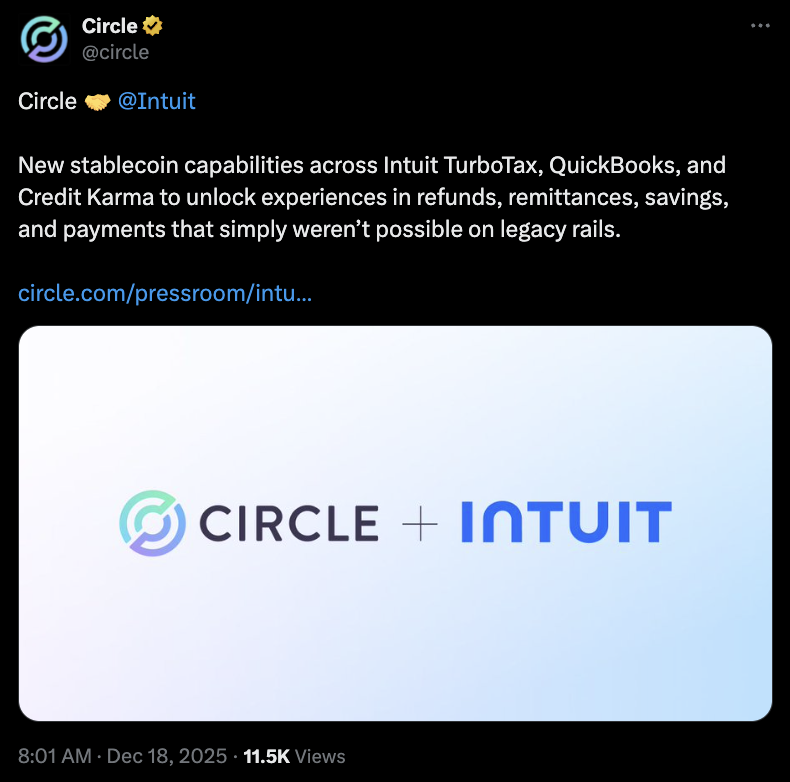
Intuit, the company behind TurboTax, Credit Karma, QuickBooks and Mailchimp, announced a “multi-year, strategic partnership” with stablecoin issuer Circle involving its stablecoin infrastructure and USDC (USDC).

In a Thursday notice, Intuit said the agreement with Circle would allow “faster, lower-cost” payments through their platforms, which focus on business transactions, tax refunds and marketing. According to Circle CEO Jeremy Allaire, the deal will “extend the speed, power and efficiency of USDC for everyday financial transactions.”

Source: Circle

USDC is the second-largest stablecoin by market capitalization, trailing Tether’s USDt (USDT) by more than $186 billion. According to data from Nansen, USDC’s market cap was more than $77 billion at the time of publication.

The stablecoin market in the United States, following the passage of the GENIUS Act in Congress, is expected to grow considerably as regulations smooth the path for issuers looking to the coins as solutions for payments and other financial transactions. US agencies are establishing guidelines in accordance with the bill before final implementation.

Related: Stablecoins break $300B market cap, post 47% growth year-to-date

The announcement referred to the stablecoins being “embedded across the Intuit platform.” Cointelegraph reached out to Intuit for comment on the potential rollout, but had not received a response at the time of publication.

Circle and others approved for US bank charters

The Intuit partnership followed the US Office of the Comptroller of the Currency (OCC)'s conditional approval of Circle for a national trust bank charter in a landmark decision for crypto companies.

Ripple received a similar approval for its application, and the OCC greenlit BitGo, Fidelity Digital Assets and Paxos, converting their existing state-level trust companies into federally chartered national trust banks.

Magazine: When privacy and AML laws conflict: Crypto projects’ impossible choice

Связанные с этим вопросы

QWhat is the nature of the partnership announced between Intuit and Circle?

AIntuit and Circle announced a multi-year, strategic partnership that involves integrating Circle's stablecoin infrastructure and USDC into Intuit's financial platforms.

QWhich specific Intuit platforms are expected to benefit from this new partnership with Circle?

AThe partnership is expected to benefit Intuit's platforms that focus on business transactions, tax refunds, and marketing, such as TurboTax, Credit Karma, QuickBooks, and Mailchimp.

QWhat are the main benefits that the partnership aims to provide to users?

AThe partnership aims to provide users with faster and lower-cost payments for everyday financial transactions by leveraging the speed, power, and efficiency of the USDC stablecoin.

QHow does the market capitalization of USDC compare to its main competitor, Tether's USDT?

AUSDC is the second-largest stablecoin by market cap, which was over $77 billion at the time of publication, trailing Tether's USDT by more than $186 billion.

QWhat recent regulatory development for crypto companies is mentioned in relation to Circle's new bank charter?

AThe U.S. Office of the Comptroller of the Currency (OCC) conditionally approved Circle for a national trust bank charter, a landmark decision. Similar approvals were also granted to Ripple, BitGo, Fidelity Digital Assets, and Paxos.

Похожее

Understanding Hash in One Article: The "Browser Miner" on Ethereum

Hash is an Ethereum-based ERC-20 token described as a "browser-minable post-quantum token." Its key features include enabling browser-based GPU mining without specialized hardware, a fixed supply cap of 21 million tokens, immutable and permissionless smart contracts with no team allocation or pre-mining, and an emphasis on post-quantum security using Keccak256 hashing. The mining mechanism is a simplified on-chain proof-of-work where miners solve unique challenges tied to their wallet address. Key design elements prevent answer theft, with epochs resetting every 100 blocks (~20 minutes) and a per-block minting limit. Emission follows a Bitcoin-like halving schedule every 100,000 mints, starting at 100 tokens per mint. Projections suggest all tokens could be mined within approximately 294 days if a target rate of one mint per minute is sustained. Hash emphasizes "post-quantum" security by leveraging hash-based primitives like Keccak256, which are considered more resistant to quantum attacks compared to elliptic-curve cryptography. While not a fully post-quantum asset, it aligns with Ethereum's broader post-quantum research narrative. The project completed its Genesis sale at $0.03 and began trading on Uniswap, with its price reaching around $0.19. The initial circulating supply is small, with 5% sold in Genesis and 5% allocated to liquidity. The majority (47.6% of total supply) is allocated to early-stage mining, leading to a front-loaded emission schedule. This structure, combined with low initial liquidity, makes Hash a high-volatility, high-risk project dependent on sustained miner participation and market demand to absorb new supply.

marsbit1 мин. назад

Understanding Hash in One Article: The "Browser Miner" on Ethereum

marsbit1 мин. назад

OpenAI's Largest Internal Wealth Creation: 600 People Cash Out a Total of $6.6 Billion, 75 Take Home the Maximum $30 Million Each

A Wall Street Journal report reveals OpenAI's unprecedented pre-IPO wealth creation. In a single employee stock sale last October, over 600 current and former employees sold shares, collectively cashing out approximately $6.6 billion. Due to high investor demand, the company tripled the individual sale cap to $30 million, with about 75 employees selling the maximum amount. This event represents the largest such transaction in tech industry history for a private company. OpenAI's valuation was $500 billion for this tender offer. Employees with over two years of tenure were eligible, allowing many post-ChatGPT hires their first liquidity event. The company's stock has reportedly grown over 100-fold in seven years. Following a restructuring, employees collectively hold about 26% of OpenAI. The scale of executive wealth is also staggering. In court testimony related to Elon Musk's lawsuit, President and co-founder Greg Brockman confirmed his OpenAI stake is worth around $30 billion. Analysis indicates about 165 current and former employees hold a combined ~$164.9 billion in equity, averaging nearly $1 billion per person in paper wealth. OpenAI's per-employee stock-based compensation is estimated to be 34 times the average of major tech firms before their IPOs. OpenAI continues its rapid ascent, closing a $122 billion funding round at an $852 billion valuation in March. With monthly revenue hitting $2 billion, over 900 million weekly ChatGPT users, and plans for a potential trillion-dollar IPO in late 2026, this wealth-creation engine shows no signs of stopping.

链捕手24 мин. назад

OpenAI's Largest Internal Wealth Creation: 600 People Cash Out a Total of $6.6 Billion, 75 Take Home the Maximum $30 Million Each

链捕手24 мин. назад

Understanding CPO (Co-Packaged Optics) in One Article: Why Nvidia Is Willing to Spend $3.2 Billion on a Fiber?

NVIDIA and Corning announced a multi-year strategic partnership on May 6, 2026, with NVIDIA committing up to $3.2 billion to support Corning's U.S. expansion. This investment will triple Corning's manufacturing plants and significantly boost its optical fiber and communications production capacity. The core driver behind this massive investment is the fundamental shift from copper to optical interconnect technology within AI data centers. As GPU clusters scale, copper wires face critical limitations: severe signal attenuation over distance, high energy consumption for signal integrity, and excessive heat generation. Optical fiber, transmitting light instead of electrical signals, solves these issues with minimal loss, near-light speed, and lower power needs. The article outlines a three-stage evolution of data center interconnect: 1. **Traditional Copper Interconnects:** The mainstream solution of the 2010s, now being phased out due to scaling bottlenecks. 2. **Pluggable Optical Modules:** The current mainstream, where modules convert electrical signals to light externally. This process still introduces energy loss and latency. 3. **CPO (Co-Packaged Optics):** The next-generation technology where the optical engine is integrated directly with the GPU chip package. This drastically reduces the electrical signal travel distance to mere millimeters, slashing power consumption and latency while boosting data density. NVIDIA CEO Jensen Huang has identified CPO as an essential core technology for AI infrastructure. NVIDIA's investment signifies a strategic shift from being a buyer to actively controlling its supply chain for critical components. With demand for specialized optical fiber far outstripping supply—evidenced by soaring prices—securing long-term manufacturing capacity has become a competitive necessity. While Corning's expansion may pressure some suppliers, a projected global fiber supply gap of 5-15% over the next few years creates a significant opportunity window, particularly for Chinese manufacturers competitive in optical preforms, chips, and modules. Ultimately, NVIDIA's move is not about chasing a trend but an engineering imperative. The transition to light-based interconnects like CPO is driven by the physical limits of copper, marking a definitive step in the ongoing AI computing revolution.

marsbit49 мин. назад

Understanding CPO (Co-Packaged Optics) in One Article: Why Nvidia Is Willing to Spend $3.2 Billion on a Fiber?

marsbit49 мин. назад

Торговля

Спот
Фьючерсы

Популярные статьи

Как купить S

Добро пожаловать на HTX.com! Мы сделали приобретение Sonic (S) простым и удобным. Следуйте нашему пошаговому руководству и отправляйтесь в свое крипто-путешествие.Шаг 1: Создайте аккаунт на HTXИспользуйте свой адрес электронной почты или номер телефона, чтобы зарегистрироваться и бесплатно создать аккаунт на HTX. Пройдите удобную регистрацию и откройте для себя весь функционал.Создать аккаунтШаг 2: Перейдите в Купить криптовалюту и выберите свой способ оплатыКредитная/Дебетовая Карта: Используйте свою карту Visa или Mastercard для мгновенной покупки Sonic (S).Баланс: Используйте средства с баланса вашего аккаунта HTX для простой торговли.Третьи Лица: Мы добавили популярные способы оплаты, такие как Google Pay и Apple Pay, для повышения удобства.P2P: Торгуйте напрямую с другими пользователями на HTX.Внебиржевая Торговля (OTC): Мы предлагаем индивидуальные услуги и конкурентоспособные обменные курсы для трейдеров.Шаг 3: Хранение Sonic (S)После приобретения вами Sonic (S) храните их в своем аккаунте на HTX. В качестве альтернативы вы можете отправить их куда-либо с помощью перевода в блокчейне или использовать для торговли с другими криптовалютами.Шаг 4: Торговля Sonic (S)С легкостью торгуйте Sonic (S) на спотовом рынке HTX. Просто зайдите в свой аккаунт, выберите торговую пару, совершайте сделки и следите за ними в режиме реального времени. Мы предлагаем удобный интерфейс как для начинающих, так и для опытных трейдеров.

1.3k просмотров всегоОпубликовано 2025.01.15Обновлено 2025.03.21

Как купить S

Sonic: Обновления под руководством Андре Кронье – новая звезда Layer-1 на фоне спада рынка

Он решает проблемы масштабируемости, совместимости между блокчейнами и стимулов для разработчиков с помощью технологических инноваций.

2.2k просмотров всегоОпубликовано 2025.04.09Обновлено 2025.04.09

Sonic: Обновления под руководством Андре Кронье – новая звезда Layer-1 на фоне спада рынка

HTX Learn: Пройдите обучение по "Sonic" и разделите 1000 USDT

HTX Learn — ваш проводник в мир перспективных проектов, и мы запускаем специальное мероприятие "Учитесь и Зарабатывайте", посвящённое этим проектам. Наше новое направление .

1.8k просмотров всегоОпубликовано 2025.04.10Обновлено 2025.04.10

HTX Learn: Пройдите обучение по "Sonic" и разделите 1000 USDT

Обсуждения

Добро пожаловать в Сообщество HTX. Здесь вы сможете быть в курсе последних новостей о развитии платформы и получить доступ к профессиональной аналитической информации о рынке. Мнения пользователей о цене на S (S) представлены ниже.

活动图片