Infini Exploiter Hackers Resurface to Buy the $ETH Dip: How $BMIC Adds Security for the Future

bitcoinistОпубликовано 2026-02-09Обновлено 2026-02-09

Введение

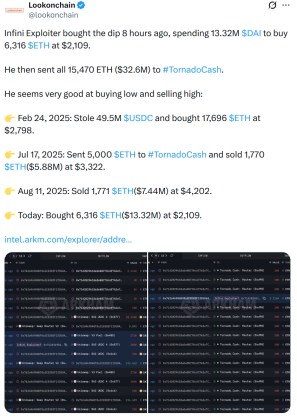
Infini Exploiter hackers have resurfaced, using approximately $13 million in stolen funds to buy the $ETH dip, highlighting persistent vulnerabilities in legacy blockchain security. This event underscores a critical failure in current architecture, where compromised funds can be monitored but not frozen, revealing the ecosystem's fragility. In response, the article highlights $BMIC as a next-generation solution deploying a quantum-secure finance stack. It uses post-quantum cryptography and a Zero Public-Key Exposure model to prevent 'Harvest Now, Decrypt Later' attacks, making wallet exploits mathematically impossible. The $BMIC presale has raised over $444K, signaling strong market demand for AI-enhanced, quantum-proof financial tools that offer protection against evolving threats and future quantum computing risks.

Trusted Editorial content, reviewed by leading industry experts and seasoned editors. Ad Disclosure

Quick Facts:

  • ➡️ The Infini exploiter resurfaced to purchase approximately $13M in $ETH, highlighting persistent vulnerabilities in legacy blockchain security.
  • ➡️ BMIC introduces post-quantum cryptography and Zero Public-Key Exposure to prevent future ‘Harvest Now, Decrypt Later’ attacks.
  • ➡️ The BMIC presale has raised over $444K, signaling strong market demand for AI-enhanced, quantum-proof financial tools.

The ghost of a past exploit has returned to the blockchain. On-chain data confirms that the wallet associated with the notorious Infini exploit has broken its silence, moving significant capital to accumulate Ethereum during the recent market dip.

This isn’t just a simple buy order. It’s a strategic reallocation of illicit funds totaling approximately $13M, timed perfectly with $ETH’s local bottom.

That re-emergence signals a troubling shift in crypto market structure: bad actors are becoming sophisticated asset managers. Instead of immediately laundering stolen funds through mixers, these entities are holding, staking, and trading to compound their gains. The market reaction has been mixed. While some traders view the whale-sized buy pressure as a bullish signal for $ETH, security analysts see it as a glaring reminder of the ecosystem’s fragility. Frankly, it’s a wake-up call.

This event exposes a critical failure in current blockchain architecture. If a wallet can be compromised and the funds monitored but not frozen, the underlying security model isn’t ready for institutional adoption. The industry is effectively playing a game of whack-a-mole with legacy vulnerabilities.

But a shift is happening. While hackers exploit the transparency of current chains, next-generation protocols are building immune systems against them. That’s where BMIC ($BMIC) comes in, a project deploying quantum-secure cryptography to render these types of wallet exploits mathematically impossible.

Closing The Door On ‘Harvest Now, Decrypt Later’

The Infini incident highlights a specific vulnerability: the exposure of public keys and the persistence of compromised data. In the current EVM landscape, once a wallet interacts with a malicious contract, the user’s assets are often exposed forever.

BMIC fundamentally alters this dynamic by introducing the first full Quantum-Secure Finance Stack. By utilizing post-quantum cryptography (PQC) and ERC-4337 Smart Accounts, BMIC ensures that even if a bad actor intercepts data today, they can’t decrypt it. Not now, and not when quantum computers eventually break standard encryption.

Why does this matter? Because the threat vector is evolving. The ‘Harvest Now, Decrypt Later’ strategy means hackers are scraping encrypted data today to unlock it when computing power advances. BMIC counters this with a proprietary Zero Public-Key Exposure model. Unlike traditional wallets that broadcast keys, BMIC transactions remain shielded. It offers a level of sovereign protection that legacy wallets simply can’t match.

Plus, the integration of AI-Enhanced Threat Detection adds a proactive layer to this defense. While the Infini hacker relied on the passive nature of the blockchain to execute their trades unnoticed until it was too late, BMIC’s infrastructure actively monitors for anomalies. This creates a secure environment for ecosystem fuel, governance, and staking, ensuring that users, not exploiters, retain control of their digital future.

FIND OUT MORE ABOUT THE BMIC QUANTUM STACK

Smart Money Rotation Into Quantum Infrastructure

While the Infini hacker buys $ETH for short-term gains, forward-looking investors are positioning themselves in infrastructure plays that solve the security crisis permanently. The $BMIC presale has emerged as a focal point for this capital rotation, already raising over $444K from early adopters who recognize that the quantum transition is inevitable.

At the current token price of $0.049474, the entry point offers a distinct asymmetry compared to buying established Layer-1s. The market is beginning to value ‘insurance’ protocols, tech that protects the trillions of dollars in TVL from catastrophic failure. BMIC ($BMIC) isn’t merely a wallet; it’s a ‘Burn-to-Compute’ utility token powering a Quantum Meta-Cloud. It bridges the gap between decentralized finance and high-performance computing, making it one of the best crypto presales.

The utility here extends beyond simple storage. By enabling quantum-secure staking with no exposed keys, $BMIC solves the dilemma of earning yield without risking the principal. As regulatory scrutiny tightens on money laundering (highlighted by the Infini hacker’s movements), enterprises will be forced to migrate to compliant, secure environments.

BMIC provides that sanctuary. The current presale phase represents a rare opportunity to acquire the standard for future digital security before the wider market reprices the risk of legacy chains.

EXPLORE THE $BMIC PRESALE

The content of this article does not constitute financial or investment advice. Cryptocurrencies are highly volatile assets, and presales carry significant risk. Always conduct your own due diligence before making any financial decisions.

Editorial Process for bitcoinist is centered on delivering thoroughly researched, accurate, and unbiased content. We uphold strict sourcing standards, and each page undergoes diligent review by our team of top technology experts and seasoned editors. This process ensures the integrity, relevance, and value of our content for our readers.

Ben Wallis

Follow

Ben is a freelance writer, and AI editor specializing in crypto developments (mainly altcoins) and the intricate ways global economics shape the digital asset space. His B.Ed. in Education provides a unique foundation for his writing, enabling him to distill complex crypto concepts and market shifts into clear, digestible insights. This skill is key to helping readers adapt and apply their understanding to the ever-evolving world of crypto investment. Passionate about making crypto accessible, Ben crafts content designed to educate a broad audience, from current market events to the essential foundational knowledge that underpins them. His goal is to empower readers through understanding. When he’s not immersed in crypto analysis and breaking down complex topics, Ben is an avid Pokémon fan and enjoys all things Disney.

Full Profile

Related Posts

Bessent Urges Senate to Fast-Track Warsh Nomination as Institutional Liquidity Pivot Favors LiquidChain

Turkey & Tether Freeze $544M: Why $BMIC Is The Safe Haven

Tether’s $23B Gold Hoard Rivals Nation States As Smart Money Pivots To $HYPER

Story Co-Founder Defends Token Unlock Delays; Why Long-Term Scaling Matters For $MAXI

Takaichi’s Victory Sends Nikkei to Records as Bitcoin Reclaims $72K; What this Means for $HYPER

Crypto.com Founder Buys AI.com For $70M As The AI-Crypto Synergy Propels SUBBD Forward

Связанные с этим вопросы

QWhat recent action did the Infini exploiter take, and what does it signify about blockchain security?

AThe Infini exploiter resurfaced to purchase approximately $13 million worth of Ethereum ($ETH) during a market dip. This action signifies a troubling trend where bad actors are becoming sophisticated asset managers, holding and trading stolen funds instead of immediately laundering them. It highlights persistent vulnerabilities in legacy blockchain security models, demonstrating that compromised funds can be monitored but not frozen, which is a critical failure for institutional adoption.

QHow does BMIC ($BMIC) address the 'Harvest Now, Decrypt Later' threat in blockchain security?

ABMIC counters the 'Harvest Now, Decrypt Later' threat by implementing a full Quantum-Secure Finance Stack. It uses post-quantum cryptography (PQC) and ERC-4337 Smart Accounts to ensure that intercepted data cannot be decrypted, even with future quantum computing advances. Its proprietary Zero Public-Key Exposure model prevents public keys from being broadcast, rendering wallet exploits mathematically impossible and providing sovereign protection for users.

QWhat is the current status of the BMIC presale, and why is it attracting investor interest?

AThe BMIC presale has raised over $444,000, indicating strong market demand. Investors are attracted because BMIC offers a quantum-proof security solution at an early stage, with a current token price of $0.049474. It addresses the growing need for 'insurance' protocols that protect against catastrophic failures in blockchain security, positioning itself as a standard for future digital safety amid increasing regulatory scrutiny.

QWhat unique technologies does BMIC integrate to enhance its security features?

ABMIC integrates several advanced technologies: post-quantum cryptography (PQC) to resist quantum attacks, ERC-4337 Smart Accounts for secure transactions, a Zero Public-Key Exposure model to prevent key broadcasting, and AI-Enhanced Threat Detection for proactive anomaly monitoring. These features combine to create a quantum-secure environment for staking, governance, and ecosystem operations, far surpassing the security of legacy wallets.

QHow does the Infini exploiter incident reflect broader issues in the crypto market's structure?

AThe Infini exploiter incident reflects broader issues such as the sophistication of bad actors in crypto, who now manage illicit funds like asset managers by holding, staking, and trading to compound gains. It exposes the fragility of current blockchain architectures, where transparency allows exploits to persist without recourse. This undermines institutional confidence and underscores the urgent need for next-generation, quantum-secure solutions like BMIC to prevent similar vulnerabilities.

Похожее

Uncovering the Truth About Agent Commerce, Payments, and Infrastructure

Decoding Agent Commerce, Payments, and Infrastructure: The Reality Over the past year, I've been building infrastructure for the Agent economy, engaging with major players like Stripe, Visa, Coinbase, Google, and dozens of startups. A clear conclusion emerges: true, large-scale demand does not yet exist. Startups face structural challenges. Data points illustrate this gap. Stripe's Agent commerce platform has over 1,000 merchants but only single-digit transacting agents. Visa's Agent payment token requires 9-month KYC and a $250M revenue threshold, accessible only to giants like Amazon. On-chain analysis reveals actual daily Agent transaction volume is around $17k, half of which are test transactions. The article analyzes four potential markets: **1. Agent-to-Merchant (A2M):** Current AI shopping UX is often inferior to traditional e-commerce for visual, comparison-heavy purchases (clothing, electronics). Chat interfaces are a step back. Real merchant interest is defensive "Agent Engine Optimization," fearing future obsolescence, not current demand. Potential exists in high-frequency, low-decision purchases (e.g., food delivery) or simplifying terrible UX (complex checkouts, non-native shoppers), but these require massive consumer distribution channels dominated by giants like DoorDash and Amazon. **2. Agent-to-API (A2A):** Developers already have subscriptions and billing for core APIs (compute, data). The argument for micro-payments via crypto for sub-dollar API calls is addressed by pre-paid balances today. The deeper issue is supplier resistance; major SaaS firms rely on enterprise contracts, not fractional cent pricing. Opportunity lies in the long tail of niche services, but this is a smaller market catering to developers, a historically low-paying group. **3. Agent-to-Agent (A2A):** This remains a theoretical long-term vision with near-zero current transaction volume. It involves unique challenges: discovery, trust, negotiation, dispute resolution. When it materializes, it will require a fundamentally new settlement infrastructure for high-speed, variable-value, multi-party transactions. It's a real long-term bet, but not the current market. **4. Agent-to-Finance (A2F):** This is the only category with existing, paying demand. Integrating AI into financial workflows (trading, portfolio management) is a natural evolution and enables new capabilities like autonomous rebalancing. However, competition favors incumbents with regulatory licenses, compliance infrastructure, and existing client relationships. **The Real Issue:** Why is infrastructure still being built? Incumbents can afford long-term bets, and payment companies see every problem as a nail for their payment hammer. However, payment is just one piece. The core challenge is *coordination*—orchestrating work between Agents and humans, verifying outcomes, and settling results. Payment is part of settlement, which is part of coordination. Companies that solve the coordination problem will subsume payments, not the other way around. Startups lack the infinite runway of giants and must find today's real market, which, after a year of exploration, lies outside these four categories—in an area with real, growing, and underserved activity.

marsbit46 мин. назад

Uncovering the Truth About Agent Commerce, Payments, and Infrastructure

marsbit46 мин. назад

Kalshi, MTS, and a16z's Ambition

The article "Kalshi, MTS, and a16z's Ambition" explores prediction markets as a focal point of excitement in 2025 for investors, crypto enthusiasts, and media. It traces their intellectual lineage from Friedrich Hayek's ideas on dispersed knowledge and market coordination to Robin Hanson's Logarithmic Market Scoring Rule (LMSR), which incentivizes truthful information sharing. The piece argues that a16z's significant investment in prediction market platform Kalshi (valued at $220B) transcends mere financial speculation. a16z frames prediction markets as a new form of "media" that provides "presence"—a way for individuals to actively engage with and influence world events through financial stakes, countering postmodern detachment. By wagering on outcomes, users become "super observers," and the market's aggregated probabilities gain authoritative power to define event truth and importance. The article uses media company MTS ("Monitoring The Situation") as a case study of a16z's "new media" strategy: rapidly producing high-intensity, multi-format content to "take over the timeline." However, prediction markets like Kalshi are presented as the ultimate piece in this media empire. Their real-money, crowd-sourced probabilities possess a unique "reality distortion field" and perceived objectivity, potentially swaying public opinion and granting a private company unprecedented interpretive power over reality. Ultimately, Kalshi's immense valuation is attributed not just to its exchange model, but to its role as a foundational component in a16z's envisioned new media landscape, where prediction markets define narrative and truth.

链捕手46 мин. назад

Kalshi, MTS, and a16z's Ambition

链捕手46 мин. назад

Торговля

Спот
Фьючерсы
活动图片