In the Eyes of Algorithms, Oil and Memecoin Are No Different

marsbitОпубликовано 2026-03-12Обновлено 2026-03-12

Введение

In 1974, Henry Kissinger’s “petrodollar” deal with Saudi Arabia helped sustain the global dominance of the U.S. dollar after the collapse of the gold standard. Fifty years later, oil markets are being shaken not by physical supply chains, but by digital signals. A single social media post by U.S. Energy Secretary Chris Wright on X triggered a flash crash in oil prices. He claimed the U.S. Navy had escorted a tanker through the Strait of Hormuz—a critical chokepoint for global oil transit. Within minutes, WTI crude fell 17%, erasing billions in market value. The post was soon deleted after a White House denial, and prices partially rebounded, but the damage was done. The incident highlights how algorithmic trading systems now drive market reactions. Algorithms scanned the post, detected keywords like “Navy,” “escorted,” and “Hormuz,” and executed sell orders in milliseconds—far faster than human traders could react. Oil, once governed by physical supply and geopolitical agreements, now behaves like a meme-driven instrument, vulnerable to unverified information. This event underscores a broader shift: the “memefication” of assets. In an age of AI and social media, even traditional commodities like oil can be swayed by narratives, emotions, and digital misinformation. The very foundations of market consensus have grown fragile, accelerated by algorithms that trade on speed, not substance. Perhaps, in the end, the meme has won.

In 1974, then-U.S. Secretary of State Henry Kissinger flew to Riyadh and struck a deal that would reshape the world order: Saudi Arabia would sell oil, accepting only U.S. dollars; and these dollars would then be recycled to purchase U.S. Treasury bonds.

At that time, Nixon had just severed the link between the dollar and gold. Inflation was spiraling out of control in the U.S., dollar reserves were depleted, gold was flowing out in large quantities, and the Bretton Woods system had collapsed. At that moment, many believed the golden age of the U.S. dollar was over.

But the deal Kissinger struck with Saudi Arabia established what later became known as the "petrodollar" system. It was this system that gave the U.S. dollar another half-century of life after the collapse of the gold standard.

This is also why any threat to block oil shipping lanes is not merely an energy issue for the United States, but a shock to the very foundation of the dollar system. This explains why the narrow, throat-like Strait of Hormuz has been regarded by the U.S. as a critical chokepoint that must be defended for the past fifty years, even resorting to military force if necessary.

Understanding this historical background helps us make sense of today's situation.

In the early hours this morning, while most of China was still asleep, a violent shock lasting less than an hour in the global crude oil futures market wiped out tens of billions of dollars in market value.

The cause was a social media post.

U.S. Secretary of Energy Chris Wright posted on platform X: "The U.S. Navy has successfully escorted an oil tanker through the Strait of Hormuz to ensure oil continues to flow to global markets."
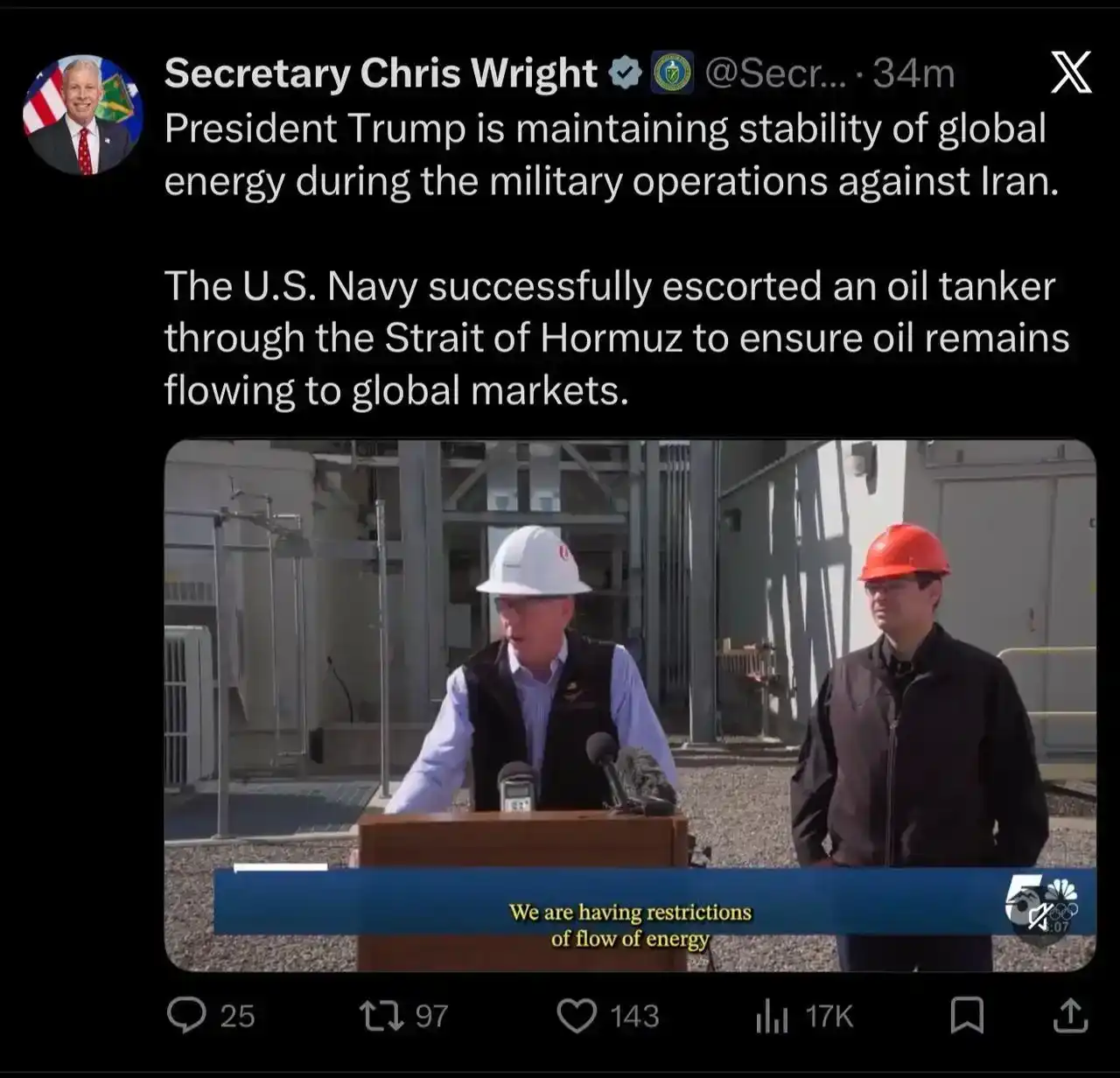
After this tweet was posted, the price of WTI crude oil plummeted within minutes, at one point falling by 17% and briefly dropping below $80 per barrel. In the preceding weeks, due to tensions in the Middle East, Brent crude had just surged from $70 to $120.
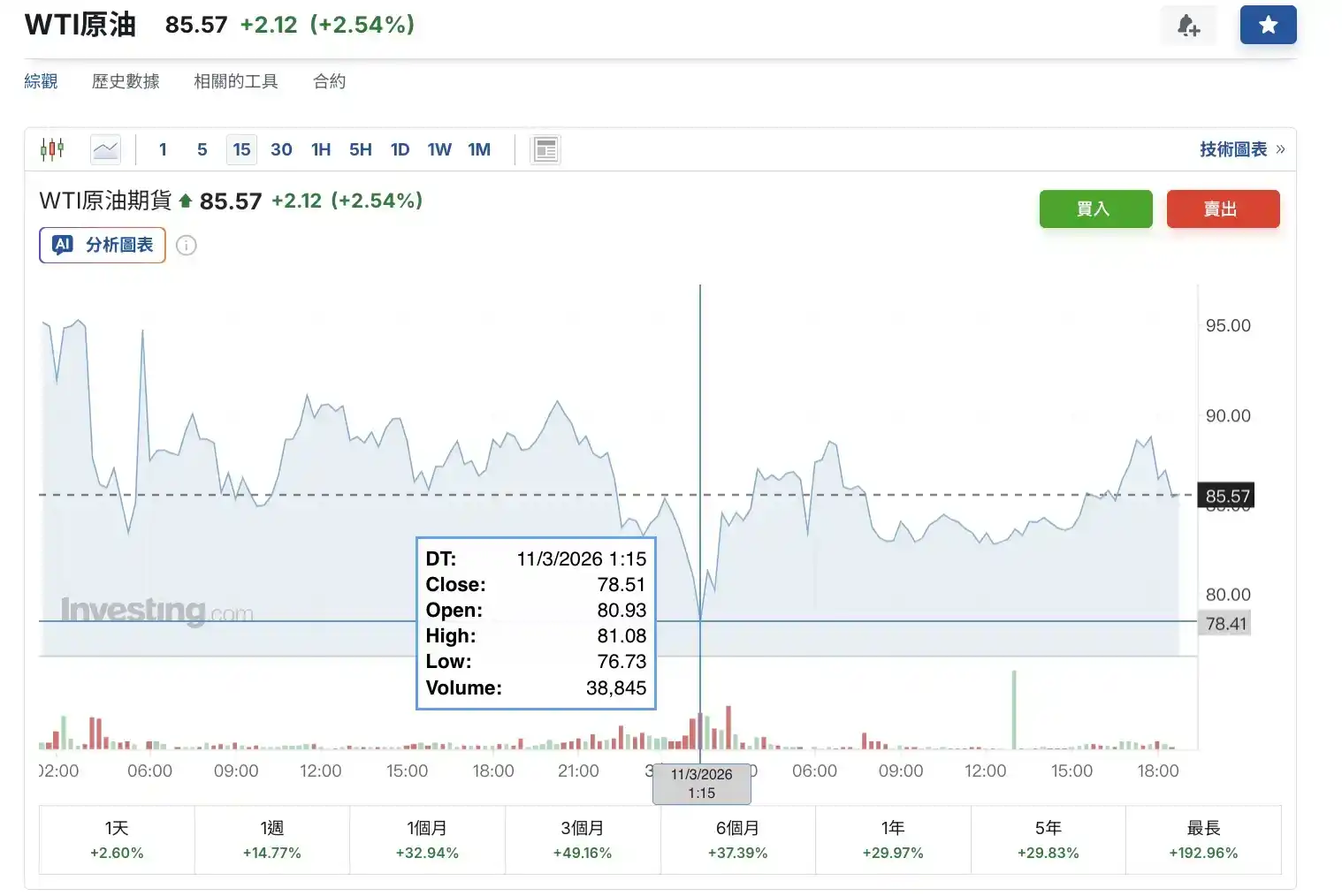
For traders betting on further oil price increases, this moment was a nightmare.

However, the plot quickly reversed.

Less than an hour later, White House Press Secretary Karoline Leavitt urgently clarified at a press briefing: the U.S. Navy is currently not escorting any oil tankers. Subsequently, Energy Secretary Chris Wright silently deleted the post without any explanation. Oil prices rebounded but failed to return to their initial levels.

One post, from publication to deletion, lasted less than sixty minutes. But the mark it left on the global financial markets far exceeded that single hour.

Since the escalation of U.S.-Iran tensions in late February, the博弈 (game) around oil has intensified. Especially after Iran announced the blockade of the Strait of Hormuz, the sudden closure of this narrow waterway, which handles about one-fifth of global crude oil shipments, caused a massive shock to the global energy market. As the situation escalated, international oil prices soared from $70 to $120 per barrel within days, putting the energy market in a state of high tension.

Almost every trader was waiting for the same signal: when will the Strait of Hormuz reopen. Under this collective anxiety, any slight movement could trigger violent price fluctuations. The rapid decline triggered by the Energy Secretary's post was a concentrated manifestation of this sentiment.

So, why could the oil price fall 17% in just a few minutes? Because humans can hardly react that fast, but algorithms can. A significant portion of today's financial market trading volume comes from high-frequency trading algorithms and AI trading systems. They scan the entire internet in real-time, including government officials' social media accounts, grabbing keywords and automatically placing orders.

That post contained three keywords: Navy, Escorted, Hormuz. The algorithms identified these words, combined with contextual semantics, and quickly reached a conclusion: the blockade is lifted, supply is restored, the logic for rising oil prices is weakened.

So the programs immediately sold.

All this happened in about 0.003 seconds.

The algorithm does not call to confirm if a tanker has actually traversed the strait; it only recognizes text and pursues speed. An unverified post, within this mechanistic "collective unconscious," was instantly converted into tens of billions of dollars in evaporated market value.

A real oil tanker crossing the Strait of Hormuz requires hours of sailing, actual military escort, and bears the cost of fuel and real-world risks. A post about an "escort" took only 0.003 seconds to cause violent fluctuations in the price of this major commodity.

In other words, oil, the king of commodities once dominated by supply and demand fundamentals, inventory data, and production agreements, has now, to some extent, become not much different from a Meme.

During the last U.S. election, Trump and Musk keenly sensed that this is an information age. One created Truth Social, the other bought Twitter.

And as the information age has developed to its current state, government officials' social media accounts have become one of the market's most sensitive information sources. This also means that power itself has begun to possess a certain Meme attribute: extremely fast propagation,极高 (extremely high) emotional concentration, and极易 (extremely easy) to be misread and amplified.

Traditional policy information transmission is slow and meticulous. White House statements, State Department bulletins, Defense Department press conferences—these mechanisms inherently involve verification, proofreading, and layers of confirmation. But when officials directly post policy-related information on X, these steps are skipped.

We can foresee that as we delve further into the AI Agent era, the speed of information capture and trading will increase exponentially, with sharp rises and falls occurring in mere milliseconds.

From a more macro perspective, this incident perhaps indicates a larger change: we are entering an era of "comprehensive asset Meme-ification." Almost any financial asset can, at some point, be driven by sentiment, narrative, and social media.

Kissinger used oil to extend the dollar's life for fifty years. But he probably never imagined that one day oil itself would also become a Meme.

No asset possesses a truly unbreakable fundamental moat. All moats are essentially built upon a certain consensus. And under the dual acceleration of social media and algorithmic trading, this consensus is more fragile and more dangerous than ever before.

Perhaps, in a sense, this is also the victory of the Meme.

Связанные с этим вопросы

QWhat was the significance of the deal between Henry Kissinger and Saudi Arabia in 1974?

AThe deal established the 'petrodollar' system, where Saudi Arabia sold oil exclusively for US dollars, and those dollars were then reinvested in US Treasury bonds. This system helped sustain the US dollar's dominance after the collapse of the Bretton Woods system.

QHow did a social media post cause a sharp drop in oil prices?

AA post by US Energy Secretary Chris Wright on X claimed the US Navy escorted a tanker through the Strait of Hormuz, signaling eased supply constraints. Algorithmic trading systems quickly parsed the keywords and sold oil futures, causing prices to drop 17% in minutes.

QWhy is the Strait of Hormuz strategically important?

AThe Strait of Hormuz is a critical chokepoint for global oil transport, handling about one-fifth of the world's oil supply. Its closure or threat of closure can significantly impact global energy markets and geopolitical stability.

QWhat role do algorithms play in modern financial markets?

AAlgorithms and AI trading systems execute trades at high speeds by scanning real-time data, including social media, for keywords and market signals. They can trigger massive market movements within milliseconds based on unverified information.

QWhat does the article suggest about the nature of assets in today's economy?

AThe article argues that assets, including traditional commodities like oil, are becoming 'meme-like'—driven by narratives, emotions, and social media rather than fundamental supply-demand dynamics, making markets more volatile and consensus-based.

Похожее

a16z: AI's 'Amnesia', Can Continuous Learning Cure It?

The article "a16z: AI's 'Amnesia' – Can Continual Learning Cure It?" explores the limitations of current large language models (LLMs), which, like the protagonist in the film *Memento*, are trapped in a perpetual present—unable to form new memories after training. While methods like in-context learning (ICL), retrieval-augmented generation (RAG), and external scaffolding (e.g., chat history, prompts) provide temporary solutions, they fail to enable true internalization of new knowledge. The authors argue that compression—the core of learning during training—is halted at deployment, preventing models from generalizing, discovering novel solutions (e.g., mathematical proofs), or handling adversarial scenarios. The piece introduces *continual learning* as a critical research direction to address this, categorizing approaches into three paths: 1. **Context**: Scaling external memory via longer context windows, multi-agent systems, and smarter retrieval. 2. **Modules**: Using pluggable adapters or external memory layers for specialization without full retraining. 3. **Weights**: Enabling parameter updates through sparse training, test-time training, meta-learning, distillation, and reinforcement learning from feedback. Challenges include catastrophic forgetting, safety risks, and auditability, but overcoming these could unlock models that learn iteratively from experience. The conclusion emphasizes that while context-based methods are effective, true breakthroughs require models to compress new information into weights post-deployment, moving from mere retrieval to genuine learning.

marsbit2 ч. назад

a16z: AI's 'Amnesia', Can Continuous Learning Cure It?

marsbit2 ч. назад

Can a Hair Dryer Earn $34,000? Deciphering the Reflexivity Paradox in Prediction Markets

An individual manipulated a weather sensor at Paris Charles de Gaulle Airport with a portable heat source, causing a Polymarket weather market to settle at 22°C and earning $34,000. This incident highlights a fundamental issue in prediction markets: when a market aims to reflect reality, it also incentivizes participants to influence that reality. Prediction markets operate on two layers: platform rules (what outcome counts as a win) and data sources (what actually happened). While most focus on rules, the real vulnerability lies in the data source. If reality is recorded through a specific source, influencing that source directly affects market settlement. The article categorizes markets by their vulnerability: 1. **Single-point physical data sources** (e.g., weather stations): Easily manipulated through physical interference. 2. **Insider information markets** (e.g., MrBeast video details): Insiders like team members use non-public information to trade. Kalshi fined a剪辑师 $20,000 for insider trading. 3. **Actor-manipulated markets** (e.g., Andrew Tate’s tweet counts): The subject of the market can control the outcome. Evidence suggests Tate’sociated accounts coordinated to profit. 4. **Individual-action markets** (e.g., WNBA disruptions): A single person can execute an event to profit from their pre-placed bets. Kalshi and Polymarket handle these issues differently. Kalshi enforces strict KYC, publicly penalizes insider trading, and reports to regulators. Polymarket, with its anonymous wallet-based system, has historically been more permissive, arguing that insider information improves market accuracy. However, it cooperated with authorities in the "Van Dyke case," where a user traded on classified government information. The core paradox is reflexivity: prediction markets are designed to discover truth, but their financial incentives can distort reality. The more valuable a prediction becomes, the more likely participants are to influence the event itself. The market ceases to be a mirror of reality and instead shapes it.

marsbit3 ч. назад

Can a Hair Dryer Earn $34,000? Deciphering the Reflexivity Paradox in Prediction Markets

marsbit3 ч. назад

Торговля

Спот
Фьючерсы
活动图片