IBIT ranking 6th in 2025 ETF flows despite negative returns is ‘a really good sign’

cointelegraphОпубликовано 2025-12-20Обновлено 2025-12-20

Введение

Despite posting negative returns for the year, BlackRock’s iShares Bitcoin Trust (IBIT) ranked sixth in 2025 ETF net inflows with approximately $25 billion. This performance, noted by Bloomberg analyst Eric Balchunas as a "really good sign," highlights strong investor commitment amid a down market. In contrast, many top-performing equity and bond ETFs saw double-digit gains. Balchunas suggested that such inflows during a weak period indicate long-term confidence rather than short-term speculation. Meanwhile, sustained institutional buying via ETFs hasn't significantly boosted Bitcoin’s price, which he attributes to profit-taking and mature market behavior. BlackRock executives defended IBIT's outflows as normal for ETF liquidity management.

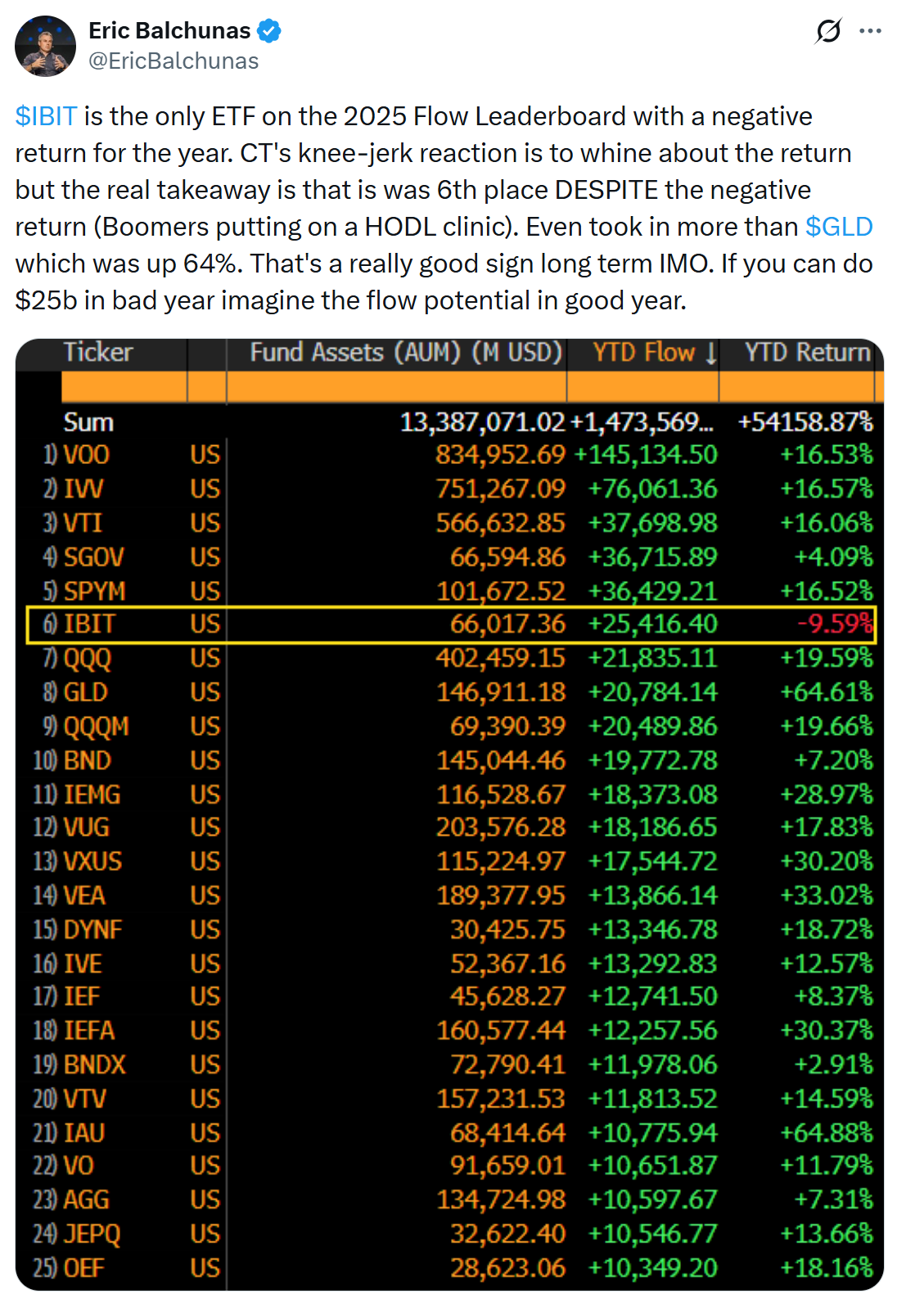
BlackRock’s spot Bitcoin ETF, iShares Bitcoin Trust (IBIT, has ranked sixth in net inflows despite being the only fund in the top cohort posting a negative return for the year.

Data shared by Bloomberg ETF analyst Eric Balchunas shows IBIT pulling in roughly $25 billion in year-to-date inflows, even as its annual performance sits in the red. By comparison, several traditional equity and bond ETFs ahead of IBIT on the leaderboard posted double-digit gains, while gold-backed ETF GLD, which is up more than 60% on the year, attracted less capital than IBIT.

Balchunas described the result as a “really good sign” over the long term, arguing that the flows reveal more about investor behavior than short-term price action.

“If you can do $25 billion in a bad year, imagine the flow potential in a good year,” he wrote, pointing to what he called a “HODL clinic” from older, long-term investors.

IBIT sees net inflows but negative returns. Source: Eric Balchunas

Related: BlackRock IBIT Bitcoin ETF achieves $70B AUM record

Why heavy ETF buying isn’t pushing Bitcoin higher?

Meanwhile, one crypto market participant questioned why sustained institutional buying through ETFs has not translated into stronger price performance.

In response, Balchunas suggested the market may be behaving more like a mature asset class, where early holders take profits and deploy income strategies, such as selling call options, rather than chasing immediate upside. He also noted Bitcoin had risen more than 120% the previous year, tempering expectations for continuous gains.

On Friday, US spot Bitcoin (BTC) ETFs saw $158 million in net outflows, with Fidelity’s FBTC the only fund to post inflows. Meanwhile, spot Ether (ETH) ETFs recorded $75.9 million in outflows, extending their losing streak to seven consecutive days.

Related: BlackRock's most profitable ETF is now a 'hair away' from $100B

BlackRock defends IBIT after outflows

BlackRock’s spot Bitcoin ETF faced heavy pressure in November, with its flagship IBIT fund recording about $2.34 billion in net outflows, including two large withdrawal days mid-month. Despite the pullback, BlackRock executives downplayed concerns.

Speaking at Blockchain Conference 2025 in São Paulo, BlackRock business development director Cristiano Castro said the firm’s Bitcoin ETFs have become one of its largest revenue drivers. He argued that ETFs are designed to facilitate capital allocation and cash-flow management, making periods of compression and outflows normal.

Magazine: 2026 is the year of pragmatic privacy in crypto — Canton, Zcash and more

Связанные с этим вопросы

QWhat is the ranking of BlackRock's iShares Bitcoin Trust (IBIT) in 2025 ETF net inflows, and what is unique about its performance?

AIBIT ranked 6th in 2025 ETF net inflows, pulling in roughly $25 billion. It is unique because it was the only fund in the top cohort to post a negative return for the year.

QAccording to Eric Balchunas, why is IBIT's performance considered a 'really good sign'?

AHe argues that the substantial inflows during a period of negative returns reveal strong long-term investor behavior and commitment (a 'HODL clinic'), suggesting even greater flow potential during a good year, rather than being solely focused on short-term price action.

QWhat reason did Eric Balchunas suggest for why sustained institutional ETF buying hasn't pushed Bitcoin's price significantly higher?

AHe suggested the market may be maturing, with early holders taking profits and deploying income strategies like selling call options, rather than chasing immediate upside. He also noted that Bitcoin had risen over 120% the previous year, tempering expectations for continuous gains.

QHow did BlackRock executives respond to the significant net outflows from IBIT in November?

ABlackRock executives downplayed concerns. Director Cristiano Castro stated that Bitcoin ETFs have become one of the firm's largest revenue drivers and argued that ETFs are designed for capital allocation and cash-flow management, making periods of outflows normal.

QHow did the net flows for US spot Bitcoin and Ether ETFs perform on the Friday mentioned in the article?

AUS spot Bitcoin ETFs saw $158 million in net outflows, with only Fidelity's FBTC posting inflows. Spot Ether ETFs recorded $75.9 million in outflows, extending their losing streak to seven consecutive days.

Похожее

55TB to 28TB? The Rumor and Panic Behind Rubin's Memory Being Halved

Title: 55TB to 28TB? The Rumor and Panic Behind the Potential Halving of Rubin's Memory. On June 4th, a report from SemiAnalysis suggested NVIDIA's next-gen Vera Rubin NVL72 AI rack may ship with roughly 28TB of SOCAMM DRAM per rack instead of the anticipated 55TB, primarily using 96GB modules. This sparked a market panic, causing Micron's stock to drop over 10% on fears of halved memory demand. However, the article argues this panic is misguided for several key reasons. First, SOCAMM modules are socketed and upgradeable, not soldered. Lower initial configuration doesn't mean permanent demand loss. Second, the primary driver is a severe 2026 LPDDR5X supply shortage, not diminished need. NVIDIA is likely prioritizing rack shipments with available components. Third, with fixed total LPDDR5X supply, using less per rack could allow NVIDIA to ship *more* racks, not necessarily reducing overall memory orders. Micron's sharp drop was also attributed to a broader semiconductor sell-off triggered by Broadcom's earnings, with the SemiAnalysis report providing a convenient narrative for profit-taking after Micron's massive rally. In summary: the report on lower default configurations is likely accurate, but interpreting it as a demand collapse is wrong. The real risk for Micron lies in its reportedly minimal HBM4 share for Rubin, not in potentially flexible SOCAMM demand. The sell-off appears more like a correction amplified by coinciding negative catalysts.

marsbit17 мин. назад

55TB to 28TB? The Rumor and Panic Behind Rubin's Memory Being Halved

marsbit17 мин. назад

Exclusive from Yingke | Tang Wenbin's 'Yuanli Lingji' Merges with Logistics Robotics Company, and Secures Investment from Zhipu, SenseTime, Jieyue, and Others

Exclusive report: Embodied AI company "Yuanli Lingji" recently completed a new round of financing from major AI model firms including Zhipu AI, Stepfun, and SenseTime, alongside continued investments from industrial backers like Huaqin and SAIC Hengxu. Founded in March 2025 by Tang Wenbin, former co-founder and CTO of Megvii, Yuanli Lingji is a general-purpose embodied AI model company. In a notable move, the company has merged with logistics robotics firm "Atomix" (formerly known as Yuanli Juhe) through a share acquisition. Atomix, which originated from Megvii's logistics robotics business led by Tang in 2016 and was spun off in July 2024, has grown to become the world's second-largest supplier of pallet shuttle robots, with annual revenue nearing 1 billion RMB and over 500 projects globally for clients like Uniqlo and CATL. This merger aims to break the industry's "data deadlock" by combining Atomix's extensive real-world operational data from more than 20 countries with Yuanli Lingji's model training capabilities. The company's embodied AI model "DM0" utilizes a cross-domain training approach, integrating internet semantics, autonomous driving rules, and robotics data to achieve hardware-agnostic, precise manipulation even with a compact 2.4B parameter size. The collective investment from key AI players and the strategic merger signal a shift in the competitive landscape, as major model companies pivot from language tokens to physical actions ("from Token to Action"). The industry is entering a consolidation phase where hardware, AI models, data, and application scenarios converge to scale embodied intelligence, a trend mirrored by recent moves from giants like ByteDance and Skild AI.

marsbit25 мин. назад

Exclusive from Yingke | Tang Wenbin's 'Yuanli Lingji' Merges with Logistics Robotics Company, and Secures Investment from Zhipu, SenseTime, Jieyue, and Others

marsbit25 мин. назад

U.S. Stock Market Trends: Dow Hits New High, Nasdaq Falls, Whom Did Broadcom's Slap Wake Up?

U.S. Stocks Split: Dow Hits Record High as Nasdaq Slips; Broadcom's Plunge Sparks Rotation On June 4, the U.S. stock market saw a sharp divergence. The Dow Jones surged 875 points (+1.73%) to a record high of 51,561.93, while the Nasdaq Composite edged down 0.09%. The S&P 500 rose 0.41%. The primary catalyst was a sharp sell-off in AI-related chip stocks, led by Broadcom (AVGO). Despite reporting a 143% year-over-year jump in AI semiconductor revenue to $10.8 billion, the company's shares plunged about 14%. This was triggered by its maintained long-term AI revenue target, which failed to meet heightened expectations for a stock that had gained 55% this quarter and traded at a high P/E ratio. The slide dragged down the broader semiconductor sector and the technology板块. Conversely, money rotated into sectors like Healthcare (+3.14%), Financials (+2.67%), and Real Estate (+1.87%). UnitedHealth and Goldman Sachs were major contributors to the Dow's gains. The rotation was attributed to a search for value outside overheated tech names and a slight dip in Treasury yields. In other major news, SpaceX confirmed its IPO for June 12, targeting a record $75 billion raise at a ~$1.75 trillion valuation. Additionally, initial jobless claims rose to a four-month high, adding nuance to the labor market narrative ahead of the key May non-farm payrolls report. The day's action signaled that while the AI growth story remains intact, excessive valuations are prompting a market reassessment. Funds are moving, at least temporarily, from high-flying tech to more defensive and value-oriented sectors. The sustainability of this rotation hinges on upcoming economic data, particularly the jobs report, and the market's absorption of the massive SpaceX IPO.

marsbit28 мин. назад

U.S. Stock Market Trends: Dow Hits New High, Nasdaq Falls, Whom Did Broadcom's Slap Wake Up?

marsbit28 мин. назад

From 'Old Dogs' to 'New Darlings': How AI is Revaluing Old Infrastructure, from Dell to Nokia

"Old Dogs" Become AI's New Darlings: Revaluing Legacy Infrastructure The AI investment narrative is shifting. Beyond the spotlight on core chipmakers like Nvidia, a new wave of interest is rising for legacy tech companies—Dell, HPE, Nokia, Cisco, Corning, Western Digital—once labeled as slow-growth, outdated stories. This resurgence stems from AI's evolution from model development to real-world deployment, creating massive demand for physical infrastructure. As AI moves into data center construction and enterprise adoption, the focus turns to who can actually build and deliver complex systems. These established players hold decades of experience in supply chains, integration, networking, and enterprise delivery—assets now critical for scaling AI. The revaluation can be grouped into three key infrastructure areas: 1. **Servers & Integration (e.g., Dell, HPE):** They are becoming essential system integrators, transforming GPUs into full-scale AI servers with networking, power, and cooling, then delivering them to clients. Strong recent earnings and AI-specific revenue/order growth for Dell and HPE underscore this shift. 2. **Networking & Connectivity (e.g., Corning, Nokia, Cisco):** As AI clusters grow, high-speed data transfer becomes paramount. Corning benefits from fiber demand for data center links, Nokia is exploring AI-integrated wireless networks (AI-RAN), and Cisco sees surging orders for data center switches—all critical for efficient AI operations. 3. **Storage (e.g., Western Digital, Seagate):** The AI data explosion requires vast capacity. Beyond high-speed memory (HBM), there's growing need for high-capacity HDDs to store training data, logs, video, and cold/archival data cost-effectively. This revaluation, however, is not a blanket endorsement. True reassessment requires concrete proof: AI-driven orders and revenue growth, upward revisions to company guidance, and sustainable improvements in profit quality, not just top-line sales. In essence, AI is not turning all old tech firms into high-growth stocks; it is selectively re-pricing the "old assets" of companies that are mission-critical for building the new AI infrastructure, transforming their legacy capabilities into renewed growth engines.

marsbit36 мин. назад

From 'Old Dogs' to 'New Darlings': How AI is Revaluing Old Infrastructure, from Dell to Nokia

marsbit36 мин. назад

Торговля

Спот
Фьючерсы

Популярные статьи

Что такое ZEST

I. Введение в проект1. Что такое Zest Protocol?Zest Protocol — это кредитный протокол, основанный на Bitcoin, построенный на Stacks Layer 2, который позволяет пользователям зарабатывать доход с помощью BTC или занимать активы, закладывая BTC. Умные контракты протокола написаны на языке Clarity, полностью работают в цепочке и являются открытым исходным кодом, с дизайном, вдохновленным Aave v3. Zest в настоящее время является крупнейшим DeFi-протоколом на Stacks, с более чем 800 BTC, внесенными в депозит, и пиковым TVL, превышающим 100 миллионов долларов. В мае 2026 года протокол дополнительно представил Bitcoin Collateral Vaults, расширив кредитные возможности с Stacks на основную сеть Bitcoin. Это позволяет пользователям занимать стейблкоины, не перемещая BTC с сети Bitcoin, что обеспечивает кредитование с самоуправлением.2. Как работает Zest Protocol?Zest Protocol состоит из двух рынков. Рынок Stacks построен на Aave v3, позволяя пользователям вносить такие активы, как sBTC, STX и USDC, чтобы зарабатывать доход или брать кредиты с избыточным обеспечением. Максимальное LTV по умолчанию составляет 50% (70% для sBTC). Рынок Bitcoin работает через недавно запущенные Bitcoin Collateral Vaults. Пользователи занимают стейблкоины, блокируя BTC в самоуправляемых хранилищах на цепочке Bitcoin. Обеспечение остается на основной сети Bitcoin на протяжении всего процесса, и пользователи сохраняют право собственности, если позиция не ликвидирована.3. Кто основал Zest Protocol?Tycho Onnasch (Соучредитель): Выпускник Оксфордского университета. Участвовал в исследованиях и грантах для Фонда открытого интернета Stacks. Бывший менеджер в Trust Machines и основатель Deedmob. Профиль LinkedIn: https://www.linkedin.com/in/tychokoonnasch/.Fernando Foy (Соучредитель): Ранее работал в IT-консалтинге в Objectif Emploi. Профиль LinkedIn: https://www.linkedin.com/in/fernando-foy/.Emil E. (Соучредитель): Имеет степень магистра физики из Университета Уорика. Бывший инженерный партнер в Trust Machines, Full-Stack разработчик для проектов Web3 и дата-ученый в HSBC. Профиль LinkedIn: https://www.linkedin.com/in/emil-e-49771a145/.Детали финансирования: В мае 2024 года Zest Protocol объявил о завершении раунда начального финансирования в размере 3,5 миллиона долларов, возглавляемого Тимом Дрейпером, с участием Binance Labs, Flow Traders, Trust Machines и других.4. Токеномика $ZEST$ZEST — это нативный токен Zest Protocol с фиксированным общим предложением в 1 миллиард токенов и без инфляционного механизма.Сообщество (27,83%): Используется для аирдропов и стимулов для пользователей;Развитие экосистемы (24,82%): Используется для ликвидности, партнерств, маркетинга, листинга на биржах и т. д.;Инвесторы (22,35%): Поддержка инвестиционных сторон, которые поддержали раннее развитие Zest Protocol;Команда (25%): Выделено для основных участников.График вестинга: Токены команды и инвесторов подлежат 1-летнему периоду блокировки, за которым следует 3 года линейного разблокирования.5. Хронология ключевых этапов2022: Официальное основание Zest Protocol.Март 2024: Завершен аудит безопасности и запущен рынок кредитования Stacks на основной сети.В феврале 2026 года запускается Stacks Market V2, вводящий группы риска.В мае 2026 года были представлены Bitcoin Collateral Vaults, и теперь доступен рабочий прототип основной сети. Это позволяет пользователям использовать самоуправляемый BTC на Bitcoin L1 в качестве обеспечения для займа стейблкоинов на EVM-цепочках, заканчивая мосты, обертки и стороннее хранение. Этот запуск разделен на два этапа. Этап 1: Использует заранее подписанные транзакции для ограничения движения BTC; Этап 2: Использует BitVM для проверки. II. Информация о токенеНазвание токена: ZEST (Zest Protocol)III. Связанные ссылкиВебсайт: https://www.zestprotocol.com/Эксплореры: https://bscscan.com/token/0x5506599c722389a60580b5213ea1da60d64754a1Твиттер: https://twitter.com/ZestProtocolПримечание: Введение в проект основано на материалах, опубликованных или предоставленных официальной командой проекта, и предназначено только для справки и не является инвестиционным советом. HTX не несет ответственности за любые прямые или косвенные убытки, возникшие в результате.

251 просмотров всегоОпубликовано 2026.05.19Обновлено 2026.06.02

Что такое ZEST

Как купить ZEST

Добро пожаловать на HTX.com! Мы сделали приобретение Zest Protocol (ZEST) простым и удобным. Следуйте нашему пошаговому руководству и отправляйтесь в свое крипто-путешествие.Шаг 1: Создайте аккаунт на HTXИспользуйте свой адрес электронной почты или номер телефона, чтобы зарегистрироваться и бесплатно создать аккаунт на HTX. Пройдите удобную регистрацию и откройте для себя весь функционал.Создать аккаунтШаг 2: Перейдите в Купить криптовалюту и выберите свой способ оплатыКредитная/Дебетовая Карта: Используйте свою карту Visa или Mastercard для мгновенной покупки Zest Protocol (ZEST).Баланс: Используйте средства с баланса вашего аккаунта HTX для простой торговли.Третьи Лица: Мы добавили популярные способы оплаты, такие как Google Pay и Apple Pay, для повышения удобства.P2P: Торгуйте напрямую с другими пользователями на HTX.Внебиржевая Торговля (OTC): Мы предлагаем индивидуальные услуги и конкурентоспособные обменные курсы для трейдеров.Шаг 3: Хранение Zest Protocol (ZEST)После приобретения вами Zest Protocol (ZEST) храните их в своем аккаунте на HTX. В качестве альтернативы вы можете отправить их куда-либо с помощью перевода в блокчейне или использовать для торговли с другими криптовалютами.Шаг 4: Торговля Zest Protocol (ZEST)С легкостью торгуйте Zest Protocol (ZEST) на спотовом рынке HTX. Просто зайдите в свой аккаунт, выберите торговую пару, совершайте сделки и следите за ними в режиме реального времени. Мы предлагаем удобный интерфейс как для начинающих, так и для опытных трейдеров.

259 просмотров всегоОпубликовано 2026.05.19Обновлено 2026.06.02

Как купить ZEST

Обсуждения

Добро пожаловать в Сообщество HTX. Здесь вы сможете быть в курсе последних новостей о развитии платформы и получить доступ к профессиональной аналитической информации о рынке. Мнения пользователей о цене на A (A) представлены ниже.

活动图片