How to Earn $300,000 a Year by Counting Musk's Tweets?

比推Опубликовано 2026-02-21Обновлено 2026-02-21

Введение

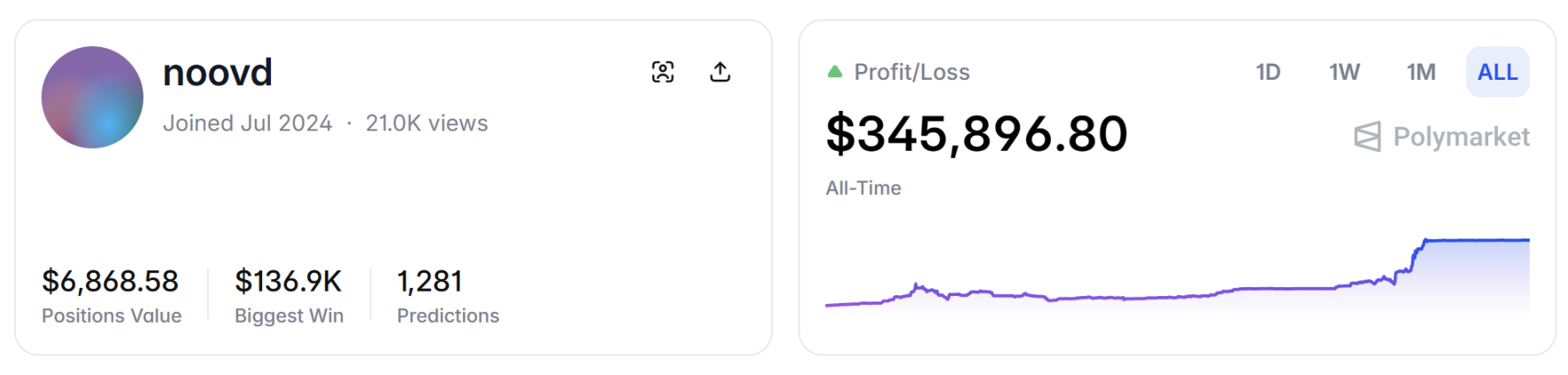
An anonymous trader known as "noovd" has reportedly earned over $345,000 in profit since July 2024 by accurately predicting the number of tweets Elon Musk would post each week on the prediction market Polymarket. The user placed 1,281 bets, with the largest single win exceeding $136,000. Noovd’s strategy focused exclusively on betting "Yes" on narrow, often undervalued tweet-count ranges (e.g., 260–279 or 420–439 tweets per week), which were typically priced as low as 2–24 cents due to market underestimation. Using a proprietary quantitative model trained on Musk’s tweet data since 2022, noovd identified mispriced probabilities—often realizing 8–20x expected value advantages. Key to the model’s success was incorporating variables like day-of-week patterns, real-world events (e.g., SpaceX launches, Tesla earnings), and mid-week recalculations to narrow the probable outcome range. The trader’s high-conviction, concentrated bets—often risking thousands per position—allowed for outsized returns, such as a 4,311% gain on a $1,569 bet. Noovd’s edge stemmed from deep data analysis, disciplined execution, and exploiting persistent market inefficiencies. The case illustrates how specialized expertise in a narrow domain can yield significant returns, emphasizing data over intuition in prediction markets.

Author: Ma He, Foresight News

Original Title: He Made $300,000 by Counting Musk's Tweets


Polymarket is home to many top-tier, profit-savvy minds. A player with the nickname noovd (0x063aeee10fbfd55b6def10da28e87a601e7deb4b) has earned hundreds of thousands in profits simply by predicting the number of tweets from the world's wealthiest man, Elon Musk.

According to the official homepage, he only joined in July 2024 but has already netted $345,000. This player has made 1,281 predictions, with the single largest win being $136,000, and currently holds positions worth $6,877.

Looking at his profit curve, it was almost flat for the first few months, but starting from late 2025, it suddenly shot up with several near-vertical spikes, each surge originating from the same source: interval bets on how many tweets Elon Musk would post per week.

As the world's richest billionaire, Musk certainly has no incentive to manipulate the market.

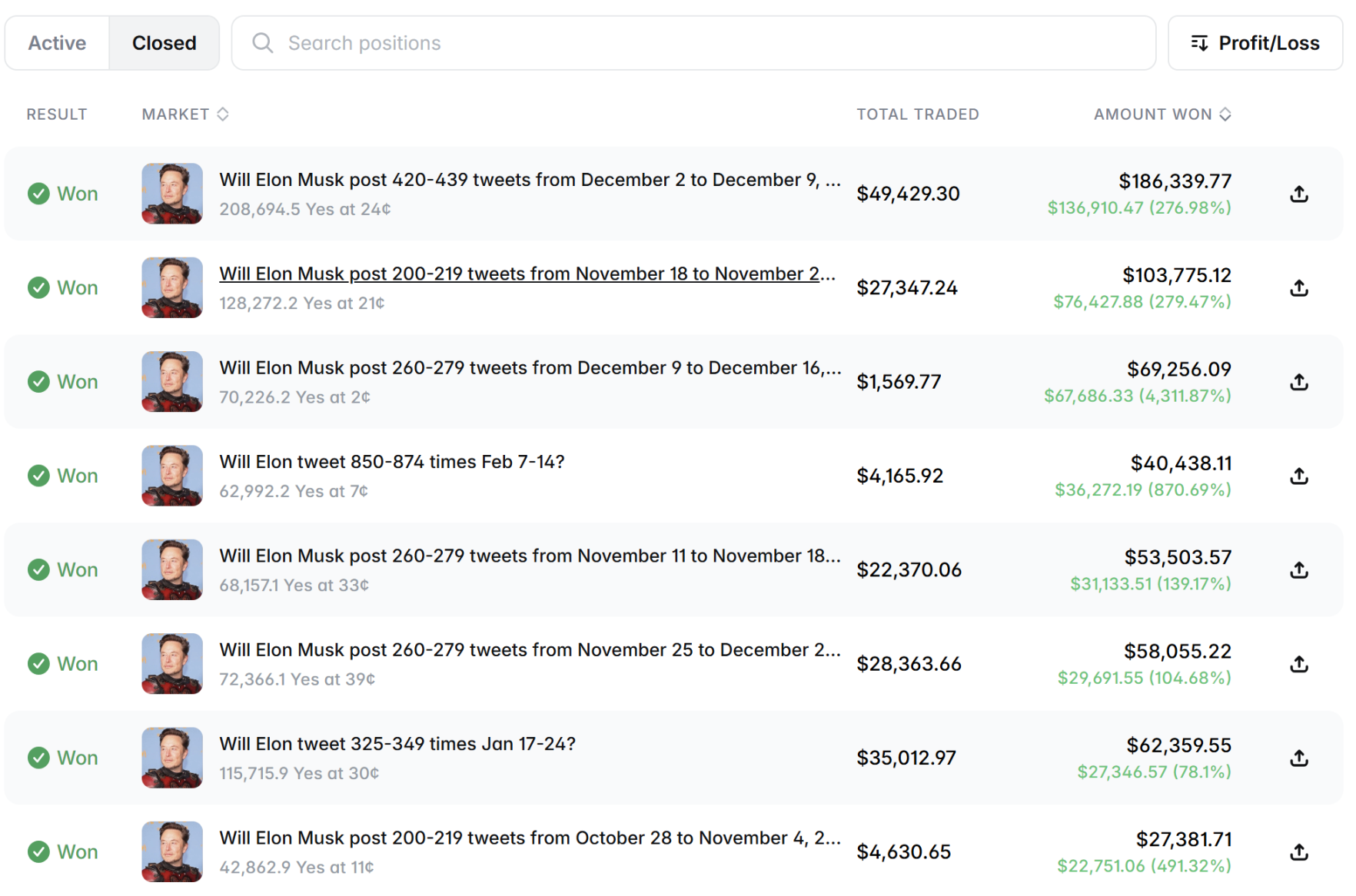
He doesn't guess NBA scores or bet on various political events; he sticks to this one track. Looking at his settled records, the top eight profits all come from betting "Yes" on "Will Musk post between X and Y tweets this week?"

Polymarket breaks down Musk's weekly tweet count into over a dozen mutually exclusive intervals, each spanning about 20 tweets—200-219, 220-239......420-439, and even extreme intervals like 850-874. Retail investors, faced with so many choices, often pick something in the middle, buying a little at 35-50 cents for psychological comfort. What about the edge intervals? Their prices often drop to 2-24 cents, even when the actual probability is clearly 15-30%.

noovd feasts on these undervalued bargains. He only buys "Yes," never "No," never sells early, and never diversifies or hedges. When he places a bet, his positions range from $4,000 to $30,000, with an average entry price between 2-39 cents. Once his model confirms, he goes all in and waits for Sunday's settlement. His brilliance lies in having a real-time rhythm model that others don't see. He doesn't rely on hunches like "Musk will probably post more this week"; instead, he feeds his model with daily tweet data since 2022, updating it daily.

Musk's posting habits from Monday to Friday, the weekend lulls, the weight of catalysts like Starlink launches, Tesla earnings, DOGE news, and xAI new features—all are quantified. By Wednesday or Thursday, he can already precisely calculate how many tweets are needed each remaining day to land exactly within a specific 20-tweet interval.

While the market is still guessing blindly with historical averages, he has compressed the error margin to within ±10-15 tweets. If he detects that a 2-cent interval has an actual probability of 18-25%, he goes heavy. The single-bet expected value advantage often reaches 8-20x. One big win can wipe out dozens of small losses and then some.

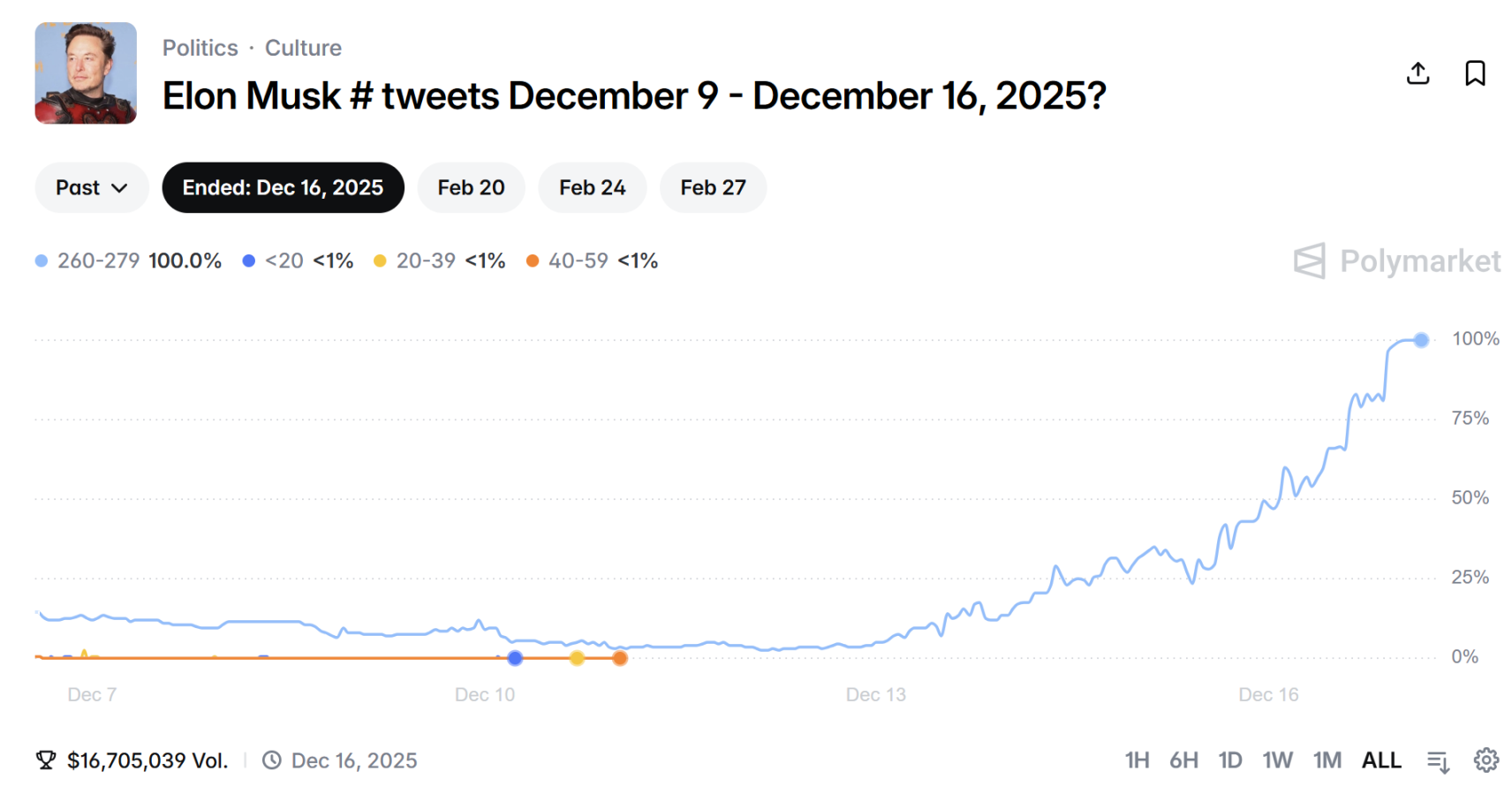
Take the prediction for December 9-16, 2025, for example. By Wednesday night, Musk had already posted 130+ tweets, leaving four days where he needed 32-35 tweets per day to precisely hit the 260-279 interval. That week had no explosive news, but discussions about xAI and Tesla were ongoing. The market, however, priced this interval extremely low because everyone thought "either it'll be平淡 180-220, or it'll shoot straight to 400+".

noovd's model might have captured some pattern of Musk's "sporadic activity." The player bought in at an average price of 2¢, investing about $1,569, and ultimately profited $67,686.33—a return of 4,311.87%.

He entered when the odds were extremely skewed, using minimal cost to lock in this narrow profit interval. This is a typical "deep out-of-the-money options" strategy, betting on the long-tail opportunities of probability distributions.

While the previous case already boasts an astonishing 43x return, the next case became his most profitable bet.

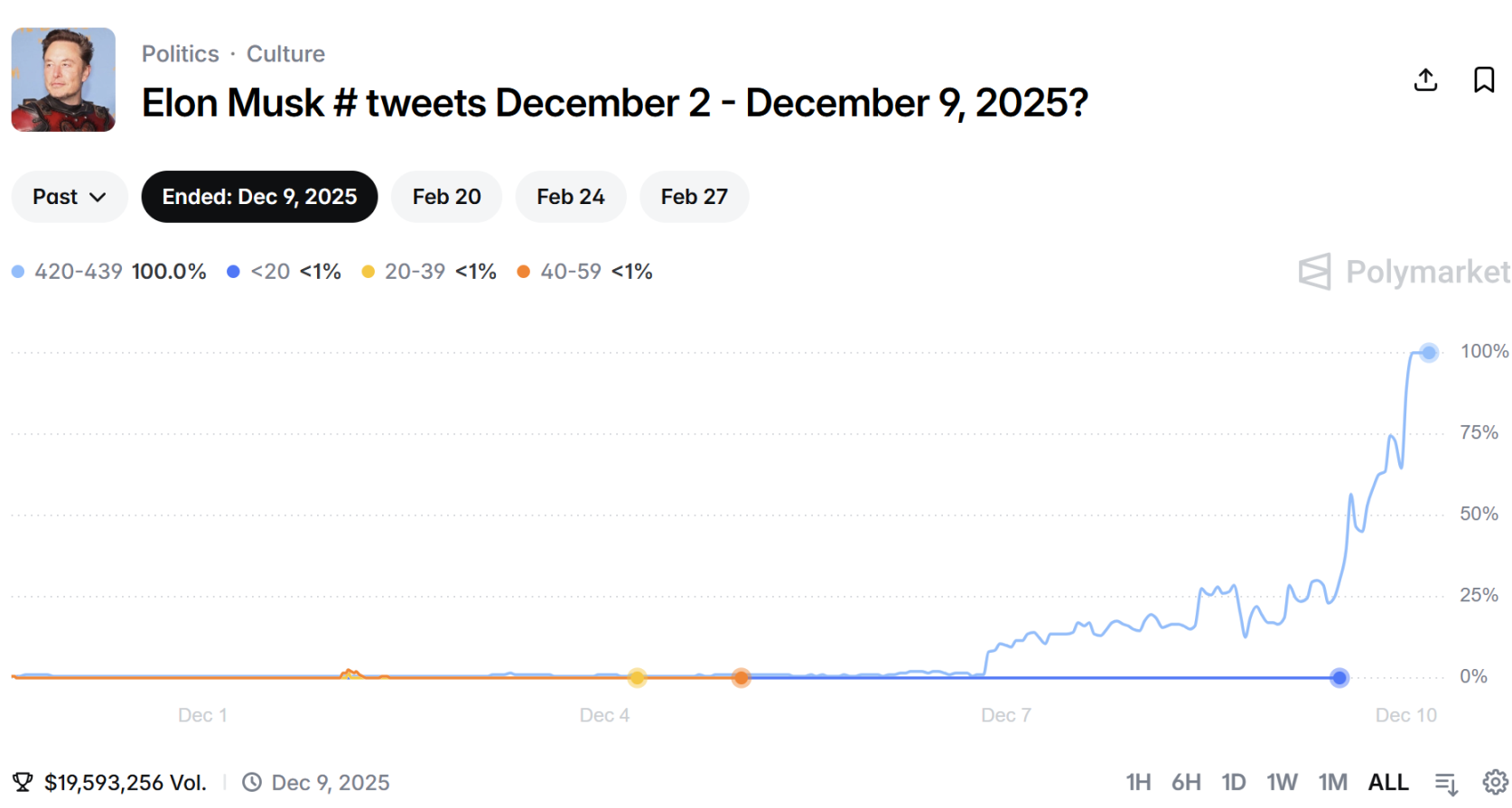
December 2-9: Will Musk post 420-439 tweets?

He bought at an average price of 24¢, heavily with $49,429, and finally profited over $130,000.

At that time, Musk's tweet count had already surged to 180+ by Tuesday. For the remaining days, he needed to maintain 65-70 tweets per day to firmly nail the 420-439 interval. That week had election aftermath and product pre-hype. The market priced it at 24 cents, but he saw that others were spreading their positions across the 400-419, 420-439, and 440-459 intervals, while the most likely landing spot was the middle one. He directly scooped up all 208,694 shares at a cost of $49k, settled for $186k—another near 3x return. Just these two December trades combined for over $255,000. The other thousand or so bets were mostly small tests or辅助 intervals in the same赛道, essentially keeping the machine oiled.

Why can this strategy keep making money, and why is it almost impossible to replicate?

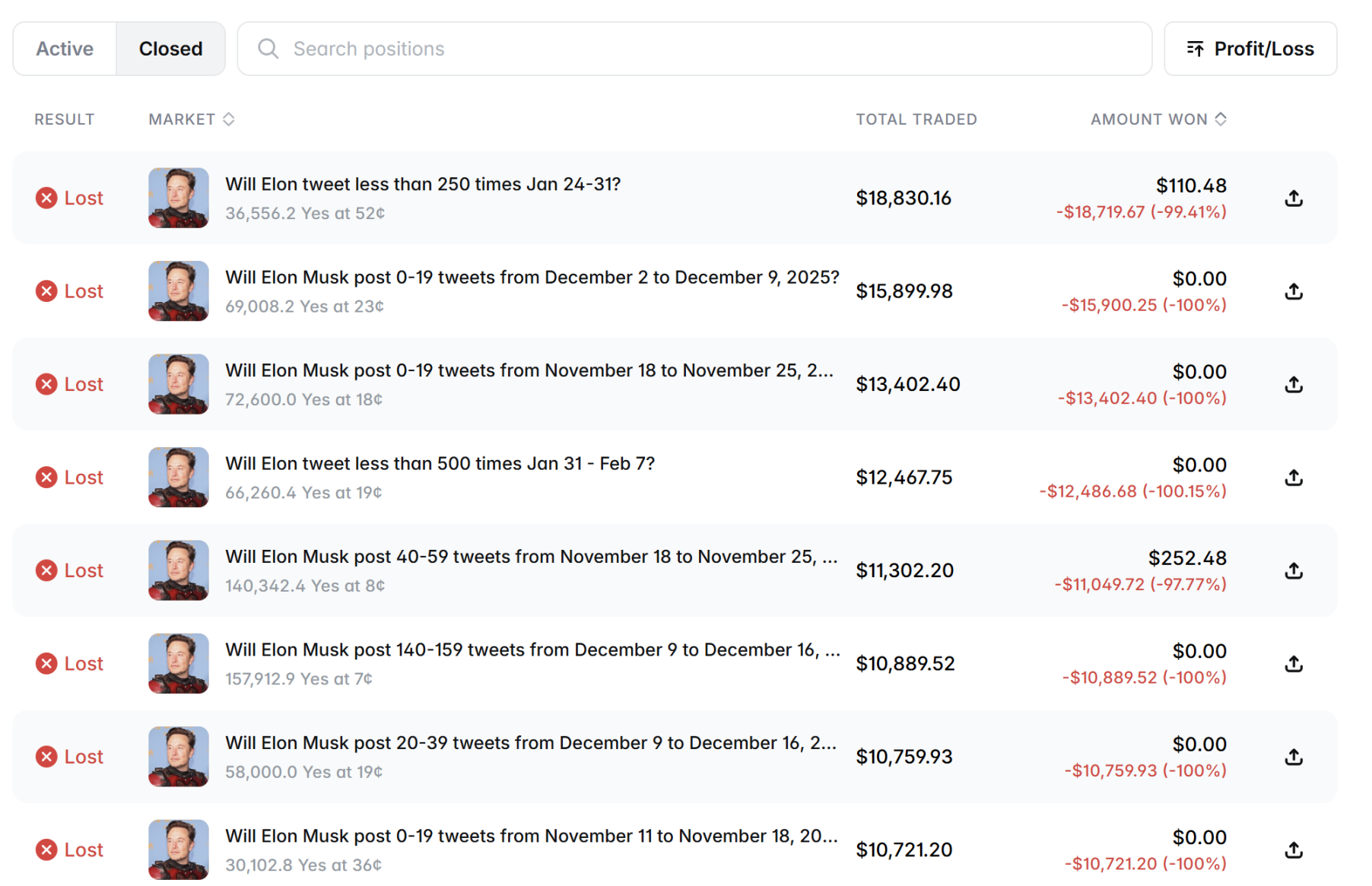
First, the information barrier is too high. You need to scrape his timeline daily, preferably have a complete historical dataset, and write your own Poisson distribution model that refreshes every 6-12 hours. Ordinary people either can't scrape the data or can't be bothered to tune the parameters. The psychological hurdle is immense. Intervals priced at 2 cents or 7 cents look like throwing money away. Anyone who hasn't endured 100 weeks of drawdowns or witnessed 100 settlements firsthand would never dare to go heavy. When you look at his settled loss screenshots, you might breathe a sigh of relief—this player isn't a 100% win-rate god either.

Second, it requires extreme execution. Only go big when the advantage is greater than 10x, treat small losses as tuition, and let big wins compound. Most critically, market inefficiencies persist.

From noovd, what ordinary people can truly learn is to stop fantasizing about conquering all markets. First, find an extremely narrow, repeatable signal and study it thoroughly. Depth always beats breadth, as long as your edge is real. Abandon feelings entirely; speak with numbers and data. Making spreadsheets, scraping data, and running regressions are ten thousand times more reliable than relying on "a feeling that Musk will go crazy this week."

2 cents with a 20% real probability is far better than 50 cents with only a 5% edge. Most people do the exact opposite. In a casino where everyone shouts about 100x returns, the quietest and fiercest wealth was made by someone who could count tweets better than anyone else.

Now, new intervals for predicting Musk's weekly tweet count are still opening regularly. The only question is, very few can turn it into their own money printer.


Twitter:https://twitter.com/BitpushNewsCN

Bitpush TG Discussion Group:https://t.me/BitPushCommunity

Bitpush TG Subscription: https://t.me/bitpush

Original link:https://www.bitpush.news/articles/7613530

Связанные с этим вопросы

QHow did the user noovd make over $300,000 on Polymarket?

ABy accurately predicting the number of tweets Elon Musk would post each week, using a sophisticated data model to identify undervalued betting intervals.

QWhat specific strategy did noovd use to profit from Musk's tweet predictions?

AHe focused on buying 'Yes' shares in undervalued, narrow tweet count intervals (e.g., 420-439 tweets) with high probability but low market prices, often at 2-39 cents, and held until结算.

QWhat was noovd's most profitable single bet, and how much did he earn from it?

AHis most profitable bet was on December 2-9, predicting Musk would tweet 420-439 times. He invested $49,429 at an average price of 24 cents and profited over $130,000.

QWhy is noovd's approach difficult for others to replicate?

AIt requires high technical skills, including scraping Musk's historical tweet data, building a real-time Poisson distribution model, and executing large bets on low-probability intervals with psychological discipline.

QWhat key lesson can be learned from noovd's success on Polymarket?

AFocus on a narrow, repeatable opportunity, use data-driven models instead of intuition, and capitalize on market inefficiencies where probability is mispriced, rather than broadly betting on multiple events.

Похожее

What Happens to Ethereum Developer Tools After the Grants Run Out?

On February 27th, the Ethereum Foundation (EF) announced Project Odin, a structured sustainability support program designed for a select group of strategic, previously grant-funded teams. Unlike a standard grant, Odin offers a long-term advisory mechanism focused on helping these teams establish credible, sustainable paths within a two-year framework, thereby reducing long-term dependence on single funding sources. The program addresses a critical post-grant challenge: how essential public goods, especially major developer tools, can achieve financial sustainability beyond initial funding. While grants from EF and programs like Gitcoin or RetroPGF remain vital for startups and research, they often fall short for mature, widely-used infrastructure. Tools like compilers, languages, and network stacks are deeply embedded but struggle with monetization, trapped between being too foundational to lose and too public to generate natural revenue. Project Odin provides teams with a dedicated Strategic Advisor to guide them through a three-phase process: 1) analyzing current funding and realistic options, 2) validating potential paths with stakeholders, and 3) executing plans, which may include crafting support contracts, service agreements, or other recurring revenue models. The first pilot participant is Vyper, a critical smart contract language for the EVM, highlighting the need for sustainable models for core infrastructure. The initiative reframes the public goods conversation from "who should be funded" to "how do already-proven teams avoid perpetual funding crises?" It encourages ecosystem participants—protocols and projects that depend on these tools—to view sustainable support not just as charity, but as essential risk management for their own operational supply chains.

marsbit15 мин. назад

What Happens to Ethereum Developer Tools After the Grants Run Out?

marsbit15 мин. назад

MARA Reports Q1 Revenue Below Expectations, Net Loss of $1.3 Billion, Stock Plunges After Hours

Bitcoin mining firm MARA Holdings reported disappointing Q1 2024 results, causing its stock to erase all daily gains and fall 3.44% in after-hours trading. Revenue dropped 18% year-over-year to $174.6 million, missing Wall Street estimates of $192.7 million. The company posted a net loss of $1.3 billion, a significant increase from a $533.4 million loss a year ago, primarily driven by unrealized losses on its holdings of 38,689 Bitcoin, which depreciated in value during the quarter. MARA also sold over 15,100 BTC in late March to repurchase debt at a discount. The broader mining environment remains challenging due to a 35% decline in Bitcoin's price from its all-time high and a nearly 30% increase in mining difficulty over the past year. MARA's market cap ranking among U.S. miners has slipped to seventh. Critically, the company announced a strategic pivot away from Bitcoin mining expansion. It stated it has no plans to purchase new mining equipment and is fully transitioning toward AI data centers. Its strategy involves retrofitting existing mining sites for AI and high-performance computing (HPC) and leveraging its recent $1.5 billion acquisition of Long Ridge Energy & Power, a gas-fired power plant and data center. This infrastructure could eventually support 600 MW of AI compute capacity, allowing MARA to redeploy up to 90% of its non-custodial mining power for AI and IT workloads.

marsbit15 мин. назад

MARA Reports Q1 Revenue Below Expectations, Net Loss of $1.3 Billion, Stock Plunges After Hours

marsbit15 мин. назад

The AI Investment Landscape Is Being Reshaped: Beyond the 'Magnificent Seven', What Opportunities Lie in the Semiconductor Supply Chain?

AI Investment Map is Reshaping: Opportunities Beyond the 'Magnificent Seven' Since ChatGPT ignited the AI wave, investment initially focused on the "Magnificent Seven" tech giants dominating cloud infrastructure. However, the rise of DeepSeek and debates on AI capital expenditure effectiveness are shifting this dynamic. Investors now recognize opportunities deeper in the supply chain—the companies providing the essential "picks and shovels." Early concerns about an AI investment "arms race" and potential low returns were partly alleviated by strong Q1 earnings from cloud providers, validating robust compute demand. This has highlighted a more certain investment thesis: regardless of which AI applications ultimately win, massive capital expenditure will first fuel demand for semiconductors and related components. This "pick-and-shovel" logic has driven semiconductor ETFs to record highs. Key beneficiaries include: * **Memory Chipmakers (e.g., SK Hynix, Samsung, Micron)**: High Bandwidth Memory (HBM) is a critical bottleneck for AI training. * **Photonics Companies**: Crucial for high-speed data transfer within AI data centers. * **The Broader "AI-11" Semiconductor Ecosystem**: This encompasses foundries & lithography (TSMC, ASML), logic & custom chips (AMD, Broadcom, Intel, Marvell), and enterprise storage (SanDisk, Western Digital). Every dollar of AI infrastructure spending flows through this chain. While the "Magnificent Seven" remain dominant in market size, their earnings growth premium over the rest of the S&P 500 ("S&P 493") is narrowing. Market attention and marginal investment are shifting towards the expanding semiconductor supply chain. The investment narrative is evolving from "betting on the ultimate AI winner" to "investing in the certainty of the infrastructure build-out." Understanding this shift from the demand side to the supply side is key to identifying future AI investment opportunities.

marsbit44 мин. назад

The AI Investment Landscape Is Being Reshaped: Beyond the 'Magnificent Seven', What Opportunities Lie in the Semiconductor Supply Chain?

marsbit44 мин. назад

Торговля

Спот
Фьючерсы

Популярные статьи

Как купить S

Добро пожаловать на HTX.com! Мы сделали приобретение Sonic (S) простым и удобным. Следуйте нашему пошаговому руководству и отправляйтесь в свое крипто-путешествие.Шаг 1: Создайте аккаунт на HTXИспользуйте свой адрес электронной почты или номер телефона, чтобы зарегистрироваться и бесплатно создать аккаунт на HTX. Пройдите удобную регистрацию и откройте для себя весь функционал.Создать аккаунтШаг 2: Перейдите в Купить криптовалюту и выберите свой способ оплатыКредитная/Дебетовая Карта: Используйте свою карту Visa или Mastercard для мгновенной покупки Sonic (S).Баланс: Используйте средства с баланса вашего аккаунта HTX для простой торговли.Третьи Лица: Мы добавили популярные способы оплаты, такие как Google Pay и Apple Pay, для повышения удобства.P2P: Торгуйте напрямую с другими пользователями на HTX.Внебиржевая Торговля (OTC): Мы предлагаем индивидуальные услуги и конкурентоспособные обменные курсы для трейдеров.Шаг 3: Хранение Sonic (S)После приобретения вами Sonic (S) храните их в своем аккаунте на HTX. В качестве альтернативы вы можете отправить их куда-либо с помощью перевода в блокчейне или использовать для торговли с другими криптовалютами.Шаг 4: Торговля Sonic (S)С легкостью торгуйте Sonic (S) на спотовом рынке HTX. Просто зайдите в свой аккаунт, выберите торговую пару, совершайте сделки и следите за ними в режиме реального времени. Мы предлагаем удобный интерфейс как для начинающих, так и для опытных трейдеров.

1.3k просмотров всегоОпубликовано 2025.01.15Обновлено 2025.03.21

Как купить S

Sonic: Обновления под руководством Андре Кронье – новая звезда Layer-1 на фоне спада рынка

Он решает проблемы масштабируемости, совместимости между блокчейнами и стимулов для разработчиков с помощью технологических инноваций.

2.2k просмотров всегоОпубликовано 2025.04.09Обновлено 2025.04.09

Sonic: Обновления под руководством Андре Кронье – новая звезда Layer-1 на фоне спада рынка

HTX Learn: Пройдите обучение по "Sonic" и разделите 1000 USDT

HTX Learn — ваш проводник в мир перспективных проектов, и мы запускаем специальное мероприятие "Учитесь и Зарабатывайте", посвящённое этим проектам. Наше новое направление .

1.8k просмотров всегоОпубликовано 2025.04.10Обновлено 2025.04.10

HTX Learn: Пройдите обучение по "Sonic" и разделите 1000 USDT

Обсуждения

Добро пожаловать в Сообщество HTX. Здесь вы сможете быть в курсе последних новостей о развитии платформы и получить доступ к профессиональной аналитической информации о рынке. Мнения пользователей о цене на S (S) представлены ниже.

活动图片