How Fake World Assets and onchain gacha became crypto’s latest craze

cointelegraphОпубликовано 2026-08-03Обновлено 2026-08-03

Введение

The crypto space is buzzing with a new trend called Fake World Assets (FWAs), a gamified onchain "gacha" system. Users pay to spin for a random NFT backed by Ether, with prizes from collections like CryptoPunks and Azuki. Shortly after launch, FWA briefly became Ethereum's top gas consumer, generating $1.53 million in daily fees at its peak. While its Total Value Locked has climbed over $6 million, critics like investor Simon Dedic argue the frenzy is driven more by token incentives than genuine demand, labeling it gambling for "crypto degens." Proponents see it as an innovative fusion of collectibles, speculation, and play. The protocol has two sides: NFT holders provide liquidity to earn fees, while players chase valuable prizes. Analysts compare the appeal to a lottery, offering hope and entertainment. The key question is whether onchain gacha represents a lasting retail use case for crypto or just another short-lived speculative craze. Its longevity will be tested as initial hype and rewards diminish.

Just when you thought crypto was getting boring, a new phenomenon is lighting up Crypto Twitter — Fake World Assets (FWAs). Yes, really.

It’s the latest iteration of the onchain gacha craze, where users receive a random collectible, or collectibles, that are usually worth very little, but are sometimes worth quite a lot.

Within four days of launch, FWAs guzzled so much Ethereum gas that they briefly became the chain’s largest gas consumer by fees over a 24-hour period.

At its peak on July 25, FWAs generated approximately $1.53 million in daily fees, and even leapfrogged Tether and Circle to briefly rank among Ethereum’s biggest consumers of blockspace. Its creators, TokenWorks, proclaimed:

“4 days since launch. Fake World Assets are the next big thing.”

TokenWorks is far from an impartial observer, but TVL continues to climb, reaching over $6.15 million on July 31. Fee revenue has now eased to around $350,000 per day, which equates to an annualized run rate of roughly $268 million. By August 1, FWA had seen 10,000 ETH in volume, and 100,000 purchases. Some of the activity is driven by users trying to access early FWA token incentives, but there also appears to be genuine interest in the gamified mechanic.
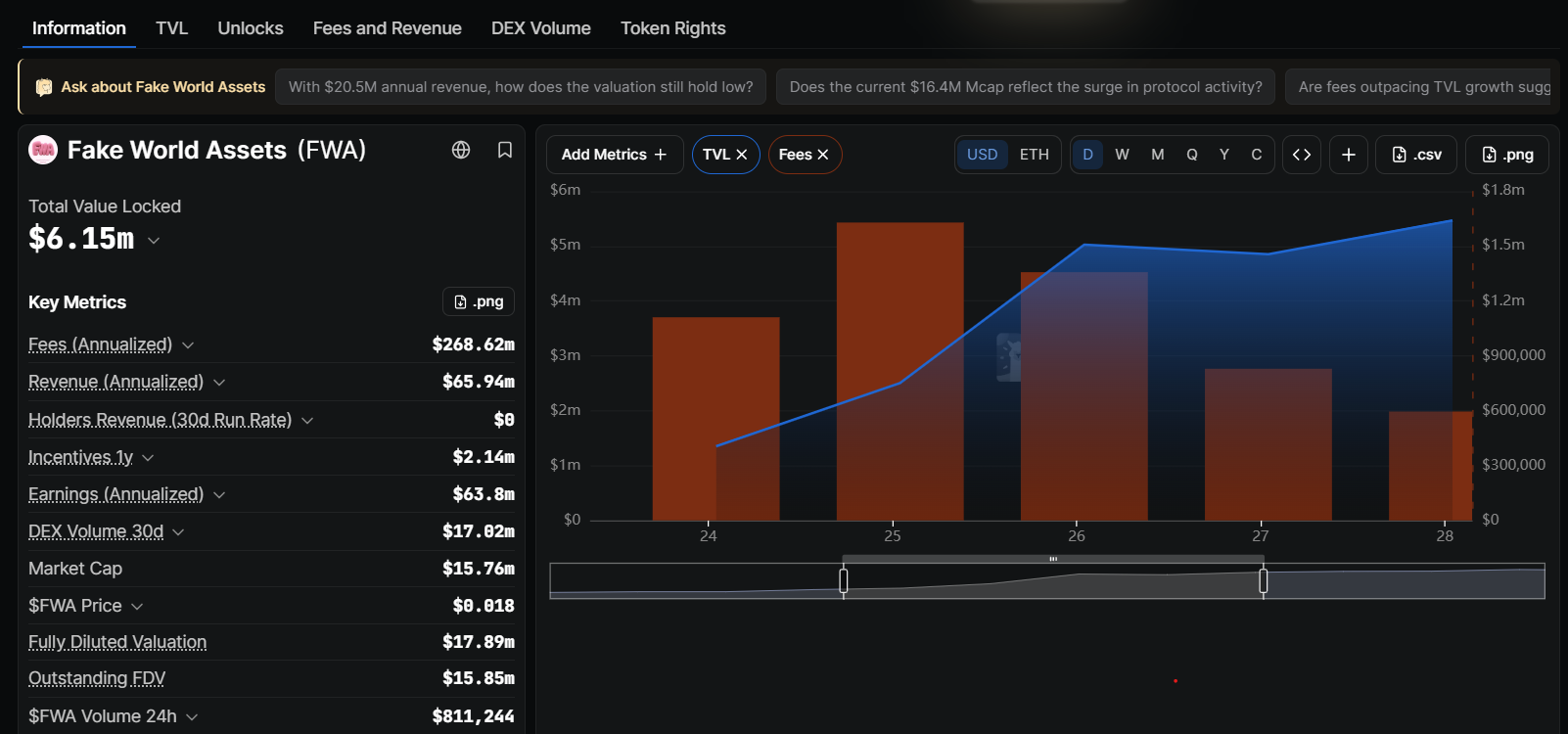
Fake World Assets TVL and fees. Source: DeFiLlama

Not everyone is convinced the excitement around FWA will last. Simon Dedic, founder of venture capital firm Moonrock Capital, and an early backer of onchain collectible platforms, tells Magazine:

“I’m very bullish on gamified commerce... my skepticism on FWA is specific.”

Dedic argues that much of the current activity is driven by generous token incentives rather than genuine demand.

“The whole thing is purely aimed at crypto degens so they can gamble and speculate,” he says.

So, is this just another short-lived obsession, or has the industry finally stumbled upon something built to last?

All very interesting, but what the heck are FWAs?

Crypto has spent years trying to put the real world onchain, from stocks and bonds to collectible cards and Brazilian cows.

Related: Gambling on random Pokémon cards: Onchain gagcha hits record high as crypto sinks

TokenWorks decided to flip the idea on its head by creating Fake World Assets, which are just NFTs. Rather than buying a specific collectible like a Bored Ape, users pay to spin an onchain “gacha” machine for the chance to win a randomly selected NFT backed by Ether.

The prizes on offer come from dozens of well-known collections, like CryptoPunks and Azuki to Lil Pudgys and Art Blocks.

Fake World Assets is just the latest Ethereum-based protocol to put a new spin on the craze.

Gacha is short for gachapon/gashapon, which are vending machines invented in Japan in the 1960s that spit out a random toy in a capsule. This mechanic migrated to mobile and browser games, with the loot boxes in Dragon Collection in 2010 often cited as the first major gacha game. Meanwhile a similar mechanic was at work with real world Pokemon trading card “booster packs” that offered a random assortment of collectible cards, of various rarity levels and values.

These cards were subsequently tokenzied onchain by projects such as Collector Crypt, Beezie and Courtyard. As Magazine reported previously, onchain gacha saw a record $324 million in volume in June. (Hundreds of these tokenized cards have now been wrapped for use on FWA.)

The concept is expanding every week, with developers experimenting with randomized “token packs” containing ERC-20 tokens, while StockRip on Robinhood chain, shows how tokenized stocks can be wrapped into NFT-based gacha packs.
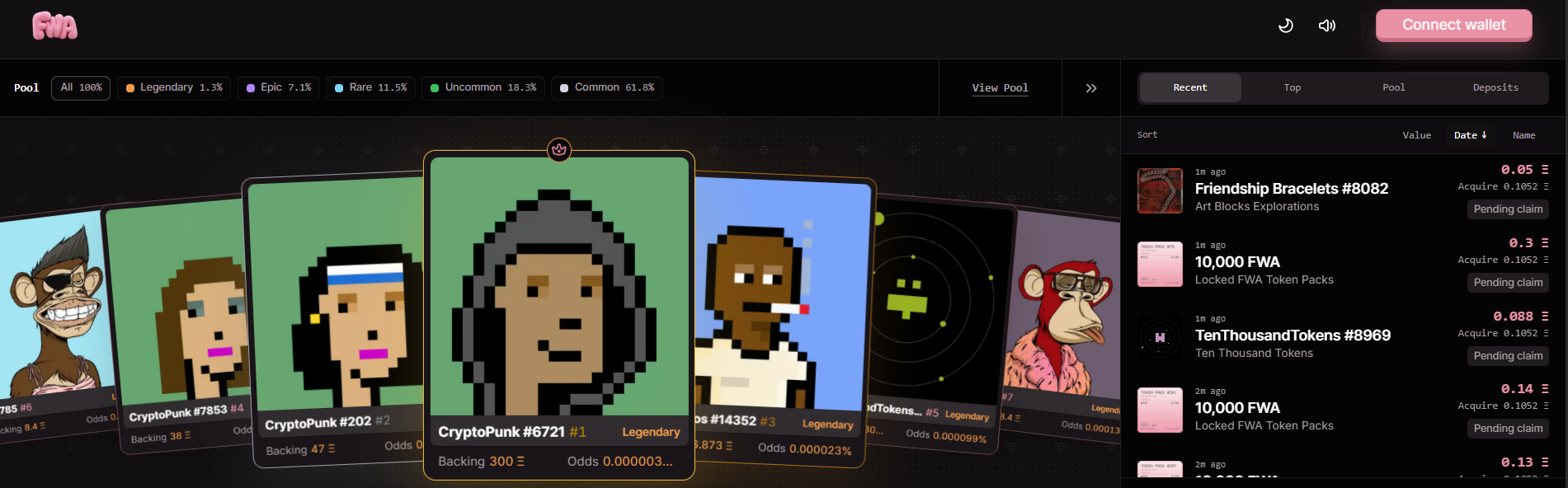

Fake World Assets. Source: fwa.fun

As AzFlin, founder of DAO launchpad daos.world and a former Uniswap engineer, says:

“Just when you think everything in crypto has been invented, something new springs up.”

What is the appeal of onchain gacha?

The gacha mechanic combines crypto, collectibles and gambling . As pseudonymous crypto commentator 2Lambroz puts it, from the player’s perspective, “you’re buying a lottery ticket on the pool.”

“People enjoy playing the lottery, and it’s important to take that seriously,” says Benjamin Lockwood, a Wharton economist whose research into state-run lotteries found that people value the experience itself, not just the chance of winning.

Related: Pudgy Penguins expands retail footprint with Target trading card rollout

Meir Statman, the behavioral finance pioneer and professor at Santa Clara University and author of A Wealth of Well-Being, tells Magazine:

“There is a parallel to ‘onchain gacha’ in people bidding on the contents of abandoned storage units. Most find items worth placing in the trash, but some find items they can sell on eBay. One found a painting worth hundreds of thousands of dollars. These combine hope for riches with playfulness. This is what lotteries offer.”

Two sides to every story
Why do people play the lottery? Source: Knowledge at Wharton

There are two sides to the FWA protocol.

NFT holders become liquidity providers (LPs), depositing collectibles alongside ETH and earning a share of the fees while their position remains in the pool.

Players, meanwhile, pay for the chance to pull a randomly selected NFT, deciding afterwards whether to keep it or redeem most of its attached ETH value instead. (Blockworks Research notes that at present, around 70% of purchasers choose to convert their winnings to FWA.)

As 2Lambroz explains, LPs are effectively hoping their NFT stays in the pool long enough to earn fees before it’s selected, while players are chasing the chance of landing a prize worth far more than the cost of a spin.
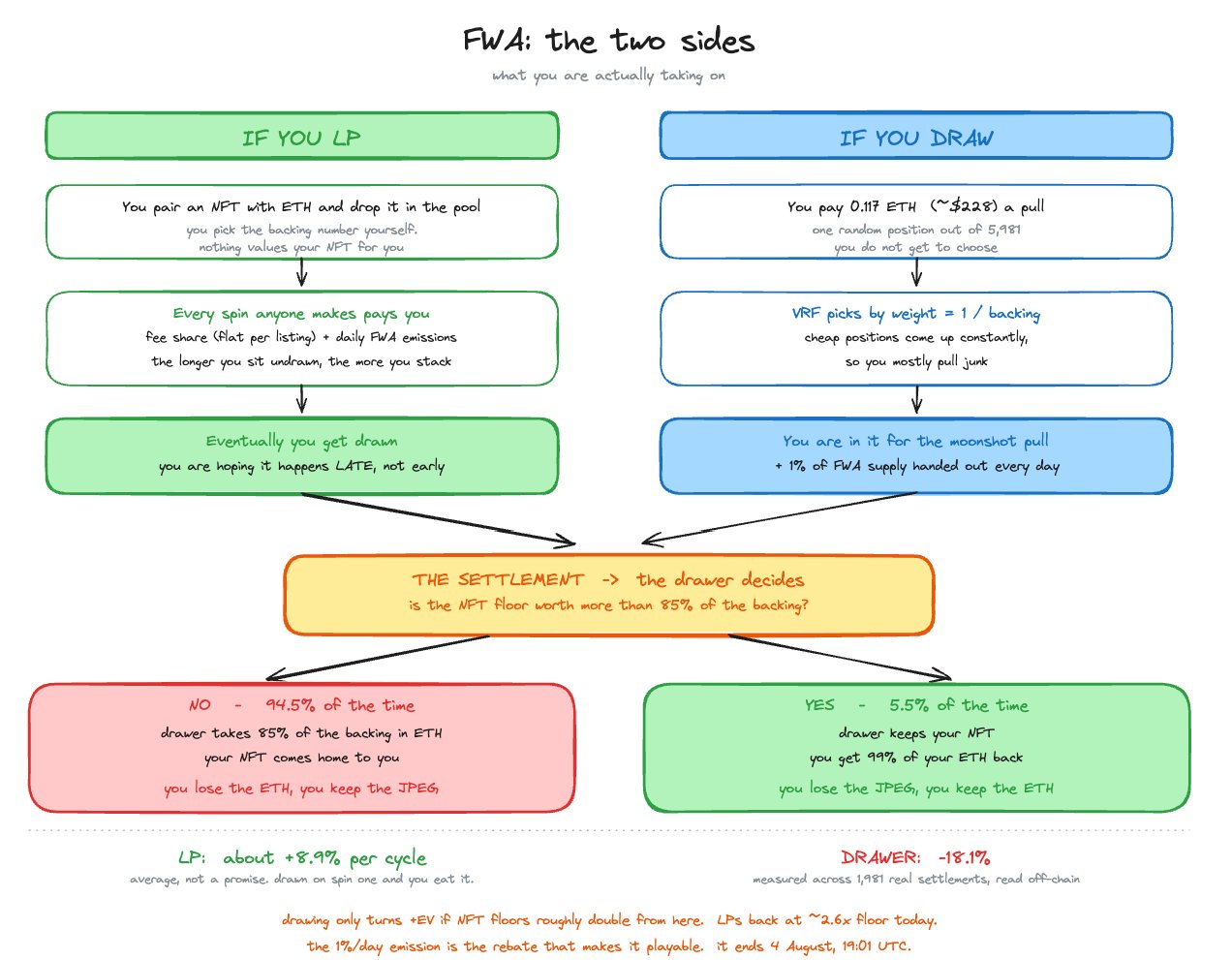
FWA: The two sides. Source: 2Lambroz

Self-proclaimed Ethereum maxi, Materkel says:

“The most fun NFT/casino primitive in over a decade of crypto, where users actually get to be both players and the house at the same time [...] Money legos on Ethereum are back!”

Can the hype last?

While Dedic believes much of the activity relates to token incentives, he says he’s “very bullish on gamified commerce for a generational reason.”

“The further Gen Z moves into being the generation with the strongest buying power, the more shopping is going to be gamified and come with a dopamine kick attached.”

And rather than offering random NFTs from last cycle, Dedic believes the mechanism is better suited to assets people already want to own, such as collectibles like Pokémon cards, watches and even whiskey.

“I see enormous potential in selling much-demanded assets in a gamified way,” he says. “I see very little in building Ponzi schemes to create demand for assets nobody wanted in the first place.”

The real test will come when the novelty wears off and the incentives fade. If users keep spinning anyway, onchain gacha may have found a retail use case crypto has been searching for all along. If not, they’ll join the dumpster fire of failed crypto experiments that burned brightly before fading away.

Magazine: The 100x obsession: Fundamentals grow in importance as crypto matures

Трендовые криптовалюты

Связанные с этим вопросы

QWhat are Fake World Assets (FWAs) and how do they work?

AFake World Assets (FWAs) are a form of onchain gacha, where users pay to spin a digital machine for a chance to win a randomly selected NFT backed by Ether. These NFTs are drawn from well-known collections like CryptoPunks and Azuki. The protocol involves two parties: NFT holders who deposit assets to earn fees as liquidity providers, and players who spin for prizes, often redeeming them for ETH or the FWA token.

QWhat was the initial market impact of Fake World Assets (FWAs) on the Ethereum network?

AWithin four days of launch, Fake World Assets briefly became the Ethereum chain's largest gas consumer by fees over a 24-hour period. At its peak on July 25, FWAs generated approximately $1.53 million in daily fees, surpassing major protocols like Tether and Circle in blockspace consumption. Its total value locked (TVL) also climbed to over $6.15 million by July 31.

QAccording to the article, what is the primary skepticism from critics like Simon Dedic regarding FWA's success?

ASimon Dedic, founder of Moonrock Capital, is skeptical that the excitement around FWAs will last because he believes much of the current activity is driven by generous token incentives rather than genuine organic demand. He argues the model primarily appeals to 'crypto degens' for gambling and speculation, rather than creating lasting value for assets people inherently want to own.

QHow do experts explain the psychological appeal of onchain gacha mechanics like those used in FWAs?

AExperts compare the appeal of onchain gacha to that of lotteries or bidding on mystery items like abandoned storage units. Behavioral economists note that people value the experience of hope, playfulness, and the chance for a big win, not just the financial outcome. This combination of gambling, collectibles, and crypto creates a powerful engagement driver.

QWhat future potential does the article suggest for gamified commerce and onchain gacha beyond FWAs?

AThe article suggests that gamified commerce has significant potential, especially as Gen Z becomes a dominant buying force. The mechanism could be successfully applied to in-demand real-world collectibles like Pokémon cards, watches, or whiskey, selling them in an engaging way. The true test for onchain gacha will be whether user engagement persists after the initial novelty and token incentives fade.

Похожее

Hashdex закроет самый маленький биткоин-ETF спустя более двух лет

Hashdex объявил о ликвидации своего спотового биткойн-ETF под тикером DEFI в конце июля. Оставшимся акционерам будут выплачены денежные средства, а активы фонда, составляющие примерно 225 BTC (на сумму около $14.25 млн), будут проданы. Решение было принято после оценки таких факторов, как ликвидность торгов, операционные расходы и интерес инвесторов. Фонд, начавший торговаться на NYSE Arca в марте 2024 года, значительно отставал от девяти других одобренных в США спотовых биткойн-ETF, которые вышли на рынок на несколько месяцев раньше. Изначально запущенный в 2022 году как фьючерсный ETF на биткойн, фонд Hashdex достиг пика активов в $17.54 млн в мае 2025 года. На данный момент он является самым маленьким среди подобных ETF в США. Для сравнения, следующий по величине фонд, WisdomTree Bitcoin Trust (BTCW), управляет активами на сумму более $140 млн.

cointelegraph15 мин. назад

Hashdex закроет самый маленький биткоин-ETF спустя более двух лет

cointelegraph15 мин. назад

Ripple делает важный шаг для XRP: совершены еще две масштабные инвестиции!

Компания Ripple, стоящая за криптовалютой XRP, объявила о стратегических инвестициях в финтех-компании ZILO и Licuido. Целью этих вложений является добавление регулируемой инфраструктуры для реестра XRP Ledger (XRPL). В частности, планируется внедрить функции для передачи ценных бумаг, выпуска активов и передачи залогового обеспечения, соответствующие нормативным требованиям. Эти шаги направлены на укрепление основы, позволяющей институциональным инвесторам выпускать, управлять и торговать активами в экосистеме XRPL в регулируемом правовом поле. Как отметили в Ripple, инвестиции призваны углубить присутствие компании на рынках капитала, добавив соответствующие услуги в свою инфраструктуру. Данные инвестиции последовали за недавним случаем, когда компания Aviva Investors разместила токенизированный фонд ликвидности в долларах США на платформе XRPL, что указывает на растущий интерес крупных институциональных игроков к возможностям реестра.

cryptonews.ru18 мин. назад

Ripple делает важный шаг для XRP: совершены еще две масштабные инвестиции!

cryptonews.ru18 мин. назад

В Fortune предупредили о рисках сделки Circle и IBM

Circle, компания-эмитент стейблкоина USDC, приобрела у IBM портфель из почти 1000 блокчейн-патентов. По мнению обозревателя Fortune Джеффа Джона Робертса, это может усилить давление на рынок стейблкоинов и инфраструктуры. Circle заявляет, что сделка укрепит развитие USDC, её платёжной сети и других продуктов. Однако аналитик видит риски: крупный патентный портфель может стать инструментом для давления на конкурентов, включая нового игрока Open USD, и для переговоров с банками. В то же время нет доказательств планов Circle использовать патенты агрессивно. Сделка делает Circle крупнейшим держателем блокчейн-патентов в США. Финансовые результаты компании за 2025 год показали рост выручки до $2.7 млрд, но чистый убыток в $70 млн из-за расходов на компенсацию акциями после IPO.

cryptonews.ru18 мин. назад

В Fortune предупредили о рисках сделки Circle и IBM

cryptonews.ru18 мин. назад

В июле объем торгов на Kalshi и Polymarket превысил $50 млрд

В июле 2026 года совокупный объем торгов на платформах для прогнозных рынков Kalshi и Polymarket достиг 50,6 млрд долларов, увеличившись на 7,7% по сравнению с июнем. Данные предоставлены The Block. При этом доля глобальной платформы Polymarket сократилась на 26%, в то время как показатели ее регулируемой американской версии Polymarket US выросли. Рост последней, вероятно, связан с отменой в мае системы авторизации через список ожидания, что открыло прямой доступ пользователям из США. Доля платформы Kalshi выросла на 14%, достигнув 37,7 млрд долларов. Этому могло способствовать как появление новых продуктов, так и изменение регуляторной среды. Лидирующими категориями на Kalshi являются спорт и экзотические рынки, в то время как политические ставки менее популярны. Дополнительным фактором всплеска активности в июле стал чемпионат мира по футболу (11 июня – 19 июля). Объем ставок на финальный матч составил 1,9 млрд долларов на Kalshi и 4 млрд долларов на Polymarket.

cryptonews.ru20 мин. назад

В июле объем торгов на Kalshi и Polymarket превысил $50 млрд

cryptonews.ru20 мин. назад

Торговля

Спот

Популярные статьи

Как купить S

Добро пожаловать на HTX.com! Мы сделали приобретение Sonic (S) простым и удобным. Следуйте нашему пошаговому руководству и отправляйтесь в свое крипто-путешествие.Шаг 1: Создайте аккаунт на HTXИспользуйте свой адрес электронной почты или номер телефона, чтобы зарегистрироваться и бесплатно создать аккаунт на HTX. Пройдите удобную регистрацию и откройте для себя весь функционал.Создать аккаунтШаг 2: Перейдите в Купить криптовалюту и выберите свой способ оплатыКредитная/Дебетовая Карта: Используйте свою карту Visa или Mastercard для мгновенной покупки Sonic (S).Баланс: Используйте средства с баланса вашего аккаунта HTX для простой торговли.Третьи Лица: Мы добавили популярные способы оплаты, такие как Google Pay и Apple Pay, для повышения удобства.P2P: Торгуйте напрямую с другими пользователями на HTX.Внебиржевая Торговля (OTC): Мы предлагаем индивидуальные услуги и конкурентоспособные обменные курсы для трейдеров.Шаг 3: Хранение Sonic (S)После приобретения вами Sonic (S) храните их в своем аккаунте на HTX. В качестве альтернативы вы можете отправить их куда-либо с помощью перевода в блокчейне или использовать для торговли с другими криптовалютами.Шаг 4: Торговля Sonic (S)С легкостью торгуйте Sonic (S) на спотовом рынке HTX. Просто зайдите в свой аккаунт, выберите торговую пару, совершайте сделки и следите за ними в режиме реального времени. Мы предлагаем удобный интерфейс как для начинающих, так и для опытных трейдеров.

1.8k просмотров всегоОпубликовано 2025.01.15Обновлено 2026.06.02

Как купить S

Sonic: Обновления под руководством Андре Кронье – новая звезда Layer-1 на фоне спада рынка

Он решает проблемы масштабируемости, совместимости между блокчейнами и стимулов для разработчиков с помощью технологических инноваций.

2.4k просмотров всегоОпубликовано 2025.04.09Обновлено 2025.04.09

Sonic: Обновления под руководством Андре Кронье – новая звезда Layer-1 на фоне спада рынка

HTX Learn: Пройдите обучение по "Sonic" и разделите 1000 USDT

HTX Learn — ваш проводник в мир перспективных проектов, и мы запускаем специальное мероприятие "Учитесь и Зарабатывайте", посвящённое этим проектам. Наше новое направление .

1.9k просмотров всегоОпубликовано 2025.04.10Обновлено 2025.04.10

HTX Learn: Пройдите обучение по "Sonic" и разделите 1000 USDT

Обсуждения

Добро пожаловать в Сообщество HTX. Здесь вы сможете быть в курсе последних новостей о развитии платформы и получить доступ к профессиональной аналитической информации о рынке. Мнения пользователей о цене на S (S) представлены ниже.

活动图片