How Can a Single Missile Take Down Global AI Giants Instantly?

比推Опубликовано 2026-03-03Обновлено 2026-03-03

Введение

An Iranian missile strike on a data center in the UAE, operated by Amazon Web Services, caused a significant outage of cloud services, including the AI system Claude. The incident occurred shortly after the US and Israel conducted airstrikes in Iran, reportedly aided by Claude for intelligence analysis. This marks the first time a commercial data center has been physically destroyed in a military conflict, highlighting the vulnerability of global AI infrastructure. The event underscores how AI, despite its digital nature, relies on physical infrastructure located in geopolitically unstable regions. Major tech companies, including Amazon, Microsoft, and OpenAI, have heavily invested in data centers across the Middle East due to favorable policies and resources. However, these facilities are now exposed to physical threats in times of conflict. The attack raises critical questions about the classification of data centers as civilian or military assets when they support both commercial and defense operations. It also exposes the lack of international legal frameworks and physical security measures for protecting such infrastructure. The incident shifts the focus from fears of AI replacing humans to the fragility of AI itself in the face of real-world threats.

Author: David, Deep Tide TechFlow

Original Title: AI Within the Range of Artillery


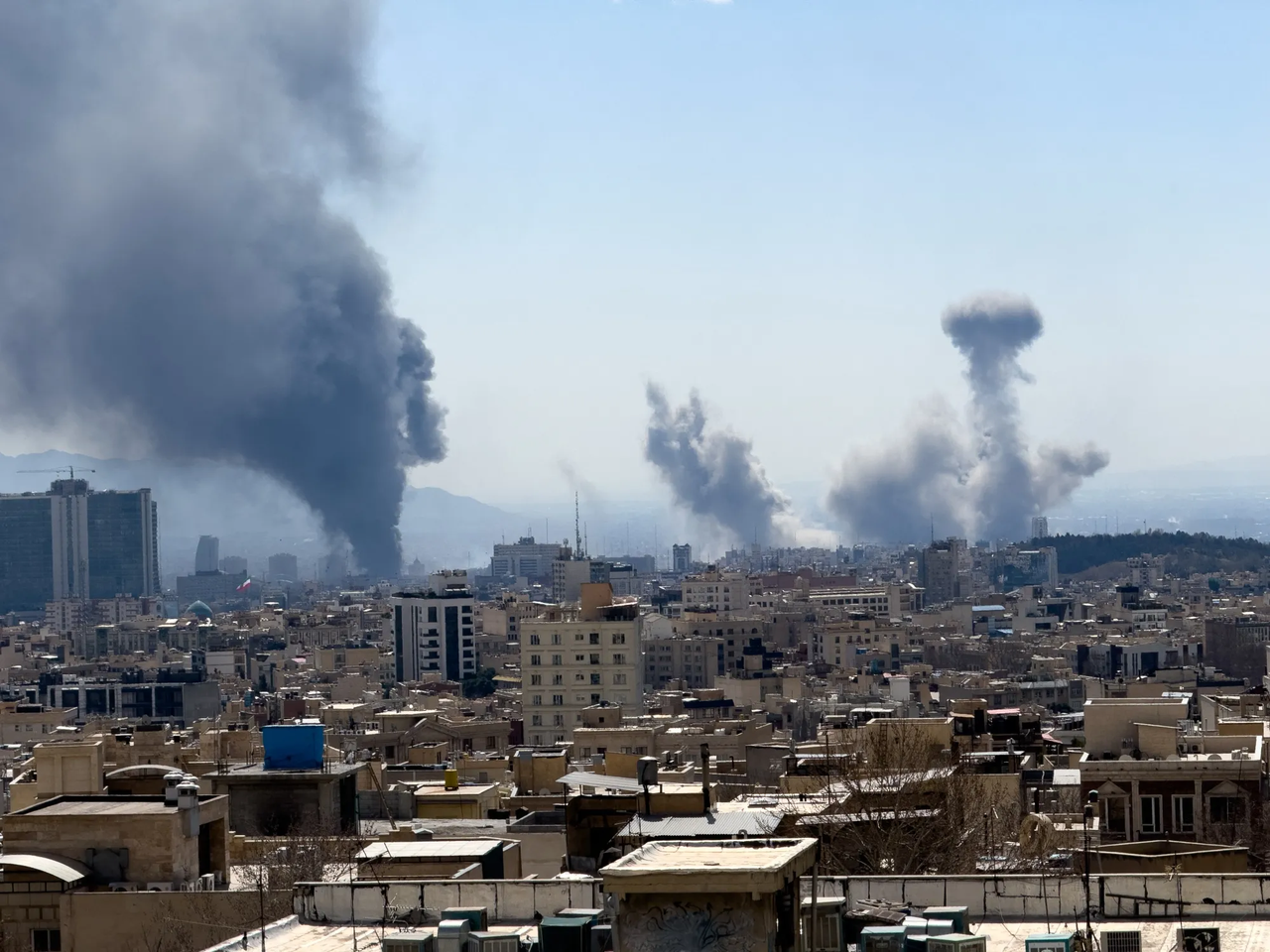
On March 1, Iranian missiles and drones struck the Gulf region, with one landing on an Amazon data center in the UAE.

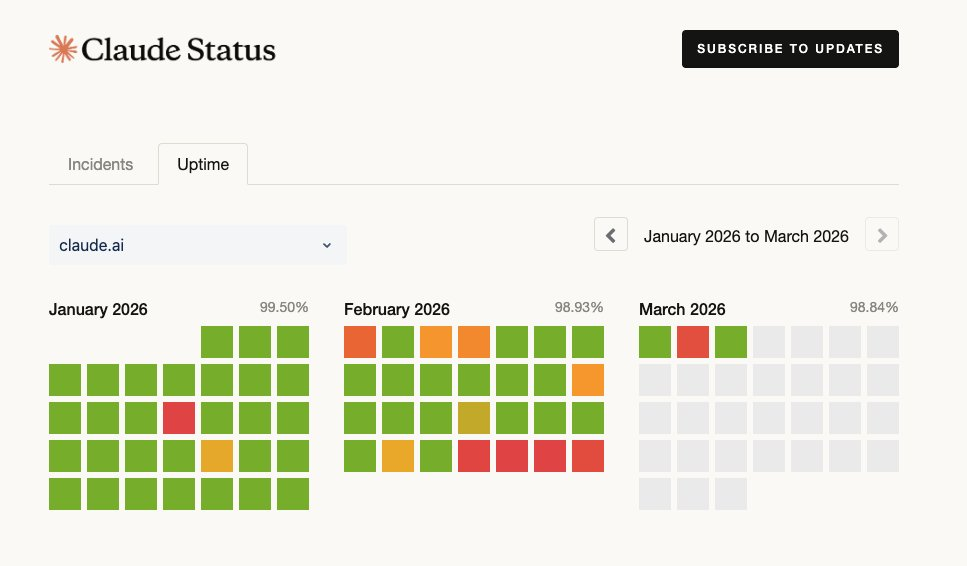
The data center caught fire, lost power, and approximately 60 cloud services were disrupted.

Claude, one of the world's most widely used AIs, runs on Amazon's cloud. On the same day, Claude experienced a global outage.

Anthropic's official explanation was a surge in users overwhelming the servers.

As of the time of writing, complaints about Claude's service being unavailable still persist on social media; the renowned prediction market Polymarket has already launched a prediction topic: "How many more times will Claude go down in March?"

If it is confirmed that Iran was responsible, this would be the first time in human history:

A commercial data center was physically destroyed in a war.

But why would a civilian data center be targeted?

Rewind two days. On February 28, the U.S. and Israel jointly launched an airstrike on Iran, killing Supreme Leader Khamenei and a number of senior officials.

A significant portion of the intelligence analysis, target identification, and battlefield simulation for this airstrike was assisted by Claude. Through collaboration between the military and data analytics company Palantir, Claude had long been integrated into the U.S. military's intelligence system.

Ironically, just hours before the airstrike, Trump ordered a comprehensive ban on Anthropic because the company refused to provide unrestricted access to its AI for the Pentagon. But despite the ban, the operation proceeded.

Publicly, it was stated that removing Claude from the military system would take at least six months.

So, before the ink on the ban was dry, the U.S. military used Claude to strike Iran. Iran then retaliated, and a missile landed on the data center running Claude AI.

Source: Bloomberg

The data center was likely not the intended target, merely collateral damage. But regardless of whether the missile was aimed at the data center, one thing is certain:

Truth lies within the range of artillery, and so does AI. Both the side firing the artillery and the side being hit by it are affected.

AI's Grand Infrastructure, Built on the Middle East Powder Keg

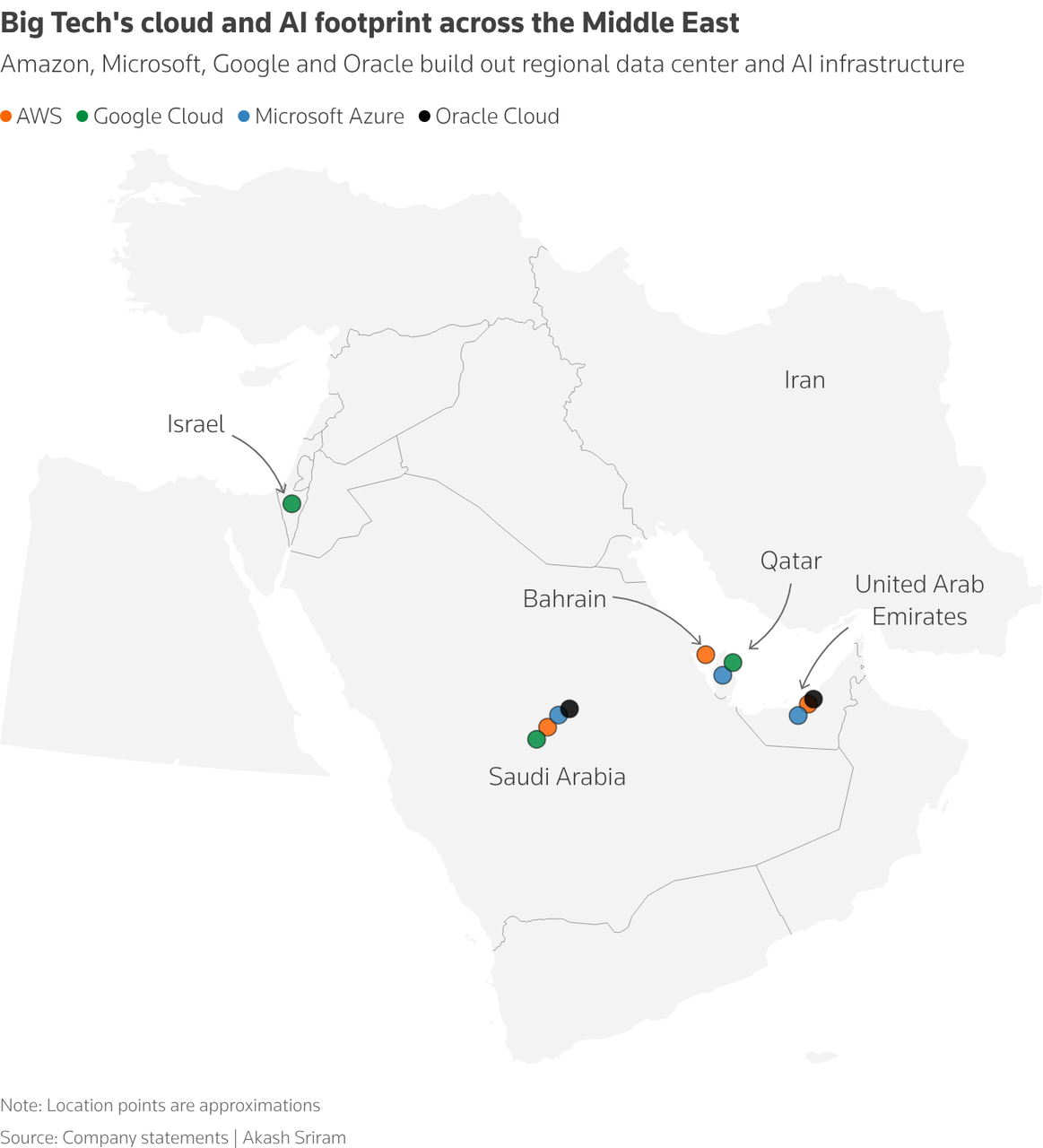
Over the past three years, Silicon Valley has relocated half of the AI industry to the Middle East Gulf.

The reason is simple. The UAE and Saudi Arabia have the world's wealthiest sovereign funds, cheap electricity, and one key regulation:

If you want to serve my customers, your data must be stored on my territory.

So Amazon opened data centers in the UAE and Bahrain, and invested $5.3 billion to build another in Saudi Arabia; Microsoft has nodes in the UAE and Qatar, with one in Saudi Arabia already completed.

OpenAI, in partnership with NVIDIA and SoftBank, is building a $30 billion AI park in the UAE, touted as the largest computing base outside the U.S.

In January of this year, the U.S. signed an agreement with the UAE and Qatar called "Pax Silica." Translated as "Silicon Peace," it sounds ideal.

The core of the agreement is to control the flow of chips, ensuring advanced chips do not fall into China's hands.

In exchange, the UAE secured permission to import hundreds of thousands of NVIDIA's most advanced processors annually. Abu Dhabi's G42 cut ties with Huawei, and Saudi AI companies pledged not to purchase Huawei equipment...

The entire Gulf's AI infrastructure, from chips to data centers to models, has fully aligned with the U.S.

These agreements considered everything: chip export controls, data sovereignty, investment reciprocity, and technology leakage risks.

But not one considered the possibility of someone bombing a data center with a missile.

An international security scholar at Qatar University made a fitting remark after the Amazon data center fire:

"These security frameworks were designed for supply chain control and political alignment. Physical security was never on the agenda."

Cloud computing has preached elasticity, redundancy, and decentralization for a decade. But data centers are physical buildings with walls, roofs, and coordinates. No matter how advanced your chips are, if the data center is bombed, it's bombed.

"Cloud" is a metaphor; data centers are not.

AI may seem virtual, running on code, floating in the cloud. But code runs on chips, chips are installed in data centers, and data centers are built on Earth.

Who Protects AI?

This time, Amazon's data center may have been collateral damage, or optimistically, mistakenly hit.

But what about next time?

In an era of escalating global geopolitical conflicts, if your data center runs AI models that help opponents with target identification, there is no reason for them not to treat your data center as a military facility.

International law has no answer to this question.

Current laws of war have provisions for "dual-use facilities," but those clauses were written for factories and bridges. No one considered data centers.

A data center that processes bank transactions by day and military intelligence analysis by night—is it civilian or military?

In peacetime, data center选址 considers latency, electricity costs, policy incentives... In war, none of that matters. What matters is how far your data center is from the nearest military base.

So, this bombing has shifted everyone's focus.

Previously, everyone was discussing the same anxiety: will AI replace my job? But no one discussed another question:

Before AI replaces you, how fragile is it itself?

A regional conflict brought down the Middle East node of the world's largest cloud service provider for an entire day; and this was just one data center.

There are nearly 1,300 hyperscale data centers worldwide today, with another 770 under construction. These centers consume increasing amounts of electricity, water, and money, and they承载 more and more—your savings, your medical records, your food delivery orders, even a country's military intelligence...

But the solutions protecting these data centers, to this day, likely still consist of fire suppression systems and backup generators.

When AI becomes a nation's infrastructure, its security is no longer just a company's concern. Who protects AI? Cloud providers? The Pentagon? Or the UAE's air defense system?

This question was theoretical three days ago. Not anymore.

AI is within the range of artillery. In fact, isn't everything in this era within the range of artillery?


Twitter:https://twitter.com/BitpushNewsCN

Bitpush TG Discussion Group:https://t.me/BitPushCommunity

Bitpush TG Subscription: https://t.me/bitpush

Original link:https://www.bitpush.news/articles/7616277

Связанные с этим вопросы

QWhat event on March 1st led to the global outage of Claude AI?

AA missile and drone attack by Iran on the Gulf region struck an Amazon data center in the UAE, causing a fire, power outage, and disruption of approximately 60 cloud services, which led to the global outage of Claude AI.

QWhy was the Amazon data center in the UAE targeted or affected by the missile strike?

AThe data center was likely not directly targeted but was affected because Claude AI, which was hosted on Amazon's cloud, had been used by the U.S. military and Palantir for intelligence analysis, target identification, and battlefield simulation in a joint U.S.-Israel airstrike on Iran just two days prior.

QWhat is the 'Pax Silica' agreement signed between the U.S., UAE, and Qatar?

AThe 'Pax Silica' agreement, signed in January, focuses on controlling the flow of advanced chips to prevent them from reaching China. In exchange, the UAE received permits to import hundreds of thousands of Nvidia's most advanced processors annually, and Gulf AI companies committed to cutting ties with Huawei and avoiding its equipment.

QHow does the article highlight the vulnerability of AI infrastructure in the context of geopolitical conflicts?

AThe article emphasizes that AI infrastructure, such as data centers, is physically vulnerable to attacks during conflicts. Despite being critical infrastructure, data centers are often protected only by basic systems like fire suppression and backup generators, and their physical security is not adequately considered in geopolitical or military planning.

QWhat broader implication does the incident have for the future of AI and cloud services in conflict zones?

AThe incident underscores that AI and cloud services, often seen as virtual and decentralized, are grounded in physical infrastructure that can be targeted in warfare. This raises unresolved questions about whether data centers hosting dual-use (civilian and military) AI should be considered military targets and who is responsible for protecting them—cloud providers, national militaries, or host countries.

Похожее

Can a Hair Dryer Earn $34,000? Deciphering the Reflexivity Paradox in Prediction Markets

An individual manipulated a weather sensor at Paris Charles de Gaulle Airport with a portable heat source, causing a Polymarket weather market to settle at 22°C and earning $34,000. This incident highlights a fundamental issue in prediction markets: when a market aims to reflect reality, it also incentivizes participants to influence that reality. Prediction markets operate on two layers: platform rules (what outcome counts as a win) and data sources (what actually happened). While most focus on rules, the real vulnerability lies in the data source. If reality is recorded through a specific source, influencing that source directly affects market settlement. The article categorizes markets by their vulnerability: 1. **Single-point physical data sources** (e.g., weather stations): Easily manipulated through physical interference. 2. **Insider information markets** (e.g., MrBeast video details): Insiders like team members use non-public information to trade. Kalshi fined a剪辑师 $20,000 for insider trading. 3. **Actor-manipulated markets** (e.g., Andrew Tate’s tweet counts): The subject of the market can control the outcome. Evidence suggests Tate’sociated accounts coordinated to profit. 4. **Individual-action markets** (e.g., WNBA disruptions): A single person can execute an event to profit from their pre-placed bets. Kalshi and Polymarket handle these issues differently. Kalshi enforces strict KYC, publicly penalizes insider trading, and reports to regulators. Polymarket, with its anonymous wallet-based system, has historically been more permissive, arguing that insider information improves market accuracy. However, it cooperated with authorities in the "Van Dyke case," where a user traded on classified government information. The core paradox is reflexivity: prediction markets are designed to discover truth, but their financial incentives can distort reality. The more valuable a prediction becomes, the more likely participants are to influence the event itself. The market ceases to be a mirror of reality and instead shapes it.

marsbit42 мин. назад

Can a Hair Dryer Earn $34,000? Deciphering the Reflexivity Paradox in Prediction Markets

marsbit42 мин. назад

First Day Review of "Musk's WeChat" XChat: Even Worse Than Expected

Elon Musk's much-anticipated "WeChat-like" app, XChat, has officially launched after multiple delays. The initial review reveals a product that falls short of expectations, offering an experience largely similar to X Platform's (formerly Twitter) direct messages, despite being marketed as an encrypted communication tool. Key observations from the first-day test include: 1. The app's promoted "end-to-end encryption" and its claimed relation to Bitcoin's architecture were criticized by experts as a superficial attempt to capitalize on crypto buzz, with no real technical connection. 2. Musk's vision of an ad-free "secure communication system" is technically met, but only because the app is currently extremely basic, featuring only a single chat interface. 3. A promised anti-screenshot feature appears inconsistent; it works in X Platform group chats but fails within the XChat app itself, where screenshots still capture avatars. 4. The app supports 45 languages and has a 16+ age rating, indicating a broader tolerance for content compared to WeChat's 13+ rating. 5. A puzzling login process requires users to verify the email associated with their X account. 6. The touted encryption" feels minimal in practice, with its presence only indicated by a simple "Encrypted - Yes" label on messages. 7. Disappearing message timers for groups can be set from 5 minutes to 4 weeks, with the timer starting upon being read by a user. 8. Group invite links are shared with X Platform groups. 9. Group size limits are planned to be increased, aiming for 1000 members, a move that has drawn user criticism. 10. The app offers 8 different colored icons, and its chat bubbles are notably similar to WeChat's. Message deletion options mimic Telegram's. Crucially, many pre-announced features like importing X contacts, integrating Grok AI, X Money payments, and Cashtags are not yet available. The initial release is seen as a bare-bones and underwhelming first step.

Odaily星球日报1 ч. назад

First Day Review of "Musk's WeChat" XChat: Even Worse Than Expected

Odaily星球日报1 ч. назад

Торговля

Спот
Фьючерсы

Популярные статьи

Неделя обучения по популярным токенам (2): 2026 может стать годом приложений реального времени, сектор AI продолжает оставаться в тренде

2025 год — год институциональных инвесторов, в будущем он будет доминировать в приложениях реального времени.

1.8k просмотров всегоОпубликовано 2025.12.16Обновлено 2025.12.16

Неделя обучения по популярным токенам (2): 2026 может стать годом приложений реального времени, сектор AI продолжает оставаться в тренде

Обсуждения

Добро пожаловать в Сообщество HTX. Здесь вы сможете быть в курсе последних новостей о развитии платформы и получить доступ к профессиональной аналитической информации о рынке. Мнения пользователей о цене на AI (AI) представлены ниже.

活动图片