History Repeats for the Fourth Time, Is BTC Launching a New Super Bull Market?

marsbitОпубликовано 2026-01-21Обновлено 2026-01-21

Введение

The cryptocurrency market, particularly Bitcoin, is experiencing a period of significant underperformance and low volatility, contrasting sharply with the strong rallies in traditional assets like gold, silver, and U.S. equities in 2025 and early 2026. This divergence is attributed to Bitcoin's role as a leading indicator for global risk assets, reflecting underlying macroeconomic pressures. Key factors behind Bitcoin's weakness include global liquidity tightening from continued Federal Reserve quantitative tightening (QT) and Bank of Japan interest rate hikes, as well as heightened geopolitical tensions under the Trump administration, which have increased market uncertainty and risk aversion. Meanwhile, the surge in traditional assets is driven by sovereign and policy-led forces rather than broad macroeconomic improvement. Gold's rise is fueled by central banks diversifying away from U.S. dollar dependency, while equity gains in the U.S. and China are concentrated in sectors aligned with national industrial policies, such as AI and defense. Historically, Bitcoin has shown four major instances of extreme overselling relative to gold (as indicated by RSI below 30), in 2015, 2018, 2022, and now in late 2025. Each preceded a significant Bitcoin bull run. The current divergence may signal an impending market rebound for Bitcoin, while traditional markets like small-cap stocks and AI sectors show signs of being overvalued and vulnerable to a correction. The article cautions agai...

"Anything But Crypto, everything else can make money."

Recently, the crypto circle and other global markets seem to be worlds apart.

Throughout 2025, gold rose over 60%, silver surged 210.9%, and the U.S. stock Russell 2000 index increased by 12.8%. Bitcoin, however, closed the year negative after briefly hitting a new high.

In early 2026, the divergence intensified. On January 20th, gold and silver hit new highs successively, the Russell 2000 index outperformed the S&P 500 for 11 consecutive days, and China's STAR 50 index gained over 15% in a single month.

In contrast, Bitcoin, on January 21st, fell for six consecutive days, dropping from $98,000 back below $90,000 without looking back.
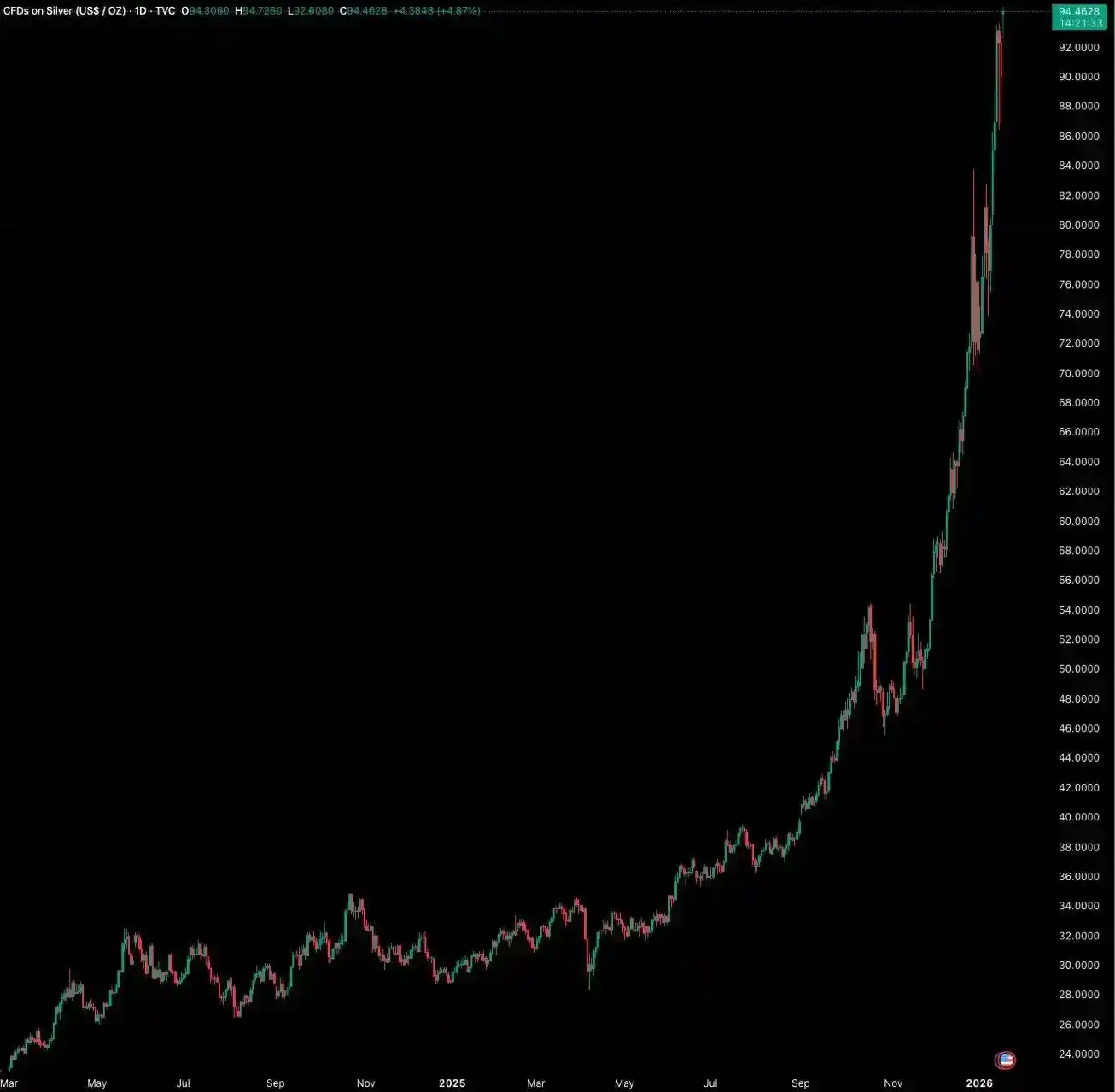
Silver's performance over the past year

Funds seem to have decisively left the crypto space after the events of October 11th (1011). BTC has been oscillating below $100,000 for over three months, and the market has entered a period of "the lowest volatility ever."

Disappointment is spreading among crypto investors. When asked about investors who left Crypto and made money in other markets, they even shared the "ABC" "secret" -- "Anything But Crypto" -- meaning, as long as you don't invest in Crypto, you can make money elsewhere.

The "Mass Adoption" anticipated in the last cycle seems to have arrived, but not in the form of decentralized application普及 everyone hoped for. Instead, it's a complete "assetization" led by Wall Street.

In this cycle, the U.S. establishment and Wall Street have embraced Crypto with an unprecedented attitude. The SEC approved spot ETFs; BlackRock and JPMorgan allocated assets to Ethereum; the U.S. incorporated Bitcoin into its national strategic reserves; pension funds in several states invested in Bitcoin; even the NYSE announced plans to launch a cryptocurrency trading platform.

So the question arises: Why, after gaining so much political and capital backing, has Bitcoin's price performance been so disappointing while precious metals and stock markets are hitting new highs?

When crypto investors have become accustomed to checking pre-market U.S. stock prices to gauge crypto market trends, why is Bitcoin not following the rise?

Why is Bitcoin so weak?

Leading Indicator

Bitcoin is a "leading indicator" for global risk assets, as Real Vision founder Raoul Pal has repeatedly mentioned in his articles. Because Bitcoin's price is purely driven by global liquidity and is not directly affected by national earnings reports or interest rates, its fluctuations often lead those of mainstream risk assets like the Nasdaq index.
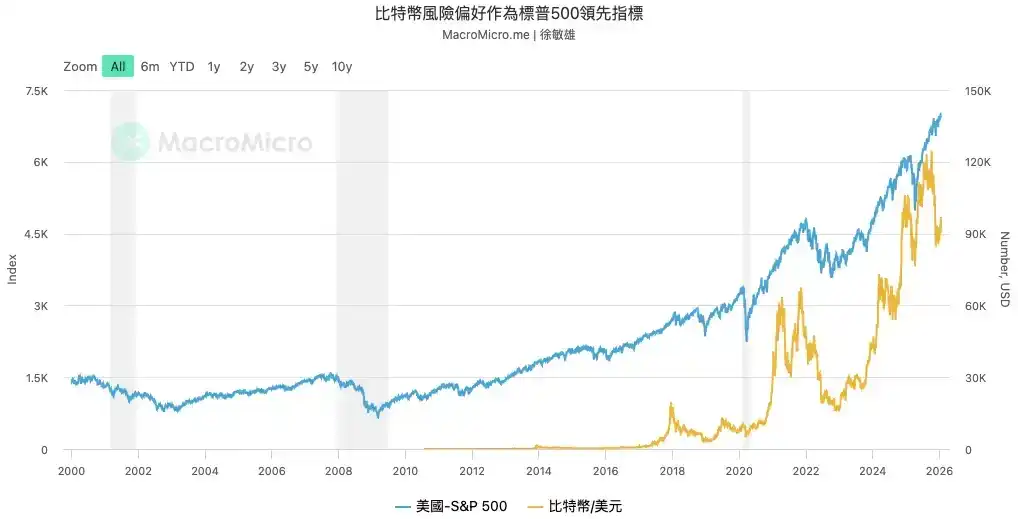
According to MacroMicro data, Bitcoin's price turning points have repeatedly led the S&P 500 index in recent years. Therefore, once the upward momentum of Bitcoin, as a leading indicator, stalls and fails to make new highs, it constitutes a strong warning signal that the upward momentum of other assets may also be nearing exhaustion.

Liquidity Tightening

Secondly, Bitcoin's price, to this day, remains highly correlated with global net dollar liquidity. Although the Fed cut interest rates in 2024 and 2025, the quantitative tightening (QT) that began in 2022 is still continuously sucking liquidity out of the market.

Bitcoin's new high in 2025 was more due to new funds brought by ETF approvals, but this did not change the fundamental landscape of tight global macro liquidity. Bitcoin's sideways movement is a direct reaction to this macro reality. In an environment short of money, it is difficult for it to start a super bull market.

And the world's second-largest source of liquidity—the yen—is also beginning to tighten. The Bank of Japan raised its short-term policy rate to 0.75% in December 2025, the highest level in nearly 30 years. This directly impacts an important source of funding for global risk assets over the past decades: the yen carry trade.

Historical data shows that since 2024, all three rate hikes by the Bank of Japan were accompanied by Bitcoin price drops of over 20%. Synchronized tightening by the Fed and the Bank of Japan has made the global liquidity environment even worse.
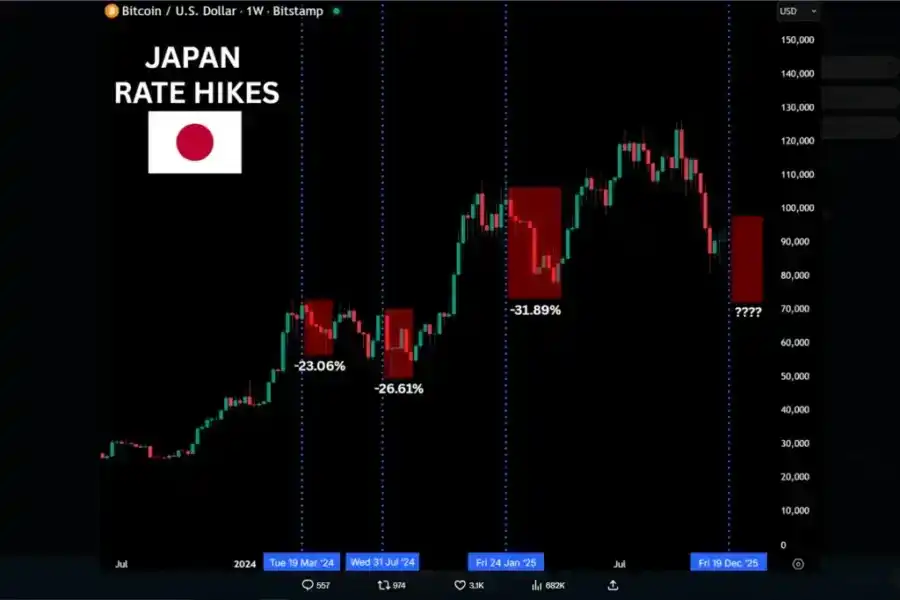
Crypto market decline following each Japanese rate hike

Geopolitical Conflict

Finally, potential geopolitical "black swans" are keeping market nerves on edge, and a series of actions by Trump in early 2026 have pushed this uncertainty to new heights.

Internationally, the actions of the Trump administration are full of unpredictability. From military intervention in Venezuela and the arrest of its president (unprecedented in modern international relations), to war with Iran again being on the brink; from attempting to forcibly purchase Greenland, to issuing new tariff threats against the EU. This series of radical unilateral actions is comprehensively intensifying major power contradictions.

Domestically in the U.S., his moves have sparked deep public concern about a constitutional crisis. He not only proposed renaming the "Department of Defense" to the "Department of War," but has also ordered active-duty troops to prepare for potential domestic deployment.

These actions, combined with his past暗示 (hints) of regretting not using military force and unwillingness to accept midterm election losses, have made public fears increasingly clear: would he refuse to accept a midterm election defeat and use force to stay in power? This speculation and high pressure are already exacerbating internal U.S. contradictions, with protests currently showing signs of expanding.

Trump invoked the Insurrection Act last week and deployed troops to Minnesota to quell protests; the Pentagon has ordered about 1,500 active-duty soldiers stationed in Alaska to be on standby.

The normalization of this conflict is dragging the world into a "gray zone" between localized war and a new Cold War. Traditional full-scale hot war had relatively clear paths, market expectations, and was even accompanied by stimulus "bailouts."

This kind of localized conflict, however, has extreme uncertainty, filled with "unknown unknowns." For risk capital markets that highly rely on stable expectations, this uncertainty is fatal. When large capital cannot judge the future, the most rational choice is to increase cash holdings and wait on the sidelines, rather than allocating funds to high-risk, high-volatility assets.

Why Aren't Other Assets Falling?

In stark contrast to the crypto silence, since 2025, markets like precious metals, U.S. stocks, and A-shares have taken turns rising. But the rise in these markets is not because the macro and liquidity fundamentals have generally improved; rather, it is a structural行情 (market trend) driven by sovereign will and industrial policy against the backdrop of great power games.

The rise in gold is a reaction by sovereign states to the existing international order, rooted in the credit cracks of the dollar system. The 2008 global financial tsunami and the 2022 freezing of Russian foreign exchange reserves completely shattered the "risk-free" myth of the U.S. dollar and U.S. Treasury bonds as the world's ultimate reserve assets. In this context, global central banks have become "price-insensitive buyers." They buy gold not for short-term profit, but to find an ultimate store of value that does not rely on any single sovereign credit.

Data from the World Gold Council shows that in 2022 and 2023, global central banks' net gold purchases exceeded 1,000 tons for two consecutive years, setting historical records. The main driver of this gold rally is official force, not market-based speculative force.
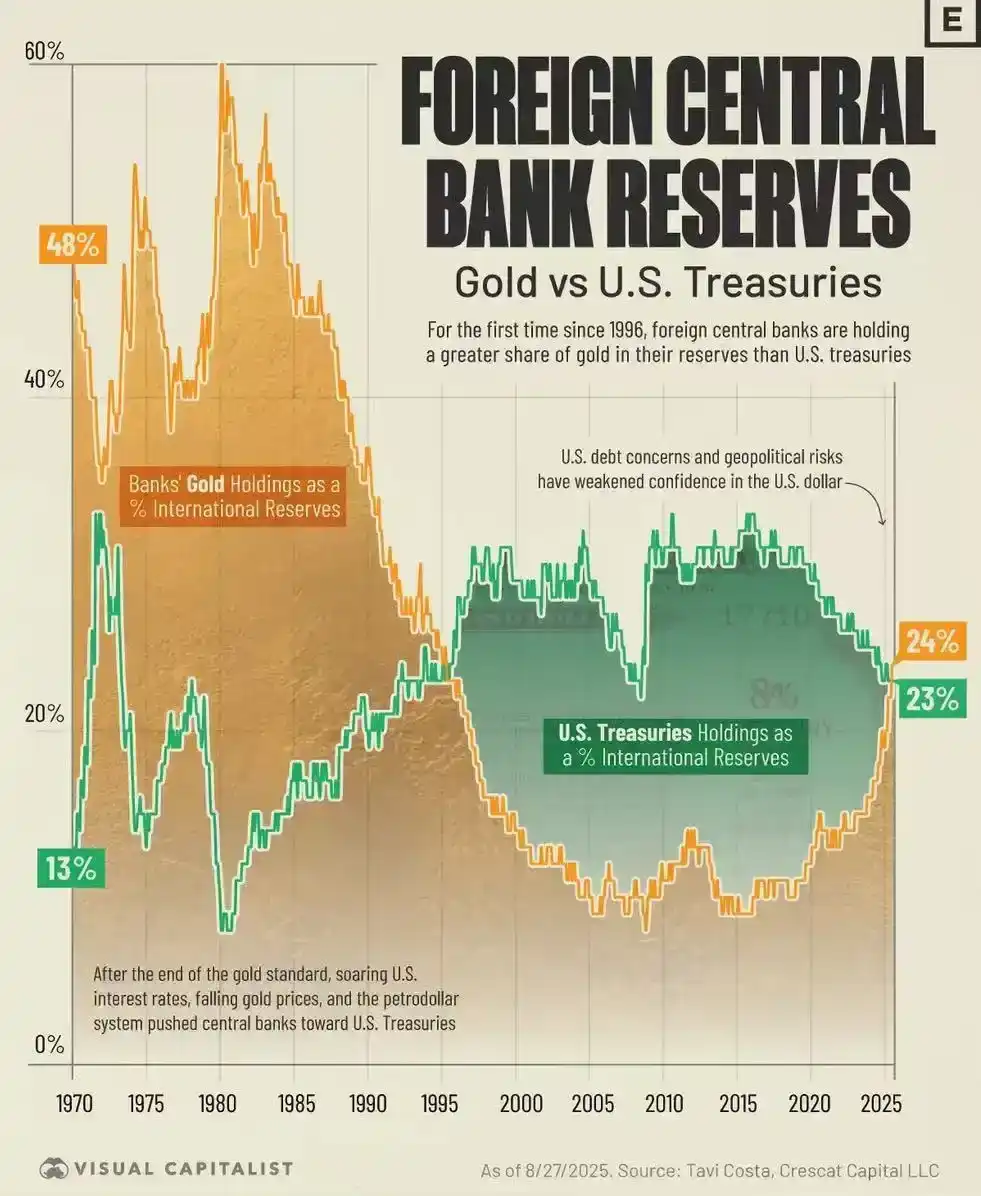
Comparison of the proportion of gold and U.S. Treasury bonds in sovereign national central bank reserves; in 2025, total gold reserves exceeded those of U.S. Treasury bonds.

The rise in the stock market is a reflection of national industrial policies. Whether it is the U.S. "AI Nationalization" strategy or China's "industrial autonomy" policy, state power is deeply介入 (intervening) and directing the flow of capital.

Take the U.S., for example. Through the CHIPS and Science Act, the AI industry has been elevated to a national security priority. Funds are clearly flowing out of large tech stocks and into more growth-oriented small and mid-cap stocks that align with policy directions.

In China's A-share market, funds are also highly concentrated in areas closely related to national security and industrial upgrading, such as "信创" (IT application innovation) and "国防军工" (national defense and military industry). This kind of government-strongly-led行情 (market trend) has a natural difference in pricing logic from Bitcoin, which relies on purely market-driven liquidity.

Will History Repeat Itself?

Historically, it is not the first time Bitcoin's performance has diverged from other assets. And each divergence ultimately ended with a strong rebound in Bitcoin.

Historically, there have been four times when Bitcoin's RSI (Relative Strength Index) against gold fell below 30, indicating extreme oversold conditions: in 2015, 2018, 2022, and 2025.

Each time Bitcoin was extremely undervalued relative to gold, it foreshadowed a rebound in the exchange rate pair or Bitcoin's price.
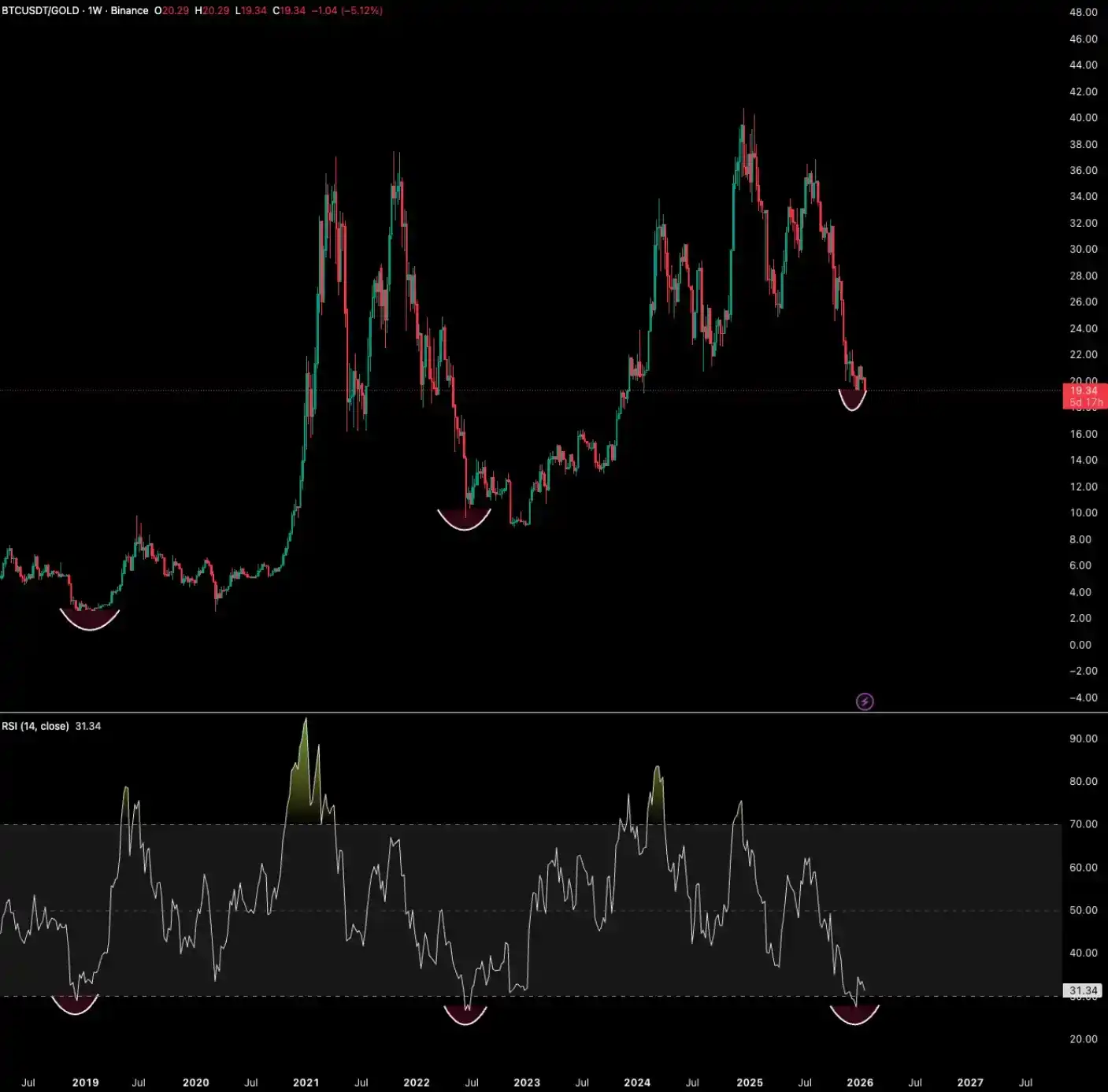
Historical trend of Bitcoin/Gold, with RSI indicator below

In 2015, at the end of the bear market, Bitcoin's RSI against gold fell below 30, subsequently launching the 2016-2017 super bull market.

In 2018, during the bear market, Bitcoin fell over 40%, while gold rose nearly 6%. After the RSI fell below 30, Bitcoin rebounded over 770% from its 2020 low.

In 2022, during the bear market, Bitcoin fell nearly 60%. After the RSI fell below 30, Bitcoin rebounded, again outperforming gold.

From late 2025 to now, we are witnessing this historic oversold signal for the fourth time. Gold surged 64% in 2025, and Bitcoin's RSI against gold has once again fallen into oversold territory.

Is It Still Worth Chasing Other Assets Now?

Amid the "ABC" noise, easily selling crypto assets to chase the rally in other currently seemingly more prosperous markets could be a dangerous decision.

When U.S. small-cap stocks start leading gains, historically it has often been the final狂欢 (carnival) before liquidity dries up at the end of a bull market. The Russell 2000 index has risen over 45% from its 2025 low, but most of its component companies have relatively poor profitability and are very sensitive to interest rate changes. Once the Fed's monetary policy falls short of expectations, the fragility of these companies will be immediately exposed.

Secondly, the frenzy in the AI sector is showing typical bubble characteristics. Whether it's Deutsche Bank's survey or warnings from Bridgewater founder Ray Dalio, the AI bubble is listed as the biggest risk for the 2026 market.

The valuations of star companies like Nvidia and Palantir have reached historical highs, and whether their profit growth can support such high valuations is being questioned more and more. A deeper risk is that the huge energy consumption of AI could trigger a new round of inflationary pressure, forcing central banks to tighten monetary policy and burst the asset bubble.

According to Bank of America's fund manager survey in January, global investor optimism hit a new high since July 2021, and global growth expectations soared. Cash holdings fell to a record low of 3.2%, and protection measures against market corrections are at their lowest level since January 2018.

On one side are sovereign assets疯狂上涨 (rising疯狂ly),普遍乐观 (generally optimistic) investor sentiment; on the other side are intensifying geopolitical conflicts.

Against this macro backdrop, Bitcoin's "stagnation" is not simply "underperforming." It is more like a清醒 (sobering) signal, an early warning of greater risks ahead, and also积蓄力量 (accumulating strength) for a grander narrative shift.

For true long-termists, this is precisely the moment to test convictions, resist temptation, and prepare for the coming crises and opportunities.


Связанные с этим вопросы

QWhy has Bitcoin's price performance been disappointing despite gaining significant political and capital backing, while other assets like gold and stocks reached new highs?

ABitcoin's weak performance is attributed to its role as a leading indicator for global risk assets, signaling potential exhaustion in other markets. It remains highly correlated with global dollar liquidity, which is tight due to ongoing quantitative tightening by the Fed and Bank of Japan's rate hikes. Additionally, geopolitical tensions and uncertainty, particularly under Trump's administration, have increased market volatility and driven capital toward safer, cash-like assets, reducing risk appetite for Bitcoin.

QWhat historical pattern suggests Bitcoin might be poised for a rebound despite its current underperformance?

AHistorically, when Bitcoin's Relative Strength Index (RSI) against gold falls below 30—indicating extreme oversold conditions—it has preceded major bull runs. This occurred in 2015, 2018, 2022, and now in 2025. Each time, Bitcoin experienced significant rebounds, such as the 2016-2017 super cycle and a 770% surge from 2020 lows after the 2018 signal.

QHow are the rallies in assets like gold and stocks driven differently from Bitcoin's price movements?

AGold's rally is driven by sovereign nations diversifying away from dollar dependency due to geopolitical tensions and loss of trust in traditional reserves, making central banks 'price-insensitive buyers.' Stock rallies, like those in the U.S. and China, are fueled by state-led industrial policies (e.g., AI nationalism, tech self-sufficiency) directing capital flow. In contrast, Bitcoin's price is more sensitive to pure market liquidity and global risk sentiment, not direct state intervention.

QWhat risks are associated with chasing the current rallies in assets like small-cap stocks and AI sectors?

AChasing small-cap stocks (e.g., Russell 2000) is risky as their outperformance often signals late-cycle euphoria before liquidity dries up; these firms are利率-sensitive and vulnerable to policy shifts. AI stocks face bubble risks with inflated valuations (e.g., Nvidia, Palantir) that may not sustain, and their high energy consumption could spur inflation, forcing central banks to tighten policies and pop the bubble. Low cash holdings among investors (3.2%) also leave markets exposed to corrections.

QHow do geopolitical factors under Trump's administration contribute to market uncertainty and Bitcoin's stagnation?

ATrump's unpredictable actions—such as military interventions (e.g., in Venezuela), threats of trade wars with allies, and domestic measures like deploying troops under the Insurrection Act—create 'unknown unknowns' that heighten geopolitical risks. This uncertainty pushes large capital toward cash and safe havens, reducing allocations to high-risk assets like Bitcoin. The常态化 of conflict in a 'gray zone' between war and cold war destabilizes expectations, further dampening risk appetite.

Похожее

В результате взлома Coldcard, одного из крупнейших взломов биткоин-кошельков за последнее время, началась новая волна убытков! Убытки растут

В результате взлома Coldcard, одного из крупнейших взломов биткоин-кошельков за последнее время, произошла третья волна атак. Исследовательская компания Galaxy Research сообщает, что из кошельков, созданных на этих устройствах, было выведено еще 207,73 BTC. Общие потери теперь составляют около 1367 BTC (примерно 88,6 млн долларов США) по 4585 адресам. Первые две волны атак демонстрировали схожие черты, что указывало на одного злоумышленника. Однако третья волна отличается по методам: используются отдельные адреса для каждой жертвы, адреса P2WSH вместо P2WPKH, и атака нацелена на стандартный путь генерации. Это может означать либо модификацию инструментов первоначальным взломщиком, либо появление нового. Похищенные биткоины, общая стоимость которых оценивается в 88,6 млн долларов, пока не были потрачены злоумышленниками. Анализ показывает, что потери в основном пришлись на кошельки с небольшим балансом, что характерно для индивидуальных пользователей, а не институциональных сервисов. Уязвимое ПО Coldcard было выпущено 17 марта 2021 года, и все украденные средства были созданы после этой даты.

cryptonews.ru20 мин. назад

В результате взлома Coldcard, одного из крупнейших взломов биткоин-кошельков за последнее время, началась новая волна убытков! Убытки растут

cryptonews.ru20 мин. назад

Trump Media продаёт ещё 2628 BTC, запасы снижаются до 4261 BTC

Компания Trump Media & Technology Group (TMTG), стоящая за социальной сетью Truth Social, продолжает сокращать свои вложения в Bitcoin. По данным аналитической платформы Lookonchain, компания продала ещё 2628 BTC на сумму около 165 миллионов долларов через платформу Crypto.com. Это продолжение серии продаж, начавшихся семь месяцев назад. Всего за этот период TMTG продала 7281 BTC на общую сумму примерно 545 миллионов долларов по средней цене 74 855 долларов за монету. Первоначально компания приобрела 11542 BTC по средней цене 118 522 доллара. После последних транзакций её резервы сократились до 4261 BTC (около 269,8 миллиона долларов), что на 63% меньше изначальных холдингов. Эти продажи происходят на фоне усиленного внимания законодателей к криптовалютным интересам, связанным с Дональдом Трампом. В Конгрессе идут дебаты по закону CLARITY Act, который касается этических норм, владения цифровыми активами и потенциальных конфликтов интересов государственных лиц. Критики указывают на такие проекты, как мемкойны TRUMP и MELANIA, а также на токены World Liberty Financial, связывая политическое влияние с частными криптоинтересами.

cointelegraph40 мин. назад

Trump Media продаёт ещё 2628 BTC, запасы снижаются до 4261 BTC

cointelegraph40 мин. назад

Фуцзянь, Цзиньцзян: супер-единорог в сфере памяти тихо делает своё дело

В провинции Фуцзянь в городе Цзиньцзян, известном производством спортивной обуви, находится перспективная компания в области производства чипов памяти — Fujian Jinhua Integrated Circuit Co. (Jinhua). Основанная в 2016 году как часть национального плана по развитию полупроводниковой промышленности, компания столкнулась с серьёзными вызовами. В 2018 году она была внесена в санкционный список Министерства торговли США по обвинению в промышленном шпионаже в пользу американской компании Micron, что привело к остановке производственной линии. После пяти лет судебных разбирательств в феврале 2024 года федеральный суд в Сан-Франциско полностью оправдал Jinhua, сняв все обвинения. Несмотря на правовую победу, компания всё ещё остаётся в санкционном списке, а годы задержек серьёзно замедлили её развитие. Под руководством своего ключевого инженера Чэнь Чжэнкуня, известного как «мастер эффективности», компания сумела адаптировать производство, увеличив долю отечественного оборудования. В отличие от ChangXin Memory Technologies (CXMT) и Yangtze Memory Technologies (YMTC), которые продвинулись дальше в производстве DRAM и NAND-памяти соответственно, Jinhua сосредоточена на специализированной (нишевой) DRAM-памяти для потребительской электроники. Её текущая производственная мощность составляет около 40 000 пластин в месяц. Хотя её доход в 2023 году оценивался примерно в 2 млрд юаней, что значительно меньше, чем у конкурентов, компания остаётся важным игроком. История Jinhua тесно связана с амбициозной промышленной трансформацией города Цзиньцзян. Местные власти оказали компании полную поддержку, включая финансовые гарантии и создание кластера, что демонстрирует стратегическую важность проекта для региона. Несмотря на то, что Jinhua упустила первые годы бума на рынке памяти, её устойчивость в условиях санкций показывает потенциал для восстановления в новом цикле роста, движимом развитием искусственного интеллекта.

marsbit1 ч. назад

Фуцзянь, Цзиньцзян: супер-единорог в сфере памяти тихо делает своё дело

marsbit1 ч. назад

Почему биткойн-фермы внезапно стали новым входом для вычислительных мощностей ИИ на фоне дефицита электроэнергии в 38 ГВт?

Заголовок: Почему майнинговые фермы для биткоина внезапно стали новым входом для вычислительных мощностей ИИ на фоне дефицита электроэнергии в 38 ГВт? Краткое содержание: Когда конкуренция между центрами обработки данных ИИ сместилась с вопроса «кто купит больше GPU» к «кто раньше получит электроэнергию», некоторые майнинговые фермы для биткоина, ранее считавшиеся волатильными активами, начали трансформироваться в центры обработки данных для облачных провайдеров, используя свои готовые возможности подключения к сети, землю и трансформаторные подстанции. По расчетам Morgan Stanley, в период 2026-2028 годов в США может возникнуть дефицит электроэнергии для ЦОДов около 38 ГВт, и модернизация старых майнинговых ферм может обеспечить от 10 до 19 ГВт. Такие компании, как TeraWulf и Hut 8, переориентируются с добычи криптовалют на предоставление инфраструктуры («Powered Shell Provider»), предлагая клиентам из сферы ИИ критически важный ресурс — возможность быстрее конкурентов развернуть значительные вычислительные мощности. Ключевой ценностью становится не вычислительная мощность для майнинга, а дефицитный доступ к электросетям, получение которого «с нуля» в некоторых регионах США теперь может занять 5-7 лет.

华尔街日报1 ч. назад

Почему биткойн-фермы внезапно стали новым входом для вычислительных мощностей ИИ на фоне дефицита электроэнергии в 38 ГВт?

华尔街日报1 ч. назад

Майкл Сэйлор: «Мы никогда не говорили, что никогда не будем продавать биткоины»

Председатель стратегической комиссии Майкл Сэйлор прокомментировал сообщения о новом разрешении компании Strategy на продажу биткоинов. Он заявил, что данное разрешение не является новым — оно было объявлено ещё 29 июня в рамках системы управления капиталом компании. Соглашение позволяет продавать BTC на сумму до 5 миллиардов долларов для определённых целей, но не обязывает компанию к продаже. Сэйлор подчеркнул, что Strategy никогда официально не брала на себя обязательство никогда не продавать свои биткоины, хотя и рассчитывает оставаться чистым покупателем BTC в долгосрочной перспективе. Он назвал текущие новости «старыми», переподанными как новые, и подтвердил, что программа монетизации биткоинов компании не предполагает обязательной продажи её активов.

cryptonews.ru2 ч. назад

Майкл Сэйлор: «Мы никогда не говорили, что никогда не будем продавать биткоины»

cryptonews.ru2 ч. назад

Торговля

Спот
活动图片




